
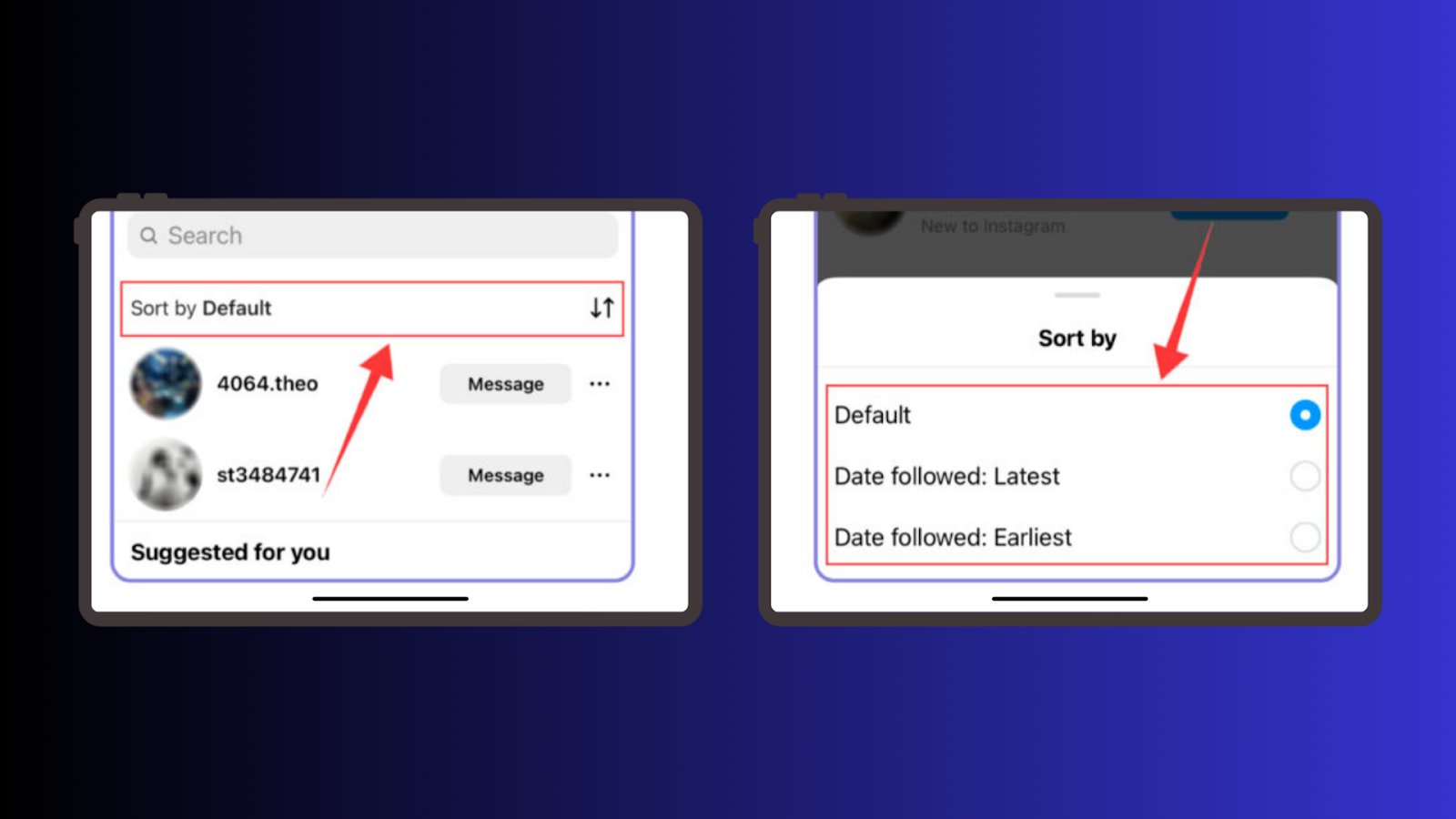
In the dynamic world of social media, the phrase “sort by default” might seem innocuous, yet it holds profound implications for how we consume, discover, and interact with content on platforms like Instagram. Far from a simple chronological arrangement, Instagram’s default sorting mechanism represents a sophisticated, continuously evolving algorithm designed to personalize your experience, maximize engagement, and ultimately, dictate the content you see. Understanding this intricate system is crucial for every user, content creator, and business striving to navigate the platform effectively. This article will demystify what “sort by default” truly means on Instagram, exploring its evolution, its technical underpinnings, and its pervasive impact on our digital lives.

The Evolution of Instagram’s Default Sorting Algorithm
Instagram’s journey from a nascent photo-sharing app to a global media powerhouse is intrinsically linked to how it presents content to its users. The “default” experience has undergone significant transformations, moving away from simplicity towards an increasingly complex, intelligent system.
From Chronological to Algorithmic Feed
In its early years, Instagram famously operated on a purely chronological feed. When you opened the app, you would see the most recent posts from the accounts you followed, ordered strictly by the time they were published. This straightforward approach was intuitive and transparent, offering users a clear view of their network’s latest updates.
However, as Instagram’s user base exploded and the volume of content grew exponentially, this chronological model began to show its limitations. Users were following hundreds, even thousands, of accounts, leading to an overwhelming stream of posts. Many users reported missing up to 70% of posts from their friends and favorite creators simply because they weren’t online at the exact moment the content was shared. In response to these challenges, and mirroring a trend seen across other major social platforms, Instagram announced a monumental shift in 2016: the introduction of an algorithmic feed. This change marked the beginning of what “sort by default” means today – a personalized, non-chronological arrangement of content driven by sophisticated predictive models.
The Core Principles of the Current Algorithm
Instagram’s current algorithm, which governs its default sorting, operates on a complex interplay of signals designed to determine the “relevance” and “interest” a particular piece of content holds for each individual user. While the exact weighting and specifics are proprietary and constantly tweaked, Instagram has publicly disclosed the primary factors influencing what appears in your default feed:
-
Interest: This is arguably the most crucial signal. The algorithm attempts to predict how interested you will be in a post based on your past behavior. If you frequently like, comment on, save, or share posts of a certain type (e.g., travel photography, cooking videos, fashion updates) or from specific accounts, the algorithm assumes you’ll want to see more similar content.
-
Relationship: Instagram prioritizes content from accounts you have a closer relationship with. This is determined by how often you interact with them through DMs, comments, likes on their posts, or even if you search for them. The more you engage with someone, the more likely you are to see their content in your feed.
-
Timeliness: While no longer strictly chronological, recency still matters. The algorithm favors newer posts over older ones, ensuring that the content you see is relatively fresh and relevant to current conversations.
-
Frequency: How often you open the Instagram app also plays a role. If you open it infrequently, the algorithm will try to show you the “best” posts since your last visit. If you open it frequently, it will attempt to provide a fresh batch of content each time.
-
Following: The number of accounts you follow influences the diversity of your feed. If you follow many accounts, the algorithm has a larger pool of content to choose from and prioritize.
-
Usage: How much time you spend on the app also impacts the feed. Longer sessions might lead to a broader range of content, while shorter sessions might prioritize the most “must-see” posts.
These principles work in concert, creating a unique and highly individualized default experience for every user, making it a far cry from a simple, one-size-fits-all ordering.
Deconstructing the “Default” Instagram Feed Experience
The term “default” on Instagram isn’t limited to just one section of the app. Different parts of Instagram utilize varying algorithmic priorities to serve their specific purposes, all falling under the umbrella of a personalized default experience.
Home Feed (Main Feed)
The Home Feed is the quintessential “default” experience most users refer to. This is the primary stream you encounter upon opening the app, blending content from accounts you follow with “suggested” posts and advertisements. Here, the algorithm’s goal is to keep you scrolling and engaged by presenting a carefully curated mix. It’s not just about what’s new, but what’s most relevant to you right now. You’ll see a dynamic mix of photos, videos, carousels, and even Reels from accounts you interact with frequently, interspersed with content Instagram believes you’ll discover and enjoy from accounts you don’t yet follow. The absence of a strict chronological order here means that a post from two days ago from a close friend might appear above a recent post from a less-engaged-with account, simply because the algorithm predicts you’ll find the former more engaging.
Explore Page
While the Home Feed focuses on your existing network and predicted interests, the Explore Page is Instagram’s dedicated hub for discovery. This is where the algorithm’s role in identifying new content from accounts you don’t follow truly shines. The Explore Page’s default sorting prioritizes virality, niche interests, and trending topics, all tailored to your past interactions. It analyzes posts you’ve liked, commented on, saved, and shared, then identifies similar content that has performed well with users who share your interests. The default here is to serve you content that broadens your horizons while remaining highly relevant to your demonstrated preferences, often showcasing content that has high engagement rates across the platform or within specific communities.
Reels and Stories Feeds
Even the more ephemeral content formats like Reels and Stories have their own default sorting mechanisms.
Reels, Instagram’s short-form video feature, heavily relies on a discovery-focused algorithm akin to TikTok’s “For You Page.” The default sorting for Reels prioritizes entertainment value, virality potential, and user interaction. If you watch a Reel to completion, like it, or share it, the algorithm is more likely to show you similar content. It’s less about who posted it and more about the content itself, aiming to hook you with engaging videos.
Stories, while often appearing more chronological at the top of your feed for accounts you follow closely, still have an algorithmic influence. The default order is subtly influenced by your interactions, prioritizing stories from friends or accounts you engage with regularly. Stories from accounts you rarely interact with might be pushed further down the line or disappear altogether if you don’t scroll through them.
The Technical Underpinnings of Algorithmic Sorting
Behind the seamless scrolling experience lies a sophisticated technological infrastructure powered by artificial intelligence and machine learning. This is the core of what “sort by default” means from a technical perspective.

Machine Learning and AI at Play
Instagram leverages cutting-edge machine learning (ML) models and artificial intelligence (AI) to power its default sorting algorithms. These systems are designed to process vast amounts of data at lightning speed to make predictions about user behavior. Every action you take on the app – a like, a comment, a save, a share, the duration you spend viewing a post, even the accounts you search for or DM – generates data points that feed into these models.
The AI continuously learns from your interactions, refining its understanding of your preferences. For instance, if you consistently skip Reels featuring a certain type of content, the algorithm learns to deprioritize similar videos. Conversely, if you frequently engage with content about a specific hobby, the AI strengthens its prediction that you’re interested in that topic. This process, often referred to as reinforcement learning, allows the algorithm to adapt and personalize your default feed in real-time, making it an ever-evolving digital mirror of your interests.
Ranking Signals and Prediction Models
The algorithmic sorting process can be broadly broken down into several stages:
-
Candidate Generation: When you open Instagram, the system first identifies a vast pool of potential content to show you. This includes recent posts from accounts you follow, popular posts from your network, and relevant content from accounts you don’t follow (for the Explore Page or suggested posts).
-
Feature Extraction: For each piece of candidate content and for your user profile, the algorithm extracts hundreds, if not thousands, of “features.” These features can include the post’s format (image, video, carousel), its caption keywords, the time it was posted, its current engagement rate, the poster’s relationship with you, your past interactions with similar content, and even broader contextual signals like popular trends.
-
Scoring/Ranking: This is where the machine learning models come into play. Based on all the extracted features, a predictive model assigns a “relevance score” to each piece of content specifically for you. This score reflects how likely you are to engage with that content (e.g., like, comment, save, share, or spend time viewing it).
-
Filtering and Display: Finally, the posts are ordered based on their scores, with the highest-scoring content appearing first. The algorithm also applies various constraints and filters to ensure diversity, prevent repetitive content, and include ads seamlessly into the stream.
This complex, multi-stage process is what defines Instagram’s “sort by default,” ensuring that the content you see is not random, but a calculated presentation designed to keep you engaged.
User Control and Navigating the Default
While Instagram’s default sorting is undeniably powerful, the platform has also made some efforts to offer users a degree of control, even if limited, over their content consumption.
Limitations of Customization
For many years, users had little to no recourse against the algorithmic default. The chronological feed was a relic of the past, and the personalized feed was the only option. However, user feedback regarding a desire for more control and transparency prompted Instagram to reintroduce some alternatives. In 2022, Instagram rolled out “Following” and “Favorites” feeds, which allow users to switch away from the main algorithmic “Home” feed.
-
Following Feed: This view presents posts from all accounts you follow in strict chronological order, effectively bringing back the original Instagram experience.
-
Favorites Feed: This allows users to curate a list of up to 50 “favorite” accounts, whose posts will then appear in a dedicated chronological feed.
Despite these additions, it’s crucial to understand that the “Home” feed remains the primary, algorithmic default. Instagram clearly prefers users to engage with its algorithmic offering, as it’s optimized for maximizing engagement, time spent on the platform, and crucially, ad revenue. These alternative feeds are typically accessed via a dropdown menu at the top of the Home Feed, requiring an intentional action from the user to switch away from the default.
Strategies for Users
Even within the algorithmic default, users aren’t entirely passive. You can “train” the algorithm to a certain extent to better reflect your preferences:
-
Engage Intentionally: Actively like, comment on, save, and share posts from accounts and content types you genuinely want to see more of.
-
Unfollow Irrelevant Accounts: If an account consistently posts content you don’t care about, unfollowing it is a direct signal to the algorithm.
-
Use “Not Interested”: For suggested posts you don’t like, tap the three dots and select “Not Interested” to reduce similar recommendations.
-
Prioritize with Favorites: Utilize the “Favorites” feature for your closest connections or most cherished content creators to ensure you don’t miss their posts when you switch to that view.
-
Switch to Following: Periodically switch to the “Following” feed to catch up on everything in chronological order, especially if you feel you’re missing posts from certain accounts.
Implications for Content Creators
For individuals, brands, and businesses relying on Instagram for reach and engagement, understanding the “sort by default” algorithm is paramount. Success on the platform is no longer just about posting great content; it’s about creating content that the algorithm deems “relevant” and “engaging” for your target audience.
-
Focus on Engagement: Encourage likes, comments, saves, and shares. These are strong signals to the algorithm that your content is valuable.
-
Create Valuable Content: Whether it’s entertaining, educational, or inspiring, content that resonates deeply with your audience will naturally drive more engagement.
-
Utilize All Features: Don’t neglect Reels, Stories, or Carousels. Diverse content types can help reach different audience segments and signal activity to the algorithm.
-
Be Consistent (But Not Spammy): Regular posting helps maintain visibility, but quality always trumps quantity.
-
Engage with Your Audience: Respond to comments and DMs. Building community strengthens your “relationship” signals with followers.
Conclusion
At its core, “sort by default” on Instagram signifies a highly personalized, AI-driven content delivery system. It’s a complex dance between user behavior, platform objectives, and sophisticated machine learning algorithms. Far from a simple chronological list, the default feed is a dynamic, continuously evolving mosaic of content curated specifically for you, aiming to maximize your engagement and time spent on the platform.
While Instagram has introduced options for a more chronological view, the algorithmic Home Feed remains the default, influencing how billions of users experience the app daily. Understanding this default is not just about comprehending a technical feature; it’s about recognizing the profound impact algorithms have on our digital consumption, content discovery, and the overall social media landscape. For users, it empowers informed choices about interaction; for creators, it provides a roadmap for achieving visibility in a crowded digital world. As technology continues to advance, the “sort by default” on Instagram will undoubtedly continue its evolution, further blurring the lines between personalized experience and algorithmic control.
aViewFromTheCave is a participant in the Amazon Services LLC Associates Program, an affiliate advertising program designed to provide a means for sites to earn advertising fees by advertising and linking to Amazon.com. Amazon, the Amazon logo, AmazonSupply, and the AmazonSupply logo are trademarks of Amazon.com, Inc. or its affiliates. As an Amazon Associate we earn affiliate commissions from qualifying purchases.