
In the intricate world of building science and climate control, acronyms frequently serve as shorthand for sophisticated technologies that quietly underpin our comfort and well-being. Among these, “ERV” often surfaces in discussions about modern HVAC systems, prompting curiosity about its exact meaning and purpose. ERV stands for Energy Recovery Ventilator, a crucial component designed to enhance both indoor air quality and energy efficiency within residential and commercial buildings. Far from being a mere add-on, an ERV represents a significant leap in ventilation technology, addressing a fundamental challenge: how to introduce fresh outdoor air without squandering the energy used to heat or cool the indoor environment.

This deep dive into ERV technology will explore its foundational principles, operational mechanics, the compelling benefits it offers, and its critical role in the broader HVAC landscape. As buildings become more airtight in pursuit of energy efficiency, the need for controlled, energy-recovering ventilation becomes paramount, making ERVs an indispensable part of a truly smart and sustainable indoor environment. Understanding ERVs is not just about deciphering an acronym; it’s about appreciating a technology that harmonizes comfort, health, and environmental responsibility.
The Core Concept: Deconstructing ERV and HVAC
To fully grasp the significance of an ERV, it’s essential to first understand the context in which it operates – the Heating, Ventilation, and Air Conditioning (HVAC) system. The interplay between these elements defines the quality of our indoor climate.
HVAC: The Foundation of Indoor Climate Control
HVAC is a comprehensive term encompassing the technologies that regulate the thermal comfort and air quality of indoor environments.
-
Heating systems (furnaces, boilers, heat pumps) are responsible for raising the air temperature during colder periods.
-
Air Conditioning (AC) systems cool the air, typically during warmer months, and often play a significant role in dehumidification.
-
Ventilation systems are designed to introduce fresh outdoor air into a building and remove stale indoor air, diluting pollutants, odors, and excess moisture. Traditionally, ventilation might have occurred passively (through leaks in the building envelope) or via exhaust fans, but modern practices demand more controlled and efficient methods.
The primary goal of HVAC is to create a comfortable, healthy, and safe indoor environment, irrespective of external weather conditions. However, achieving this through conventional means often comes with a substantial energy cost, particularly when conditioning large volumes of air. This is precisely where the ERV enters the picture as a sophisticated solution to a longstanding problem.
ERV: A Smart Addition to Modern Ventilation
An ERV, or Energy Recovery Ventilator, is a mechanical ventilation system that works in conjunction with your existing HVAC setup. Its primary purpose is two-fold:
-
Introduce fresh outdoor air into the building, improving indoor air quality.
-
Recover a significant portion of the energy (both sensible heat and latent heat/moisture) from the outgoing stale air and transfer it to the incoming fresh air.
In essence, an ERV acts as a lung for the building, constantly cycling air to maintain freshness, but doing so intelligently. Instead of simply expelling conditioned air and drawing in unconditioned air (which would force your heating or cooling system to work harder), an ERV captures the energy embedded in the exhausted air and uses it to “pre-condition” the incoming air. This remarkable capability is what makes ERVs a cornerstone of energy-efficient and healthy building design, especially as construction standards push for tighter, more insulated building envelopes.
How ERVs Work: The Mechanics of Energy Recovery
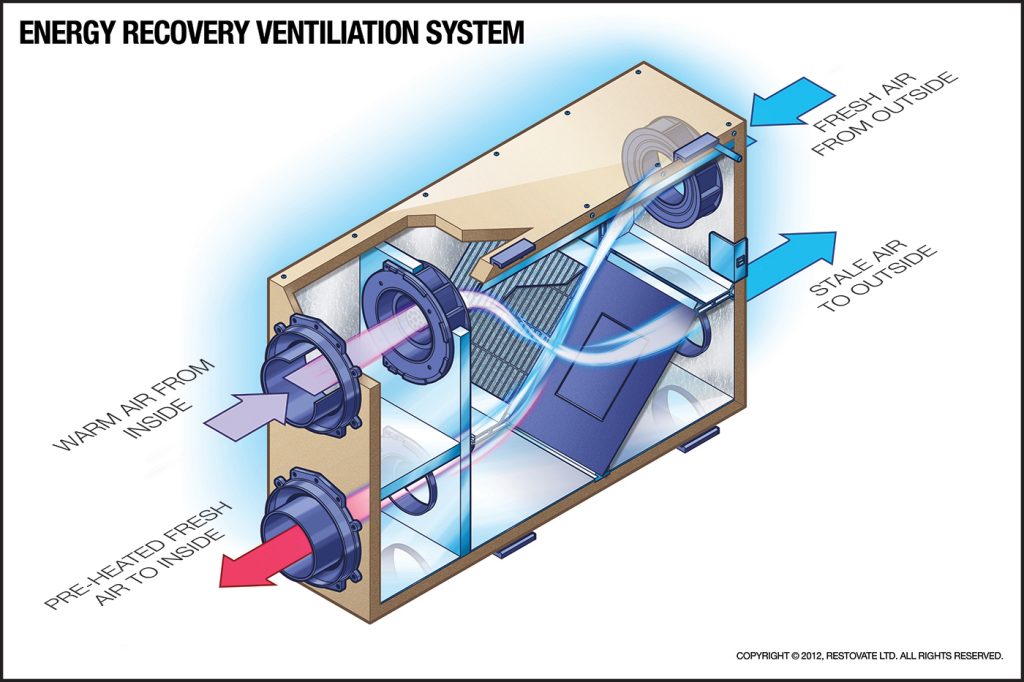
The magic of an ERV lies in its ability to facilitate a controlled exchange of energy between two separate air streams without ever mixing the air itself. This non-mixing principle is critical for maintaining air quality.
The Principle of Heat and Moisture Exchange
At the heart of every ERV is a specialized heat exchanger core. This core is typically made of a material that allows for the transfer of both sensible heat (the heat that changes temperature) and latent heat (the heat associated with moisture content, which causes phase changes like evaporation or condensation).
Imagine two separate paths through this core: one for the stale, outgoing indoor air and another for the fresh, incoming outdoor air. As these two air streams pass adjacent to each other within the core, separated by thin membranes or plates:
-
In winter: The warm, moist exhaust air passes through one channel. Its heat (sensible and latent) is transferred through the core material to the cold, dry incoming outdoor air, warming and humidifying it before it enters the living space. This reduces the load on the furnace.
-
In summer: The cool, dry exhaust air passes through one channel. Its coolness and dryness (energy) are transferred to the hot, humid incoming outdoor air, cooling and dehumidifying it before it enters the living space. This reduces the load on the air conditioner.
This continuous process ensures that while the air within the building is constantly being refreshed, the energy required to condition that air is significantly minimized. The transfer process is highly efficient, often recovering 70-80% or even more of the energy that would otherwise be lost.
Key Components: Heat Exchanger Core, Fans, and Controls
An ERV unit is a sophisticated piece of equipment comprising several essential components that work in concert:
-
Heat Exchanger Core: This is the central component where the actual energy transfer occurs. Cores can be fixed-plate (stationary channels), rotary (a slowly rotating wheel), or sometimes made of specialized membranes that are highly permeable to water vapor but not to air contaminants. The choice of core material and design dictates the efficiency of sensible and latent heat transfer.
-
Two Separate Fans: One fan draws stale air from inside the building and pushes it through the exhaust path of the core and out of the building. The other fan draws fresh air from outside, pulls it through the supply path of the core, and delivers it into the building. These fans are typically energy-efficient DC motors, often variable speed, allowing for precise control over airflow.
-
Ductwork: A network of ducts is necessary to connect the ERV to the outside (for fresh air intake and stale air exhaust) and to the building’s existing duct system (to distribute the conditioned fresh air and collect stale air).
-
Filters: Both the incoming and outgoing air streams pass through filters (typically MERV-rated) to prevent dust, pollen, and other particulate matter from entering the heat exchanger core and from being introduced into the building. Regular filter replacement is crucial for maintaining efficiency and air quality.
-
Controls: Modern ERVs feature sophisticated control systems that allow users to manage fan speeds, operate on timers, integrate with smart home systems, and even monitor indoor/outdoor air conditions. Some advanced units include defrost mechanisms for cold climates to prevent ice buildup in the core.
Summer vs. Winter Operation: Seasonal Adaptability
The beauty of an ERV lies in its dynamic adaptability to different seasonal conditions, making it a versatile solution for a wide range of climates.
-
Winter Mode (Heating Season): When it’s cold and dry outside and warm and humid inside, the ERV captures both the heat (sensible) and moisture (latent) from the outgoing warm, moist indoor air. This energy is then transferred to the cold, dry incoming outdoor air, effectively pre-warming and pre-humidifying it before it circulates through the home. This reduces the workload on the furnace or heat pump.
-
Summer Mode (Cooling Season): Conversely, when it’s hot and humid outside and cool and dry inside, the ERV works in reverse. It captures the coolness and dryness from the outgoing cool, dry indoor air. This energy is then transferred to the hot, humid incoming outdoor air, effectively pre-cooling and pre-dehumidifying it. This significantly lessens the strain on the air conditioning system, making the indoor environment more comfortable and reducing energy consumption for cooling and dehumidification.
This bi-directional energy transfer mechanism distinguishes ERVs as highly efficient and intelligent ventilation systems, capable of optimizing performance regardless of the prevailing outdoor climate conditions.
Why ERVs Matter: The Multifaceted Benefits
The integration of ERV technology into modern HVAC systems offers a cascade of benefits, impacting everything from occupant health to environmental sustainability. These advantages make ERVs a compelling choice for both new constructions and retrofits aiming for higher performance standards.
Enhancing Indoor Air Quality (IAQ)
One of the most critical benefits of an ERV is its profound impact on Indoor Air Quality (IAQ). Modern buildings are often constructed to be very airtight to maximize energy efficiency, which, while beneficial for insulation, can inadvertently trap indoor pollutants. Sources such as volatile organic compounds (VOCs) from building materials and furnishings, pet dander, dust mites, cooking fumes, cleaning products, and even human respiration contribute to a build-up of stale, contaminated air.
-
Continuous Fresh Air Supply: An ERV provides a constant, controlled supply of fresh, filtered outdoor air, diluting these indoor pollutants and expelling stale air. This continuous air exchange is vital for respiratory health and overall well-being.
-
Pollutant Dilution: By regularly replacing indoor air with fresh outdoor air, ERVs effectively reduce concentrations of allergens, viruses, bacteria, CO2, and other harmful airborne particles, creating a healthier living and working environment. This is particularly important in today’s world where concerns about airborne contaminants are high.
Significant Energy Savings and Cost Reduction
The “Energy Recovery” aspect of an ERV’s name highlights its most financially attractive feature. By transferring energy between exhaust and supply air streams, ERVs drastically reduce the energy load on a building’s primary heating and cooling systems.
-
Reduced HVAC Load: Without an ERV, bringing in fresh outdoor air means introducing air that needs to be fully heated or cooled from scratch. This is a massive energy drain. An ERV pre-conditions this incoming air, meaning the furnace or AC unit has to do significantly less work to bring it to the desired temperature and humidity level.
-
Lower Utility Bills: This reduced workload directly translates into lower energy consumption for heating and cooling, which in turn leads to substantial savings on utility bills over the lifetime of the system. The upfront investment in an ERV is often recouped through these energy savings, especially in climates with extreme temperature swings.
-
Right-Sizing HVAC Equipment: In some cases, the reduced load provided by an ERV can even allow for the installation of smaller, less expensive heating and cooling equipment, providing additional upfront cost savings.
Maintaining Optimal Indoor Comfort
Beyond energy savings and IAQ, ERVs play a crucial role in maintaining consistent and comfortable indoor conditions.
-
Eliminating Drafts and Temperature Swings: Traditional ventilation methods (like opening windows) can lead to uncomfortable drafts and sudden temperature fluctuations. ERVs introduce pre-conditioned air gently and uniformly, avoiding these issues.
-
Humidity Control: A key advantage of ERVs over simpler heat recovery systems (HRVs) is their ability to transfer moisture (latent heat). In humid climates, ERVs help to reduce the moisture load on the AC system, preventing sticky, uncomfortable conditions and inhibiting mold growth. In dry climates, they can help retain some indoor humidity in winter, preventing overly dry air that can cause discomfort.
-
Consistent Environment: By working in tandem with the HVAC system, ERVs ensure a more stable and predictable indoor climate, contributing significantly to occupant satisfaction and productivity.
Environmental Impact and Sustainability
The energy efficiency inherent in ERV technology also has a positive ripple effect on the environment.
-
Reduced Carbon Footprint: Lower energy consumption means a reduced demand for electricity and fossil fuels, which directly translates to fewer greenhouse gas emissions. This makes ERVs a powerful tool in combating climate change.
-
Support for Green Building Initiatives: ERVs are often a requirement or a highly recommended component in high-performance green buildings and sustainable construction certifications (e.g., LEED, Passive House). They contribute significantly to a building’s overall energy performance and environmental rating.
-
Resource Conservation: By making heating and cooling systems more efficient, ERVs help conserve natural resources that would otherwise be consumed in generating the additional energy required.
In essence, ERVs are not just about ventilating a building; they are about ventilating it intelligently, sustainably, and in a way that maximizes both occupant comfort and the building’s operational efficiency.
ERV vs. HRV: Understanding the Nuance
While often discussed interchangeably, Energy Recovery Ventilators (ERVs) and Heat Recovery Ventilators (HRVs) are distinct technologies with specific applications. Understanding their differences is crucial for selecting the appropriate system for a given climate and building type.
HRV: Heat Recovery Ventilator – Focusing on Sensible Heat
An HRV, or Heat Recovery Ventilator, is a ventilation system that also recovers energy from exhaust air and transfers it to incoming fresh air. However, its primary focus is on sensible heat transfer.
-
Mechanism: HRVs typically use a heat exchanger core (often made of aluminum or plastic) that efficiently transfers heat from the warmer air stream to the cooler air stream.
-
Function: In winter, the HRV transfers heat from warm exhaust air to cold incoming air, pre-heating it. In summer, it transfers coolness from cool exhaust air to warm incoming air, pre-cooling it.
-
Moisture Management: HRVs do not transfer significant amounts of moisture (latent heat). This means that in humid climates during summer, an HRV will bring in moist outdoor air, potentially increasing the load on the air conditioner’s dehumidification function. In dry winter climates, it will exhaust moist indoor air, potentially making the indoor environment too dry.
HRVs are generally well-suited for colder climates where the primary concern is recovering heat during the winter and where indoor humidity levels might already be low or can be managed separately.
The Critical Difference: Latent Heat (Moisture) Transfer
The defining characteristic that sets an ERV apart from an HRV is its ability to transfer latent heat, which is the energy associated with moisture content.
-
ERV’s Unique Core: ERVs utilize a specialized core material (often polymeric or paper-based with desiccant properties) that is permeable to water vapor. This allows moisture to migrate from the more humid air stream to the drier air stream.
-
Humid Climates (Summer): In hot, humid summers, the ERV captures moisture from the cooler, drier exhaust air and prevents it from entering with the hot, humid incoming air. This significantly reduces the dehumidification load on the air conditioning system, leading to greater comfort and energy savings.
-
Dry Climates (Winter): In cold, dry winters, the ERV retains moisture from the warm, humid exhaust air, transferring it to the cold, dry incoming air. This helps prevent the indoor air from becoming excessively dry, improving comfort and reducing static electricity.
This capacity for moisture transfer makes ERVs a more versatile and often more comfortable choice, particularly in climates characterized by significant humidity fluctuations throughout the year.
Choosing the Right System: Climate and Application Considerations
The decision between an ERV and an HRV largely hinges on the specific climate conditions and the building’s ventilation needs:
-
Cold, Dry Climates: An HRV might be sufficient if the primary concern is heat recovery in winter and if maintaining indoor humidity isn’t a major challenge (or if separate humidification is already in place).
-
Mixed or Humid Climates: An ERV is generally the superior choice. Its ability to manage both sensible and latent heat transfer makes it ideal for regions with hot, humid summers and cold, dry or moderately humid winters. It balances temperature and humidity, providing year-round benefits.
-
Specific Building Needs: For buildings where maintaining consistent indoor humidity is critical (e.g., museums, archives, certain manufacturing facilities, or homes with sensitive occupants), an ERV’s moisture transfer capabilities make it indispensable. For very tight, energy-efficient homes aiming for optimal performance in all seasons, an ERV is typically preferred.
While HRVs are excellent at heat recovery, ERVs offer a more comprehensive solution by tackling both temperature and humidity, making them a more advanced and often more appropriate technology for modern, high-performance buildings across a broader spectrum of climatic conditions.
Installation, Maintenance, and Future Trends in ERV Technology
Integrating an ERV into an HVAC system is a long-term investment, and like any advanced technology, its effectiveness and longevity are contingent upon proper installation, diligent maintenance, and an eye towards future innovations.
Sizing and Installation Considerations
The successful implementation of an ERV begins with accurate sizing and professional installation.
-
Proper Sizing: An ERV must be sized appropriately for the specific building’s volume and occupancy. An undersized unit won’t provide adequate ventilation, while an oversized unit can be less efficient and more costly to operate. Sizing calculations involve factors like square footage, number of occupants, local ventilation codes, and desired air changes per hour.
-
Ductwork Integration: ERVs require dedicated ductwork for fresh air intake, stale air exhaust, and integration with the building’s main HVAC supply and return ducts. This can be complex, especially in existing homes, and requires careful planning to ensure balanced airflow and minimal pressure drops.
-
Professional Installation: Due to the complexity of integrating an ERV with existing HVAC systems and ensuring balanced airflow, professional installation by a qualified HVAC technician is highly recommended. Incorrect installation can lead to reduced efficiency, poor air quality, and potential operational issues. Proper sealing and insulation of all ductwork are also crucial to prevent energy losses.
-
Condensate Drainage: As ERVs transfer moisture, especially during cooling season in humid climates, they may produce condensate. Proper drainage is essential to prevent water damage and mold growth within the unit or ductwork.
Routine Maintenance for Optimal Performance
Like any mechanical system, an ERV requires regular maintenance to ensure its efficient and effective operation. Neglecting maintenance can lead to decreased performance, reduced air quality, and potential system failures.
-
Filter Replacement/Cleaning: This is perhaps the most critical and frequent maintenance task. ERVs have filters on both the incoming and outgoing air streams. These filters collect dust, pollen, and other particulates, and if they become clogged, airflow is restricted, leading to reduced efficiency and potential fan motor strain. Filters should typically be checked monthly and replaced or cleaned every 3-6 months, depending on air quality and usage.
-
Core Cleaning: Over time, the heat exchange core itself can accumulate dust and debris, reducing its transfer efficiency. Most ERV cores are removable and can be cleaned (often with a vacuum or mild detergent, following manufacturer instructions). The frequency of core cleaning depends on the filter efficiency and local air quality, but typically once a year or every few years is sufficient.
-
Fan Inspection: Periodically check the fans for any unusual noises or vibrations, which could indicate wear and tear or imbalance. Dust accumulation on fan blades can also reduce efficiency.
-
Drain Pan/Line Cleaning: If the ERV has a condensate drain, ensure it is clear of blockages and cleaned periodically to prevent mold or algae growth.
-
Professional Check-ups: An annual professional inspection by an HVAC technician can help identify and address potential issues before they become major problems, ensuring the ERV operates at peak efficiency.
Smart Integration and Advancements
The future of ERV technology is undoubtedly tied to smart home integration and continuous efficiency improvements.
-
Smart Home Connectivity: Modern ERVs are increasingly integrated with smart home ecosystems, allowing for remote control, scheduling, and monitoring via apps. They can interact with other smart devices, such as thermostats and air quality sensors, to optimize ventilation based on real-time conditions (e.g., increasing ventilation when CO2 levels rise or occupancy is detected).
-
Improved Efficiency and Materials: Ongoing research focuses on developing more efficient heat exchange cores, utilizing advanced materials that maximize sensible and latent heat transfer while minimizing pressure drop. Advances in fan motor technology are also making units quieter and more energy-efficient.
-
Demand-Controlled Ventilation (DCV): Future ERVs will likely feature more sophisticated DCV capabilities, using CO2 sensors, VOC sensors, and humidity sensors to dynamically adjust ventilation rates based on actual indoor air quality needs, rather than relying on fixed schedules. This “ventilation only when needed” approach further maximizes energy savings.
-
Miniaturization and Decentralization: While centralized ERVs are common, there’s a growing trend towards smaller, decentralized units that can be installed in individual rooms or zones, offering more tailored ventilation solutions.
As our understanding of indoor air quality and energy efficiency evolves, ERV technology will continue to advance, becoming even more intelligent, efficient, and seamlessly integrated into our living and working environments.

Conclusion
ERV stands for Energy Recovery Ventilator, a sophisticated and increasingly vital component in modern HVAC systems. Far more than just a fan, it is an intelligent gateway that allows buildings to breathe, continuously exchanging stale indoor air for fresh outdoor air while simultaneously recovering a substantial portion of the energy embedded in that air. This dual capability makes ERVs indispensable for enhancing indoor air quality, significantly reducing energy consumption for heating and cooling, and maintaining optimal indoor comfort levels year-round.
By efficiently transferring both sensible heat and latent heat (moisture), ERVs bridge the gap between building airtightness and the critical need for healthy ventilation. They stand apart from HRVs due to their unique moisture transfer ability, making them a more versatile solution for a wide range of climates. As building codes push for greater energy efficiency and awareness of indoor air quality continues to grow, the adoption of ERV technology will only expand. They represent a fundamental shift towards more sustainable, healthier, and comfortable indoor environments, cementing their position as a cornerstone of advanced HVAC design. Understanding and implementing ERVs is not just about adopting a new technology; it’s about embracing a smarter, greener, and healthier approach to how we condition our indoor spaces.
aViewFromTheCave is a participant in the Amazon Services LLC Associates Program, an affiliate advertising program designed to provide a means for sites to earn advertising fees by advertising and linking to Amazon.com. Amazon, the Amazon logo, AmazonSupply, and the AmazonSupply logo are trademarks of Amazon.com, Inc. or its affiliates. As an Amazon Associate we earn affiliate commissions from qualifying purchases.