
In the vast landscape of architectural innovation, few structures command as much intrigue and respect as the geodesic dome. More than just a quirky building shape, the geodesic dome is a profound testament to the power of engineering principles, mathematical precision, and innovative material science. It represents a radical departure from conventional rectilinear construction, offering unparalleled strength, efficiency, and versatility. To truly understand “what is the geodesic dome” is to delve into a technological marvel that continues to inspire and challenge our perceptions of what built environments can be.
At its core, a geodesic dome is a spherical or hemispherical shell structure composed of a network of triangles, forming a self-bracing framework. The “geodesic” refers to the shortest distance between two points on a curved surface (a great circle arc), and in the dome’s construction, these geodesic lines define the edges of the triangular elements. This geometric arrangement ensures that stress is distributed evenly across the entire structure, making it incredibly robust and capable of enclosing maximum space with minimum material.

The Engineering Marvel Behind Geodesic Domes
The geodesic dome is not merely an architectural style; it is a direct application of advanced engineering and mathematical concepts to solve real-world structural challenges. Its ingenuity lies in its ability to harness natural forces for unparalleled structural integrity.
Buckminster Fuller’s Vision and Mathematical Foundations
The concept of the geodesic dome is inextricably linked with its primary popularizer, R. Buckminster Fuller. A visionary American architect, systems theorist, author, designer, and inventor, Fuller was driven by a desire to do “more with less.” He sought to create lightweight, efficient, and easily constructible structures that could address global housing and resource challenges. Fuller did not invent the geometry itself, which had been explored by others like Walther Bauersfeld, but he significantly developed, patented, and popularized the design principles, coining the term “geodesic dome.”
Fuller’s work drew heavily on polyhedra, specifically the icosahedron, a polyhedron with 20 faces and 12 vertices. By subdividing the triangular faces of an icosahedron into smaller triangles and projecting these vertices onto a sphere, Fuller created a complex yet incredibly stable network. The genius of this approach is that the spherical shape naturally distributes external forces, such as wind or snow loads, evenly across its surface. Unlike a flat roof that bears all weight on specific points, the dome’s curvature allows forces to be transmitted throughout its entire framework, eliminating localized stress points and dramatically increasing its load-bearing capacity relative to its material usage. This mathematical elegance is the foundational technology enabling the dome’s superior performance.
Principles of Tensegrity and Structural Efficiency
A key technological principle underpinning the geodesic dome, though not always exclusively applied, is tensegrity (tensional integrity). While not all domes are pure tensegrity structures, Fuller’s broader design philosophy often embraced its principles. Tensegrity structures are characterized by discontinuous compression elements (struts) and continuous tension elements (cables or rods). In simpler terms, the rigid components (struts) do not touch each other but are held in place by continuous tension elements, creating a pre-stressed, stable structure. This allows for incredibly lightweight yet strong structures that can adapt to various forces without collapsing.
In a geodesic dome, the triangulation of elements ensures that the structure acts as a singular, unified membrane. Each strut in the dome is under either compression or tension, and these forces are balanced throughout the entire network. This structural efficiency means that domes require significantly less material than conventional box-shaped buildings to enclose the same volume, making them highly resource-efficient. The inherent rigidity of the triangle, the only polygon that cannot be deformed without changing the length of its sides, provides the dome with its extraordinary stiffness and resistance to deformation, even under extreme conditions.
Material Innovation and Construction Techniques
The construction of geodesic domes has historically pushed the boundaries of material science and fabrication techniques. Early domes often used steel tubing for struts and lightweight panels for cladding. However, as technology advanced, so did the range of suitable materials. Aluminum alloys, known for their high strength-to-weight ratio and corrosion resistance, became popular. For more permanent structures, reinforced concrete and even timber have been employed, sometimes combined with advanced composites.
The modular nature of the triangular components is a crucial technological advantage. Domes can be prefabricated off-site, with each strut and panel precisely cut and drilled, then transported and assembled rapidly on location. This “kit-of-parts” approach significantly reduces construction time and labor costs compared to traditional building methods. Advanced CAD/CAM (Computer-Aided Design/Computer-Aided Manufacturing) software now allows for the precise calculation and fabrication of thousands of unique struts and panels required for larger, more complex domes, ensuring accurate fit and rapid assembly. This technological integration from design to construction is what makes large-scale dome projects feasible today.
Technological Advantages and Applications
Beyond their striking appearance, geodesic domes offer a plethora of practical advantages rooted deeply in their innovative design and engineering. These benefits have made them attractive for a diverse range of applications.
Optimal Strength-to-Weight Ratio and Durability
One of the most remarkable technological advantages of a geodesic dome is its unparalleled strength-to-weight ratio. By distributing stress uniformly across its entire surface, a dome can withstand immense external forces, including high winds, heavy snow loads, and even seismic activity, far better than many conventional structures. The spherical shape inherently minimizes the surface area exposed to wind pressure, and the continuous triangular framework prevents localized failure by redistributing loads across the whole structure. This makes them exceptionally durable and reliable in extreme environments, from arctic research stations to hurricane-prone coastal regions. The efficiency of material usage directly translates to lower embodied energy and reduced environmental impact, a critical consideration in modern sustainable technology.
Energy Efficiency and Sustainable Design
Geodesic domes are also champions of energy efficiency, thanks to their unique geometry. The spherical shape encloses the largest volume with the least surface area compared to any other form, minimizing heat loss in winter and heat gain in summer. This reduces the energy required for heating and cooling. The smooth, curved exterior allows for efficient airflow, reducing drag and minimizing drafts. Furthermore, domes are often designed to incorporate passive solar principles, with strategically placed windows or translucent panels maximizing natural light and warmth. Ventilation systems can be optimized for natural convection, drawing cool air in and expelling warm air without the need for extensive mechanical systems. This inherent sustainability makes them a prime example of green building technology.
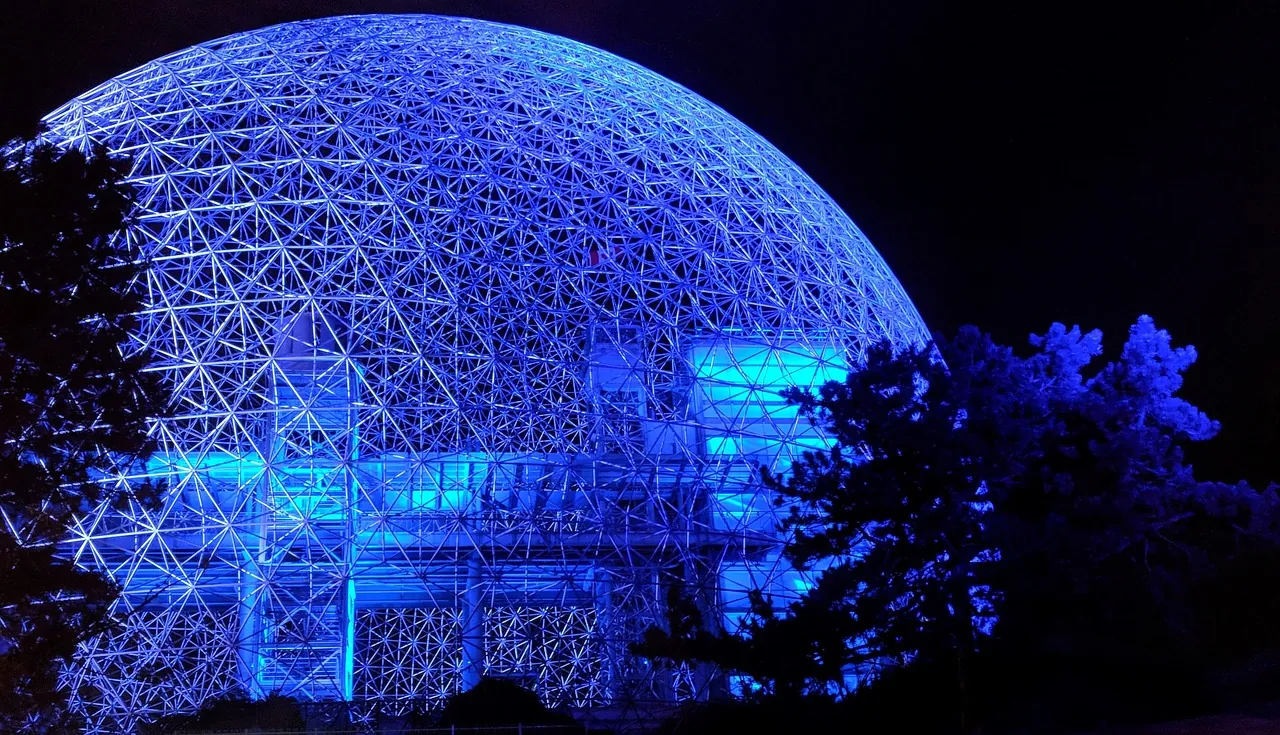
Versatile Deployments: From Habitats to High-Tech Facilities
The versatility of the geodesic dome is another key technological attribute. Their adaptability has led to their deployment in an astonishing array of contexts:
-
Residential Homes: Offering unique living spaces, often integrated with natural landscapes.
-
Exhibition Spaces and Event Venues: Providing large, unobstructed interior volumes for grand displays, such as the famous Spaceship Earth at Epcot Center.
-
Greenhouses and Agricultural Facilities: Their optimal light distribution and thermal properties create ideal conditions for plant growth.
-
Radar Domes and Telecommunication Enclosures: Their non-obstructive structure protects sensitive equipment from elements while allowing signals to pass through.
-
Research Stations: In remote or extreme environments like Antarctica, where durability and ease of assembly are paramount.
-
Disaster Relief Shelters: Their rapid deployment capability and resilience make them suitable for emergency housing.
-
Thematically advanced structures: Such as Biosphere 2, an ambitious project to create a self-contained ecological system.
Each of these applications leverages specific technological advantages of the dome, from its environmental control capabilities to its structural integrity in harsh conditions.
Design Challenges and Technological Solutions
Despite their numerous advantages, geodesic domes present unique design and construction challenges that often require advanced technological solutions.
Complex Manufacturing and Precision Engineering
Manufacturing the components of a geodesic dome, especially large or complex ones, demands a high degree of precision engineering. Unlike standard rectangular building components, dome struts and panels are often unique in length and angle. Manual fabrication can lead to errors, assembly issues, and structural weaknesses. Modern CAD software is indispensable here, allowing engineers to precisely model the dome, calculate exact dimensions for each component, and generate cutting lists. This data can then be fed directly into CNC (Computer Numerical Control) machines for automated and highly accurate fabrication, ensuring every part fits perfectly. This reliance on digital fabrication technologies transforms a geometrically complex challenge into a manageable, repeatable process.
Integration of Modern Systems
Integrating conventional building systems like HVAC, plumbing, and electrical wiring into a non-traditional spherical structure can be challenging. Standardized rectangular components designed for flat walls and ceilings don’t always adapt easily to curved surfaces. This requires specialized design and custom solutions. For instance, plumbing and electrical conduits must follow the unique internal framework, often requiring innovative routing and attachment methods. HVAC systems need careful design to ensure uniform air distribution within the large, open volume of the dome without creating dead air zones. However, technological advancements in modular systems, flexible piping, and smart home automation can simplify these integrations, making domes just as functional and comfortable as traditional buildings. The open nature of many domes also lends itself to exposed conduit and pipe runs as a design feature, further simplifying installation.
Overcoming Psychological and Aesthetic Hurdles
While not purely a technical challenge, the unique aesthetics of the geodesic dome can present psychological and market acceptance hurdles. Many people are accustomed to rectilinear spaces and may find the curved walls or lack of traditional “corners” unsettling or impractical for furniture placement. Addressing this involves clever interior design and technological solutions for customization. For instance, designers might create internal partitions that delineate functional areas while maintaining the open feel. Modular furniture designed for curved spaces, or the use of projection mapping technologies to create dynamic interior surfaces, could further enhance the living experience within a dome. The proliferation of virtual reality and augmented reality in architectural visualization also helps prospective occupants experience and adapt to these unique spaces before construction, bridging the gap between innovative design and user acceptance.
The Geodesic Dome in the Future of Technology and Architecture
The principles embodied by the geodesic dome—efficiency, strength, and adaptability—are more relevant than ever in an era demanding sustainable and resilient architectural solutions. The future of the geodesic dome is likely to be shaped by continued technological advancements.
Advancements in Parametric Design and Digital Fabrication
The future of geodesic domes will heavily leverage parametric design, a process based on algorithmic thinking that enables the generation of complex geometries and their iterative refinement. AI-assisted design tools can optimize dome configurations for specific site conditions, material properties, and performance criteria (e.g., solar gain, wind resistance). This allows for bespoke dome designs that are not only structurally optimal but also aesthetically unique. Coupled with advancements in digital fabrication—including large-scale 3D printing of structural elements or entire modules—the construction of domes could become even faster, cheaper, and more precise. Imagine printing custom nodes and struts on-site from recycled materials, dramatically reducing waste and logistics.
Space Colonization and Extreme Environment Habitats
One of the most exciting potential applications for geodesic domes lies beyond Earth. Their strength-to-weight ratio, ease of assembly, and ability to create hermetically sealed environments make them ideal candidates for lunar bases, Martian habitats, and other extraterrestrial colonization efforts. Researchers are exploring domes made from lunar regolith (moon dust) using advanced additive manufacturing techniques, or inflatable domes that could be easily transported and deployed. In such extreme environments, the technological advantages of a dome—its structural integrity, efficient volume enclosure, and resistance to external pressures—are not just beneficial but absolutely critical for survival.

Sustainable Urbanism and Rapid Deployment Structures
On Earth, geodesic domes will continue to play a role in sustainable urbanism and addressing urgent needs for rapid deployment. As cities face increasing population density and climate change impacts, domes offer a path towards more efficient use of resources and resilient construction. Modular, prefabricated dome systems can provide quick and effective solutions for emergency shelters, temporary housing for displaced populations, or even permanent, low-impact dwellings. Furthermore, their potential for vertical farming and enclosed ecological systems could contribute to urban food security and green infrastructure, integrating nature into dense urban environments through technologically advanced enclosed biomes.
In conclusion, the geodesic dome is far more than a simple building; it is a profound technological statement. From its mathematical origins conceived by Buckminster Fuller to its current and future applications, it represents a commitment to efficiency, resilience, and ingenuity in design and construction. As we continue to push the boundaries of what is possible in architecture and engineering, the geodesic dome stands as a timeless symbol of humanity’s ability to create remarkable structures by understanding and leveraging the fundamental principles of nature. Its continued evolution, fueled by new materials, advanced manufacturing, and computational design, ensures its place at the forefront of technological innovation in the built environment.
aViewFromTheCave is a participant in the Amazon Services LLC Associates Program, an affiliate advertising program designed to provide a means for sites to earn advertising fees by advertising and linking to Amazon.com. Amazon, the Amazon logo, AmazonSupply, and the AmazonSupply logo are trademarks of Amazon.com, Inc. or its affiliates. As an Amazon Associate we earn affiliate commissions from qualifying purchases.