
In the vast and ever-evolving landscape of technology, efficiency is paramount. Every millisecond saved, every resource optimized, contributes to a smoother, faster, and more powerful user experience. At the heart of much of this efficiency, particularly in data retrieval, lies a deceptively simple yet profoundly powerful algorithm: Binary Search. Often hailed as one of the cornerstone algorithms in computer science, understanding binary search is fundamental for anyone delving into software development, data structures, or simply appreciating the elegance of intelligent problem-solving. It’s not just an academic exercise; binary search underpins countless real-world applications, from database queries to version control systems.
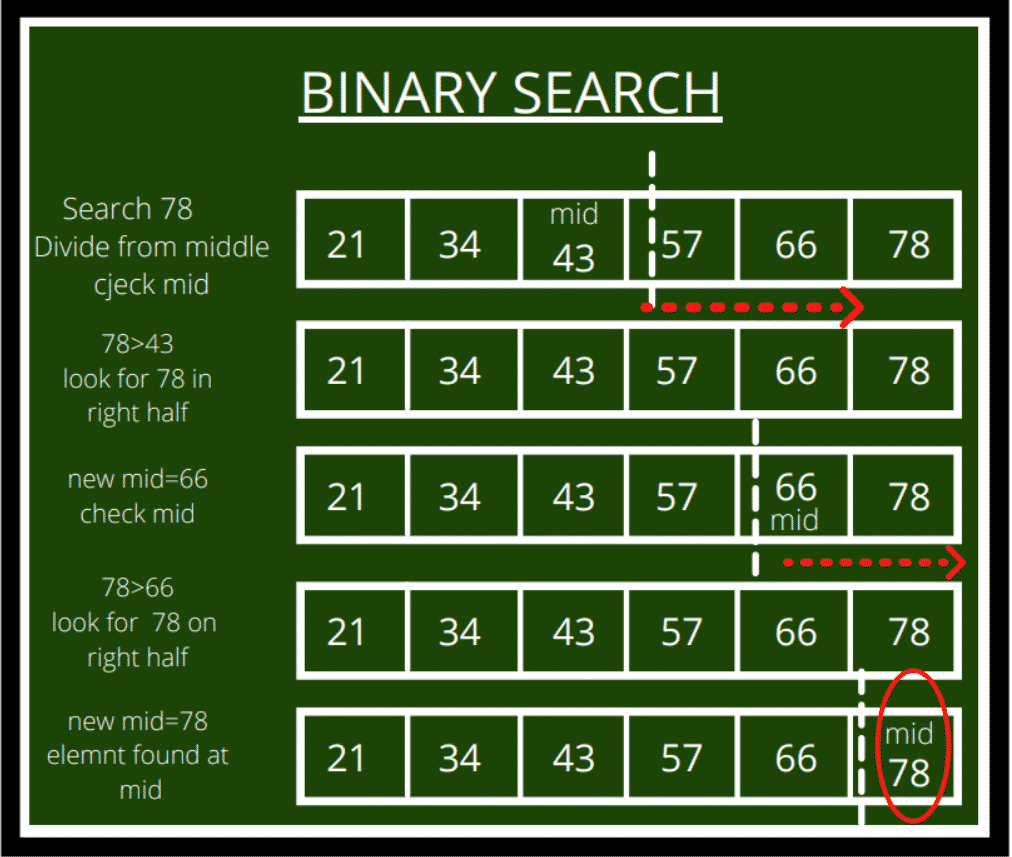
At its core, binary searching is an algorithm designed to locate the position of a target value within a sorted array or list. Its power stems from its “divide and conquer” strategy, which dramatically reduces the number of comparisons needed compared to a more naive approach. While a linear search meticulously checks each element one by one, binary search smartly eliminates half of the remaining search space with every step, rapidly homing in on the desired item. This logarithmic time complexity makes it an indispensable tool for handling large datasets efficiently, defining a standard for optimized search operations across the digital world.
The Core Principle: Divide and Conquer
The genius of binary search lies in its systematic approach to narrowing down possibilities. Imagine trying to find a specific page in a thick book without an index. A linear search would mean flipping through pages one by one from the beginning until you find it. Binary search, however, would have you open the book roughly in the middle, check the page number, and then decide whether your target page is in the first half or the second half. You then repeat the process on the chosen half, discarding the other half entirely. This iterative halving of the search space is what makes it so incredibly fast.
How It Works: A Step-by-Step Walkthrough
For binary search to work its magic, one crucial prerequisite must be met: the data set must be sorted. Whether it’s an array of numbers in ascending order, a list of strings alphabetically, or objects sorted by a specific attribute, the ordered nature is non-negotiable. Without it, the algorithm’s core assumption—that elements to one side of a pivot are all smaller and elements to the other side are all larger—falls apart.
Let’s break down the process:
-
Initialize Pointers: Start by defining three pointers:
low(pointing to the first element’s index),high(pointing to the last element’s index), and implicitly,mid. -
Calculate Midpoint: In each step, calculate the
midindex. This is typically(low + high) / 2(or more robustly,low + (high - low) / 2to prevent potential integer overflow with very largelowandhighvalues). -
Compare and Adjust:
-
Compare the value at the
midindex with yourtargetvalue. -
If
mid_value == target: Congratulations! You’ve found your element. Return themidindex. -
If
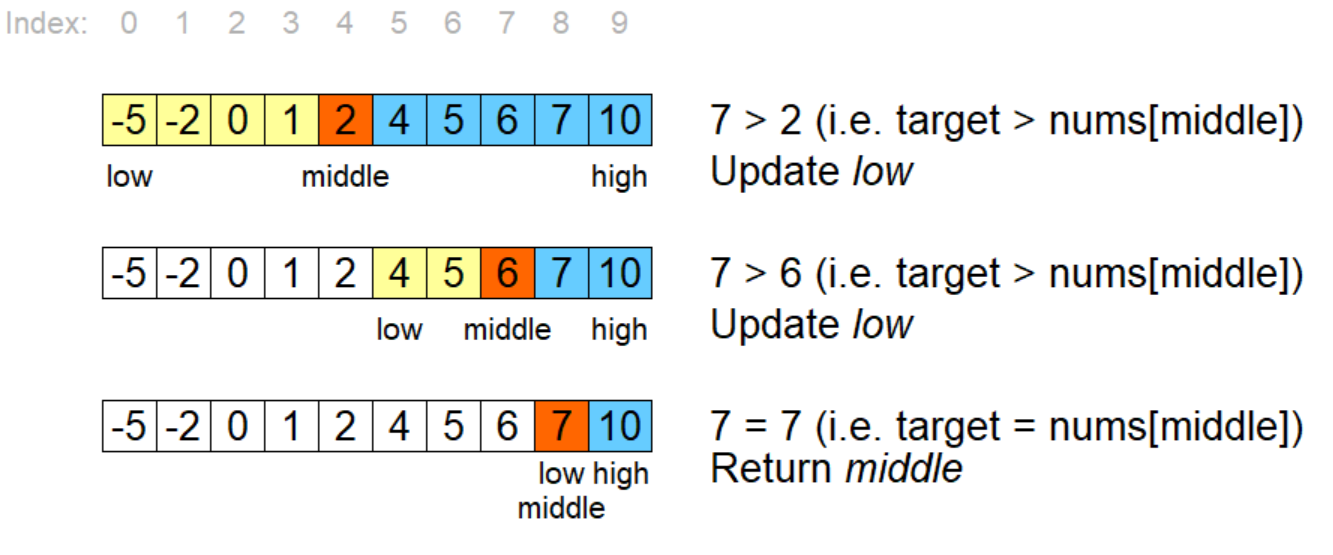
mid_value < target: This means yourtargetmust lie in the upper half of the current search space (since the array is sorted). Adjustlowtomid + 1, effectively discarding the lower half and themidelement itself. -
If
mid_value > target: Yourtargetmust be in the lower half. Adjusthightomid - 1, discarding the upper half and themidelement.
-
-
Repeat or Terminate: Continue steps 2 and 3 as long as
low <= high. Iflowbecomes greater thanhigh, it means the search space has collapsed, and the target element is not present in the array. In this case, the algorithm terminates, indicating that the item was not found.
Illustrative Example
Imagine you have a sorted list of numbers: [2, 5, 8, 12, 16, 23, 38, 56, 72, 91] and you want to find the number 23.
-
Initial:
low = 0,high = 9(length – 1). -
Iteration 1:
-
mid = (0 + 9) / 2 = 4. The element at index 4 is16. -
16 < 23. So,targetis in the upper half. -
Update
low = mid + 1 = 5.highremains9.
-
-
Iteration 2:
-
mid = (5 + 9) / 2 = 7. The element at index 7 is56. -
56 > 23. So,targetis in the lower half. -
Update
high = mid - 1 = 6.lowremains5.
-
-
Iteration 3:
-
mid = (5 + 6) / 2 = 5. The element at index 5 is23. -
23 == 23. Target found at index 5!
-
Contrast this with linear search, which would have taken 6 comparisons (checking 2, 5, 8, 12, 16, then 23) in the worst case, or on average half the list. Binary search found it in just 3 steps. The advantage becomes astronomical with larger lists.
Why Binary Search Matters: Efficiency and Performance
The impact of binary search isn’t merely academic; it translates directly into tangible performance benefits across a myriad of digital systems. Its efficiency is a cornerstone for designing scalable and responsive software.
Comparing to Linear Search: The Performance Gap
To truly appreciate binary search, one must compare it to its simpler, less efficient cousin: linear search.
-
Linear Search: Also known as sequential search, this method checks each element in the list one by one until a match is found or the end of the list is reached. In the worst-case scenario (the target is the last element or not present), it must examine n elements, where n is the size of the list. Its time complexity is O(n), meaning the time taken grows linearly with the size of the input. For a list of a million items, it might take up to a million comparisons. This is perfectly fine for small lists, but quickly becomes impractical for large ones.
-
Binary Search: As we’ve seen, binary search halves the search space with each step. This leads to a logarithmic time complexity, denoted as O(log n). What does logarithmic mean in practical terms? It means that as the input size n grows, the number of operations required grows incredibly slowly. For a list of a million items (n = 1,000,000), log base 2 of 1,000,000 is approximately 20. This means binary search can find an item in a list of a million elements in, at most, about 20 steps! This dramatic reduction in comparisons highlights why binary search is a go-to algorithm for large datasets.
The performance gap is immense and crucial for applications demanding speed. Imagine a database with billions of records; an O(n) search would take an unacceptably long time, whereas an O(log n) search could return results almost instantly.
Real-World Applications
Binary search’s influence extends far beyond theoretical computer science problems. It is woven into the fabric of countless modern technologies:
-
Database Indexing: When you query a database, the system doesn’t typically scan every single record. Instead, it uses indexes, which are sorted data structures (often B-trees or similar variations based on binary search principles) that allow for rapid lookup of records based on key values.
-
Dictionary and Phone Book Lookups: While not digital, the method you use to find a word in a physical dictionary or a name in a phone book is intuitively binary search. You open to the middle, decide which half to proceed with, and repeat.
-
Version Control Systems (e.g., Git Bisect): Tools like Git use binary search to efficiently find the commit that introduced a bug. If you know a bug exists between two commit points,
git bisectwill automatically check commits in the middle until it isolates the problematic one. -
Compilers and Interpreters: Symbol tables and other data structures within compilers often rely on efficient search mechanisms like binary search to quickly locate variable names, function definitions, and other identifiers.
-
Finding an Optimal Value: In many engineering and scientific computing problems, you might need to find a specific input that produces a desired output. If the function relating input to output is monotonic (always increasing or always decreasing), binary search can be used to efficiently find the input that yields a target output. For instance, finding the root of an equation (where the function output is zero) or calculating a precise square root.
-
Graphics and Gaming: Algorithms for collision detection, spatial partitioning (like quadtrees or octrees, which are extensions of binary search principles into higher dimensions), and rendering often employ search techniques rooted in the divide-and-conquer strategy.
Implementing Binary Search: Key Considerations
While the core logic of binary search is straightforward, its implementation can present subtle challenges. Understanding these nuances is key to writing robust and correct code.

Iterative vs. Recursive Approaches
Binary search can be implemented in two primary ways:
-
Iterative Approach: This involves using a loop (e.g.,
whileloop) to repeatedly update thelowandhighpointers. It typically uses less memory as it doesn’t create new stack frames with each step, making it generally preferred for large datasets to avoid potential stack overflow errors that can occur with deep recursion. It can sometimes be less intuitive to read for beginners due to explicit loop management. -
Recursive Approach: This involves a function calling itself with modified
lowandhighparameters. Each recursive call represents one step in halving the search space. This approach often leads to more concise and elegant code that closely mirrors the conceptual definition of divide and conquer. However, for extremely large inputs, the depth of recursion might exhaust the call stack, leading to a “stack overflow” error.
Both approaches yield the same O(log n) time complexity. The choice often comes down to personal preference, readability, and the specific constraints of the environment.
Handling Edge Cases
A well-implemented binary search algorithm must correctly handle various edge cases to be truly robust:
-
Empty Array: If the input array is empty, the search should immediately return “not found” or an equivalent indicator.
-
Target Not Found: The algorithm must correctly terminate when the
targetis not present in the array. This happens whenloweventually exceedshigh. -
Array with One Element: The logic should correctly identify the target if it’s the only element, or confirm its absence.
-
Duplicate Elements: If the array contains duplicate values and the goal is to find any instance of the target, the standard binary search works. However, if the requirement is to find the first or last occurrence of a duplicate, the algorithm needs slight modifications (e.g., once a match is found, continue searching in the lower half for the first occurrence or in the upper half for the last).
-
Integer Overflow: As mentioned,
mid = (low + high) / 2can lead to integer overflow iflow + highexceeds the maximum value an integer can hold. The safer calculationmid = low + (high - low) / 2avoids this by calculating the offset fromlowrather than the absolute sum.
Language Agnostic Pseudocode
function binarySearch(arr, target):

    low = 0

    high = arr.length - 1


    while low <= high:

        mid = low + (high - low) / 2  // Prevents potential overflow


        if arr[mid] == target:

            return mid // Target found at index mid

        else if arr[mid] < target:

            low = mid + 1 // Target is in the upper half

        else: // arr[mid] > target

            high = mid - 1 // Target is in the lower half


    return -1 // Target not found
Beyond the Basics: Advanced Concepts and Variations
The core idea of binary search is so powerful that it has inspired and forms the basis for numerous advanced algorithms and data structures. Its applicability extends beyond simple arrays into more abstract problem spaces.
Binary Search on Answer (or Function Output)
Sometimes, the “array” you’re searching isn’t explicitly defined, but the search space is monotonic. This means that if a certain value X works (or satisfies a condition), then all values less than X also work (or fail), and vice-versa. In these scenarios, you can binary search on the answer or the output of a function.
For example, finding the square root of a number N. You’re looking for a number x such that x*x = N. The function f(x) = x*x is monotonic for positive x. You can binary search for x within a range (e.g., from 0 to N), checking f(mid) against N and adjusting your search range accordingly. This technique is extremely powerful for optimizing problems where you need to find a maximum or minimum value that satisfies a certain condition.
Binary Search Trees (BSTs)
Binary search provides the foundational principle for one of the most fundamental data structures in computer science: the Binary Search Tree (BST). A BST is a tree-based data structure where each node has at most two children, referred to as the left child and the right child. The key property of a BST is that for any given node:
-
All keys in the left subtree are smaller than the node’s key.
-
All keys in the right subtree are larger than the node’s key.
This property ensures that searching for an element in a BST follows a very similar “divide and conquer” logic to binary search. Starting from the root, you compare the target with the current node’s value. If the target is smaller, you move to the left child; if larger, you move to the right child. This process continues until the element is found or a null pointer is encountered. Operations like insertion, deletion, and searching in a balanced BST also typically have an average time complexity of O(log n).
Ternary Search (Brief Mention)
While binary search divides the search space into two, ternary search divides it into three parts. It’s typically used for finding the minimum or maximum of a unimodal function (a function that strictly decreases and then strictly increases, or vice-versa) within a continuous interval. While it’s a valid search algorithm, it generally offers no significant asymptotic advantage over binary search for finding elements in sorted arrays and often requires more comparisons. However, it’s a testament to how the core idea of interval reduction can be adapted.
Conclusion
Binary searching stands as a testament to the elegance and power of algorithmic thinking in computer science. Its ability to drastically cut down search times, transforming potentially millions of operations into a mere handful, makes it an indispensable tool in the tech professional’s arsenal. From the core principles of divide and conquer to its wide-ranging applications in databases, operating systems, and advanced data structures like Binary Search Trees, understanding binary search is more than just knowing an algorithm; it’s grasping a fundamental pattern of efficient problem-solving. As technology continues to generate ever-larger datasets, the importance of algorithms like binary search, which prioritize speed and resourcefulness, will only continue to grow. Mastering it not only enhances coding skills but also deepens one’s appreciation for the sophisticated mechanisms that power our digital world.
aViewFromTheCave is a participant in the Amazon Services LLC Associates Program, an affiliate advertising program designed to provide a means for sites to earn advertising fees by advertising and linking to Amazon.com. Amazon, the Amazon logo, AmazonSupply, and the AmazonSupply logo are trademarks of Amazon.com, Inc. or its affiliates. As an Amazon Associate we earn affiliate commissions from qualifying purchases.