
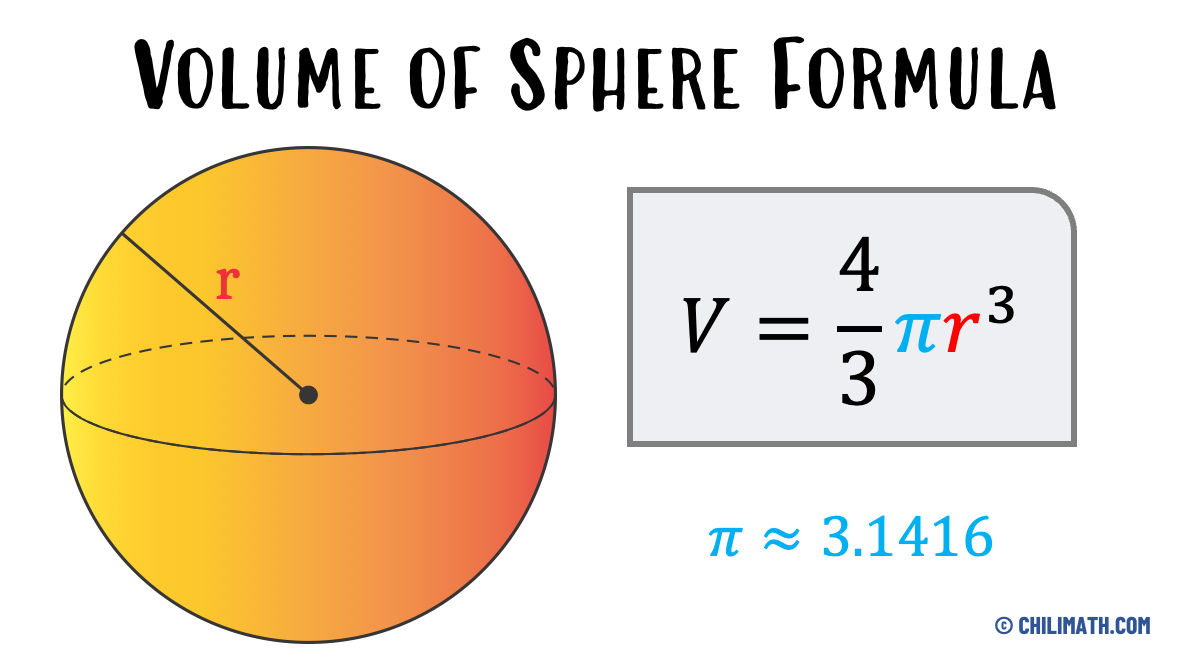
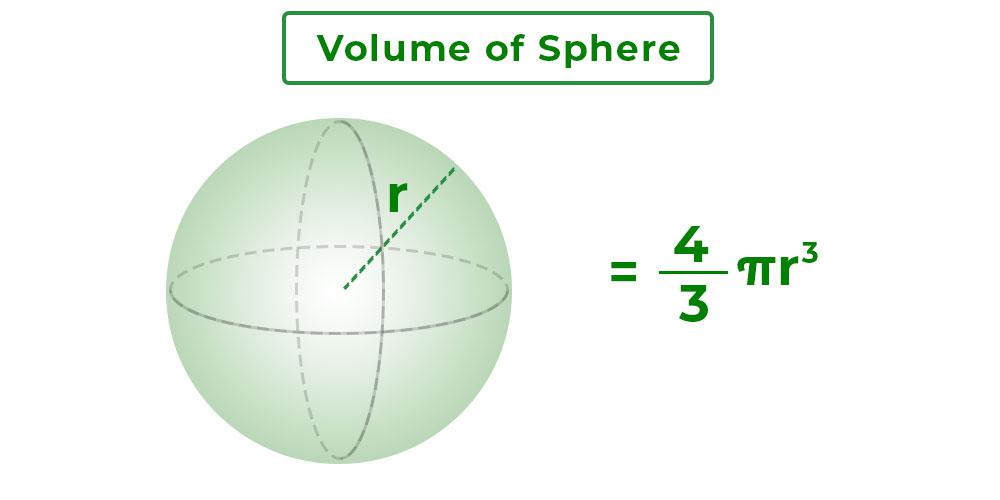
In the realm of mathematics, the formula for the volume of a sphere—$V = frac{4}{3}pi r^3$—is a fundamental pillar of Euclidean geometry. While students often encounter this equation in middle school textbooks, its implications stretch far beyond the classroom. In the contemporary technology sector, this formula serves as a cornerstone for everything from 3D rendering engines and game physics to the complex data structures used in artificial intelligence.
Understanding how to calculate the volume of a sphere is not merely an academic exercise; it is a prerequisite for software engineers, data scientists, and hardware designers who must translate physical realities into digital environments. As we delve into the intersection of geometry and technology, we see that the sphere—the most efficient shape in nature—is also one of the most critical shapes in our digital infrastructure.
1. Computational Geometry and 3D Modeling Software
At the heart of modern design lies Computer-Aided Design (CAD) and 3D modeling software like AutoCAD, Blender, and SolidWorks. These tools rely heavily on computational geometry to represent three-dimensional objects. When a software developer writes code to generate a sphere, the volume formula is integral to the software’s ability to calculate mass, density, and material requirements.
The Role of Volumetric Calculations in 3D Printing
In the world of additive manufacturing (3D printing), the volume of a sphere determines the amount of “filament” or resin required for a build. Slicing software—the tech that converts a 3D model into instructions for a printer—uses the $V = frac{4}{3}pi r^3$ formula to estimate print time and material costs. If the volume calculation is off by even a fraction, it can lead to structural failures or significant resource waste in large-scale industrial manufacturing.
Voxel-Based Rendering and Simulation
Unlike traditional polygon meshes, voxel-based tech (think Minecraft but for high-end medical imaging) treats space as a series of volumetric pixels. When simulating spherical biological structures, such as cells or tumors, developers use the volume formula to ensure that the digital representation maintains the correct physical properties. This is vital in health-tech, where surgeons use VR simulations to prepare for procedures; the accuracy of the volume calculation directly impacts the realism of the digital organ being modeled.
2. Game Engines and Real-Time Physics Simulations
The gaming industry is one of the most significant users of geometric formulas. Whether it is the Unreal Engine or Unity, the sphere is the “gold standard” for optimization. Because spheres are mathematically simple—defined only by a center point and a radius ($r$)—they are computationally “cheaper” to process than complex shapes.
Sphere Colliders and Hitbox Logic
In game development, “collision detection” determines when two objects touch. Calculating collisions between complex character models is CPU-intensive. To solve this, developers use “sphere colliders.” By wrapping a character or an object in an invisible sphere, the engine can use the volume and radius to quickly determine if a projectile has hit a target. The formula $V = frac{4}{3}pi r^3$ allows the engine to calculate the “displacement” or impact volume when two objects collide, leading to more realistic explosions, water splashes, or debris scattering.
Particle Systems and Fluid Dynamics
Modern graphics cards (GPUs) use the sphere volume formula to render realistic smoke, fire, and water. These elements are often composed of thousands of tiny spherical particles. By calculating the volume of these particles collectively, the physics engine can simulate buoyancy and resistance. For instance, in a digital simulation of a flood, the tech must calculate the volume of water (modeled as spheres) to determine how much force it exerts against a digital wall.
3. Artificial Intelligence and High-Dimensional Data Space
While a sphere in our 3-dimensional world is easy to visualize, AI developers work with “hyperspheres” in multi-dimensional space. This is a concept known as “High-Dimensional Geometry,” and it is essential for machine learning algorithms.
Clustering Algorithms and Vector Space
In AI, data points are often mapped into a vector space. To group similar data—such as identifying similar consumer behaviors or categorizing images—algorithms often look for data “clusters.” These clusters are frequently treated as spheres. The “volume” of these spheres in high-dimensional space helps data scientists understand the density of data. If the volume of a data cluster is too high, it might indicate that the AI model is too vague; if the volume is too small, the model may be “overfitting” and failing to generalize.
The Curse of Dimensionality
One of the most fascinating aspects of tech-centric geometry is the “Curse of Dimensionality.” As the number of dimensions increases, the volume of a sphere behaves in ways that are counterintuitive compared to our 3D $V = frac{4}{3}pi r^3$ formula. In high-dimensional tech environments, the volume of a sphere actually concentrates near its surface. Understanding this mathematical quirk is crucial for engineers building recommendation engines for platforms like Netflix or Spotify, as it dictates how the algorithm “searches” through the volume of available content to find a match for the user.
4. Digital Security and Cryptographic Architectures
Even in the abstract world of digital security, the concept of spherical volume plays a role. Lattice-based cryptography—a type of encryption designed to be “quantum-resistant”—relies on the complexity of finding points within specific geometric volumes.
Error-Correcting Codes and Signal Processing
In telecommunications, especially 5G and satellite tech, data is often transmitted as signals that can be modeled as points in space. To prevent data corruption, engineers use “Sphere Packing” techniques. This involves calculating how many spheres (data packets) can fit into a given volume without overlapping. By using the sphere volume formula, software can optimize the “bandwidth” of a signal, ensuring that the maximum amount of information is sent with the minimum amount of interference.
Hardware Design and Thermal Management
On the hardware side, the physical design of components like high-end sensors and microphones often utilizes spherical shapes to capture sound or light from all directions (omnidirectional tech). Engineers must calculate the internal volume of these spherical casings to house delicate circuitry while ensuring proper airflow. The ratio of surface area to volume in a sphere is the lowest of any shape, which makes it a preferred choice for tech that needs to minimize heat loss or withstand high pressure, such as deep-sea sensors or space exploration hardware.
5. The Future of Geometry in Tech: Quantum and Beyond
As we move toward quantum computing and more advanced nanotechnology, the precision of our geometric formulas becomes even more critical. In nanotech, the “volume” of spherical gold nanoparticles is being used to deliver medicine directly to human cells. The software used to design these particles must be accurate to the nanometer, relying on the classic $V = frac{4}{3}pi r^3$ formula to determine dosage and reactivity.

Summary of Geometric Integration
The formula of a sphere for volume is more than a relic of high school math; it is a vital tool in the tech professional’s toolkit. Its applications include:
-
Software Engineering: Determining material costs in 3D printing and CAD.
-
Game Development: Optimizing physics engines through sphere colliders.
-
AI & Data Science: Analyzing data density in multi-dimensional vector spaces.
-
Cybersecurity: Optimizing signal integrity and encryption through sphere-packing.
In conclusion, as technology continues to evolve, our reliance on these fundamental mathematical truths only deepens. Whether we are simulating a galaxy in a video game or securing a financial transaction through complex encryption, the humble sphere and its volume formula remain at the heart of our most sophisticated digital innovations. By mastering the $V = frac{4}{3}pi r^3$ equation, tech professionals can continue to bridge the gap between the physical laws of our universe and the limitless possibilities of the digital frontier.
aViewFromTheCave is a participant in the Amazon Services LLC Associates Program, an affiliate advertising program designed to provide a means for sites to earn advertising fees by advertising and linking to Amazon.com. Amazon, the Amazon logo, AmazonSupply, and the AmazonSupply logo are trademarks of Amazon.com, Inc. or its affiliates. As an Amazon Associate we earn affiliate commissions from qualifying purchases.