
In the complex world of finance, terms often overlap, leading to confusion for business owners, students, and everyday consumers alike. One such term that frequently appears on bank statements, loan agreements, and corporate balance sheets is “disbursement.” While it may sound like a synonym for a simple “payment,” the nuances of disbursement are critical for anyone looking to master their financial health or manage a successful enterprise.
To understand disbursement is to understand the mechanics of how money moves from a source to a destination. Whether you are waiting for a student loan to hit your account or you are a CFO managing a multi-million dollar vendor payout, the disbursement process is the heartbeat of liquidity. This article explores the depths of what disbursement means, the various forms it takes, and how to manage it effectively within the “Money” niche.

1. Defining Disbursement in the Modern Financial Landscape
At its most fundamental level, a disbursement is the act of paying out money from a dedicated fund or account. In accounting and finance, it represents a “cash outflow.” While many use “payment” and “disbursement” interchangeably, professional finance distinguishes them by the context of the transaction. A payment is a broad term for any transfer of value, whereas a disbursement usually refers to a specific, recorded distribution of funds for a pre-determined purpose.
The Core Definition and Etymology
The word originates from the Old French “desbourser,” meaning to take out of a purse. In a modern sense, it refers to the actual delivery of funds. In a ledger, a disbursement is recorded when the money actually leaves the entity’s possession, not necessarily when the obligation to pay was created. This distinction is vital for “cash basis” accounting, where transactions are only recorded when cash changes hands.
Disbursement vs. Expenditure: What’s the Difference?
It is common to confuse disbursement with expenditure. An expenditure represents an entity’s commitment to pay for a good or service—essentially the recognition of a liability. A disbursement, however, is the final step: the settlement of that liability. For example, if a business receives an invoice for $5,000 in January (expenditure) but pays it in February, the disbursement occurs in February. Understanding this lag is the cornerstone of effective cash flow management.
The Role of the Disburser
The “disburser” is the party responsible for releasing the funds. In a corporate setting, this is typically the Accounts Payable (AP) department. In the public sector, it might be a government agency distributing tax refunds or grants. The disburser holds the fiduciary responsibility to ensure that the funds are sent to the correct recipient, in the correct amount, and at the legally or contractually mandated time.
2. Types of Disbursements in Business and Personal Finance
Disbursements occur in various sectors of the economy, each with its own set of rules and expectations. Recognizing the specific type of disbursement you are dealing with can help you better predict when funds will be available or when your obligations will be cleared.
Business Operating Disbursements
For a corporation, disbursements are the lifeblood of operations. These include:
-
Payroll: The periodic distribution of wages to employees.
-
Vendor Payments: Settling invoices for raw materials, utilities, and services.
-
Dividend Disbursements: The distribution of a portion of a company’s earnings to its shareholders.
-
Petty Cash: Small, immediate payouts for minor office expenses.
Effective management of these disbursements ensures that a company maintains a high credit rating and keeps its supply chain moving smoothly.
Loan and Credit Disbursements
In the world of personal finance and banking, a “disbursement” often refers to the release of loan proceeds.
-
Student Loans: When a student is approved for a loan, the lender does not usually send the money directly to the student’s bank account first. Instead, they “disburse” the funds directly to the university to cover tuition and fees. Any remaining balance is then disbursed to the student for living expenses.
-
Mortgages and Construction Loans: In real estate, funds may be disbursed in “draws.” For a construction loan, the bank disburses money in stages as specific milestones of the building process are completed.
Government and Tax-Related Disbursements
Governments manage massive disbursement programs. Social Security payments, unemployment benefits, and tax refunds are all forms of disbursements. During economic crises, “stimulus checks” are a form of direct government disbursement intended to increase liquidity in the consumer market. These are often high-volume, automated processes that require immense digital infrastructure to execute without error.
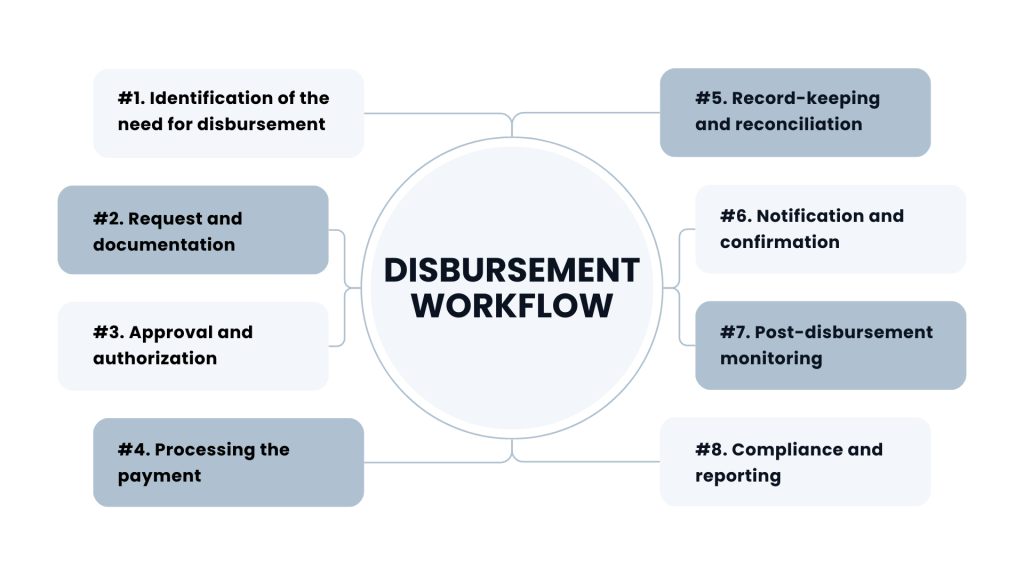
3. The Disbursement Process: How Funds Move
The journey of a dollar from a payer’s account to a receiver’s pocket is rarely instantaneous. It involves a series of checks and balances designed to ensure security, accuracy, and compliance with financial regulations.

Initiation and Authorization
Every disbursement begins with a trigger. In business, this is usually an approved invoice or a payroll run. In personal finance, it might be the signing of a loan contract. Authorization is the critical “gatekeeping” step. For large corporations, this often requires “dual authorization,” where two different executives must sign off on a payment to prevent embezzlement or accidental overpayment.
Verification and Compliance
Before money moves, the disburser must verify the recipient’s identity and the legitimacy of the debt. This includes checking for:
-
KYC (Know Your Customer): Ensuring the recipient isn’t on a sanctions list.
-
Tax Documentation: Confirming that a W-9 or similar form is on file for contractors.
-
Matching: The “three-way match” in accounting involves comparing the purchase order, the receiving report, and the vendor’s invoice to ensure everything aligns before the disbursement is made.
Execution Methods: ACH, Wire, and Check
The “how” of disbursement affects the “when.”
-
ACH (Automated Clearing House): The most common method for payroll and routine bills. It is cost-effective but can take 1–3 business days to clear.
-
Wire Transfers: Used for high-value or urgent transactions (like a house down payment). It is nearly instantaneous but carries higher fees.
-
Digital Wallets and Instant Payments: Emerging technologies now allow for real-time disbursements, which is becoming the standard for gig-economy workers (e.g., Uber or DoorDash drivers).
-
Physical Checks: Still used in some industries, though declining due to the “float” time and higher risk of fraud.
4. Optimizing Disbursement Strategies for Growth
In the niche of money and business finance, timing is everything. How a company or individual manages their disbursements can be the difference between a healthy balance sheet and a liquidity crisis.
Cash Flow Management and “The Float”
Strategic disbursement involves managing “the float”—the time between when a payment is initiated and when the money actually leaves the account. By timing disbursements to occur as late as possible without incurring late fees, a business can keep its cash in interest-bearing accounts longer. This is known as “maximizing the cash conversion cycle.”
Reducing Transaction Costs
Every disbursement has a cost. Physical checks involve paper, ink, postage, and manual labor. Wire transfers involve bank fees. By migrating to integrated electronic disbursement systems, businesses can save thousands of dollars annually. Automation also reduces the risk of human error, which can lead to costly “duplicate disbursements.”
Leveraging Automation for Accuracy
Modern financial tools allow for “scheduled disbursements.” For an individual, this might look like automated bill pay, which ensures a perfect payment history and a higher credit score. For a business, it involves using Enterprise Resource Planning (ERP) software to automatically trigger payments when certain conditions are met, ensuring that early-payment discounts from vendors are always captured.
5. Common Challenges and Risk Mitigation
Wherever money is moving, there is risk. Disbursement is often the primary target for financial crimes and internal errors.
Preventing Fraud and Internal Errors
Disbursement fraud is one of the most common types of white-collar crime. This can include “ghost employees” on a payroll or “shell company” invoices. To mitigate this, organizations must implement strict internal controls, such as:
-
Segregation of Duties: The person who authorizes a payment should never be the same person who executes the payment.
-
Positive Pay: A service offered by banks where the company sends a list of all checks issued. The bank will only honor checks that match the list exactly.
Navigating Regulatory Requirements
Disbursements across international borders add a layer of complexity. Different countries have different tax withholding requirements and reporting standards. Failure to properly manage the tax implications of a disbursement can lead to heavy fines from the IRS or other global tax authorities.
The Impact of Delays
For the recipient, a delayed disbursement can be catastrophic. Whether it’s a small business waiting on a client to pay an invoice or a family waiting on a mortgage disbursement to close on a home, timing matters. Professionals in the money niche must prioritize transparency, providing recipients with “tracking” or clear timelines of when funds will be available.
Conclusion
Disbursement is far more than a technical accounting term; it is the physical realization of financial obligations and goals. For the individual, understanding how and when funds are disbursed—whether from a loan, an insurance settlement, or a paycheck—is essential for personal budgeting and financial security. For the business professional, mastering the disbursement cycle is a strategic lever that can improve liquidity, foster vendor trust, and protect against fraud.
In an era of rapid digital transformation, the way we disburse money is evolving. From the slow crawl of paper checks to the instantaneous pulse of blockchain-enabled payments, the core principle remains the same: the responsible, accurate, and timely distribution of capital. By paying close attention to the disbursement process, you gain better control over the most important resource in the world of finance—cash.
aViewFromTheCave is a participant in the Amazon Services LLC Associates Program, an affiliate advertising program designed to provide a means for sites to earn advertising fees by advertising and linking to Amazon.com. Amazon, the Amazon logo, AmazonSupply, and the AmazonSupply logo are trademarks of Amazon.com, Inc. or its affiliates. As an Amazon Associate we earn affiliate commissions from qualifying purchases.