
In the landscape of modern technology, particularly within software development and artificial intelligence, few concepts have undergone as dramatic a transformation as the Non-Player Character, or NPC. Traditionally defined as any character in a video game that is not controlled by a human player, the NPC has evolved from a simple, scripted obstacle into a sophisticated demonstration of computational logic and generative AI. Today, the term transcends its gaming origins, representing a frontier in how humans interact with digital environments and how autonomous agents operate within complex software ecosystems.
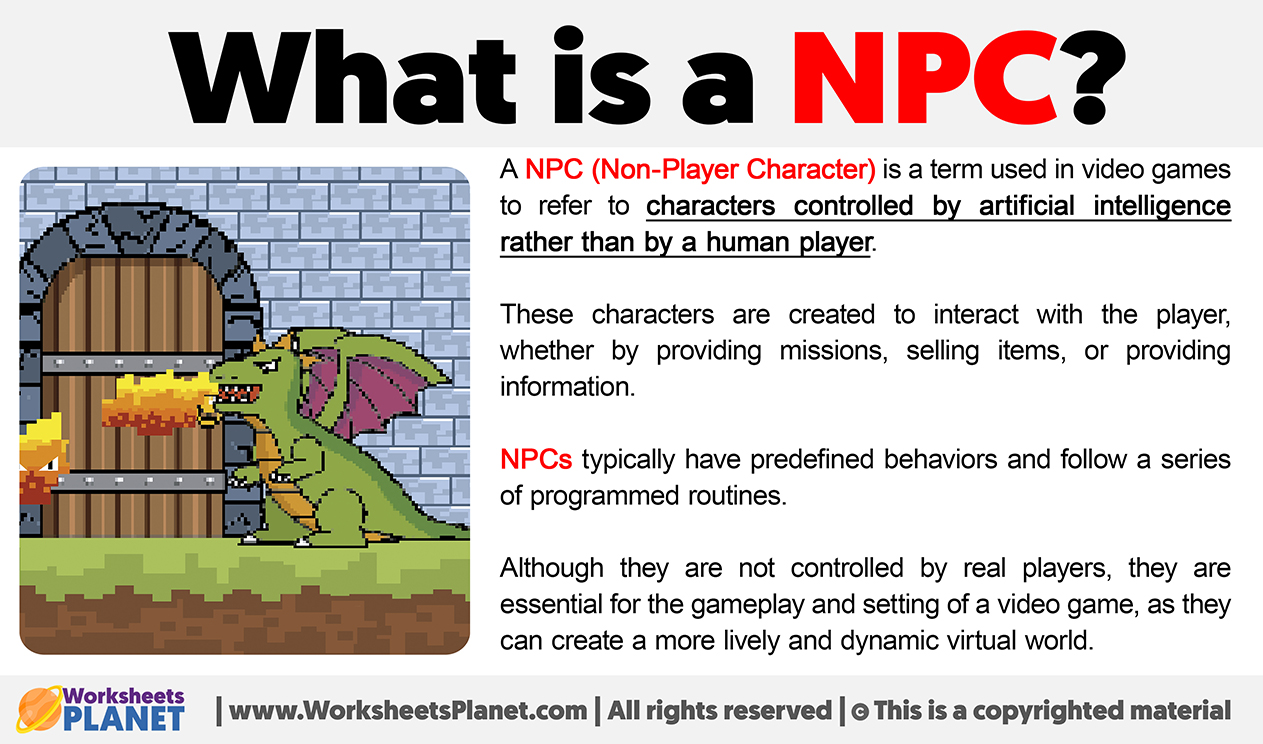
To understand what NPCs are in the current technological era, one must look beyond the “shopkeeper” or the “enemy soldier” of 1990s gaming. We are now witnessing the birth of digital entities capable of memory, reasoning, and real-time adaptation. This exploration delves into the technical architecture, the AI-driven evolution, and the future implications of NPCs as they move from static scripts to dynamic, intelligent agents.
The Technical Foundation: From Static Scripts to Complex Logic
At its core, an NPC is a software construct designed to perform specific functions within a digital simulation. In the early days of computing, these functions were governed by “hard-coded” scripts—linear sets of instructions that dictated every movement and line of dialogue. While effective for simple tasks, these early iterations lacked the flexibility required for immersive environments.
The Role of Finite State Machines (FSM)
For decades, the standard for NPC behavior was the Finite State Machine (FSM). This is a mathematical model of computation that allows an NPC to exist in one of a limited number of “states” at any given time. For example, a guard NPC might have three states: Idle, Patrol, and Attack. Logic gates determine when the NPC transitions from one state to another (e.g., “If player is within 10 meters, switch from Patrol to Attack”). While FSMs provide a reliable framework, they are inherently predictable, making the NPC feel robotic and limited.
Behavior Trees and Hierarchical Task Networks
As game worlds grew in complexity, developers shifted toward Behavior Trees (BT) and Hierarchical Task Networks (HTN). Behavior Trees allow for more modular and scalable AI. Instead of a linear state change, a BT evaluates a series of conditions and tasks in a branching structure, allowing NPCs to make more nuanced decisions. For instance, an NPC might “decide” to find cover, check its ammunition, and then return fire, rather than simply standing and shooting. This architectural shift marked the beginning of “emergent behavior,” where the interaction of various sub-routines produces results that the programmer may not have explicitly scripted.
The AI Revolution: Generative Models and Dynamic Dialogue
The most significant leap in NPC technology has occurred within the last five years, driven by the explosion of Large Language Models (LLMs) and Generative AI. We are moving away from the “dialogue tree”—where players select from pre-written responses—toward open-ended, natural language processing.
Integrating Large Language Models (LLMs)
By integrating LLMs like GPT-4 or Claude into the NPC backend, developers can create characters that understand and respond to voice or text input in real-time. These NPCs are no longer limited to a script; they have a “brain” that can synthesize information from the game’s lore and react to the player’s unique actions. This requires a complex tech stack involving real-time Speech-to-Text (STT), an LLM processing layer, and Text-to-Speech (TTS) with emotive inflection. The technical challenge here is latency—ensuring the NPC responds fast enough to maintain the “flow” of the experience.
Procedural Personality and Contextual Memory
Modern AI tools allow NPCs to possess “Long-Term Memory.” Using vector databases, an NPC can store information about past interactions with a player. If a player was rude to an NPC in a previous encounter, the NPC can retrieve that data and alter its tone or refuse to provide assistance later. This level of persistence is achieved through Retrieval-Augmented Generation (RAG), a technique that allows the AI to query a specific knowledge base (the game’s history) before generating a response. This transforms the NPC from a disposable asset into a persistent inhabitant of the digital world.
Navigation and Spatial Awareness: The Physics of NPCs

An NPC’s intelligence is not solely defined by its ability to speak; it is also defined by how it navigates a 3D space. This requires a deep integration of physics engines and pathfinding algorithms.
Pathfinding and Navigation Meshes (NavMesh)
The industry standard for NPC movement is the A* (A-Star) search algorithm, which calculates the most efficient path between two points. To facilitate this, developers use a “Navigation Mesh”—an invisible overlay on the game world that tells the NPC which surfaces are walkable. Advanced NPCs now utilize “Dynamic NavMeshes,” which update in real-time. If a player blows up a bridge, the NPC’s software immediately recognizes that the path is no longer viable and recalculates a new route, demonstrating a level of spatial awareness that mimics human logic.
Animation Rigging and Procedural Movement
To prevent NPCs from looking like sliding statues, developers employ “Inverse Kinematics” (IK) and procedural animation. Instead of playing a fixed “walking” animation, the NPC’s skeleton reacts to the terrain. If an NPC walks on a slope, the software automatically adjusts the angle of the feet and the bend of the knees. This level of technical fidelity is crucial for overcoming the “Uncanny Valley,” the point at which a digital entity looks almost, but not quite, human, causing a sense of unease in the observer.
Beyond Gaming: NPCs in the Enterprise and the Metaverse
While the term NPC originated in gaming, the underlying technology is being rapidly adopted by the broader tech industry. The “NPC” is essentially becoming the “Autonomous Agent” of the professional world.
Digital Twins and Simulation
In industries like urban planning and logistics, NPCs are used within “Digital Twins”—virtual replicas of physical systems. For example, a city planner might populate a digital twin of a subway station with thousands of NPCs to simulate how a crowd would evacuate during an emergency. These NPCs are programmed with “Swarm Intelligence” to model realistic human bottlenecks and flow patterns. Here, the NPC is a tool for data analysis and risk management.
AI Avatars and Virtual Assistants
In the realm of digital security and customer service, the NPC has evolved into the “AI Avatar.” Companies are deploying high-fidelity, autonomous characters to act as the first point of contact for users. Unlike basic chatbots, these entities use the same skeletal animation and generative AI found in top-tier gaming. They can recognize facial expressions via a user’s webcam and adjust their response accordingly, representing a shift toward “Affective Computing,” where software can identify and respond to human emotion.
The Future of Autonomous Digital Entities
As we look toward the future, the boundary between a “non-player character” and a “digital person” continues to blur. The next frontier in NPC technology involves a shift from reactive agents to proactive ones.
The Turing Test in Digital Environments
We are approaching a point where NPCs can pass a localized Turing Test—where a human cannot distinguish if the entity they are interacting with is controlled by another human or an algorithm. This has profound implications for the “Metaverse” and social digital spaces. If an environment is populated by thousands of convincing NPCs, the social fabric of that space changes, offering companionship, education, or even complex adversarial challenges that feel truly human.

Ethical Considerations in NPC Autonomy
As NPCs become more lifelike, the tech community must grapple with the ethics of AI behavior. How do we program “morality” into an autonomous agent? If an NPC is designed to learn from its environment, how do developers prevent it from adopting biased or harmful behaviors? The development of “Guardrail Systems” is now a critical part of the NPC software lifecycle, ensuring that while the characters feel autonomous, they remain within the bounds of safe and intended interaction.
In conclusion, “NPCs” are no longer just background characters; they are a sophisticated synthesis of pathfinding logic, behavioral psychology, and generative artificial intelligence. As hardware capabilities grow and AI models become more efficient, the NPC will continue to evolve, moving from the fringes of our screens to the center of our digital lives, redefining the very nature of human-computer interaction.
aViewFromTheCave is a participant in the Amazon Services LLC Associates Program, an affiliate advertising program designed to provide a means for sites to earn advertising fees by advertising and linking to Amazon.com. Amazon, the Amazon logo, AmazonSupply, and the AmazonSupply logo are trademarks of Amazon.com, Inc. or its affiliates. As an Amazon Associate we earn affiliate commissions from qualifying purchases.