
For decades, the question of what causes Autism Spectrum Disorder (ASD) has been one of the most complex puzzles in both medicine and science. Historically, the search for answers was limited by the manual processing of clinical observations and fragmented genetic studies. However, we have entered a new era where the intersection of biotechnology, artificial intelligence, and big data is fundamentally reshaping our understanding of neurodevelopment. By leveraging high-performance computing and sophisticated algorithms, researchers are moving beyond general theories toward a precise, data-driven map of the biological and environmental factors that contribute to autism.

The Genomic Revolution: High-Throughput Sequencing and Genetic Mapping
At the core of modern autism research is the explosion of genomic technology. While it has long been understood that genetics play a significant role in ASD, the sheer complexity of the human genome meant that identifying specific “driver” genes was like searching for a needle in a haystack. Today, technology has turned that haystack into a searchable database.
Next-Generation Sequencing (NGS) and the Search for Biomarkers
Next-Generation Sequencing (NGS) has revolutionized the speed and cost-effectiveness of DNA analysis. Unlike older methods that could only look at one gene at a time, NGS allows researchers to sequence entire exomes—the protein-coding regions of the genome—or even the entire genome in a single run. This technological leap has allowed scientists to identify “de novo” mutations (new mutations not inherited from parents) that are frequently associated with autism. By using software to compare the genomes of thousands of individuals, tech-enabled labs are identifying specific biomarkers that indicate a predisposition to the spectrum, providing the first concrete “why” for many families.
The Role of Big Data in Mapping Rare Genetic Variants
The challenge with autism is that it is polygenic, meaning it involves hundreds, if not thousands, of small genetic variations. Traditional statistical methods often lack the power to connect these dots. Enter Big Data analytics. Cloud-based platforms now aggregate genomic data from hundreds of thousands of participants worldwide. Using distributed computing, researchers can perform Genome-Wide Association Studies (GWAS) at a scale previously unimaginable. These platforms analyze trillions of data points to identify patterns of rare variants that, when combined, cross a threshold to influence neurological development.
Artificial Intelligence and Machine Learning in Neurological Analysis
If genomics provides the “blueprint,” then neuroimaging and behavioral analysis provide the “construction report.” Artificial Intelligence (AI) and Machine Learning (ML) are now being deployed to analyze how the brain functions and develops in real-time, offering insights into the structural causes of autism that the human eye might miss.
Predictive Modeling for Early Diagnosis
Machine learning models are increasingly adept at processing early-childhood data to predict the onset of autism before clinical symptoms become obvious. By training algorithms on “normal” versus “atypical” developmental trajectories, AI can analyze eye-tracking data, motor patterns, and even vocal frequencies. These predictive models are vital because they suggest that the “cause” of autism is often rooted in the timing of specific neurological pruning processes during infancy. Tech-driven screening tools allow for earlier intervention, which is currently the most effective way to manage the developmental outcomes of the condition.
Using Deep Learning to Analyze Brain Connectivity Patterns
Functional MRI (fMRI) and Diffusion Tensor Imaging (DTI) generate massive amounts of visual and spatial data regarding brain connectivity. Deep learning—a subset of AI—is uniquely suited to process these complex images. Recent tech-led studies have used Convolutional Neural Networks (CNNs) to identify “hyper-connectivity” or “hypo-connectivity” in specific brain regions, such as the amygdala or the prefrontal cortex. These digital insights suggest that autism may be caused by specific “wiring” differences in how neurons communicate across long distances in the brain. By quantifying these differences through software, we are moving closer to a digital signature for ASD.
Digital Phenotyping and the Impact of Wearable Tech
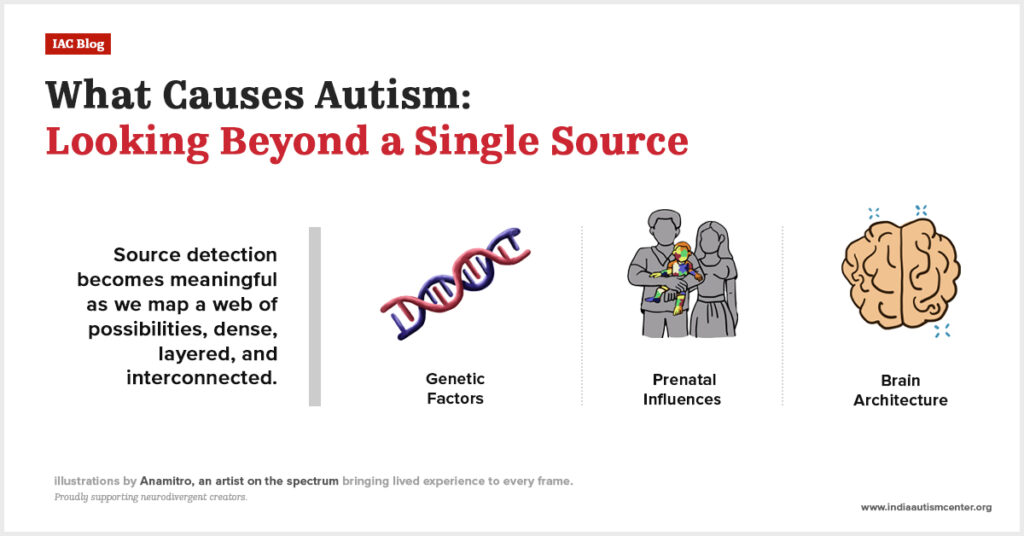
Understanding what causes autism also requires looking at the interaction between a person’s biology and their environment. This is where the concept of “Digital Phenotyping” comes into play—using data from digital devices to build a profile of a person’s health and behavior.
IoT Devices and Behavioral Data Acquisition
The Internet of Things (IoT) has introduced a range of wearable sensors that can track physiological markers such as heart rate variability, skin conductance, and sleep patterns. For individuals on the spectrum, these devices provide a continuous stream of data that helps researchers understand how sensory processing sensitivities (a hallmark of autism) are triggered by environmental factors. By analyzing this data, tech companies are helping to identify whether certain environmental stressors act as catalysts for the expression of autistic traits in genetically predisposed individuals.
Quantifying Environmental Triggers through Smart Sensors
There is significant interest in the “environmental” component of autism—factors such as prenatal exposure to certain chemicals or air quality. Modern environmental sensors, paired with GPS data and longitudinal health records, allow for high-resolution spatial mapping. Data scientists use this information to look for correlations between geographic clusters of autism and specific environmental variables. This tech-heavy approach allows for a level of granular analysis that was impossible with paper-based epidemiological surveys, potentially uncovering external triggers that contribute to the development of the condition.
The Future of Neuro-Tech: Toward Personalized Support and Ethical Integration
As we utilize technology to uncover the causes of autism, the focus is shifting from a generic understanding to a personalized one. The future of this niche lies in how we manage the massive amounts of sensitive data being generated and how we use it to improve lives.
Ethical Considerations in AI-Driven Genetic Research
With the power of genomic sequencing and AI comes a significant responsibility regarding data security and ethics. As we identify the genetic markers that cause autism, the tech industry faces a reckoning over privacy. Who owns this genetic data? How do we ensure that predictive algorithms are not used for discriminatory purposes by insurance companies or employers? The development of “Ethical AI” frameworks and secure, blockchain-based medical ledgers is becoming a critical sub-sector of the tech industry, ensuring that the search for causes does not compromise the rights of the neurodivergent community.
The Shift from “Cure” to “Support” via Assistive Technology
Perhaps the most profound impact of technology on the discourse of “what causes autism” is the shift in perspective it has enabled. As AI and data science reveal the immense complexity and diversity of the human brain, the tech world is increasingly viewing autism through the lens of neurodiversity rather than as a “problem” to be “fixed.”
The industry is moving toward creating assistive technologies—such as AI-driven communication apps and VR-based social training platforms—that accommodate the unique neurological causes of the spectrum. By understanding the technological “why” behind the condition, developers can create tools that play to the strengths of the autistic brain, such as high-pattern recognition and logical processing.

Conclusion: A Data-Driven Path Forward
The question of “what causes autism” is no longer a purely medical inquiry; it is a technological one. Through the power of Next-Generation Sequencing, the analytical depth of Machine Learning, and the real-world insights provided by IoT and digital phenotyping, we are finally beginning to see the full picture.
While we have not yet found a single, solitary cause—largely because autism is a spectrum of many different biological realities—technology has provided us with the tools to map its vast landscape. As these tools continue to evolve, they will not only help us understand the origins of neurodiversity but also empower us to build a more inclusive world where technology bridges the gap between different ways of thinking. The synergy between human insight and machine intelligence is, and will remain, the most powerful weapon in our quest to decode the mysteries of the human mind.
aViewFromTheCave is a participant in the Amazon Services LLC Associates Program, an affiliate advertising program designed to provide a means for sites to earn advertising fees by advertising and linking to Amazon.com. Amazon, the Amazon logo, AmazonSupply, and the AmazonSupply logo are trademarks of Amazon.com, Inc. or its affiliates. As an Amazon Associate we earn affiliate commissions from qualifying purchases.