
For centuries, the Northern Lights—or Aurora Borealis—were viewed as mystical omens, celestial spirits, or unexplained natural wonders. However, in the 21st century, our understanding of this phenomenon has shifted from the mythological to the technological. Today, the quest to see the lights is as much about data analytics and sensor technology as it is about travel. Understanding “what” and “where” the Northern Lights are now requires a deep dive into solar physics, geospatial software, and the cutting-edge hardware that allows us to capture the invisible.

The Quantum Mechanics of the Sky: Understanding the “What” Through Solar Physics
To understand what the Northern Lights are, we must look at the sun not just as a light source, but as a massive, turbulent nuclear reactor emitting constant streams of data and energy. The Aurora Borealis is the visual manifestation of a complex interaction between the solar wind and Earth’s magnetic field—a process that scientists now track with the same precision used in financial market forecasting.
Solar Wind and the Magnetospheric Data Stream
The “what” of the Northern Lights begins with the solar wind—a stream of charged particles (protons and electrons) ejected from the sun’s corona. When these particles reach Earth, they interact with our magnetosphere. Technology such as the Deep Space Climate Observatory (DSCOVR) satellite acts as an early-warning system, measuring the velocity and density of this solar wind before it hits our atmosphere. From a technical perspective, the aurora is a giant plasma physics experiment occurring in the upper atmosphere, where kinetic energy is converted into light energy via ionization.
The Atmospheric Light-Emitting Diode (LED)
At a height of 60 to over 200 miles, these solar particles collide with atmospheric gases like oxygen and nitrogen. This process is remarkably similar to how a neon sign or a modern LED works. When an electron from the sun hits an oxygen atom, the atom becomes “excited.” As it returns to its ground state, it releases a photon.
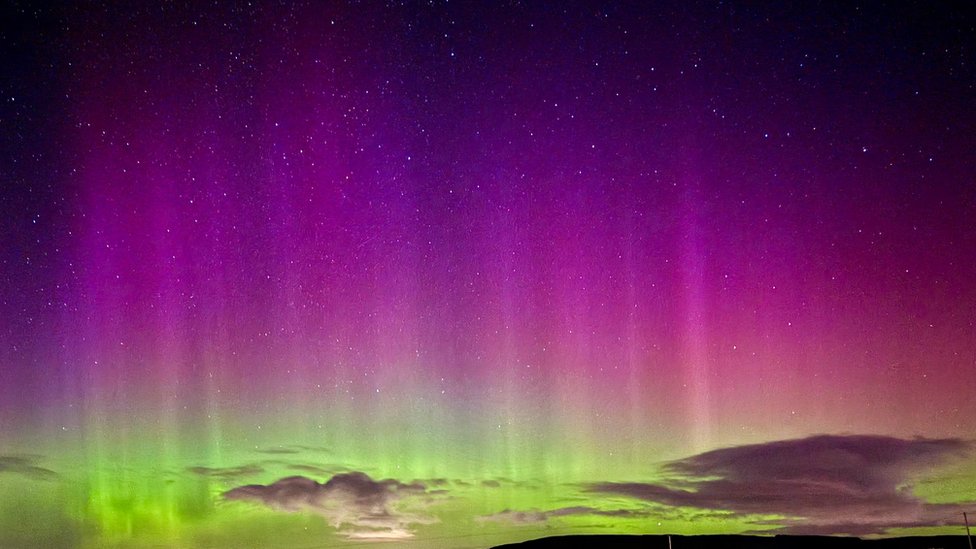
The color of the light depends on the altitude and the gas involved. Green, the most common color, is produced by oxygen at lower altitudes (around 60 miles), while rare red auroras are produced by oxygen at much higher altitudes (200 miles). Nitrogen produces blue or purplish-red hues. For the tech-savvy observer, this is a lesson in spectral analysis and atomic excitation, tracked by spectrometers that break down the light to understand the chemical composition of our outer atmosphere.
Digital Cartography: Locating the Aurora with Geospatial Software
Answering “where” the Northern Lights are has traditionally been a matter of luck and latitude. However, the rise of “Aurora Tech” has transformed the chase into a calculated, data-driven pursuit. We no longer just look up; we look at our screens to predict exactly where the auroral oval will descend.
The KP Index and Predictive Algorithms
The primary metric used to locate the lights is the Kp-index, a scale from 0 to 9 that measures geomagnetic activity. Modern apps and websites, such as the Space Weather Prediction Center (SWPC) operated by NOAA, utilize complex algorithms to provide real-time updates. These tools integrate data from ground-based magnetometers around the world to visualize the “Auroral Oval”—the ring-shaped region around the magnetic poles where the lights are most likely to appear. For enthusiasts, “where” the lights are is now a live-updating heatmap on a smartphone.
The Geofencing of the Auroral Zone
Geographically, the “where” remains focused on the high-latitude regions—the Arctic Circle. This includes Alaska, Northern Canada, Iceland, Norway, Sweden, and Finland. However, tech-driven travel planning has refined these locations into “hotspots” backed by connectivity. Digital nomads and tech-tourists now flock to locations like Tromsø, Norway, or Fairbanks, Alaska, not just for the view, but because these hubs offer the high-speed fiber-optic infrastructure necessary to livestream the event to global audiences. The intersection of remote geography and digital accessibility has redefined the modern exploration of the north.
Capturing the Invisible: Advancements in Low-Light Imaging and AI
Perhaps the most significant technological leap in the “Northern Lights” experience is how we record them. The human eye often perceives the aurora as a faint, milky cloud; it is the sensor technology in modern cameras and smartphones that reveals the vibrant greens and purples that we see in media.
The Evolution of CMOS Sensors and ISO Sensitivity
The “what” of the Northern Lights is often better understood through a lens than the naked eye. The development of Back-Illuminated (BSI) CMOS sensors has revolutionized low-light photography. Cameras like the Sony Alpha series or the Nikon Z9 possess the dynamic range and ISO sensitivity required to capture photons in near-total darkness without overwhelming the image with digital noise. This hardware allows us to see the “flicker” of the aurora—rapid movements that occur at a frequency often too fast for the human brain to process in low light.
Computational Photography and AI Post-Processing
In the palm of our hands, the iPhone and Google Pixel use computational photography to make the Northern Lights accessible to everyone. Through “Night Mode” or “Astrophotography” settings, these devices use AI to align multiple short exposures, subtract “hot pixels” (sensor noise), and enhance the natural luminescence of the aurora. We are now in an era where artificial intelligence interprets the data captured by a tiny mobile lens to reconstruct a celestial event, making the “where” of the lights less about professional gear and more about having the right software in your pocket.
The Future of Aurora Tech: From Citizen Science to VR
As we move forward, the relationship between technology and the Northern Lights is becoming more collaborative. We are moving beyond mere observation into active data contribution and immersive virtual experiences.
Crowdsourced Data and Citizen Science Apps
Apps like “Aurora Reach” and “Hello Aurora” allow users to report sightings in real-time. This creates a crowdsourced data network that supplements satellite information. When a user in rural Iceland hits “confirm” on a sighting, that data point is instantly fed into an API that alerts thousands of other users. This democratization of data has turned the global community of aurora hunters into a massive, distributed sensor array, refining our understanding of exactly “where” the lights are at any given second.
The Rise of Virtual Reality (VR) Auroras
For those who cannot travel to the Arctic, technology is bringing the Northern Lights to them. High-resolution 360-degree cameras and 8K drone footage are being used to create immersive VR experiences. Through platforms like the Meta Quest, users can experience a “Digital Aurora” that is indistinguishable from the real thing. This use of VR not only serves as entertainment but as a tool for researchers to study auroral structures in a controlled, three-dimensional environment. It answers the “what” and “where” by removing the physical barriers of geography altogether.

Conclusion: The Synergy of Nature and Technology
The Northern Lights remain one of the most breathtaking sights on Earth, but our relationship with them has been fundamentally transformed by technology. We no longer wonder “what” they are in a state of fear; we analyze them as solar data and atmospheric chemistry. We no longer guess “where” they might appear; we track them via satellite telemetry and real-time mobile alerts.
By leveraging advancements in space weather forecasting, low-light sensor hardware, and AI-driven software, we have turned a fleeting natural phenomenon into a measurable, shareable, and deeply understood digital asset. Whether you are a photographer pushing the limits of a CMOS sensor or a casual observer using a Kp-index app, the Northern Lights represent the perfect intersection of the ancient natural world and the cutting edge of modern technology. As we enter a period of increased solar activity (the Solar Maximum), the technology we use to find and capture these lights will only become more vital, ensuring that the wonder of the Aurora Borealis is never more than a click away.
aViewFromTheCave is a participant in the Amazon Services LLC Associates Program, an affiliate advertising program designed to provide a means for sites to earn advertising fees by advertising and linking to Amazon.com. Amazon, the Amazon logo, AmazonSupply, and the AmazonSupply logo are trademarks of Amazon.com, Inc. or its affiliates. As an Amazon Associate we earn affiliate commissions from qualifying purchases.