
In the world of finance, certain numbers carry more weight than others. While a percentage is mathematically a simple ratio, in the context of personal finance, business management, and wealth building, the “percentage of 30” represents several of the most significant benchmarks an individual or organization can track. Whether it pertains to the percentage of your income dedicated to housing, the ceiling for your credit utilization, or the ideal allocation for discretionary spending, the number 30 serves as a recurring threshold for financial health.
Understanding the implications of 30% across various financial disciplines allows for a more structured approach to money management. It is not merely a static figure; it is a guidepost used by lenders, tax authorities, and financial planners to measure stability and risk. By dissecting what the “percentage of 30” means in different contexts, we can build a comprehensive framework for long-term fiscal success.
The 50/30/20 Rule: Defining Discretionary Spending
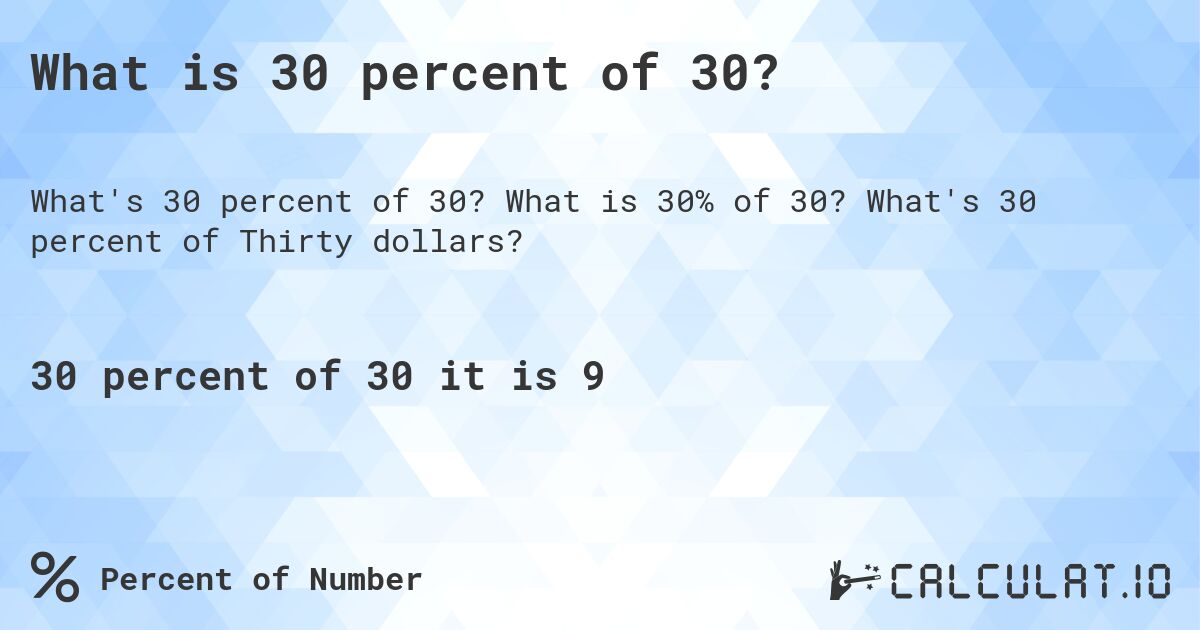
One of the most popular frameworks in modern personal finance is the 50/30/20 rule. Popularized by Senator Elizabeth Warren in her book All Your Worth, this budgeting method simplifies complex financial planning into three digestible categories. In this model, the 30% represents the portion of your after-tax income that should be allocated to “wants” or discretionary spending.
Defining “Wants” vs. “Needs”
The “percentage of 30” in a budget covers the non-essential expenses that improve quality of life but are not strictly necessary for survival. This includes dining out, hobby-related expenses, streaming subscriptions, travel, and luxury purchases. While it may seem indulgent, formalizing this 30% allocation is crucial for mental sustainability. Without a dedicated space for lifestyle enjoyment, most people find it difficult to stick to a strict financial plan over the long term.
Why 30% is the Sweet Spot for Sustainability
Allocating exactly 30% allows for a balanced life. If this percentage creeps higher, it typically eats into the 20% reserved for savings and debt repayment, or the 50% reserved for essential needs. Conversely, if it is too low, the risk of “frugality fatigue” increases. Maintaining this 30% threshold requires disciplined tracking and the ability to distinguish between a “need” (like basic groceries) and a “want” (like an expensive restaurant meal).
Credit Utilization: The 30 Percent Rule for Your Credit Score
Beyond budgeting, the “percentage of 30” is perhaps most famous in the realm of credit scoring. Credit utilization—the amount of revolving credit you are using divided by the total amount of credit available to you—is the second most important factor in calculating a FICO score, accounting for roughly 30% of the total calculation.
How Lenders View Your Balance-to-Limit Ratio
Lenders use credit utilization as a proxy for financial risk. If you have a total credit limit of $10,000 across all your cards and your current balance is $3,000, your utilization is exactly 30%. In the eyes of credit bureaus, exceeding this 30% threshold signals that you may be overextended or relying too heavily on credit to fund your lifestyle. Once utilization passes the 30% mark, credit scores typically begin to decline, sometimes significantly.
Strategies to Lower Utilization Under 30%
To optimize a financial profile, it is often recommended to stay well below 30%, with many experts suggesting 10% as the “gold standard.” However, 30% remains the hard ceiling for maintaining a “good” to “excellent” rating. Strategies to manage this include making multiple payments throughout the month to keep reported balances low, requesting credit limit increases without increasing spending, and strategically spreading expenses across multiple lines of credit to ensure no single card exceeds the 30% mark.
The 30 Percent Tax Threshold: Understanding Brackets and Withholding
In the landscape of income and business finance, 30% is frequently cited as a safe harbor for tax planning. While tax brackets vary by jurisdiction and income level, the “percentage of 30” is a critical rule of thumb for freelancers, small business owners, and high-earning professionals.
Self-Employment Tax and Set-Asides
For those who are self-employed or participating in the “gig economy,” there is no employer to withhold taxes from a paycheck. This places the burden of tax compliance entirely on the individual. Financial advisors almost universally recommend that self-employed individuals set aside 30% of every dollar earned into a separate high-yield savings account. This 30% generally covers federal income tax, state income tax, and the self-employment tax (which covers Social Security and Medicare). By treating 30% of gross income as “already gone,” business owners avoid the common pitfall of a massive, unaffordable tax bill at the end of the fiscal year.
Capital Gains and Corporate Tax Considerations
In the world of investing, 30% also appears in discussions regarding capital gains in certain jurisdictions or for specific asset classes. Furthermore, looking at corporate history, many statutory tax rates have hovered around the 30% mark globally. For an investor, calculating the “percentage of 30” on a profit is a quick way to estimate net take-home pay after the government takes its share. Understanding this helps in calculating the true Return on Investment (ROI) of a trade or business venture.
Housing and Debt-to-Income: The 30 Percent Standard
For decades, the standard benchmark for housing affordability has been the 30% rule. This guideline suggests that an individual or household should spend no more than 30% of their gross monthly income on housing costs, including rent or mortgage payments, property taxes, and insurance.
Is the 30% Rule for Rent Still Realistic?
In the current economic climate, characterized by rising property values and stagnant wages in some sectors, many find it challenging to stick to the 30% housing rule. However, it remains a vital metric for financial health. When housing costs exceed 30%, a household is considered “house burdened.” This leaves less capital for healthcare, education, and retirement. Even if the market makes it difficult to achieve, the 30% figure serves as a diagnostic tool to identify when a lifestyle change or a move to a more affordable area may be necessary.
Front-End vs. Back-End Ratios in Mortgage Lending
When applying for a mortgage, lenders look at two specific ratios. The “front-end ratio” typically focuses on housing costs alone, where 28% to 30% is the preferred limit. The “back-end ratio” looks at all debt obligations (including car loans and student debt), where 36% to 43% is often the maximum. Being aware that your housing cost should ideally be a “percentage of 30” relative to your income is the first step in preparing for a successful mortgage application.
Strategic Investment Allocation: The Role of 30 Percent in Diversification
In the context of wealth management and portfolio construction, the number 30 often defines the boundaries of specific asset classes. Diversification is the only “free lunch” in finance, and 30% is a common weighting for various sectors within a balanced portfolio.
Balancing High-Risk and Low-Risk Assets
A classic aggressive-growth portfolio might see an investor placing 30% of their capital into international stocks or emerging markets, while keeping the remaining 70% in domestic equities. Alternatively, a conservative investor nearing retirement might hold 30% of their portfolio in cash and short-term bonds to provide a liquid buffer against market volatility. In these scenarios, the 30% allocation acts as a stabilizer—large enough to provide meaningful returns or protection, but small enough to prevent a single sector’s downturn from liquidating the entire portfolio.
The 30% Rule in Business Capitalization
For entrepreneurs, 30% is often a target for gross profit margins or equity retention during early funding rounds. A business that can consistently maintain a 30% net profit margin is generally considered highly efficient and attractive to investors. Similarly, when a founder is looking to scale, giving away more than 30% of equity in a single round is often cautioned against, as it can lead to a premature loss of control.
Conclusion: The Power of 30 as a Financial Compass
The “percentage of 30” is not a random occurrence in finance; it is a recurring theme because it represents a point of equilibrium. Whether it is the balance between enjoying today (discretionary spending) and securing tomorrow (savings), the balance between using credit and maintaining a score, or the balance between income and the cost of shelter, 30% serves as a primary indicator of stability.
By internalizing these benchmarks, you can move away from reactive financial habits and toward a proactive strategy. If you can keep your credit utilization under 30%, your housing costs around 30%, and your tax set-asides at 30%, you are not just following rules of thumb—you are building a fortress of financial security that can withstand economic fluctuations. In the end, understanding the percentage of 30 is about more than just math; it is about mastering the ratios that define a successful financial life.
aViewFromTheCave is a participant in the Amazon Services LLC Associates Program, an affiliate advertising program designed to provide a means for sites to earn advertising fees by advertising and linking to Amazon.com. Amazon, the Amazon logo, AmazonSupply, and the AmazonSupply logo are trademarks of Amazon.com, Inc. or its affiliates. As an Amazon Associate we earn affiliate commissions from qualifying purchases.