
In the intricate world of finance, few concepts hold as much power and pervasive influence as compound interest. Often dubbed the “eighth wonder of the world” by Albert Einstein, its implications stretch across every facet of our financial lives, from the humble savings account to complex investment portfolios and the very structure of our debts. Among its various forms, “compounded annually” stands out as a fundamental and widely encountered method of calculating and applying interest. Understanding what this specific term means is not just an academic exercise; it’s a critical component of financial literacy that empowers individuals to make informed decisions, build wealth, and manage debt effectively.
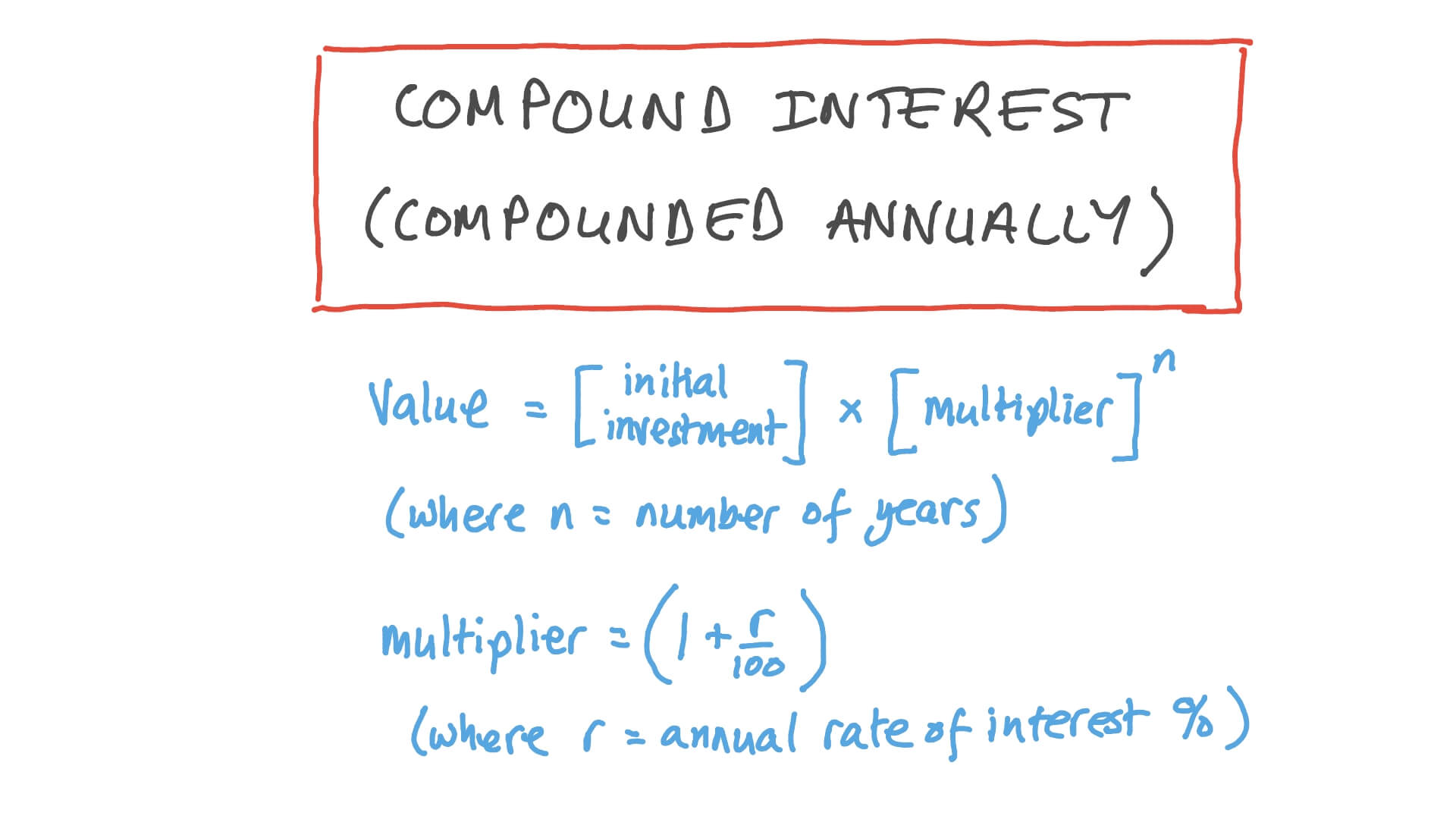
At its core, “interest compounded annually” refers to the process where the interest earned or charged on an initial principal amount is added back to that principal at the end of each year. In subsequent years, the interest is then calculated not only on the original principal but also on the accumulated interest from previous periods. This creates a snowball effect, where your money begins to earn money on money, leading to exponential growth over time. Conversely, for borrowers, it means that unpaid interest can also accumulate, increasing the total cost of a loan if not managed carefully. This article will deconstruct the meaning of annually compounded interest, explore its mechanics, and highlight its profound impact on both saving and borrowing.
The Fundamentals of Interest: Simple vs. Compound
Before diving deep into annual compounding, it’s essential to grasp the foundational distinction between simple and compound interest. This contrast illuminates why compound interest, especially when applied annually, wields such significant financial power.
Understanding Simple Interest
Simple interest is the most straightforward way to calculate interest. It is computed solely on the original principal amount of a loan or deposit. The formula is quite basic: Simple Interest = Principal × Rate × Time. For example, if you invest $1,000 at a 5% simple annual interest rate for 3 years, you would earn $50 each year ($1,000 * 0.05). Over three years, your total interest earned would be $150, and your investment would grow to $1,150. The key characteristic here is that the principal amount remains constant for interest calculation purposes throughout the duration. Simple interest is less common in modern financial products, though it might be seen in some short-term loans or specific bond structures.
Introducing Compound Interest: Interest on Interest
Compound interest, by contrast, is a game-changer. It’s the interest earned on both the initial principal and the accumulated interest from previous periods. This concept introduces a dynamic element to your money’s growth. Rather than remaining static, your principal effectively grows larger with each compounding period, leading to an accelerated rate of return. The power of compound interest lies in this “interest on interest” phenomenon. It leverages time as a critical component, transforming modest initial sums into substantial wealth over the long term. This is why financial advisors consistently stress the importance of starting to save and invest early.
Deconstructing “Compounded Annually”
While compound interest can be calculated at various frequencies—daily, monthly, quarterly, semi-annually—”compounded annually” specifies that this process occurs once every year. This timing has specific implications for how your money grows or how your debt accrues.
The Compounding Period Defined
The “compounding period” refers to the interval at which accumulated interest is added to the principal. When interest is “compounded annually,” this period is precisely one year. This means that at the end of each year, the interest accrued over that year is calculated and then merged with the existing principal. This new, larger sum then becomes the basis for calculating interest in the subsequent year. Understanding the compounding period is vital because the more frequently interest is compounded, the faster your money grows (or your debt increases), assuming the same nominal interest rate. However, for “annually,” this happens just once a year.
The Mechanics of Annual Compounding
Let’s illustrate the mechanics of annual compounding with an example. Suppose you deposit $10,000 into a savings account that offers a 5% interest rate compounded annually.
-
Year 1:
-
Initial Principal: $10,000
-
Interest Earned: $10,000 * 0.05 = $500
-
New Balance (Principal + Interest): $10,000 + $500 = $10,500
-
-
Year 2:
-
Beginning Principal (from end of Year 1): $10,500
-
Interest Earned: $10,500 * 0.05 = $525
-
New Balance: $10,500 + $525 = $11,025
-
-
Year 3:
-
Beginning Principal: $11,025
-
Interest Earned: $11,025 * 0.05 = $551.25
-
New Balance: $11,025 + $551.25 = $11,576.25
-
Notice how the interest earned increases each year ($500, then $525, then $551.25), even though the interest rate remains constant. This acceleration is the direct result of compounding annually. The previous year’s interest becomes part of the principal for the next year’s calculation. If this were simple interest, you would only earn $500 each year, resulting in a balance of $11,500 after three years, significantly less than the $11,576.25 achieved with annual compounding.
The Difference a Year Makes
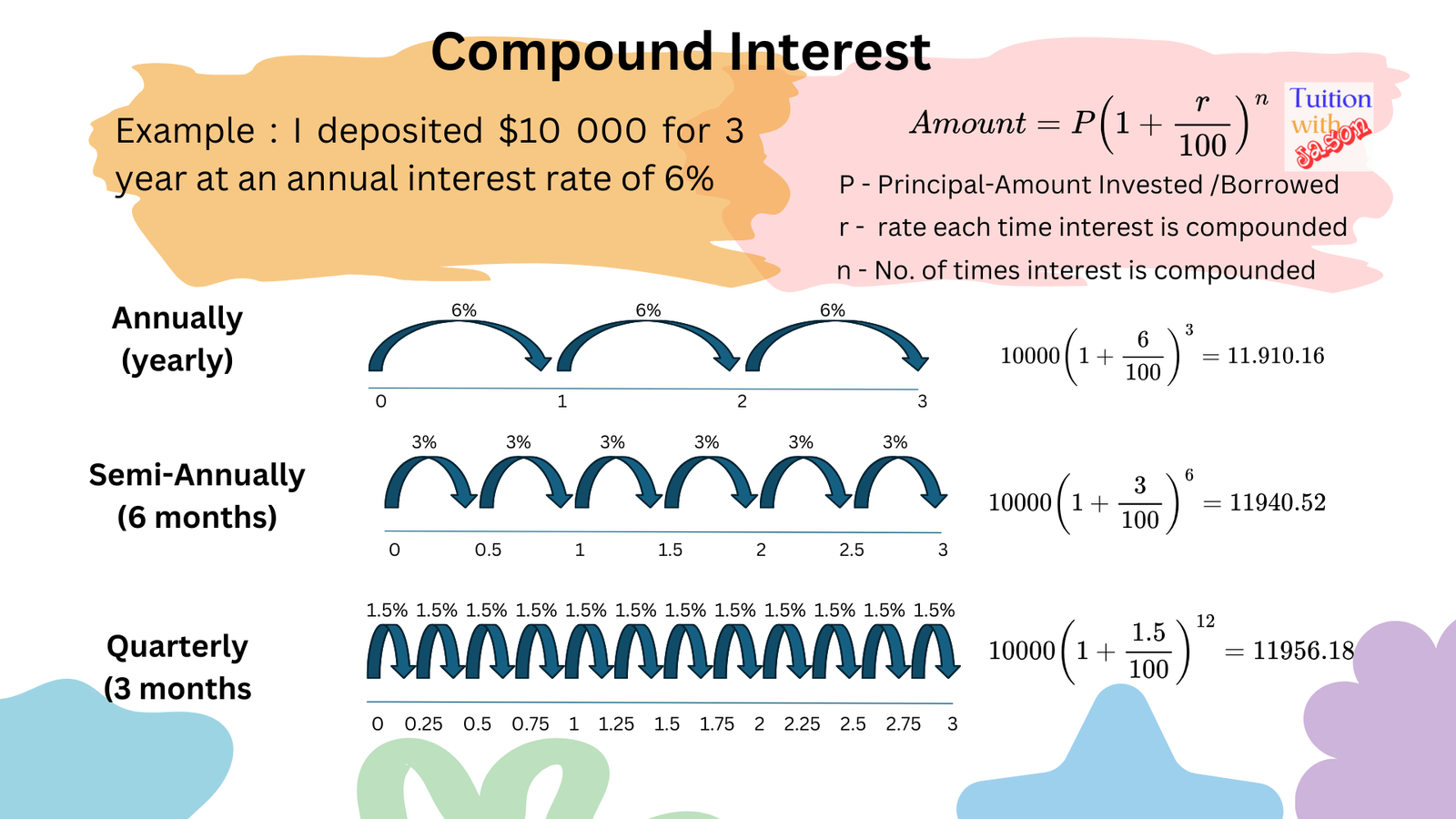
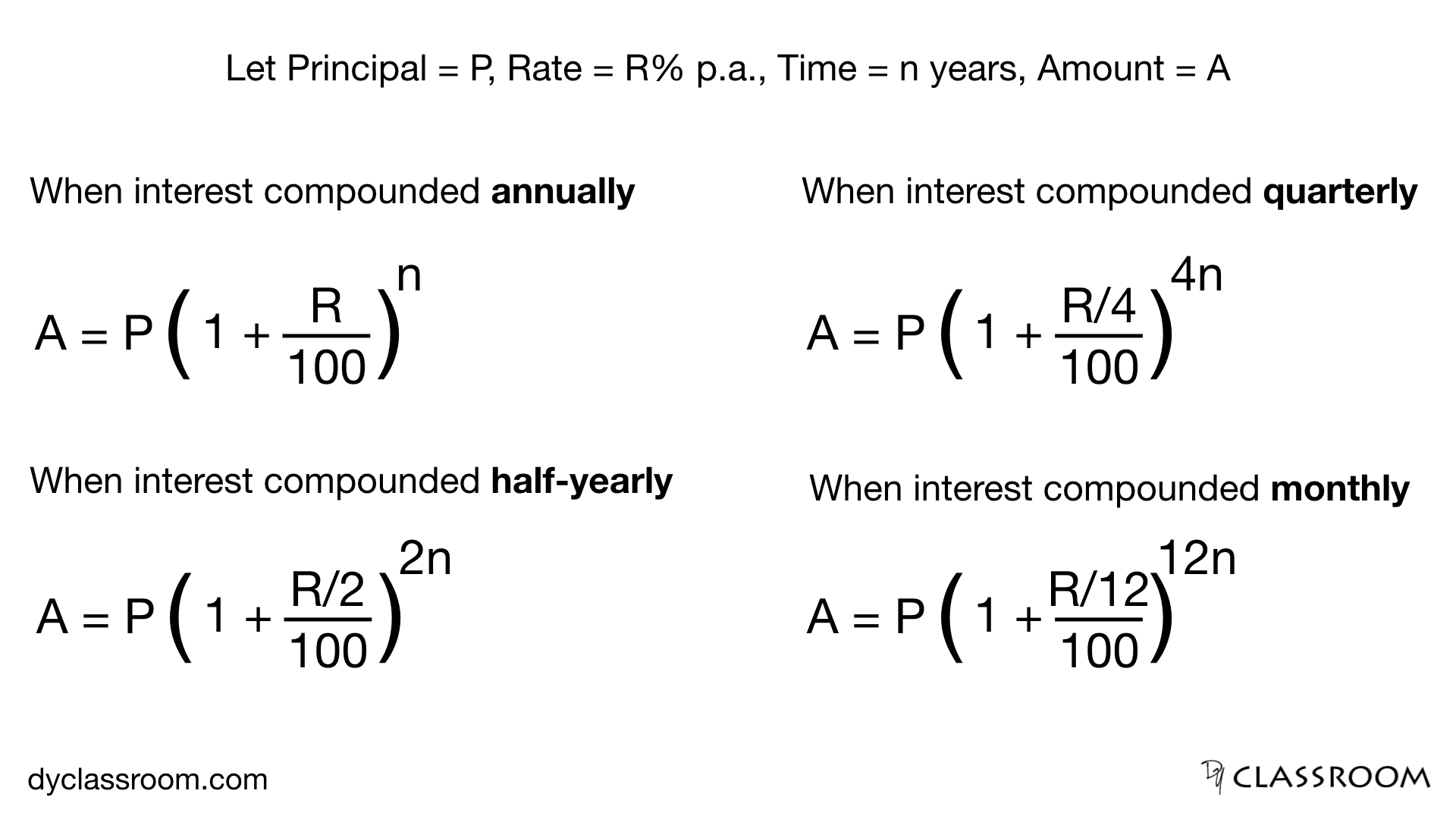
While “annually” means once a year, it’s insightful to consider what that means in comparison to other frequencies. If interest were compounded more frequently (e.g., monthly), the interest would be added to the principal 12 times a year, causing the balance to grow even faster. For instance, a 5% interest rate compounded monthly would yield a slightly higher final balance than 5% compounded annually over the same period, because the “interest on interest” effect starts sooner and happens more often. The difference might seem small in the short term, but over many years, the gap widens considerably. This highlights that while annual compounding is powerful, even more frequent compounding can further amplify returns, a concept often reflected in the Annual Percentage Yield (APY) discussed later.
The Power of Annual Compounding in Personal Finance
Understanding annually compounded interest is not merely an academic exercise; it has tangible implications across various personal financial instruments and decisions.
Savings Accounts and Certificates of Deposit (CDs)
For savers, annual compounding is generally a beneficial feature. Many traditional savings accounts, money market accounts, and Certificates of Deposit (CDs) advertise interest rates that are compounded annually. This means your deposited funds will grow more significantly over time than if simple interest were applied. When comparing different savings products, it’s crucial to look beyond just the nominal interest rate and consider the compounding frequency, as well as the Annual Percentage Yield (APY), which accounts for the effect of compounding over a year. A higher APY, even if the nominal rate is the same, indicates more frequent compounding or a higher effective rate due to annual compounding.
Loans and Mortgages: The Borrower’s Perspective
While beneficial for savers, annual compounding can be a double-edged sword for borrowers. Many loans, including certain personal loans and mortgages, accrue interest that is calculated and added to the principal on a periodic basis, often annually or even more frequently. For borrowers, understanding this means recognizing how outstanding interest can increase the principal amount of the loan if payments don’t cover both the principal and the accrued interest. This is particularly relevant for loans with deferred payments or for those where borrowers only make minimum payments, which might primarily cover interest, leading to slow principal reduction. The Annual Percentage Rate (APR) on loans is often expressed as an annual rate, but the actual cost can be influenced by how frequently interest is compounded throughout the year.
Retirement Planning and Investments
Perhaps nowhere is the power of annually compounded interest more evident and impactful than in retirement planning and long-term investments. Investment vehicles like mutual funds, exchange-traded funds (ETFs), and even individual stocks held in retirement accounts (like 401(k)s or IRAs) often generate returns that, when reinvested, benefit from compounding. When dividends or capital gains are automatically reinvested, they buy more shares, and those new shares then earn their own returns, creating a powerful compounding cycle. Over decades, the exponential growth enabled by annual (or more frequent) compounding can transform modest regular contributions into substantial retirement nest eggs, illustrating why starting early is perhaps the single most important factor in successful long-term investing.
Key Factors Influencing Annually Compounded Interest
The overall impact of annually compounded interest is not solely dependent on the fact that it happens once a year. Several other variables play a crucial role in determining the final amount.
Principal Amount
The initial sum of money deposited or borrowed, known as the principal, is foundational. A larger principal will naturally generate more interest, even at the same rate and compounding frequency. This is why starting with a solid initial investment or making significant down payments on loans can have a substantial long-term effect.
Interest Rate
The interest rate, expressed as a percentage, is perhaps the most obvious factor. A higher interest rate will lead to greater interest earnings (or costs) with each annual compounding period. Even a seemingly small difference in interest rates can translate into significant financial outcomes over many years due to compounding.
Time Horizon
Time is arguably the most powerful ally in the realm of compound interest. The longer your money has to grow, the more compounding cycles it undergoes, and the more pronounced the “interest on interest” effect becomes. This exponential growth makes time an invaluable asset for investors and a formidable foe for those carrying long-term debt. The concept of “the time value of money” is deeply intertwined with compounding.
Additional Contributions/Payments
For savings and investments, regularly adding to your principal (e.g., through monthly contributions to a retirement account) supercharges the compounding process. Each new contribution starts earning interest, and then interest on that interest, accelerating wealth accumulation. Conversely, for loans, making additional payments above the minimum required, especially early in the loan term, can significantly reduce the principal faster, thereby curtailing the amount of interest compounded annually over the life of the loan.
Maximizing Annually Compounded Returns (and Minimizing Costs)
Understanding annual compounding is the first step; strategically applying this knowledge is how you optimize your financial outcomes.
Starting Early is Crucial
The single most impactful strategy for leveraging annual compounding for wealth creation is to start as early as possible. Even small, consistent contributions made in your 20s can outperform much larger contributions started in your 40s or 50s, simply because of the extended time horizon for compounding to work its magic. The “Rule of 72” offers a quick estimate of how long it takes for an investment to double at a given annual interest rate (Years to Double = 72 / Interest Rate). This rule vividly demonstrates the power of time.
Understanding APR vs. APY
When evaluating financial products, especially savings accounts or CDs, it’s vital to distinguish between Annual Percentage Rate (APR) and Annual Percentage Yield (APY).
-
APR represents the annual rate charged for borrowing or earned by an investment without taking compounding into account. It’s often the nominal rate.
-
APY (or Effective Annual Rate) does take compounding into account. It reflects the total amount of interest earned on a deposit over a year, considering the effect of compounding. For deposits, you always want to look for the highest APY, as it tells you the true annual return your money will achieve after compounding. For loans, APR is commonly used, but for a true understanding of borrowing costs, one might look at the effective annual interest rate. If interest is compounded annually, APR and APY will be the same. If compounded more frequently, APY will be higher than APR.
Strategies for Debt Management
For debt, the goal is to minimize the impact of compounding. Strategies include:
-
Paying More Than the Minimum: Even a small extra payment can significantly reduce the principal, leading to less interest accruing in subsequent annual compounding periods.
-
Targeting High-Interest Debt: Prioritize paying off loans with higher interest rates first (e.g., credit card debt), as these accrue interest most rapidly.
-
Refinancing: If possible, refinancing to a lower interest rate can reduce the annual interest burden and the amount that compounds.
Leveraging Investment Vehicles
To maximize annually compounded returns, individuals should strategically utilize investment vehicles that allow for efficient compounding:
-
Retirement Accounts (401(k), IRA): These offer tax advantages alongside the benefit of compounding, significantly boosting long-term growth.
-
Dividend Reinvestment Plans (DRIPs): Reinvesting dividends automatically buys more shares, creating an immediate compounding effect.
-
Growth Stocks and Funds: Investments focused on capital appreciation can see their value grow, and if held for the long term, the compounded growth can be substantial.
In conclusion, “interest compounded annually” signifies a powerful financial mechanism where interest earned (or charged) in one year is added to the principal, and subsequent interest is calculated on this new, larger sum. For savers and investors, it’s a potent engine for wealth accumulation, making time and consistent contributions invaluable assets. For borrowers, it underscores the importance of prompt payments and diligent debt management to avoid the snowball effect of growing interest. A comprehensive understanding of this fundamental concept is not just helpful; it’s essential for navigating the financial landscape and achieving long-term financial success.
aViewFromTheCave is a participant in the Amazon Services LLC Associates Program, an affiliate advertising program designed to provide a means for sites to earn advertising fees by advertising and linking to Amazon.com. Amazon, the Amazon logo, AmazonSupply, and the AmazonSupply logo are trademarks of Amazon.com, Inc. or its affiliates. As an Amazon Associate we earn affiliate commissions from qualifying purchases.