
In the dynamic world of finance, numbers tell a story. Whether you’re tracking your investment portfolio, analyzing business growth, or simply trying to understand your latest salary bump, the ability to accurately calculate and interpret percentage increase is an indispensable skill. It allows us to move beyond raw figures and understand the true proportional change, providing context that absolute numbers alone often cannot convey. This guide will demystify the process, empower you with the essential formula, and illustrate its profound importance across various financial landscapes.
Understanding the Power of Percentage Increase in Finance
At its core, percentage increase is a fundamental mathematical concept. However, when applied to financial data, it transforms into a powerful analytical tool. It’s not merely about knowing that a number went up; it’s about understanding how much it went up relative to its starting point. This relative measure is crucial for making informed decisions, setting realistic goals, and effectively communicating financial performance.
More Than Just Math: A Financial Compass
Imagine being told your investment grew by $1,000. Is that good? It depends. If your initial investment was $10,000, a $1,000 increase represents a significant 10% gain. However, if your initial investment was $100,000, the same $1,000 increase is a mere 1%. The percentage increase provides this vital context, acting as a financial compass that helps you navigate complex data and identify true progress or stagnation. It allows for apples-to-apples comparisons, even when the underlying absolute values are vastly different. For instance, comparing the growth of two companies with different revenue scales becomes meaningful when viewed through the lens of percentage increase.
Key Applications Across Personal and Business Finance
The utility of percentage increase spans every facet of financial management. In personal finance, it helps you understand the true growth of your savings, the impact of a pay raise, or how much your expenses have climbed over time. For investors, it’s the bedrock of performance measurement, indicating the return on investment (ROI) for stocks, bonds, or mutual funds. In the business realm, percentage increase is critical for assessing sales growth, profit margin expansion, operational efficiency, and market share shifts. Without this metric, financial analysis would be a blind exercise in comparing disparate numbers.
The Core Formula: Demystifying Percentage Increase
Calculating percentage increase is straightforward once you understand the underlying formula. It involves three simple steps that quantify the absolute change and then express it as a proportion of the original value. Mastering this formula is your gateway to confident financial analysis.
Step-by-Step Calculation for Clarity
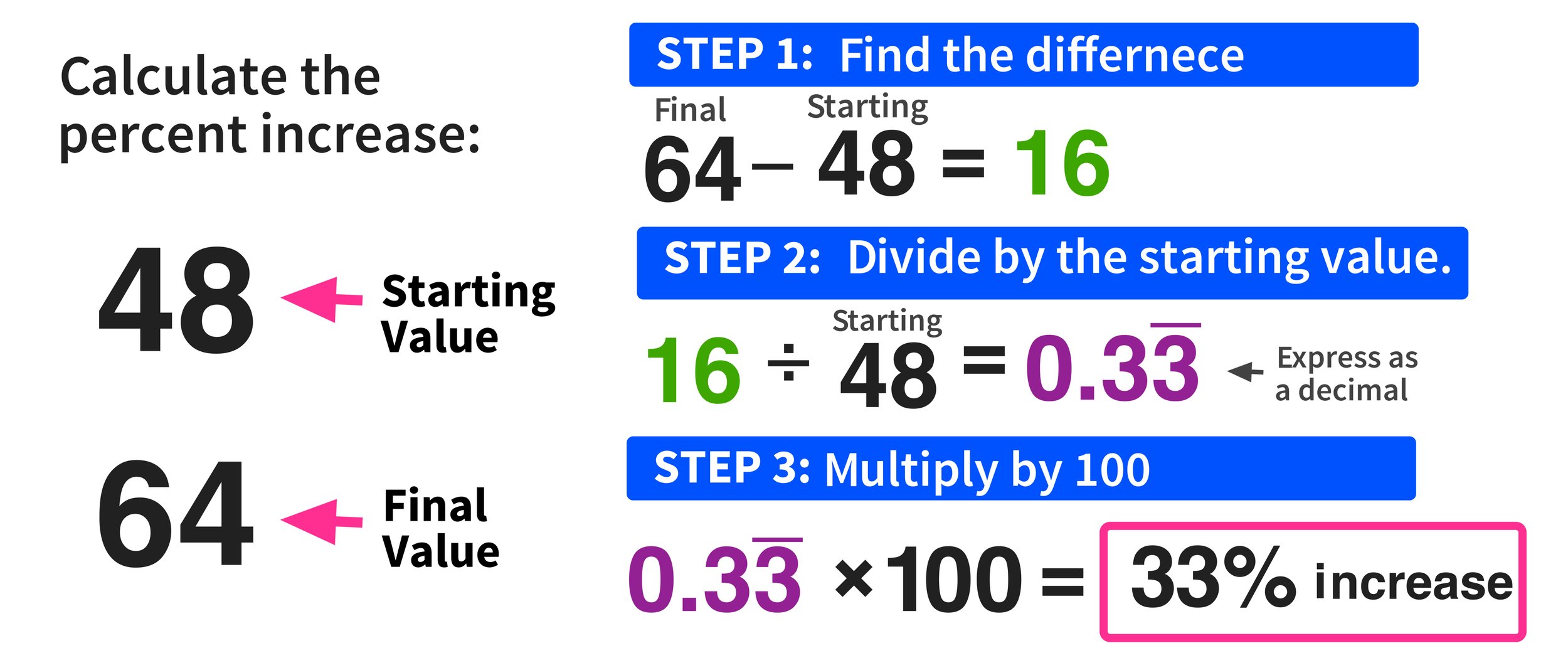
The formula for percentage increase is as follows:
Percentage Increase = ((New Number – Original Number) / Original Number) * 100
Let’s break this down into digestible steps:
-
Calculate the Absolute Increase: Subtract the “Original Number” (the starting value) from the “New Number” (the ending value). This gives you the raw amount by which the number has increased.
- Example: New Number (110) – Original Number (100) = Increase (10)
-
Divide by the Original Number: Take the absolute increase you calculated in step 1 and divide it by the “Original Number.” This step determines the proportional change relative to the starting point. The result will be a decimal.
- Example: Increase (10) / Original Number (100) = 0.10
-
Multiply by 100: To express this decimal as a percentage, multiply the result from step 2 by 100.
- *Example: 0.10 * 100 = 10%*
And there you have it: a 10% increase. This systematic approach ensures accuracy and clarity in your calculations.
Practical Example: Illustrating the Formula
Let’s apply this to a common financial scenario: a salary increase.
Scenario: Last year, your annual salary was $50,000. This year, after a performance review, your annual salary is $53,500. What is the percentage increase in your salary?
Original Number (Original Salary) = $50,000
New Number (New Salary) = $53,500
-
Calculate the Absolute Increase:
$53,500 – $50,000 = $3,500
-
Divide by the Original Number:
$3,500 / $50,000 = 0.07
-
Multiply by 100:
0.07 * 100 = 7%
Conclusion: Your salary increased by 7%. This precise figure allows you to compare your raise against inflation, average industry increases, or your personal financial goals.
Real-World Financial Scenarios: Where Percentage Increase Shines
Understanding how to calculate percentage increase is merely the first step. The true value lies in its application across diverse financial contexts. From personal budgeting to corporate financial reporting, this metric provides crucial insights.
Personal Finance: Tracking Your Wealth Growth
For individuals, percentage increase is a vital tool for personal wealth management and financial planning.
-
Investment Portfolio Performance: If your portfolio was worth $100,000 at the start of the year and grew to $112,000 by year-end, you’ve achieved a 12% return. This metric is essential for comparing your portfolio’s performance against benchmarks (like the S&P 500) or other investment options.
-
Salary or Income Growth: As illustrated in our previous example, tracking your salary increase year-over-year helps you understand if your earnings are keeping pace with inflation or exceeding it, directly impacting your purchasing power.
-
Budgeting and Expense Analysis: Did your grocery bill jump from $400 to $450 last month? That’s a 12.5% increase. Identifying these percentage shifts helps you pinpoint areas where spending is rising unexpectedly, allowing for timely adjustments to your budget.
Investing: Gauging Returns and Market Movements
Investors rely heavily on percentage increase to evaluate the success of their decisions and understand market dynamics.
-
Stock Performance and Capital Appreciation: If you bought a stock at $50 per share and it’s now trading at $65, that’s a 30% capital gain ( (($65 – $50) / $50) * 100). This figure is critical for assessing individual stock performance.
-
Mutual Fund/ETF Growth: These pooled investment vehicles report their returns as percentages, enabling investors to easily compare different funds and see how their investments are performing over various timeframes (e.g., 1-year, 5-year, 10-year returns).
-
Real Estate Value Increases: When a property’s market value rises, calculating the percentage increase helps owners understand their equity growth, which can inform decisions about refinancing, selling, or leveraging assets.
Business Finance: Measuring Performance and Profitability
In the corporate world, percentage increase is a cornerstone of financial reporting, strategic planning, and performance evaluation.
-
Sales Revenue Growth: A company reporting a 15% increase in sales revenue quarter-over-quarter or year-over-year indicates strong market demand and effective sales strategies. This is a key metric for investors and management alike.
-
Profit Margin Expansion: If a company’s net profit margin grew from 8% to 10%, that’s a significant improvement in efficiency and profitability, translating to a ( (10 – 8) / 8 ) * 100 = 25% increase in the margin itself.
-
Operational Efficiency Improvements: Analyzing percentage increases or decreases in costs (e.g., a 5% reduction in production costs) or productivity (e.g., a 10% increase in output per employee) helps businesses identify areas of success and opportunities for further optimization.
Common Pitfalls and Advanced Considerations
While the percentage increase formula is robust, misinterpretations or overlooking certain nuances can lead to flawed conclusions. Awareness of these points enhances the accuracy and insightfulness of your financial analysis.
The Importance of the “Base” Number
The “Original Number” (or base) is critical. A small absolute increase can appear massive as a percentage if the base number is very small. Conversely, a large absolute increase might seem modest if the base number is huge. For example, if your personal savings grew from $10 to $20, that’s a 100% increase, which sounds phenomenal. However, the actual monetary gain is only $10. Always consider the absolute values alongside the percentage to get a complete picture. Misleading statistics often manipulate the base number to exaggerate or downplay results.
When Percentage Increase Can Be Misleading
In certain situations, a simple percentage increase might not tell the whole story.
-
Volatile Data: For data that fluctuates wildly, a single period’s percentage increase might not be indicative of a long-term trend. Averaging or using annualized rates can provide a more stable view.
-
New Ventures or Small Bases: For new businesses or products starting from near zero, even a minimal increase in sales can result in an astronomically high percentage increase (e.g., going from 1 sale to 10 sales is a 900% increase). While numerically correct, it might not signify substantial growth in absolute terms yet.
-
Negative to Positive: If a number goes from negative to positive, a simple percentage increase calculation won’t work intuitively. For instance, moving from a loss of -$10 to a profit of $5 is a significant improvement, but the standard formula might yield confusing results. In such cases, focusing on the absolute change or a different metric is often more appropriate.
Beyond Simple Increase: Annualized Growth Rates (CAGR)
For long-term financial analysis, especially in investing, the Compound Annual Growth Rate (CAGR) is often a more sophisticated metric than a simple percentage increase. CAGR accounts for the compounding effect of growth over multiple periods. If an investment grows from $1,000 to $1,500 over five years, a simple percentage increase is 50%. However, CAGR would tell you the average annual growth rate needed to reach that final value, assuming the profits were reinvested. This provides a smoother, more realistic picture of multi-year performance, preventing the misinterpretation of volatile year-over-year swings. While the core formula for percentage increase is a building block, understanding when to use more advanced growth metrics like CAGR is a hallmark of sophisticated financial literacy.
Leveraging Tools for Financial Calculation
While the formula for percentage increase is simple enough for manual calculation, modern financial analysis benefits immensely from digital tools that automate and streamline the process, reducing errors and saving time.
Spreadsheet Software: Your Financial Command Center
Programs like Microsoft Excel, Google Sheets, or Apple Numbers are indispensable for any serious financial analysis. They allow you to:
-
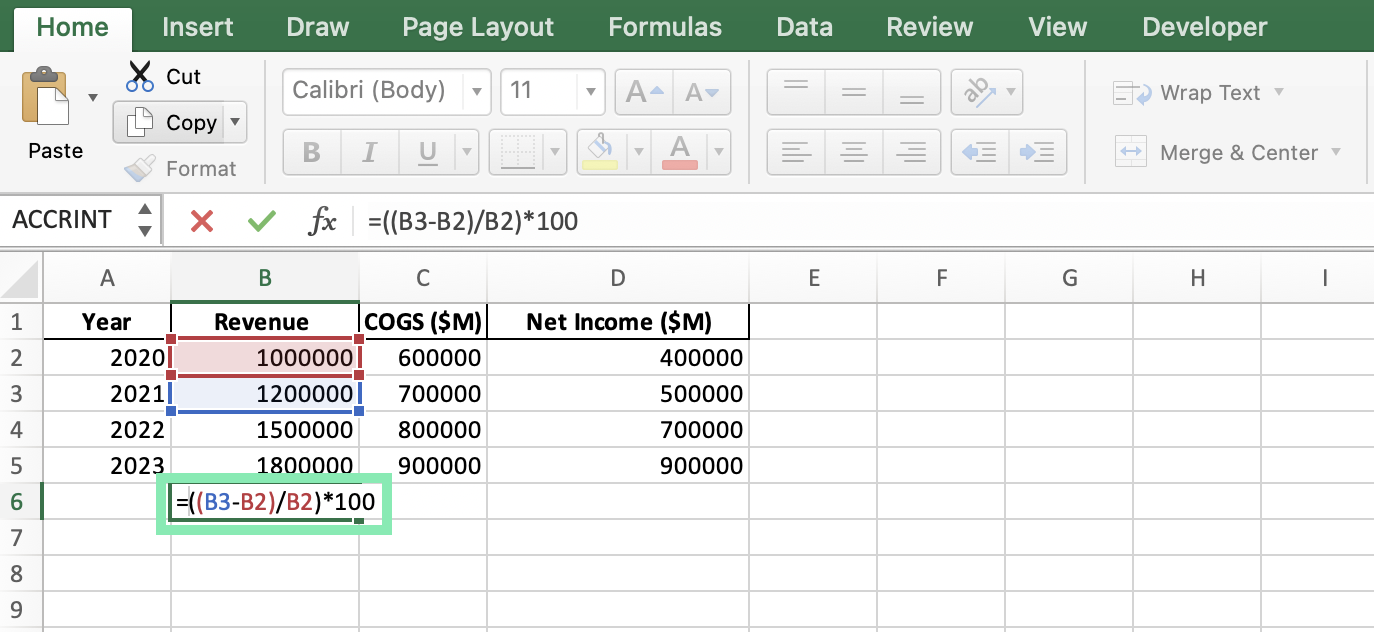
Automate Calculations: Input your original and new numbers, and a simple formula (
=(B2-A2)/A2) can instantly calculate the decimal increase. Formatting cells as a percentage then displays the final result. -
Track Trends Over Time: Create tables to track data points over weeks, months, or years, and then easily calculate percentage increases across these periods, allowing for visual trend analysis through charts and graphs.
-
Perform Scenario Analysis: Quickly change numbers to see the impact on percentage increases, useful for forecasting and planning.
-
Integrate with Other Data: Combine percentage increase calculations with budgeting, investment tracking, and other financial models within a single, organized spreadsheet.
Online Calculators and Financial Apps
For quick, one-off calculations, a multitude of free online percentage increase calculators are available. Many financial apps also incorporate this functionality when tracking investments or personal budgets. These tools are convenient for immediate answers without needing to set up a spreadsheet.

When to Seek Professional Financial Advice
While understanding percentage increase empowers you to conduct basic financial analysis, interpreting complex trends, making significant investment decisions, or navigating intricate business finance scenarios often requires expert guidance. Financial advisors, accountants, and business consultants can provide nuanced insights, help you identify underlying causes for financial shifts, and develop strategies based on a comprehensive understanding of your financial situation and goals. They can also help contextualize percentage changes within broader economic conditions or industry benchmarks, adding layers of insight that simple calculations alone cannot provide.
In conclusion, the ability to calculate and interpret percentage increase is a foundational skill in the world of money. It transforms raw numbers into meaningful insights, enabling better decision-making in personal finance, investing, and business operations. By mastering this simple formula and understanding its applications and nuances, you equip yourself with a powerful analytical tool that will serve you well in all your financial endeavors.
aViewFromTheCave is a participant in the Amazon Services LLC Associates Program, an affiliate advertising program designed to provide a means for sites to earn advertising fees by advertising and linking to Amazon.com. Amazon, the Amazon logo, AmazonSupply, and the AmazonSupply logo are trademarks of Amazon.com, Inc. or its affiliates. As an Amazon Associate we earn affiliate commissions from qualifying purchases.