
Compound interest is often hailed as the “eighth wonder of the world,” and for good reason. It’s the engine behind long-term wealth creation, allowing your money to grow not just on your initial principal but also on the accumulated interest from previous periods. Understanding how to calculate it is not merely an academic exercise; it’s a fundamental skill for anyone looking to build savings, plan for retirement, or even comprehend the true cost of debt. This article will demystify compound interest, breaking down its core components, demonstrating various calculation methods, and offering insights into how you can harness its incredible power.
Understanding the Fundamentals of Compound Interest
Before diving into calculations, it’s crucial to grasp the bedrock concepts that make compound interest so potent. At its heart, it’s about earning “interest on interest.”
What is Simple Interest?
To truly appreciate the power of compounding, it helps to understand its simpler counterpart: simple interest. Simple interest is calculated only on the initial principal amount. If you invest $1,000 at a 5% simple interest rate for three years, you would earn $50 each year ($1,000 * 0.05 = $50). After three years, you would have earned a total of $150 in interest, bringing your total to $1,150. The interest amount remains constant because it’s always calculated on the original principal.
The Core Concept of Compound Interest
Compound interest takes a different path. Each period, the interest earned is added to the principal, and then the next period’s interest is calculated on this new, larger principal. This snowball effect means your money grows at an accelerating rate. Using the same example: if you invest $1,000 at a 5% compound interest rate, in the first year you still earn $50. However, in the second year, you earn 5% on $1,050, not just the original $1,000. This is where the magic begins. This reinvestment of earnings is the bedrock of compound growth, turning modest sums into substantial assets over time.
Key Variables in Compound Interest Calculations
To work out compound interest, you need to be familiar with several key variables:
-
Principal (P): The initial amount of money deposited or borrowed.
-
Interest Rate (r): The annual rate of interest, expressed as a decimal (e.g., 5% becomes 0.05).
-
Time (t): The number of years the money is invested or borrowed for.
-
Number of Compounding Periods per Year (n): How often the interest is calculated and added to the principal within a year. This can be annually (n=1), semi-annually (n=2), quarterly (n=4), monthly (n=12), daily (n=365), or even continuously. The more frequent the compounding, the faster your money grows.
Manual Calculation Methods
While digital tools make calculating compound interest effortless, understanding the underlying formula and performing a manual calculation or two provides invaluable insight into how the process works.
The Compound Interest Formula Explained
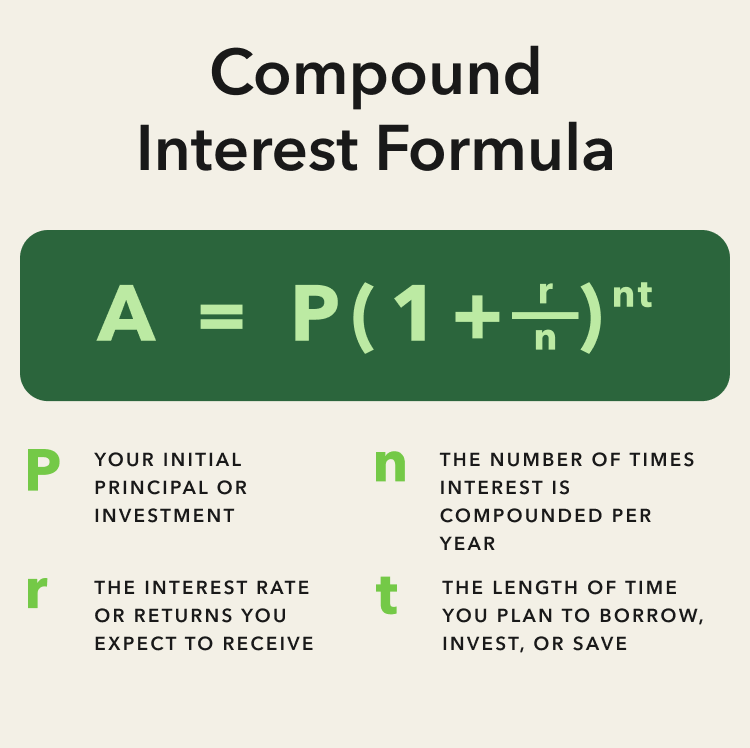
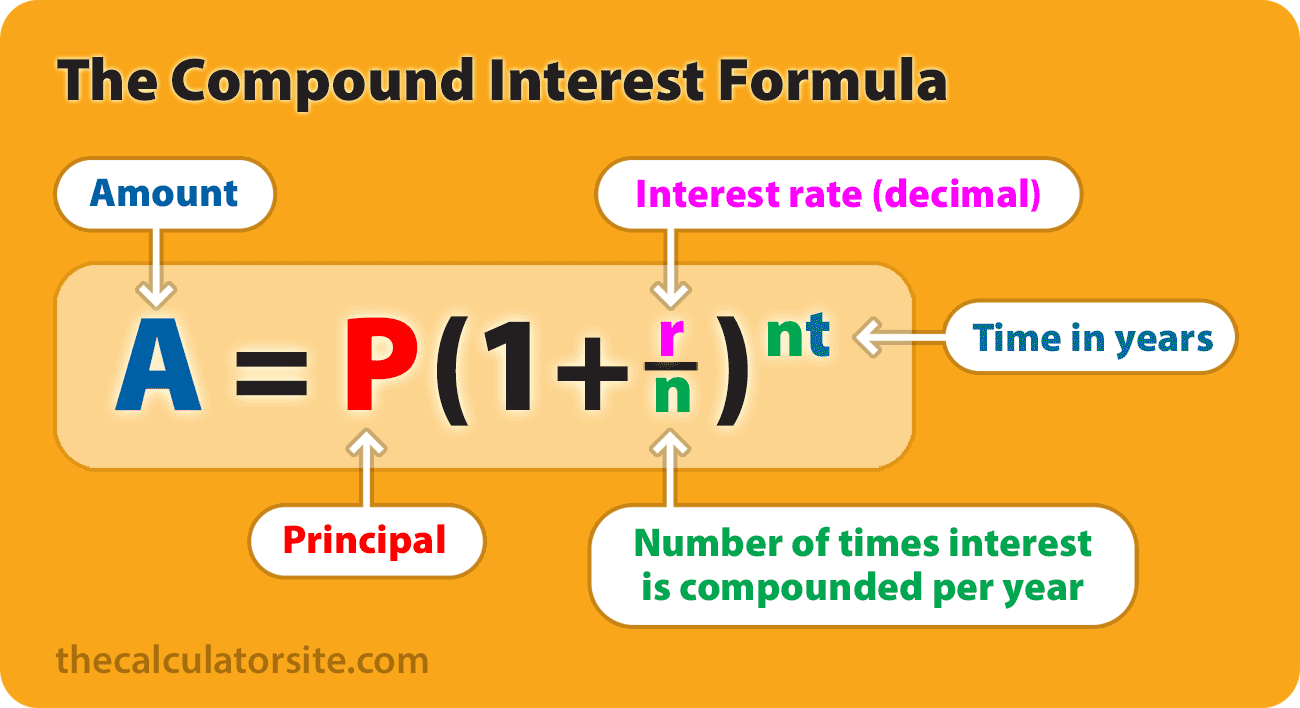
The standard formula for calculating the future value of an investment with compound interest is:
A = P (1 + r/n)^(nt)
Where:
-
A = The future value of the investment/loan, including interest.
-
P = The principal investment amount (the initial deposit or loan amount).
-
r = The annual interest rate (as a decimal).
-
n = The number of times that interest is compounded per year.
-
t = The number of years the money is invested or borrowed for.
Let’s break down each part:
-
(r/n): This calculates the interest rate per compounding period. If the annual rate is 5% and it compounds quarterly, the rate per quarter is 5%/4 = 1.25%.
-
(1 + r/n): This represents the growth factor for each period. It adds the interest rate per period to 1 (representing the principal portion).
-
^(nt): This raises the growth factor to the total number of compounding periods over the investment horizon. If you invest for 3 years, compounding quarterly (n=4), there are 3 * 4 = 12 total compounding periods.
Illustrative Example Walkthrough
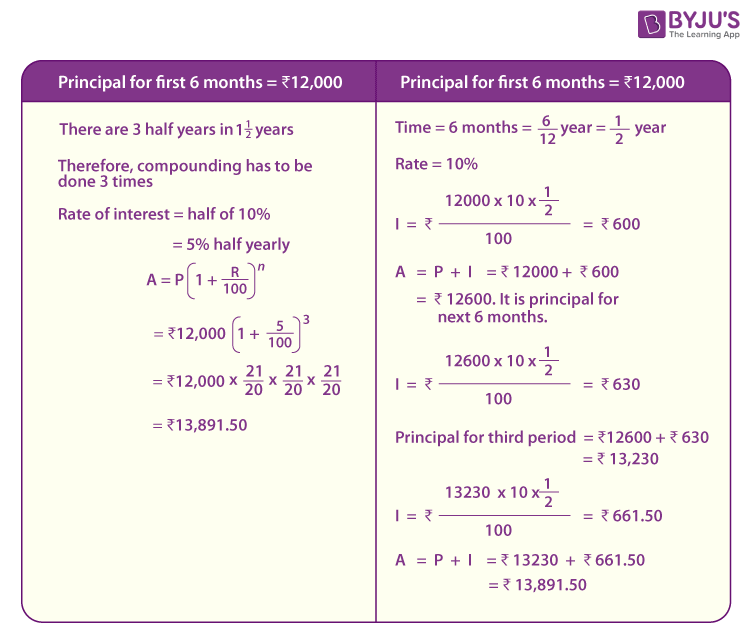
Let’s apply the formula to a practical example. Suppose you invest $1,000 at an annual interest rate of 5%, compounded annually for 3 years.
-
P = $1,000
-
r = 0.05
-
n = 1 (compounded annually)
-
t = 3 years
Year 1:
-
Interest = $1,000 * 0.05 = $50
-
New Principal = $1,000 + $50 = $1,050
Year 2:
-
Interest = $1,050 * 0.05 = $52.50
-
New Principal = $1,050 + $52.50 = $1,102.50
Year 3:
-
Interest = $1,102.50 * 0.05 = $55.13 (rounded)
-
New Principal = $1,102.50 + $55.13 = $1,157.63
Using the formula:
A = $1,000 (1 + 0.05/1)^(1*3)
A = $1,000 (1 + 0.05)^3
A = $1,000 (1.05)^3
A = $1,000 * 1.157625
A = $1,157.63 (This matches our step-by-step calculation, demonstrating the formula’s accuracy).
This example clearly shows how each year’s interest is added to the principal, creating a larger base for the next year’s earnings.
Leveraging Digital Tools for Accuracy and Efficiency
While manual calculations are great for understanding, for everyday use, particularly with more complex scenarios or longer timeframes, digital tools are indispensable. They offer speed, precision, and the ability to model different scenarios effortlessly.
Online Compound Interest Calculators
The internet is replete with free compound interest calculators. These tools are incredibly user-friendly; you simply input your principal, interest rate, compounding frequency, and time horizon, and they instantly provide the future value, total interest earned, and often a breakdown of annual growth.
-
Why use them? They eliminate human error, allow for quick comparisons between different investment scenarios (e.g., 4% vs. 5% interest), and can calculate for various compounding frequencies (daily, monthly, quarterly).
-
Common features: Many also allow for additional regular contributions, showing how consistent deposits can dramatically accelerate wealth accumulation. Reputable financial websites, brokerage firms, and personal finance blogs often host excellent calculators.
Spreadsheet Applications (Excel/Google Sheets) for Advanced Analysis
For those who prefer a hands-on approach and need more flexibility for custom scenarios, spreadsheet applications like Microsoft Excel or Google Sheets are powerful tools. They allow you to build your own models and perform more complex analyses.
-
The FV function: The most direct way to calculate future value with compound interest in a spreadsheet is using the
FV(Future Value) function.The syntax is:
FV(rate, nper, pmt, [pv], [type])-
rate: The interest rate per period (e.g.,annual_rate/n). -
nper: The total number of payment periods in an annuity (e.g.,years*n). -
pmt: The payment made each period (for additional contributions, 0 if only initial principal). -
pv: The present value or the lump-sum amount that a series of future payments is worth right now (your initial principal, entered as a negative value). -
type: (Optional) When payments are due (0 for end of period, 1 for beginning).
Example:
=FV(0.05/1, 3*1, 0, -1000)would return $1,157.63. -
-
Building a simple model: You can also create a table year-by-year, similar to our manual example, with formulas for principal, interest, and new balance, allowing you to visually track growth and easily change variables. This offers a transparent view of the compounding process.
Financial Calculators and Apps
Beyond online websites and spreadsheets, dedicated financial calculators (both physical and app-based) are excellent for specific financial calculations, including compound interest. These are particularly useful for finance students, professionals, or anyone who frequently needs to perform such calculations on the go. Many popular banking and investment apps also integrate simple compound interest estimators or projections for your accounts.
Beyond the Basics: Factors Influencing Compound Growth
Understanding the formula is one thing; leveraging it strategically is another. Several critical factors dramatically influence the extent of compound growth.
The Power of Time
Time is arguably the most crucial variable in the compound interest equation. The longer your money has to grow, the more periods it has to compound, and the more significant the “interest on interest” effect becomes. This is why financial advisors consistently stress the importance of starting to invest early. Even small amounts invested early can outperform much larger sums invested later, simply due to the extended compounding runway. The difference between investing $5,000 at age 25 versus age 35 can be hundreds of thousands of dollars by retirement, assuming the same rate of return.
Impact of Interest Rate
Naturally, a higher interest rate leads to faster growth. Even a seemingly small difference in interest rates can lead to substantial disparities over long periods. For example, over 30 years, an investment earning 7% annually will grow significantly more than one earning 5%, illustrating the value of seeking out competitive returns for your savings and investments. Conversely, on the debt side, higher interest rates mean faster accumulation of interest charges.
The Role of Compounding Frequency
As n (the number of compounding periods per year) increases, so does the future value of your investment, albeit at a diminishing rate. Daily compounding will yield slightly more than monthly, which yields more than quarterly, and so on. While the difference between annual and daily compounding might seem minor over a single year, over decades, it can add up. Most savings accounts compound monthly or daily, while bonds often compound semi-annually.
Regular Contributions
While the basic compound interest formula calculates the growth of a lump sum, the reality for most investors involves making regular contributions to their savings or investment accounts. Adding fresh capital to your principal periodically (e.g., monthly contributions to an IRA or 401(k)) supercharges the compounding process. Each new contribution immediately becomes part of the principal, earning interest alongside the existing funds. This combined effect of consistent savings and compound interest is the most powerful wealth-building strategy available to individuals.
Practical Applications and Strategic Insights
Mastering compound interest isn’t just about formulas; it’s about applying this knowledge to make informed financial decisions.
Investing for Retirement (IRAs, 401ks)
Understanding compound interest is paramount for retirement planning. Accounts like 401(k)s and IRAs benefit immensely from long compounding horizons and often tax-advantaged growth. By consistently contributing to these accounts, individuals can harness the power of time and compounding to build substantial nest eggs. Even modest monthly contributions, sustained over decades, can lead to multi-million-dollar retirement portfolios.
Saving for Long-Term Goals (Education, Down Payment)
Whether you’re saving for a child’s college education, a down payment on a house, or a major life event, compound interest is your ally. Setting up dedicated savings accounts or investment vehicles that earn compound interest can significantly reduce the amount you need to save manually, as your money works hard alongside your contributions.
Understanding Debt (The Flip Side of Compounding – Credit Cards, Loans)
It’s crucial to recognize that compound interest works both ways. While it’s a boon for investments, it can be a significant burden when it comes to debt. Credit cards, for instance, often charge very high interest rates that compound daily or monthly. If balances are not paid off, the interest quickly compounds, making it incredibly difficult to pay down the principal and potentially leading to a spiral of increasing debt. Understanding this mechanism is vital for managing loans, mortgages, and consumer debt effectively.
The Rule of 72
For a quick estimate of how long it will take for an investment to double at a given annual compound interest rate, you can use the “Rule of 72.” Simply divide 72 by the annual interest rate (without converting it to a decimal). For example, at an 8% annual rate, an investment would take approximately 72 / 8 = 9 years to double. While an approximation, it’s a handy mental shortcut for understanding growth potential.
Conclusion
Working out compound interest is more than just performing a mathematical operation; it’s about understanding one of the most fundamental forces in finance. Whether calculated manually, via an online tool, or within a spreadsheet, the principle remains the same: your money has the capacity to earn money, which then earns more money, creating an exponential growth curve. By grasping this concept, leveraging available tools, and making smart, consistent financial choices, you can effectively harness the “eighth wonder of the world” to achieve your financial goals and secure a prosperous future. Start early, stay consistent, and let the power of compounding work for you.
aViewFromTheCave is a participant in the Amazon Services LLC Associates Program, an affiliate advertising program designed to provide a means for sites to earn advertising fees by advertising and linking to Amazon.com. Amazon, the Amazon logo, AmazonSupply, and the AmazonSupply logo are trademarks of Amazon.com, Inc. or its affiliates. As an Amazon Associate we earn affiliate commissions from qualifying purchases.