
In the intricate world of finance, numbers tell a story, but percentages reveal its true meaning. Whether you’re a budding investor, a meticulous budgeter, an aspiring entrepreneur, or simply someone looking to make smarter financial decisions, understanding how to calculate what percentage one number is of another is an indispensable skill. It’s the foundational arithmetic that underpins everything from discerning a good deal to evaluating investment performance, tracking expenses, and analyzing business profitability.
Far from being a mere academic exercise, this fundamental mathematical concept translates directly into actionable financial insights. It empowers you to quantify relationships between different financial figures, allowing for clearer comparisons, more informed planning, and ultimately, greater control over your money. This guide will demystify the process, demonstrating its profound relevance across personal, investment, and business finance, ensuring you can confidently harness the power of percentages.
The Core Concept: Deconstructing the Percentage Formula
Before diving into complex financial scenarios, it’s crucial to firmly grasp the bedrock principle behind percentage calculation. It’s a remarkably straightforward formula that, once understood, unlocks a world of financial understanding.
Understanding the Basics: What is a Percentage?
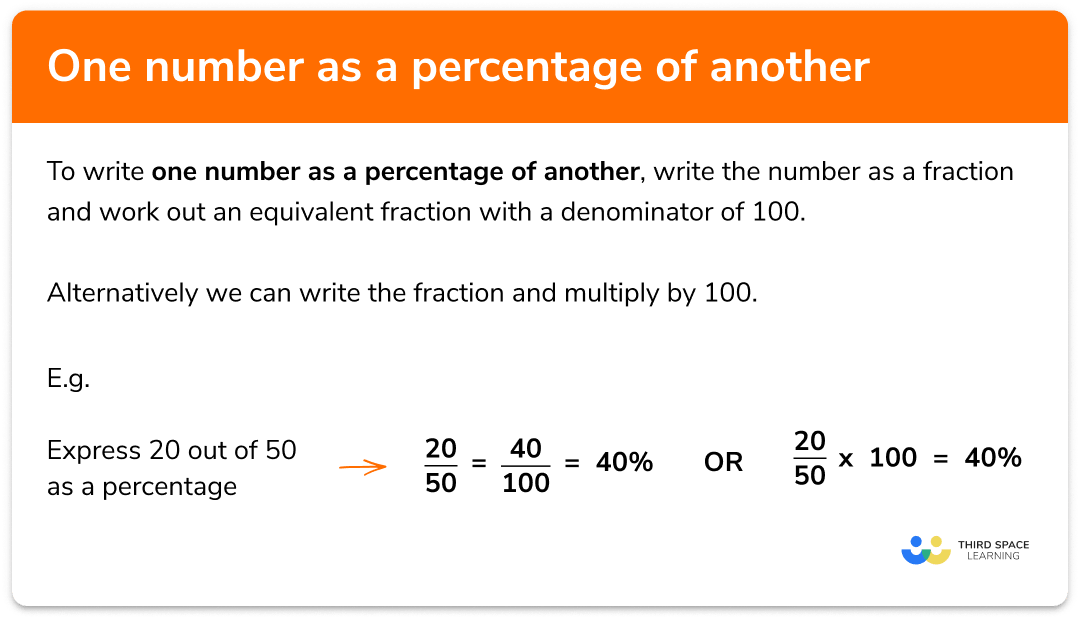
At its heart, “percent” means “per hundred.” It’s a way of expressing a number as a fraction of 100. For instance, 50 percent (50%) literally means 50 out of 100, or 50/100, which simplifies to 1/2. Percentages provide a standardized way to compare parts of a whole, regardless of the size of the whole itself. They allow us to instantly understand proportions in a universally comparable format.
The Fundamental Formula: Part / Whole x 100
The calculation for finding what percentage one number is of another is elegant in its simplicity:
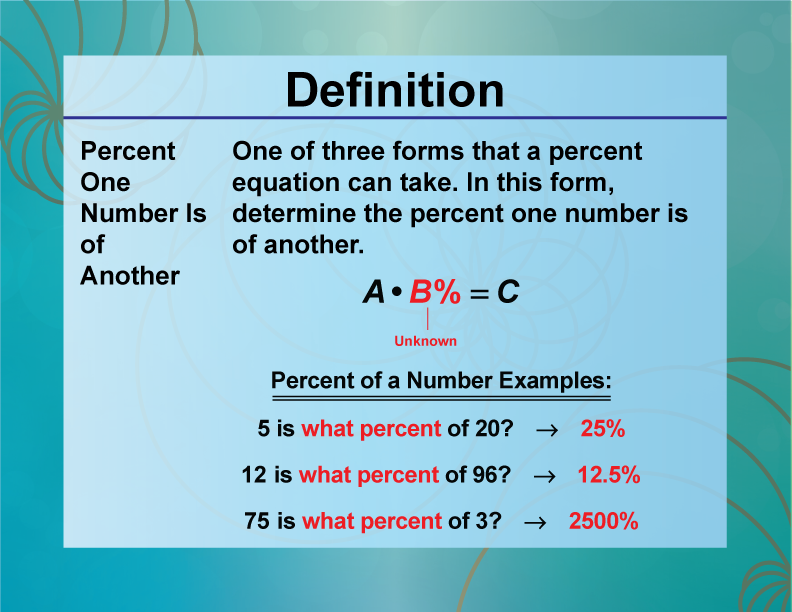
Percentage = (Part / Whole) × 100
Let’s break down each component:
-
Part: This is the specific number or amount you want to express as a percentage of the larger total. It’s the subset, the component, or the change you are examining.
-
Whole: This is the total, the original amount, or the reference number against which the “part” is being compared. It represents the complete set or the baseline.
-
× 100: Multiplying by 100 converts the resulting decimal or fraction into a percentage, expressing it in terms of “per hundred.”
Example: If you have 20 apples (the “part”) out of a total of 80 apples (the “whole”), you would calculate:
(20 / 80) × 100 = 0.25 × 100 = 25%
This means 20 apples represent 25% of the total 80 apples. Mastering this basic formula is your gateway to financial literacy.
Practical Applications in Personal Finance
In your daily financial life, percentages are far more prevalent and useful than you might initially realize. From managing your household budget to planning for future goals, these calculations provide essential insights.
Budgeting and Expense Tracking
One of the most immediate applications of percentage calculation is in managing your personal budget. Understanding what proportion of your income goes towards various expenses is critical for financial health.
-
Income Allocation: You can determine what percentage each expense category (e.g., housing, food, transportation, entertainment) consumes of your total monthly income. If your rent is $1,500 and your monthly net income is $5,000, then your rent is ($1,500 / $5,000) × 100 = 30% of your income. This helps you adhere to common budgeting rules, like the 50/30/20 rule.
-
Spending Habits: By tracking your spending, you can see what percentage of your total expenditure goes to discretionary items versus necessities. This highlights areas where you might be overspending and can make adjustments.
Savings Goals and Progress
Setting and achieving savings goals becomes more tangible when you can quantify your progress using percentages.
-
Goal Achievement: If you aim to save $10,000 for a down payment and you’ve already saved $3,500, you’ve reached ($3,500 / $10,000) × 100 = 35% of your goal. This provides motivation and helps you estimate how much more effort is needed.
-
Savings Rate: Calculating the percentage of your income you save each month or year is a key metric for financial independence. If you save $1,000 from a $5,000 income, your savings rate is 20%.
Understanding Discounts and Sales
Shopping wisely often involves evaluating discounts, and percentages are the language of sales.
-
Discount Depth: A product originally priced at $200 is now selling for $150. The discount amount is $50. To find the percentage discount: ($50 / $200) × 100 = 25%. Knowing the actual percentage helps you compare deals across different stores or products.
-
Effective Price: You can also calculate what percentage of the original price you are paying. If an item is 25% off, you are paying 75% of the original price.
Debt Management and Interest Rates
Debt, whether it’s a mortgage, student loan, or credit card balance, is intrinsically linked to percentages through interest rates.
-
Interest as a Cost: An interest rate of 6% means you pay 6 cents for every dollar borrowed annually. Understanding this helps you calculate the cost of borrowing.
-
Debt Reduction Progress: If you started with a $10,000 loan and have paid off $2,500, you’ve paid off ($2,500 / $10,000) × 100 = 25% of your debt. This can be a powerful motivator.
Essential for Investing and Wealth Building
For anyone looking to grow their wealth, percentages are the fundamental metric for evaluating performance, risk, and portfolio health.
Return on Investment (ROI)
ROI is arguably the most critical percentage in investing. It measures the profitability of an investment relative to its cost.
-
Calculating ROI: The formula is: ((Current Value of Investment – Original Cost of Investment) / Original Cost of Investment) × 100. If you bought stocks for $5,000 and they are now worth $6,500, your ROI is (($6,500 – $5,000) / $5,000) × 100 = ($1,500 / $5,000) × 100 = 30%.
-
Evaluating Performance: ROI allows you to compare the profitability of different investments, helping you make informed decisions about where to allocate capital for the best returns.
Portfolio Allocation
A diversified investment portfolio is key to managing risk, and diversification is often described in terms of percentages.
-
Asset Mix: Investors typically allocate their portfolio across different asset classes (e.g., stocks, bonds, real estate, cash) based on their risk tolerance and financial goals. For example, a common allocation might be 60% stocks and 40% bonds. If your total portfolio is worth $100,000, then $60,000 should be in stocks and $40,000 in bonds.
-
Rebalancing: As market values fluctuate, these percentages change. You use percentage calculations to determine when and how much to rebalance your portfolio to maintain your target allocation.
Compounding and Growth Rates
While compound interest often involves calculating percentage changes over time, the underlying understanding of what a percentage represents is crucial.
- Annual Growth Rate: An investment that grows by 7% annually means that each year, its value increases by 7% of its value from the previous year, demonstrating the power of compounding. Calculating historical growth rates for an asset (e.g., a stock, mutual fund, or real estate) helps predict potential future returns.
Business Finance and Operational Insights
For business owners, managers, or anyone involved in commercial operations, percentages are indispensable tools for assessing performance, identifying trends, and making strategic decisions.
Profit Margins
Profit margins are among the most important financial ratios for any business, providing a clear picture of its profitability.
-
Gross Profit Margin: This tells you what percentage of revenue is left after accounting for the cost of goods sold (COGS). Formula: ((Revenue – COGS) / Revenue) × 100. A high gross profit margin indicates efficient production.
-
Net Profit Margin: This reveals what percentage of revenue remains after all expenses, including COGS, operating expenses, interest, and taxes, have been deducted. Formula: (Net Income / Revenue) × 100. This is the ultimate indicator of a company’s overall profitability. Comparing these margins over time or against industry benchmarks helps gauge business health.
Sales Growth and Market Share
Businesses constantly track their growth and position within the market, which is predominantly measured using percentages.
-
Sales Growth Rate: Calculating the percentage increase or decrease in sales revenue from one period to another is a standard way to assess business expansion or contraction. Formula: ((Current Period Sales – Prior Period Sales) / Prior Period Sales) × 100.
-
Market Share: This metric represents a company’s sales as a percentage of the total sales in its industry. If a company has $10 million in sales in an industry with $100 million in total sales, its market share is ($10M / $100M) × 100 = 10%. This helps businesses understand their competitive standing.
Cost Analysis and Efficiency
Optimizing costs is vital for profitability, and percentage analysis helps pinpoint areas for improvement.
-
Cost Allocation: Businesses use percentages to understand how different expenses contribute to their total operating costs. For example, salaries might account for 40% of total expenses, rent 15%, and utilities 5%. This breakdown highlights where cost-cutting efforts might have the most impact.
-
Efficiency Ratios: Various operational efficiency ratios are expressed as percentages, helping businesses benchmark their performance. For instance, employee turnover rate (number of employees leaving / total employees × 100) is a key HR metric.
Leveraging Technology for Percentage Calculations
While the underlying math is simple, modern financial practices often involve large datasets or frequent calculations. Fortunately, technology makes computing percentages incredibly efficient.
Basic Calculators and Smartphone Apps
For quick, one-off calculations, a standard scientific calculator or the calculator app on your smartphone is perfectly adequate. Simply input the part, divide by the whole, and then multiply by 100 (or use the dedicated percentage button if available).
Spreadsheets (Excel/Google Sheets)
Spreadsheets are invaluable tools for financial management, especially when dealing with budgets, financial models, or tracking investments.
-
Automated Formulas: You can set up columns for “Part” and “Whole” and then use a formula like
=(B2/C2)*100(assuming “Part” is in B2 and “Whole” in C2) to instantly calculate percentages across many rows. -
Percentage Formatting: Spreadsheets also allow you to format cells as percentages directly. If you enter
0.25into a cell and then apply percentage formatting, it will display as25%. This automatically handles the “× 100” part for you.
Financial Software and Tools
Dedicated financial software, from personal budgeting apps like Mint or YNAB to professional accounting software like QuickBooks and investment platforms, extensively uses and displays percentages. These tools automate the calculations, providing real-time insights into your financial health, investment performance, and business profitability through intuitive dashboards and reports, all built upon the fundamental percentage calculations discussed here.

Conclusion
Understanding how to find what percentage a number is of another is not just a mathematical trick; it is a cornerstone of financial literacy. From the everyday decisions about household spending to complex investment strategies and critical business analyses, percentages provide clarity, context, and comparability. They transform raw numbers into meaningful insights, enabling you to identify trends, measure progress, and make informed choices. By mastering this fundamental skill, you empower yourself to navigate the financial landscape with greater confidence, precision, and control, laying a robust foundation for enduring financial success.
aViewFromTheCave is a participant in the Amazon Services LLC Associates Program, an affiliate advertising program designed to provide a means for sites to earn advertising fees by advertising and linking to Amazon.com. Amazon, the Amazon logo, AmazonSupply, and the AmazonSupply logo are trademarks of Amazon.com, Inc. or its affiliates. As an Amazon Associate we earn affiliate commissions from qualifying purchases.