
Compound interest is often heralded as the “eighth wonder of the world,” a financial force so potent that it can transform modest savings into a substantial fortune over time. While the concept of interest is straightforward—earning a percentage on your principal—the mechanism of compounding adds a layer of exponential growth. When interest is calculated monthly rather than annually, the frequency of growth increases, allowing your wealth to snowball at an accelerated pace. Understanding how to find and calculate compound interest monthly is not just an academic exercise; it is a fundamental skill for anyone serious about personal finance, investing, and long-term wealth management.
Understanding the Mechanics of Monthly Compounding
To master the calculation of monthly compound interest, one must first grasp the core distinction between simple interest and compound interest. Simple interest is calculated solely on the initial principal amount. In contrast, compound interest is calculated on the principal plus any interest that has already accumulated from previous periods. When we speak of “monthly” compounding, we are referring to the process where the interest earned each month is added back into the balance, and the following month’s interest is calculated based on that new, higher total.
The Power of Frequency
The frequency of compounding is a critical variable in the growth of an investment. Generally, the more frequently interest is compounded, the higher the effective yield will be. For example, an annual interest rate of 6% compounded annually will yield exactly 6% at the end of the year. However, that same 6% compounded monthly results in a slightly higher effective annual rate because the interest earned in January begins earning its own interest in February, March, and so on.
For investors, monthly compounding is common in high-yield savings accounts, certificates of deposit (CDs), and many dividend-reinvesting stocks. For borrowers, it is the standard for credit cards and mortgages. Knowing how to navigate these calculations allows you to compare different financial products accurately and choose the ones that best serve your financial goals.
The Impact of Time and Consistency
The true magic of monthly compounding lies in the duration of the investment. In the early stages, the difference between monthly and annual compounding may seem negligible. However, over a decade or two, the gap widens significantly. This is due to the exponential nature of the growth curve. By calculating interest monthly, you are essentially “checking in” on your growth twelve times a year, ensuring that every penny earned is immediately put back to work.
The Mathematical Formula for Monthly Compounding
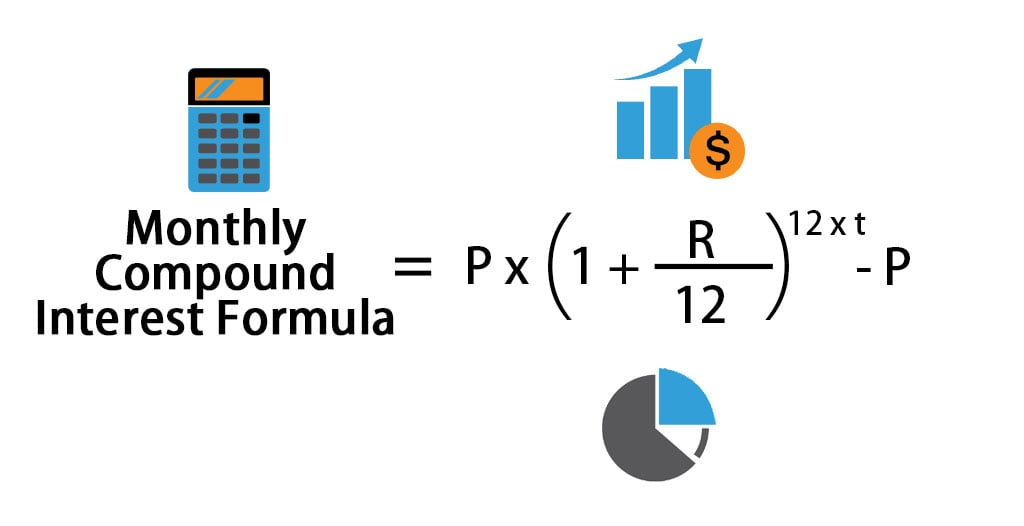
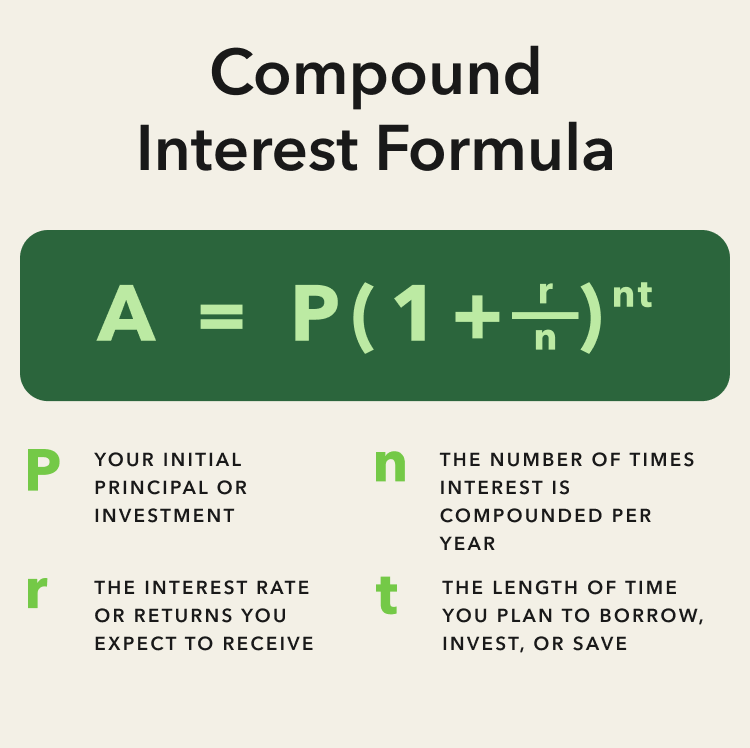
While online calculators are readily available, understanding the underlying mathematical formula provides the clarity needed to make informed financial decisions. The standard formula for compound interest is expressed as:
A = P(1 + r/n)^(nt)
To find compound interest monthly, we must define each variable specifically for that timeframe:
-
A: The final amount of money accumulated after n years, including interest.
-
P: The principal amount (the initial sum of money).
-
r: The annual interest rate (decimal). For example, 5% becomes 0.05.
-
n: The number of times that interest is compounded per unit t. For monthly compounding, n is always 12.
-
t: The time the money is invested or borrowed for, expressed in years.
Breaking Down the Calculation Step-by-Step
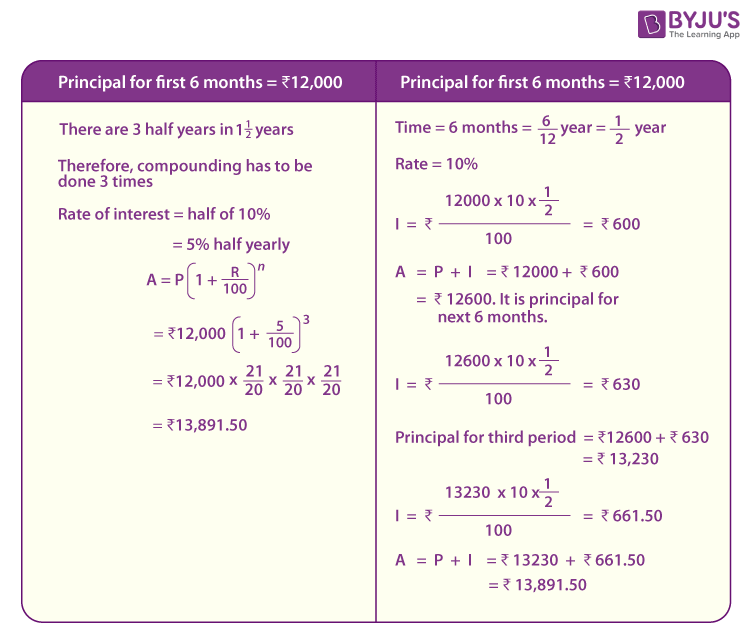
To illustrate how to find monthly compound interest, let us walk through a practical scenario. Suppose you invest $10,000 in a high-yield savings account with an annual interest rate of 4%, compounded monthly, for a period of 5 years.
-
Identify the variables: P = 10,000, r = 0.04, n = 12, t = 5.
-
Calculate the periodic rate: Divide the annual rate by the number of periods (0.04 / 12 = 0.003333). This is the interest you earn each month.
-
Determine the total number of periods: Multiply the years by the compounding frequency (5 * 12 = 60 months).
-
Apply the formula: A = 10,000 * (1 + 0.003333)^60.
-
Solve the exponent: (1.003333)^60 ≈ 1.221.
-
Find the final amount: 10,000 * 1.221 = $12,210.
By the end of five years, your $10,000 has grown to $12,210. The interest earned is $2,210. Had this been simple interest, you would have earned only $2,000. That $210 difference is the result of the interest “compounding” every month.
The Rule of 72 and Monthly Compounding
A quick mental shortcut often used in finance is the “Rule of 72,” which estimates how long it will take for an investment to double at a fixed annual rate of interest. You simply divide 72 by the annual interest rate. For an 8% return, it takes about 9 years to double. While the Rule of 72 is usually applied to annual compounding, monthly compounding actually makes the doubling happen slightly faster. Understanding the exact math allows you to refine these estimates and plan your retirement or major purchases with greater precision.
Digital Tools and Automation for Calculating Interest
In the modern financial landscape, you do not need to carry a scientific calculator to find monthly compound interest. Various digital tools can automate these calculations, providing instant insights into your financial future.
Leveraging Spreadsheet Software
Excel and Google Sheets are among the most powerful tools for financial modeling. To find the future value of an investment with monthly compounding, you can use the built-in FV (Future Value) function. The syntax is:
=FV(rate/12, nper*12, pmt, -pv)
-
rate: The annual interest rate.
-
nper: The number of years.
-
pmt: Any additional monthly payments (use 0 if it is a lump sum).
-
pv: The present value or principal.
By using a spreadsheet, you can create a monthly “amortization” or “growth schedule.” This allows you to see exactly how much interest is added to your account on the 1st of every month, providing a visual representation of your wealth building.
Online Financial Calculators and Fintech Apps
Many brokerage firms and banking apps now integrate compound interest calculators directly into their user interfaces. These tools often allow for “what-if” scenarios, where you can adjust the monthly contribution or the interest rate to see how it impacts your long-term balance. For those pursuing “FIRE” (Financial Independence, Retire Early), these tools are essential for determining the exact monthly savings rate required to hit a specific target.
Strategic Applications in Wealth Building
Knowing how to calculate monthly compound interest is only half the battle; the other half is applying that knowledge to your investment strategy. Different financial vehicles utilize monthly compounding in unique ways.
High-Yield Savings and Money Market Accounts
For many, the first introduction to monthly compounding is through a savings account. In an environment of rising interest rates, moving funds from a traditional bank (which may offer 0.01%) to a high-yield online bank (offering 4% or more) can result in thousands of dollars in “found money” over time. Because these accounts typically compound monthly, the growth is visible and provides a safe, liquid foundation for an emergency fund.
The Role of Dividend Reinvestment Plans (DRIPs)
In the world of stock market investing, dividends are often distributed quarterly. However, many investors use Dividend Reinvestment Plans (DRIPs) to purchase more shares automatically. While not “monthly” in the strictest sense of a bank account, the principle is the same: taking the earnings (dividends) and immediately reinvesting them to increase the size of the principal. Over decades, a portfolio of dividend-paying stocks can grow exponentially because the number of shares—and thus the size of the dividend payments—increases with every cycle.
Managing Monthly Compounding Debt
It is vital to remember that compound interest is a double-edged sword. While it builds wealth for savers, it can be devastating for borrowers. Credit cards are the most common example of monthly (and often daily) compounding. If you carry a balance, the interest charged in January becomes part of the principal in February. This is why credit card debt can spiral out of control so quickly. By understanding the math, consumers can see the true cost of minimum payments and prioritize debt snowball or avalanche methods to stop the “reverse compounding” that drains their net worth.
Maximizing Returns through Consistent Contributions
The most effective way to utilize monthly compounding is to pair it with regular, monthly contributions. This strategy, often called dollar-cost averaging when applied to stocks, ensures that you are constantly increasing the principal upon which the interest is calculated.
The Synergy of Interest and New Capital
When you add $500 to an account every month, you are not just adding to the total; you are increasing the “base” for the next month’s interest calculation. This creates a dual-engine of growth:
-
Interest on the existing balance.
-
Interest on the new contributions.
Over a 30-year career, the difference between making a single lump-sum investment and making consistent monthly contributions is staggering. The monthly contribution method leverages the frequency of compounding to its fullest extent, ensuring that no capital sits idle.
Mitigating Inflation with Compounding Assets
Inflation erodes the purchasing power of money over time. To maintain wealth, an investor’s portfolio must grow at a rate that exceeds inflation. Monthly compounding provides a more frequent “correction” to the balance, helping the investor stay ahead of the rising cost of living. By focusing on assets that compound monthly or quarterly, such as real estate investment trusts (REITs) or interest-bearing bonds, individuals can build a robust financial shield against inflationary pressures.
In conclusion, the ability to find and calculate compound interest monthly is a cornerstone of financial literacy. By mastering the formula, utilizing digital tools, and understanding the strategic implications of compounding frequency, you position yourself to make smarter decisions with your capital. Whether you are aiming to eliminate debt or build a multi-million dollar retirement fund, the disciplined application of monthly compounding is the most reliable path to achieving lasting financial success.
aViewFromTheCave is a participant in the Amazon Services LLC Associates Program, an affiliate advertising program designed to provide a means for sites to earn advertising fees by advertising and linking to Amazon.com. Amazon, the Amazon logo, AmazonSupply, and the AmazonSupply logo are trademarks of Amazon.com, Inc. or its affiliates. As an Amazon Associate we earn affiliate commissions from qualifying purchases.