
In the realm of personal and business finance, the ability to calculate percentages is not merely a mathematical skill—it is a fundamental pillar of financial literacy. Whether you are calculating the interest on a high-yield savings account, determining the return on a stock market investment, or analyzing the profit margins of a startup, percentages provide a universal language for measuring growth, cost, and value. Understanding how to determine the percentage of a number allows you to strip away the complexity of raw data and reveal the underlying trends that dictate financial success.

The concept of a “percentage” translates literally to “per one hundred.” By converting figures into a standardized scale of 100, we gain the ability to compare disparate financial values on an equal playing field. This guide explores the essential formulas for percentage calculation and examines their critical applications across various financial sectors, from daily budgeting to complex investment strategies.
The Foundations of Financial Calculation
Before diving into complex financial models, one must master the basic mechanics of percentage determination. At its core, finding the percentage of a number involves a simple three-part relationship: the whole (the total amount), the part (the portion of the total), and the percentage (the rate).
The Basic Percentage Formula
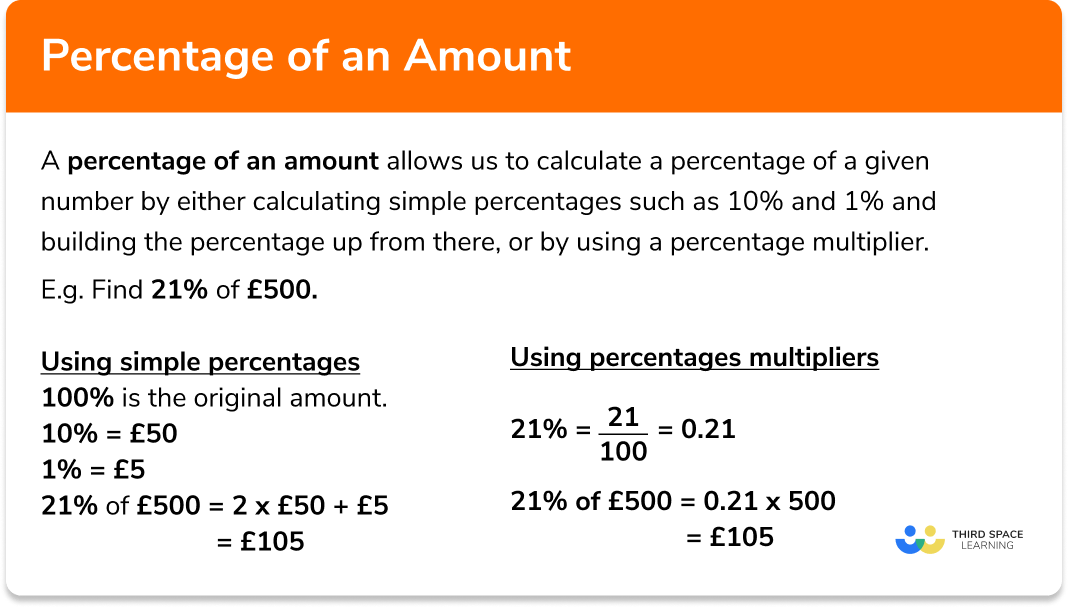
To find a specific percentage of a number, the most direct method is to convert the percentage into a decimal and multiply it by the total. The formula is expressed as:
Value = (Percentage / 100) × Total Amount
For example, if you are looking to set aside 15% of a $5,000 monthly salary for retirement, you would divide 15 by 100 to get 0.15, then multiply $5,000 by 0.15. The result, $750, represents the portion of your income dedicated to your future wealth.
Reversing the Formula: Finding the Rate
In many financial scenarios, you already know the “part” and the “whole,” but you need to determine what percentage the part represents. This is common when tracking expenses or evaluating portfolio weightings. The formula is:
Percentage = (Part / Whole) × 100
If your monthly housing costs are $2,000 out of a $6,000 take-home pay, the calculation (2,000 / 6,000) results in 0.333. Multiplying by 100 reveals that 33.3% of your income is allocated to housing—a critical metric for determining if you are “house burdened” by traditional lending standards.
Essential Applications in Personal Finance
Mastering these calculations is the first step toward optimizing your personal economy. From the checkout counter to the bank branch, percentages dictate the cost of living and the speed of debt accumulation.
Calculating Discounts and Realized Savings
Retail marketing often uses percentages to entice consumers. However, savvy financial managers calculate the “real” price before making a purchase. To find the sale price of an item, you can either calculate the discount and subtract it from the original, or multiply the original price by the “remaining” percentage.
If a professional suite costs $400 and is marked 30% off, you are essentially paying 70% of the original price. Calculating $400 × 0.70 gives you an immediate sale price of $280. This mental shortcut is invaluable for quick decision-making during major sales events, ensuring that the “deal” aligns with your actual budget.
The 50/30/20 Rule of Budgeting
One of the most effective ways to apply percentage calculations to your financial life is through the 50/30/20 rule. This framework suggests allocating 50% of your income to “Needs,” 30% to “Wants,” and 20% to “Savings and Debt Repayment.”
By determining the percentage of your total income that flows into these categories, you can identify “lifestyle creep”—the tendency for discretionary spending to increase as income rises. If your “Wants” category begins to exceed 40%, you have a mathematical indicator that your financial health is at risk, allowing you to course-correct before reaching a crisis.
Understanding Interest Rates and Debt
Credit cards, mortgages, and personal loans are all priced using Annual Percentage Rates (APR). Understanding how to calculate the interest on a balance is vital for debt management. If you carry a $1,000 balance on a credit card with a 24% APR, the monthly interest is roughly 2% (24% divided by 12 months). By calculating 2% of $1,000, you realize that $20 of your payment is going toward interest alone, rather than reducing the principal. This realization often provides the necessary motivation to prioritize high-interest debt repayment.
Percentages in Investing and Wealth Building
In the world of investing, percentages are the primary metric for measuring performance. While raw dollar gains are satisfying, they do not provide the context necessary to evaluate the efficiency of your capital.
Determining Return on Investment (ROI)

The most important calculation for any investor is the Return on Investment. ROI tells you how much profit or loss you have made relative to the amount of money invested. The formula is:
ROI = [(Current Value – Initial Investment) / Initial Investment] × 100
Consider an investment of $10,000 in a mutual fund that is now worth $12,500. The gain is $2,500. By dividing $2,500 by the original $10,000 and multiplying by 100, you determine an ROI of 25%. This percentage allows you to compare the mutual fund’s performance against other benchmarks, such as the S&P 500 or the interest rate on a 10-year Treasury note.
Asset Allocation and Rebalancing
Modern Portfolio Theory suggests that the key to risk management is asset allocation—the percentage of your total portfolio held in different asset classes like stocks, bonds, and real estate. Over time, as some assets outperform others, your original percentages will shift.
If your target allocation is 60% stocks and 40% bonds, but a bull market pushes your stock holdings to 75% of your total portfolio, you are now exposed to more risk than intended. Rebalancing involves calculating the dollar amount needed to sell in the over-performing category and reinvest in the under-performing one to return to your target percentages. This disciplined approach ensures you are “buying low and selling high” systematically.
The Impact of Inflation and “Real” Returns
Investors must also calculate the percentage impact of inflation on their purchasing power. If your portfolio returns 7% in a year where inflation is 3%, your “real” rate of return is actually 4%. Determining the percentage of your gains lost to inflation is essential for long-term retirement planning, as it dictates how much your future self will actually be able to buy with the accumulated wealth.
Business Finance and Profitability Metrics
For entrepreneurs and business leaders, percentage calculations are the pulse of the company. They reveal whether a business is scaling efficiently or if hidden costs are eroding the bottom line.
Gross and Net Profit Margins
Revenue alone is a “vanity metric.” The true health of a business is found in its margins.
-
Gross Profit Margin is calculated by taking (Revenue – Cost of Goods Sold) / Revenue × 100. It shows the percentage of revenue remaining after direct production costs.
-
Net Profit Margin is (Net Income / Revenue) × 100. This is the “bottom line” percentage, showing how much of every dollar earned actually becomes profit after all expenses, taxes, and interest are paid.
A software company might have an 80% gross margin but only a 10% net margin due to high marketing costs. By calculating these percentages, management can pinpoint exactly where the business needs to optimize.
Year-over-Year (YoY) Growth
To assess the trajectory of a business, one must calculate the percentage change in revenue or users over specific periods. The formula for percentage change is:
% Change = [(New Value – Old Value) / Old Value] × 100
If a startup had 50,000 users last year and 80,000 this year, the growth rate is 60%. Investors use these percentage growth rates to value companies; a company growing at 50% YoY is valued much higher than one growing at 5%, even if their current revenue is identical.
Tools and Strategies for Financial Precision
While the formulas are straightforward, the application of percentage calculations in a fast-paced financial environment requires both mental shortcuts and digital tools.
Mental Math Shortcuts for Quick Decisions
In a meeting or at a negotiation table, you may not have a calculator. A powerful mental trick is the “10% rule.” To find 10% of any number, simply move the decimal point one place to the left. Once you have 10%, you can easily find 5% (by halving the result) or 20% (by doubling it). If you are looking for 15%, add the 10% and 5% figures together. These quick estimations allow for rapid vetting of business deals or investment opportunities before committing to a deeper analysis.
Leveraging Financial Spreadsheets
For complex financial modeling, software like Microsoft Excel or Google Sheets is indispensable. The “Percentage” format in these tools automates the (Part / Whole) × 100 calculation. Using the SUM and PERCENTAGE functions allows a business owner to see a real-time breakdown of expenses. For instance, creating a pie chart of a company’s budget automatically calculates the percentage of total capital allocated to payroll, R&D, and marketing, providing a visual representation of the firm’s strategic priorities.
Avoiding Common Pitfalls: The Percentage of a Percentage
A common mistake in financial analysis is the “percentage point” error. If an interest rate rises from 4% to 5%, it has increased by one percentage point, but the percentage increase is actually 25% (1 / 4 × 100). Misunderstanding this distinction can lead to significant errors in projecting loan costs or investment growth. Always clarify whether you are discussing an absolute change in percentage points or a relative percentage change.
In conclusion, determining the percentage of a number is more than a classroom exercise; it is the fundamental mechanism through which we interpret the value of money. Whether you are a consumer looking to save, an investor looking to grow, or an entrepreneur looking to scale, percentages provide the clarity needed to make informed, data-driven decisions. By mastering these calculations, you gain the ability to look past the raw numbers and see the true financial story they are trying to tell.
aViewFromTheCave is a participant in the Amazon Services LLC Associates Program, an affiliate advertising program designed to provide a means for sites to earn advertising fees by advertising and linking to Amazon.com. Amazon, the Amazon logo, AmazonSupply, and the AmazonSupply logo are trademarks of Amazon.com, Inc. or its affiliates. As an Amazon Associate we earn affiliate commissions from qualifying purchases.