
In the realm of personal and business finance, understanding the granular movement of money is the hallmark of sophisticated fiscal management. While many people focus on annual percentage rates (APR) or monthly statements, the true engine of wealth accumulation and debt accrual often operates on a daily scale. Learning how to compute daily interest is more than just a mathematical exercise; it is a vital skill for anyone looking to optimize their savings, manage high-interest debt, or forecast business cash flow with surgical precision.
By breaking down annual figures into daily increments, you gain a clearer picture of how interest fluctuates based on your balance, the timing of your payments, and the specific terms of your financial agreements. This guide provides an exhaustive look at the methodologies, formulas, and practical applications of daily interest calculations.

Understanding the Fundamentals of Interest Calculation
Before diving into the formulas, it is essential to understand the core components that dictate how interest is generated. Interest is essentially the cost of borrowing money or the reward for lending it. When expressed as a daily figure, it represents the incremental cost or gain for a single 24-hour period.
The Role of the Annual Percentage Rate (APR)
The starting point for almost all daily interest calculations is the Annual Percentage Rate (APR). This is the standardized way that lenders and financial institutions express interest over the course of a year. However, the APR is often a “nominal” rate, meaning it does not necessarily account for the effects of compounding within that year. To find the daily rate, you must first deconstruct this annual figure.
The Daily Periodic Rate (DPR)
The Daily Periodic Rate is the most critical variable in your calculation. It represents the APR expressed as a daily percentage. To calculate the DPR, you divide the annual interest rate by the number of days in the year. While most modern institutions use 365 days, some business contracts or older “Banker’s Rule” calculations use a 360-day year to simplify the math.
The Formula for DPR:
Daily Periodic Rate = (Annual Interest Rate / 100) / 365
For example, if you have a credit card with an APR of 24%, your daily periodic rate would be 0.24 divided by 365, which equals approximately 0.000657 (or 0.0657% per day).
Simple vs. Compound Interest
The complexity of your calculation depends heavily on whether the interest is simple or compounded.
-
Simple Interest: Interest is calculated only on the principal amount (the original sum of money).
-
Compound Interest: Interest is calculated on the principal plus any interest that has already accumulated. Most modern savings accounts and credit cards use compound interest, often compounding on a daily basis, which means your balance grows (or your debt increases) at an accelerating rate.
Step-by-Step Manual Calculation Methods
To compute daily interest manually, you need three pieces of data: your current principal balance, your APR, and the time period in question.
The Basic Daily Interest Formula
For a single day of simple interest, the formula is straightforward:
Daily Interest = Principal × (APR / 365)
If you wish to calculate the interest accrued over a specific number of days (for example, 15 days between payments), the formula expands:
Total Interest = Principal × (APR / 365) × Number of Days
Calculating Interest on Savings Accounts
In a high-yield savings account, daily interest is your friend. Banks often calculate interest daily and credit it to your account monthly. If you have $10,000 in an account with a 4.5% APR:
-
Convert the percentage to a decimal: 0.045.
-
Divide by 365: 0.00012328.
-
Multiply by the principal: $10,000 × 0.00012328 = $1.23.
In this scenario, you are earning approximately $1.23 in interest every single day. If the bank compounds daily, that $1.23 is added to your principal the next day, meaning the following day’s interest will be calculated on $10,001.23.
The Average Daily Balance Method
Most credit card issuers do not just take your balance at the end of the month to calculate interest. Instead, they use the “Average Daily Balance” method. This is a more complex version of daily interest computation that accounts for charges and payments made throughout the billing cycle.
To compute this:
-
Record the balance of the account for each day of the billing cycle.
-
Add all those daily balances together.
-
Divide the total by the number of days in the cycle to find the Average Daily Balance.
-
Multiply the Average Daily Balance by the Daily Periodic Rate.
-
Multiply that result by the number of days in the billing cycle to find your total interest charge for the month.
This method highlights why making a payment early in the billing cycle—rather than on the due date—can significantly reduce the amount of interest you owe, even if the total payment amount remains the same.
The Impact of Compounding Frequency on Your Wealth

The frequency with which interest is compounded can have a profound impact on the total amount of interest earned or paid. While the daily interest amount might seem negligible, the cumulative effect over months and years is substantial.
The Power of Daily Compounding
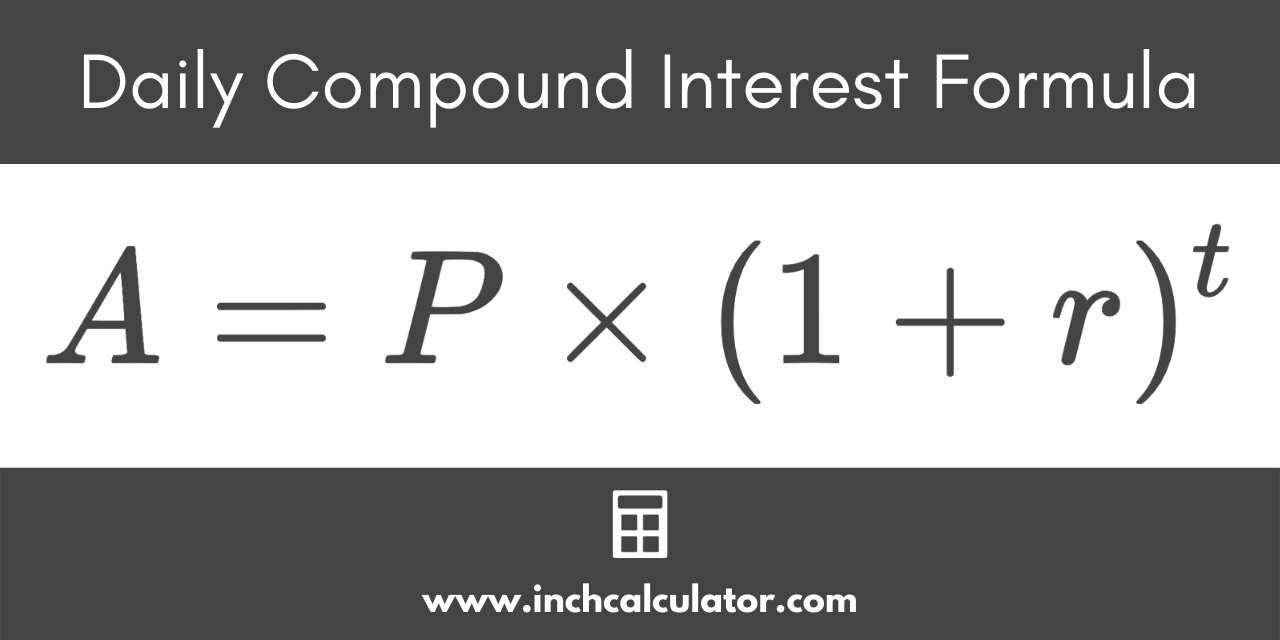
When interest compounds daily, the “Interest on Interest” effect becomes highly efficient. For savers, this means wealth grows faster. For borrowers, it means debt can spiral if left unchecked.
Consider the difference between a loan that compounds annually versus one that compounds daily. On a $50,000 loan at 10% interest:
-
Annual Compounding: After one year, you owe $5,000 in interest.
-
Daily Compounding: Using the formula
A = P(1 + r/n)^(nt), wherenis 365, the interest would be approximately $5,258.
The $258 difference may seem small on a large loan, but when projected over a 10-year period, the gap widens significantly. Understanding this allows you to compare financial products more effectively, looking beyond the nominal APR to the Effective Annual Yield (EAY) or Effective Annual Rate (EAR).
The Rule of 72 and Daily Accrual
Financial planners often use the “Rule of 72” to estimate how long it will take for an investment to double. You divide 72 by the annual interest rate. However, when dealing with daily interest and compounding, the doubling period is slightly shorter than the rule suggests. By computing daily interest, you can more accurately track your progress toward long-term financial milestones, such as retirement or a down payment on a home.
Practical Applications in Personal and Business Finance
Daily interest computation is not just for mathematicians; it is a practical tool for everyday decision-making in both personal and professional contexts.
Managing High-Interest Credit Card Debt
For those carrying a balance on credit cards, the daily interest charge is the primary obstacle to becoming debt-free. By calculating your daily interest, you can see exactly how much of your monthly payment is going toward “renting” the money rather than paying down the principal.
If you discover your daily interest charge is $15, you realize that if you pay $500 toward your card at the end of the month, nearly $450 of that month’s accrual was just interest (assuming a 30-day cycle). This realization often motivates borrowers to make multiple small payments throughout the month to keep the “Average Daily Balance” lower.
Business Cash Flow and Lines of Credit
In the corporate world, businesses often utilize revolving lines of credit to manage operational expenses. These lines of credit typically charge interest on a daily basis based on the outstanding balance.
A business owner who understands how to compute daily interest can make strategic decisions about when to draw from the line of credit and when to deposit revenues. For example, if a business receives a large payment from a client, applying that cash immediately to the line of credit—even if only for three days before it needs to be spent elsewhere—can save hundreds or thousands of dollars in daily interest charges over the course of a fiscal year.
Mortgage Prepayments
While most mortgages are calculated using monthly interest, some “simple interest” mortgages exist. Even in standard mortgages, understanding the daily interest breakdown helps you see the impact of an extra payment. When you make a principal-only payment, you are effectively reducing the “daily cost” of your loan for every day remaining in the mortgage term.
Leveraging Digital Tools for Accuracy
While manual calculation is excellent for understanding the logic, digital tools provide the speed and accuracy required for complex financial planning.
Spreadsheet Functions
Programs like Microsoft Excel and Google Sheets are ideal for tracking daily interest. You can build a “Daily Interest Tracker” by setting up columns for the date, starting balance, interest earned/charged, and ending balance.
The formula for the interest cell would look like this:
=(Balance * Annual_Rate) / 365
By dragging this formula down across 365 rows, you can create a dynamic model that shows how your balance changes every single day, allowing you to “stress test” different scenarios, such as increasing your monthly savings or making extra debt payments.
Using Financial APIs and Calculators
For developers and business owners, financial APIs can integrate daily interest calculations directly into accounting software or customer-facing apps. Furthermore, online daily interest calculators are readily available for quick checks. These are particularly useful when dealing with leap years, as they automatically adjust the divisor from 365 to 366, ensuring that your calculations remain accurate to the penny.
Precision in Financial Forecasting
In conclusion, the ability to compute daily interest is a foundational pillar of financial literacy. It strips away the abstraction of “annual rates” and reveals the reality of how money moves in real-time. Whether you are a consumer trying to escape the cycle of debt, an investor looking to maximize the yield on a portfolio, or a business leader optimizing capital, mastering the daily periodic rate and the mechanics of accrual ensures that you are always in control of your financial destiny. Precision in the small details—the daily cents and dollars—is what ultimately builds significant long-term wealth and stability.
aViewFromTheCave is a participant in the Amazon Services LLC Associates Program, an affiliate advertising program designed to provide a means for sites to earn advertising fees by advertising and linking to Amazon.com. Amazon, the Amazon logo, AmazonSupply, and the AmazonSupply logo are trademarks of Amazon.com, Inc. or its affiliates. As an Amazon Associate we earn affiliate commissions from qualifying purchases.