
The journey to financial prosperity is often paved with smart decisions, consistent effort, and a keen understanding of fundamental financial principles. Among these, compound interest stands as a titan, lauded by many as the “eighth wonder of the world.” While most are familiar with interest compounding annually, quarterly, or even daily, there’s a theoretical, yet incredibly powerful, concept that represents the ultimate limit of this growth: continuous compound interest. Understanding how to calculate it not only deepens your financial literacy but also provides a powerful lens through which to view potential investment growth and the dynamics of certain financial instruments.
In essence, continuous compounding imagines a scenario where interest is calculated and added to the principal an infinite number of times over a given period. While this might sound purely academic, it serves as a cornerstone in complex financial modeling, particularly for derivative pricing and sophisticated investment analysis. For the average investor, it represents the absolute maximum potential growth for an investment under ideal compounding conditions, offering a benchmark against which other forms of compounding can be measured. This article will demystify continuous compound interest, break down its formula, provide practical examples, and explore its significance in your financial world.
Understanding the Power of Compounding
Before diving into the intricacies of continuous compounding, it’s crucial to firmly grasp the concept of compound interest itself. It’s the interest on an initial principal, which then earns interest on its own in subsequent periods, leading to exponential growth.
The Basics of Discrete Compound Interest
Most people encounter “discrete” compound interest, where interest is calculated and added at specific intervals—annually, semi-annually, quarterly, monthly, or even daily. The more frequently interest is compounded, the faster your money grows, because you start earning interest on your accumulated interest sooner.
The general formula for discrete compound interest is:
A = P(1 + r/n)^(nt)
Where:
-
A = the future value of the investment/loan, including interest
-
P = the principal investment amount (the initial deposit or loan amount)
-
r = the annual interest rate (as a decimal)
-
n = the number of times that interest is compounded per year
-
t = the number of years the money is invested or borrowed for
Let’s illustrate with a quick example: If you invest $1,000 at an annual interest rate of 5% compounded annually for 10 years, your calculation would be: A = 1000(1 + 0.05/1)^(110) = $1,628.89. If compounded monthly, A = 1000(1 + 0.05/12)^(1210) = $1,647.01. Notice how even a shift from annual to monthly compounding yields a slightly higher return. This small difference highlights the power of compounding frequency.
Why Continuous Compounding Matters
Continuous compounding takes this idea of compounding frequency to its theoretical limit. Instead of compounding every day, hour, or minute, it assumes interest is compounded an infinite number of times per year. While no real-world financial product literally compounds continuously, this concept is incredibly valuable in finance for several reasons:
-
Theoretical Maximum: It provides a ceiling for how much an investment can grow through compounding.
-
Financial Modeling: It simplifies calculations for certain financial models and derivatives where discrete time intervals might overcomplicate the analysis.
-
Benchmark: It serves as a benchmark for comparing the effectiveness of different compounding frequencies.
-
Natural Growth Processes: The mathematical constant at its heart, ‘e’ (Euler’s number), is fundamental in describing all forms of natural, continuous growth processes, from population dynamics to radioactive decay.
Understanding continuous compounding helps you appreciate the maximum potential of your capital and grasp more advanced financial theories.
The Formula for Continuous Compound Interest
The leap from discrete to continuous compounding requires introducing a special mathematical constant: Euler’s number.
Introducing Euler’s Number (e)
Euler’s number, denoted by ‘e’, is an irrational number approximately equal to 2.71828. It’s often called the natural base for exponents because it naturally arises in calculations involving continuous growth. Just as pi (π) is fundamental to circles, ‘e’ is fundamental to processes of continuous growth and decay. In the context of compound interest, as the compounding frequency ‘n’ in our discrete formula approaches infinity, the term (1 + 1/n)^n approaches ‘e’. This elegant mathematical convergence simplifies the formula dramatically.
The Continuous Compounding Formula Explained
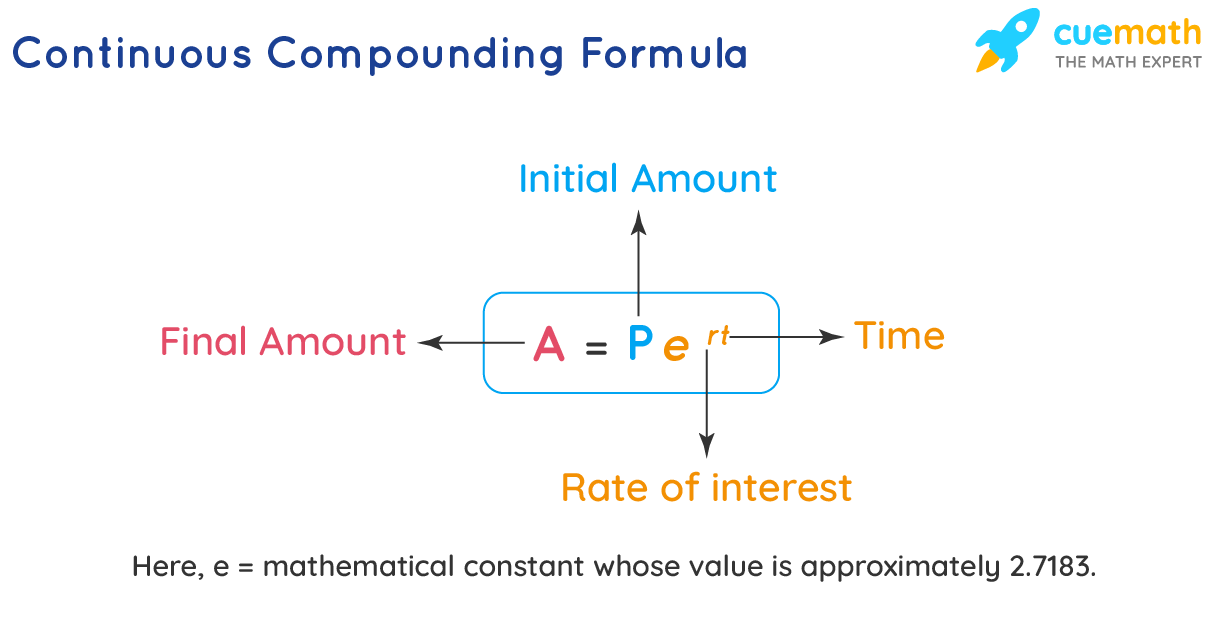
With ‘e’ in hand, the formula for continuous compound interest becomes strikingly simple:
A = Pe^(rt)
Where:
-
A = the future value of the investment/loan, including interest
-
P = the principal investment amount (the initial deposit)
-
e = Euler’s number (approximately 2.71828)
-
r = the annual interest rate (as a decimal)
-
t = the number of years the money is invested or borrowed for
This formula is often referred to as the “PERT” formula, a simple mnemonic to remember its components.
Step-by-Step Calculation Example
Let’s use our previous example and apply the continuous compounding formula.
Scenario: You invest $1,000 at an annual interest rate of 5% compounded continuously for 10 years.
-
Identify your variables:
-
P (Principal) = $1,000
-
r (Annual interest rate) = 0.05 (5% as a decimal)
-
t (Time in years) = 10
-
e (Euler’s number) ≈ 2.71828
-
-
Substitute the values into the formula:
- A = 1000 * e^(0.05 * 10)
-
Calculate the exponent (r * t):
- 0.05 * 10 = 0.5
-
Calculate e to the power of (r * t):
- e^0.5 ≈ 1.64872
-
Multiply by the principal:
-
A = 1000 * 1.64872
-
A = $1,648.72
-

So, after 10 years, your initial $1,000 investment would grow to approximately $1,648.72 with continuous compounding. Comparing this to the $1,628.89 (annual) and $1,647.01 (monthly) from our earlier examples, you can see that continuous compounding yields the highest return, albeit only slightly more than daily or monthly compounding. This illustrates the diminishing returns of increasing compounding frequency beyond a certain point.
Practical Applications and Real-World Implications
While continuous compounding is a theoretical ideal, its understanding has significant practical implications in finance.
Investment Growth Projections
For long-term investors, understanding continuous compounding provides the most optimistic projection for growth. It shows the absolute maximum an investment could yield given a specific rate and time period. This can be a useful benchmark when comparing different investment opportunities or assessing the long-term potential of a retirement portfolio. While actual returns will likely be slightly less due to discrete compounding intervals, continuous compounding offers a clean upper bound. Many financial models, especially those dealing with asset pricing or future value calculations over very short, effectively continuous, timeframes, use this formula as a simplifying assumption.
Loan Calculations and Interest Accrual
Although rare for standard consumer loans, some complex financial instruments, particularly in wholesale or interbank markets, may approach continuous interest accrual. For bonds, the concept of continuously compounded yield is often used for analytical purposes, especially when comparing bonds with different payment frequencies. While you won’t typically see a mortgage or car loan compounded continuously, grasping this concept enhances your ability to understand the most aggressive forms of interest calculation and how even small differences in compounding frequency can add up over time.
Comparing Different Compounding Frequencies
The difference between continuous compounding and other frequencies helps quantify the “cost” of less frequent compounding. For instance, comparing the future value of an investment compounded annually, monthly, daily, and continuously reveals how much of the maximum potential return is “lost” due to discrete intervals. This insight can influence investment choices, pushing investors towards products that compound more frequently, assuming all other factors are equal. The marginal gain from continuous over daily compounding is often small, but it underscores the power of time and consistent growth.
Tools and Resources for Calculation
Calculating continuous compound interest is straightforward, especially with modern tools.
Using Financial Calculators
Dedicated financial calculators, like the HP 12c or Texas Instruments BA II Plus, often have a function for ‘e^x’ or ‘EXP’. To use them, you would typically:
-
Input the interest rate (r) multiplied by the time (t).
-
Press the ‘e^x’ or ‘EXP’ button.
-
Multiply the result by the principal (P).
These calculators are designed for financial professionals and can handle more complex functions, but for continuous compounding, the process is quite direct.
Spreadsheet Software (Excel/Google Sheets)
Spreadsheet programs like Microsoft Excel or Google Sheets are excellent tools for these calculations, allowing you to easily set up scenarios and compare results.
The formula in Excel/Google Sheets is: =P * EXP(r * t)
For example, if:
-
Principal (P) is in cell A2
-
Annual rate (r) is in cell B2
-
Years (t) is in cell C2
You would enter: =A2 * EXP(B2 * C2) into another cell to get the future value. The EXP() function in spreadsheets calculates ‘e’ raised to the power of the number provided in its argument. This makes it incredibly simple to run different scenarios by just changing the values in cells A2, B2, or C2.
Online Calculators and Financial Software
Numerous websites offer free online continuous compound interest calculators. These are user-friendly: you simply input your principal, interest rate, and time period, and the calculator instantly provides the future value. Many financial planning software suites also incorporate these calculations, allowing you to model investment growth within your overall financial plan. These tools are perfect for quick estimates and for those who prefer not to manually calculate.
Strategies for Maximizing Compound Interest
Understanding continuous compounding isn’t just about calculation; it’s about leveraging its underlying principles to maximize your financial growth.
Start Early, Stay Consistent
The single most impactful factor in any compound interest calculation, whether discrete or continuous, is time (t). The longer your money has to grow, the more significantly compounding (especially at higher frequencies) will impact your returns. Starting to invest early, even with modest amounts, gives your capital decades to benefit from exponential growth. Consistency in contributions further amplifies this effect, as more principal means more interest earned in each period.
Reinvest Earnings
To fully harness the power of compounding, ensure that any interest or dividends earned on your investments are reinvested. If you withdraw your earnings, you reduce the principal amount that can compound in future periods, slowing down your growth. Reinvesting means your interest starts earning interest, accelerating your journey towards financial goals. This is a critical habit for long-term wealth building.
Understanding Tax Implications
While not directly part of the calculation, it’s crucial to acknowledge that taxes can impact your actual compounded returns. Interest and investment gains are often subject to income or capital gains tax. Using tax-advantaged accounts like 401(k)s, IRAs, or HSAs, where investments can grow tax-deferred or tax-free, allows your money to compound more efficiently without annual tax erosion. Always consider the after-tax return when evaluating investment growth.

Conclusion
Calculating continuous compound interest might seem like an advanced financial concept, but it boils down to a straightforward formula involving Euler’s number. A = Pe^(rt) provides the theoretical maximum return an investment can achieve, compounding infinitely often. While purely theoretical for most everyday investments, its importance in financial modeling, benchmarking, and understanding the absolute potential of compounding cannot be overstated.
By grasping this concept, you gain a deeper appreciation for the unparalleled power of time and consistent investment in wealth creation. Utilize readily available tools like spreadsheets or online calculators to project potential growth, and always remember that the earlier you start, the more consistently you invest, and the more faithfully you reinvest your earnings, the closer you get to experiencing the “eighth wonder of the world” in your own financial life.
aViewFromTheCave is a participant in the Amazon Services LLC Associates Program, an affiliate advertising program designed to provide a means for sites to earn advertising fees by advertising and linking to Amazon.com. Amazon, the Amazon logo, AmazonSupply, and the AmazonSupply logo are trademarks of Amazon.com, Inc. or its affiliates. As an Amazon Associate we earn affiliate commissions from qualifying purchases.