
In the vast landscape of personal finance, business operations, and economic understanding, percentages serve as fundamental building blocks. They allow us to express proportions, calculate changes, and compare values in a standardized way. Among these, calculating 5 percent of a number is a surprisingly frequent and practical task, appearing everywhere from sales discounts and tax computations to investment returns and budgeting. Mastering this seemingly simple calculation is not just about crunching numbers; it’s about empowering yourself with financial literacy, enabling smarter decisions, and fostering a deeper understanding of the monetary world around you.
This article will demystify the process of calculating 5 percent, offering multiple methods, exploring its wide-ranging financial applications, and providing insights to ensure accuracy and confidence in your calculations. Whether you’re a budding entrepreneur, a diligent budgeter, or simply someone looking to better understand their finances, grasping this core concept is an invaluable skill.
The Fundamental Importance of 5% in Finance
While any percentage can be calculated, 5% holds a particular significance in many financial contexts. It’s often used as a benchmark, a common increment, or a recognizable proportion that frequently surfaces in our daily financial lives. Understanding why it’s so prevalent helps underscore the utility of knowing how to calculate it quickly and accurately.
Why 5% is a Common Benchmark
The number 5, as a single digit, is intuitive and often easy to work with mentally. When translated into a percentage, 5% represents a relatively small but meaningful portion. It’s often seen as a reasonable discount rate, a modest interest rate, a common sales tax increment (or part of one), or a manageable portion for saving or spending categories in a budget. For many, it’s a ‘sweet spot’ – large enough to be impactful, yet small enough to feel achievable or acceptable. This makes it a go-to figure for quick estimations, policy thresholds, and marketing strategies. For instance, a “5% increase” or “5% off” is instantly digestible and often seen as a fair adjustment.
Everyday Scenarios Where 5% Matters
The prevalence of 5% extends across a myriad of financial situations. Consider these common examples:
-
Sales Tax and Service Charges: In many jurisdictions, sales tax rates are either exactly 5% or are combinations that make calculating 5% a useful stepping stone (e.g., a 10% tax can be thought of as two 5% increments). Restaurants or service providers might also add a 5% service charge.
-
Tipping: While 15-20% is more common, calculating 5% can be a quick way to estimate a quarter of a 20% tip, or to quickly sum up to a desired tip amount (e.g., 10% + 5% = 15%).
-
Discounts and Promotions: Retailers frequently offer “5% off” promotions, especially for specific payment methods, loyalty programs, or during flash sales.
-
Budgeting and Savings: Many financial advisors recommend allocating specific percentages of income to different categories, and 5% might be a target for a particular savings goal, charitable giving, or a discretionary spending fund.
-
Interest Rates: While often higher, a 5% interest rate on a savings account or a loan is a very straightforward figure to calculate simple interest on, especially for short periods.
-
Investment Returns: Understanding a 5% annual return on an investment helps in projecting growth and comparing different investment vehicles.
-
Business Margins: Businesses constantly calculate profit margins, cost reductions, and price increases, where 5% adjustments can be significant to the bottom line.
These examples underscore that calculating 5% isn’t just an academic exercise; it’s a practical skill directly applicable to managing your money effectively.
Mastering the Basic Calculation Methods
Calculating 5% of a number is a straightforward mathematical operation. However, there isn’t just one way to do it. Depending on the context, the numbers involved, and whether you have a calculator handy, different methods might be more efficient. Understanding these various approaches gives you flexibility and speed.
The Decimal Method: Multiplying by 0.05
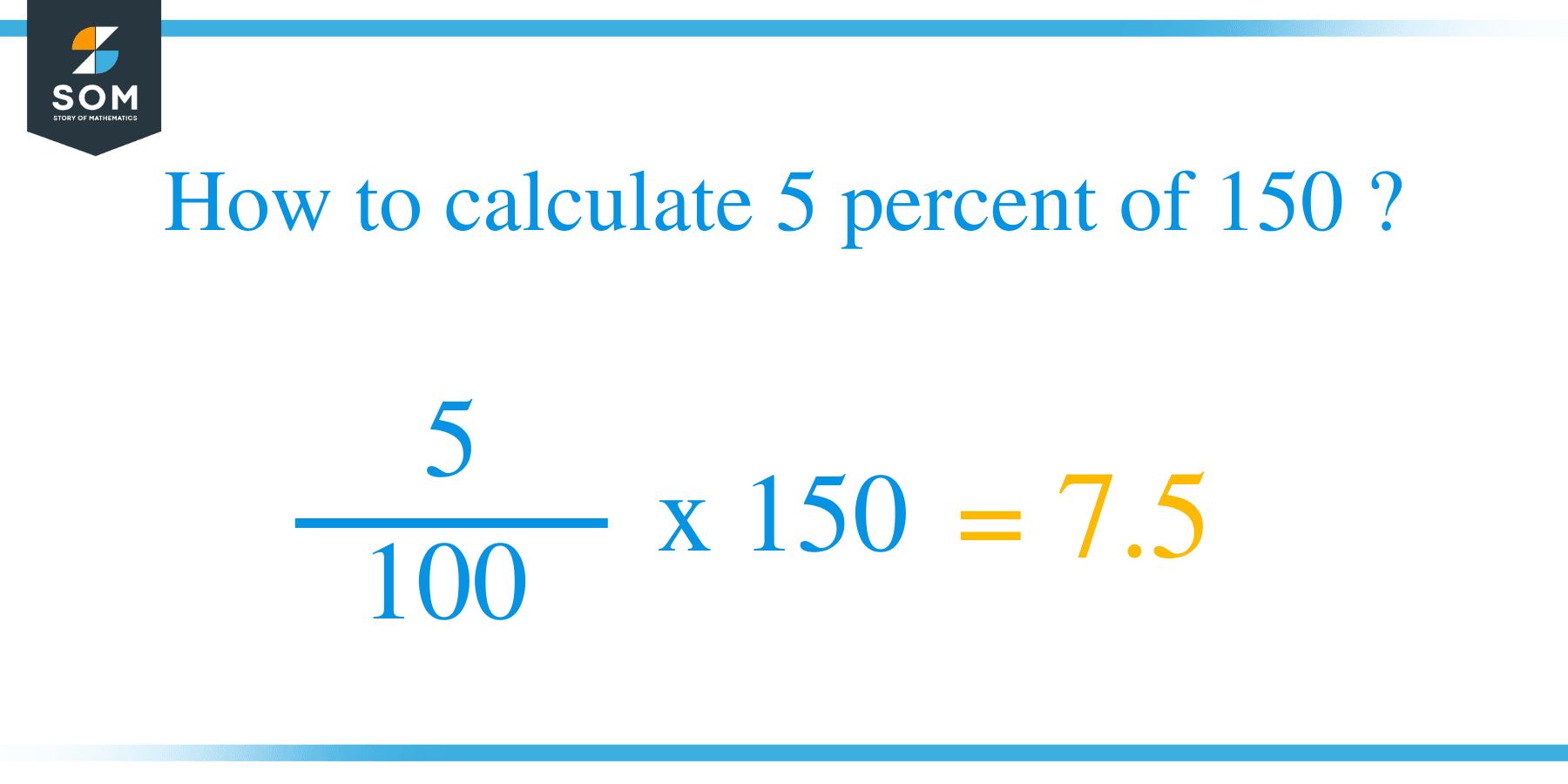
This is perhaps the most universally applicable and mathematically sound method. The word “percent” literally means “per one hundred,” so 5 percent is equivalent to 5 out of 100, or 5/100. As a decimal, 5/100 is 0.05.
Method: Convert the percentage to a decimal by dividing it by 100 (moving the decimal point two places to the left), then multiply that decimal by the number you’re interested in.
Formula: Number × 0.05
Example: Calculate 5% of $200.
$200 × 0.05 = $10
This method is particularly useful when using a calculator or spreadsheet, as it’s direct and leaves little room for error.
The Fractional Method: Dividing by 20
Another elegant way to think about 5% is in terms of fractions. Since 5% is 5/100, we can simplify this fraction:
5 ÷ 5 = 1
100 ÷ 5 = 20
So, 5% is equivalent to 1/20.
Method: To find 5% of a number, simply divide that number by 20.
Formula: Number ÷ 20
Example: Calculate 5% of $200.
$200 ÷ 20 = $10
This method is excellent for mental math or when dealing with numbers that are easily divisible by 20, as it can often be quicker than the decimal multiplication, especially without a calculator.
The “Divide by 10 then Halve” Shortcut
This mental math shortcut is incredibly powerful because it leverages the ease of dividing by 10. We know that 10% is simply moving the decimal point one place to the left. Since 5% is exactly half of 10%, we can apply this simple two-step process.
Method: First, calculate 10% of the number, then divide that result by 2 (or halve it).
Formula: (Number ÷ 10) ÷ 2
Example: Calculate 5% of $200.
-
Calculate 10% of $200: $200 ÷ 10 = $20
-
Halve the result: $20 ÷ 2 = $10
This method is arguably the fastest for mental calculations, especially with whole numbers or numbers ending in zero, and is a favorite among those who need to make quick financial estimations on the fly.
Using a Calculator Efficiently
While the mental math techniques are valuable, for complex numbers or when precision is paramount, a calculator is indispensable. Most calculators have a dedicated percentage button (%).
Method 1 (Direct):
-
Enter the number.
-
Press the multiplication button (
×). -
Enter 5.
-
Press the percentage button (
%).
Example: 200 × 5 % will directly yield 10.
Method 2 (Decimal approach on calculator):
-
Enter the number.
-
Press the multiplication button (
×). -
Enter 0.05.
-
Press the equals button (
=).
Example: 200 × 0.05 = will yield 10.
Both methods work, but understanding the decimal approach (× 0.05) is more universally applicable across different calculator types and software like spreadsheets, which may not have a ‘%’ button that functions identically.
Real-World Financial Applications of 5%

Beyond the pure mechanics of calculation, the true value of understanding 5% lies in its practical application across various financial domains. From everyday consumer transactions to broader financial planning, 5% frequently emerges as a pivotal figure.
Sales Tax and Discounts
One of the most common encounters with percentages is in retail. Imagine you’re buying an item for $75, and the sales tax rate in your area is 5%. Using the decimal method: $75 × 0.05 = $3.75. Your total cost would be $75 + $3.75 = $78.75.
Conversely, if a store offers a “5% off” discount on an item priced at $120. Using the “divide by 10 then halve” method:
-
10% of $120 = $12
-
5% of $120 = $12 ÷ 2 = $6
The discount is $6, so the new price is $120 – $6 = $114. These quick calculations empower you to verify prices and understand your savings.
Tipping and Service Charges
When dining out or receiving a service, leaving a tip is customary. While 15-20% is standard, calculating 5% can be a useful step. If your bill is $85, and you want to leave a 15% tip:
-
Calculate 10% of $85 = $8.50
-
Calculate 5% of $85 = $8.50 ÷ 2 = $4.25
-
Add them together for 15%: $8.50 + $4.25 = $12.75.
Knowing how to calculate 5% quickly makes approximating other percentages much easier.
Budgeting and Savings Goals
Financial planning often involves allocating percentages of your income. Let’s say your monthly take-home pay is $4,000, and you decide to dedicate 5% of it to a specific long-term savings goal, like a down payment for a house.
$4,000 × 0.05 = $200.
This means you’d be saving $200 each month for that particular goal. Regularly calculating and setting aside percentages ensures you’re on track to meet your financial objectives without feeling overwhelmed.
Business Margins and Pricing
For business owners, understanding percentages is critical for profitability. If a product costs $50 to produce, and you aim for a 5% profit margin on that cost, you’d add:
$50 × 0.05 = $2.50
So, you’d want to sell it for at least $50 + $2.50 = $52.50 to cover costs and achieve that 5% margin. Pricing strategies, discounts offered to bulk buyers, and supplier negotiations all rely heavily on accurate percentage calculations to maintain healthy financial operations.
Simple Interest Calculations
While many financial products use compound interest, understanding simple interest is a foundational concept. If you have a $1,000 savings bond that offers a simple interest rate of 5% per year, the interest earned in one year would be:
$1,000 × 0.05 = $50.
Over two years, it would be $50 × 2 = $100. This calculation is a basic building block for understanding how loans accrue interest and how investments grow.
Understanding Investment Returns
When evaluating investment opportunities, return percentages are paramount. If an investment portfolio had a 5% return in a given year on an initial $10,000 investment:
$10,000 × 0.05 = $500.
Your investment would have grown by $500, bringing its value to $10,500 (before any fees or taxes). Comparing investments with different historical returns or projected yields often comes down to accurately calculating and interpreting these percentages.
Avoiding Common Pitfalls and Ensuring Accuracy
While calculating 5% is generally straightforward, minor errors or misunderstandings can lead to significant financial discrepancies. Being aware of these common pitfalls can help ensure your calculations are always accurate.
Distinguishing Between ‘Of’ and ‘Off’
This is a subtle but crucial distinction. “5% of a number” means you are finding a portion of that number. “5% off a number” means you are finding 5% of the number, and then subtracting that amount from the original number. For example:
-
5% of $100 = $5
-
5% off $100 = $100 – ($100 × 0.05) = $100 – $5 = $95
Always read financial statements, discounts, and terms carefully to understand whether a percentage refers to a portion of the original value or a reduction off the original value.
The Impact of Rounding
When dealing with money, calculations often result in decimal places beyond two. For example, 5% of $75.50 is $3.775. Since currency typically only goes to two decimal places (cents), you’ll need to round.
-
Standard rounding rules apply: if the third decimal place is 5 or greater, round up the second decimal place. If it’s 4 or less, round down (keep the second decimal place as is).
-
In the example, $3.775 would round up to $3.78.
-
A common mistake is rounding too early in a multi-step calculation, which can compound errors. It’s generally best to carry out calculations with full precision and only round the final answer to two decimal places for currency.
Double-Checking Your Calculations
Even with the simplest calculations, it’s wise to double-check, especially for significant financial decisions.
-
Use a different method: If you calculated 5% using the decimal method, quickly verify it with the “divide by 10 then halve” shortcut.
-
Mental estimation: Always do a quick mental check. If you’re calculating 5% of $1,000, you know 10% is $100, so 5% should be around $50. If your calculator shows $5 or $500, you know something is wrong.
-
Reverse calculation: If you found 5% of $X is $Y, you can try dividing $Y by 0.05 to see if you get back to $X (e.g., $10 ÷ 0.05 = $200).
These simple habits can save you from costly errors and provide peace of mind in your financial dealings.
Leveraging Technology for Percentage Calculations
While mental math and manual calculations are excellent for building financial acumen, modern technology offers powerful tools that can make calculating 5% (and any other percentage) faster, more accurate, and integrated into your financial management.
Spreadsheet Functions (Excel, Google Sheets)
Spreadsheets are financial powerhouses. They make repetitive calculations effortless and allow for complex scenario planning.
-
Direct Formula: If you have a number in cell A1 (e.g., 200), you can find 5% of it in another cell using the formula
=A1*0.05. -
Using Percentage Format: You can also type
=A1*5%. Excel and Google Sheets automatically interpret “5%” as 0.05. -
Scenario Planning: Imagine you want to see the effect of a 5% change across multiple items. You can set up a column for original prices, apply a 5% discount formula, and instantly see the new prices for hundreds of items.
Mastering basic spreadsheet functions for percentages is a fundamental skill for anyone managing personal or business finances.
Online Calculators and Mobile Apps
For quick, on-the-go calculations, countless online calculators and mobile apps are available.
-
General Calculators: Most standard calculator apps on smartphones have a percentage button. As discussed, entering
200 × 5 %is typically all it takes. -
Specialized Financial Apps: Many budgeting apps, investment tracking apps, or point-of-sale systems have built-in percentage calculators for discounts, tips, or profit margins, streamlining financial operations.
-
Web-Based Tools: A quick search for “percentage calculator” will yield numerous websites that allow you to input a number and a percentage to get an instant result, useful for quick checks without opening a spreadsheet.
These tools provide convenience and accuracy, especially when you don’t have a pen and paper or need a quick verification.
Financial Software Integration
Modern financial management software, from personal budgeting tools like Mint or YNAB to business accounting software like QuickBooks or Xero, often integrates percentage calculations seamlessly.
-
Automated Budgeting: You can set rules that allocate, for example, 5% of every incoming paycheck to a specific savings category automatically.
-
Invoice Generation: Business software can automatically apply a 5% late fee or a 5% early payment discount when generating invoices, reducing manual effort and errors.
-
Reporting: Financial dashboards and reports often display key performance indicators as percentages (e.g., “profit margin increased by 5%”), making it easy to track trends and make informed decisions.
By understanding how these technologies handle percentage calculations, you can better utilize them to manage your money more efficiently and gain deeper insights into your financial health.

Conclusion
Calculating 5 percent of a number is far more than a simple arithmetic problem; it’s a foundational skill for financial literacy. From navigating daily transactions like sales tax and discounts to making informed decisions about investments, budgeting, and business operations, the ability to quickly and accurately determine 5% is invaluable.
By mastering the various calculation methods—be it the precise decimal method, the efficient fractional approach, or the speedy “divide by 10 then halve” shortcut—you equip yourself with the tools to confidently handle a multitude of financial scenarios. Coupled with an awareness of common pitfalls like rounding errors and the distinction between “of” and “off,” and the intelligent use of modern technological aids, you can ensure your financial computations are always accurate and insightful.
In a world increasingly driven by numbers and percentages, taking the time to truly understand and apply these basic concepts empowers you to take control of your financial destiny, making smarter choices and building a more secure financial future.
aViewFromTheCave is a participant in the Amazon Services LLC Associates Program, an affiliate advertising program designed to provide a means for sites to earn advertising fees by advertising and linking to Amazon.com. Amazon, the Amazon logo, AmazonSupply, and the AmazonSupply logo are trademarks of Amazon.com, Inc. or its affiliates. As an Amazon Associate we earn affiliate commissions from qualifying purchases.