
Understanding how interest is calculated on a savings account is more than just a financial curiosity; it’s a fundamental aspect of personal finance that empowers individuals to make informed decisions about their money. For many, a savings account is the first step on their financial journey, a safe haven for emergency funds, short-term goals, or simply accumulating wealth. Yet, the precise mechanics of how those small, seemingly insignificant interest payments add up can often feel opaque. This article will demystify the process, breaking down the key concepts and calculations involved, and providing insights into how you can optimize your savings to work harder for you.

At its core, interest is the cost of borrowing money or the reward for lending it. In the context of a savings account, you are essentially lending your money to the bank, and in return, the bank pays you a percentage of your deposit as interest. This symbiotic relationship allows banks to operate by using your deposits for loans and investments, while simultaneously providing you with a secure place to store your money and earn a modest return. Grasping the details of this calculation is crucial for anyone looking to grow their wealth effectively, differentiate between various savings products, and ultimately achieve their financial objectives.
Understanding the Fundamentals of Savings Account Interest
Before delving into the mathematical formulas, it’s essential to establish a clear understanding of the basic principles and terminology that govern interest calculations. These foundational concepts are the building blocks for comprehending how your savings truly grow over time.
What is Interest?
Simply put, interest is the money a bank pays you for keeping your funds with them. From your perspective as a saver, it’s the return you earn on your principal deposit. From the bank’s perspective, it’s the cost of using your money to fund their lending activities and operations. This payment is typically expressed as a percentage of your balance over a specific period, usually annually.
Why Do Banks Pay Interest?
Banks are financial intermediaries. They take deposits from savers and lend that money out to borrowers (individuals, businesses, governments) at a higher interest rate than they pay to their savers. The difference, known as the “interest rate spread,” covers their operational costs and generates profit. By offering interest, banks incentivize individuals to deposit their money, ensuring a steady supply of funds for lending. It’s a core part of the banking business model.
Key Terminology to Know
Navigating the world of savings accounts requires familiarity with specific terms. Misunderstanding these can lead to confusion and suboptimal financial choices.
-
Principal: This is the initial amount of money you deposit into your savings account, or the total amount currently held in the account, upon which interest is calculated.
-
Interest Rate: Expressed as a percentage, this is the annual rate at which interest is paid on your principal. It’s often referred to as the Annual Percentage Rate (APR), though for savings accounts, the APY is generally a more useful metric.
-
Compounding: This is the process where the interest earned on your principal is added back to your principal, and then the next interest calculation is based on this new, larger amount. It’s the engine behind long-term wealth growth.
-
Compounding Frequency: How often the interest is added to your principal. Common frequencies include daily, monthly, quarterly, or annually. The more frequently interest compounds, the faster your money grows.
-
Annual Percentage Yield (APY): This is perhaps the most important term for savers. APY represents the total return you’ll earn on your savings account over a year, taking into account the effect of compounding interest. It provides a standardized way to compare the true earning potential of different accounts, regardless of their compounding frequency.
-
Annual Percentage Rate (APR): While often used interchangeably with APY, APR typically refers to the simple interest rate over a year, without factoring in compounding. For savings accounts, APY is a more accurate reflection of actual earnings.
The Mechanics of Interest Calculation
Understanding the fundamental terms lays the groundwork for exploring how interest is actually calculated. The primary distinction lies between simple interest and the far more powerful compound interest.
Simple Interest vs. Compound Interest
-
Simple Interest: This is calculated only on the initial principal amount. The formula is straightforward:
Interest = Principal × Rate × Time. If you deposit $1,000 at a 1% simple interest rate annually, you’d earn $10 each year, and your principal would remain $1,000 for calculation purposes. While simple to understand, it’s rarely used for standard savings accounts. -
Compound Interest: This is where the magic happens for savers. Compound interest is calculated on the initial principal and on the accumulated interest from previous periods. This means your money grows exponentially over time, as you earn “interest on interest.” It’s often called the “eighth wonder of the world” for a reason.
The Power of Compound Interest
Most savings accounts utilize compound interest because it benefits both the bank (by encouraging long-term deposits) and the saver (by accelerating wealth growth).
Compounding Frequency
The frequency at which interest is compounded significantly impacts your total earnings.
-
Daily Compounding: Interest is calculated and added to your principal every day. This provides the highest yield for a given interest rate.
-
Monthly Compounding: Interest is calculated and added once a month.
-
Quarterly Compounding: Interest is calculated and added once every three months.
-
Annually Compounding: Interest is calculated and added once a year.
The more frequently interest compounds, the higher your APY will be, even if the stated annual interest rate (APR) is the same. For example, an account with a 1% annual interest rate compounded daily will yield slightly more than an account with a 1% annual interest rate compounded annually.
Formula for Compound Interest
While banks handle these calculations automatically, understanding the formula can deepen your appreciation for compounding:
A = P(1 + r/n)^(nt)
Where:
-
A= the future value of the investment/loan, including interest -
P= the principal investment amount (the initial deposit) -
r= the annual interest rate (as a decimal) -
n= the number of times that interest is compounded per year -
t= the number of years the money is invested or borrowed for
For example, if you deposit $1,000 at an annual interest rate of 1% (0.01 as a decimal), compounded monthly (n=12), for 5 years (t=5):
A = 1000(1 + 0.01/12)^(12*5)
A = 1000(1 + 0.0008333)^(60)
A = 1000(1.0008333)^(60)
A ≈ 1000(1.0512)
A ≈ $1051.20
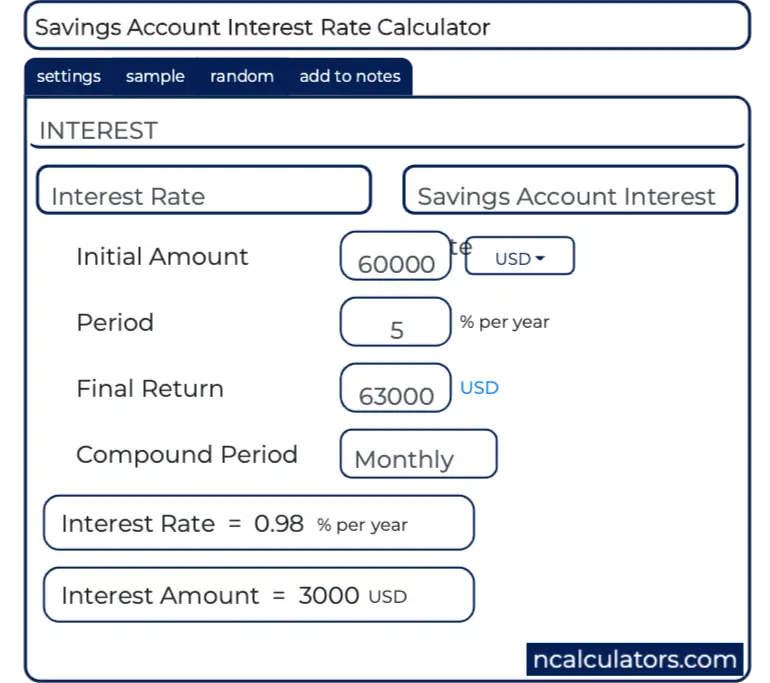
This calculation shows your total balance after 5 years, including the initial principal and the earned compound interest.
Annual Percentage Yield (APY) vs. Interest Rate
It cannot be stressed enough: always compare savings accounts using their APY. The stated “interest rate” (or APR) does not reflect the true earnings because it doesn’t account for compounding. APY standardizes the comparison by providing the effective annual rate of return, factoring in the effect of compounding interest. This is why a savings account advertising a 0.995% interest rate compounded daily might have an APY of 1.00%, which is what you should focus on.
Factors Influencing Your Savings Account Interest Earnings
Beyond the core mechanics, several other factors play a critical role in how much interest you ultimately earn on your savings account. Being aware of these elements can help you make more strategic decisions.
Interest Rate
This is the most obvious factor. A higher interest rate directly translates to more earnings. Even a difference of a fraction of a percentage point can accumulate significantly over time, especially with larger balances.
Account Balance (Principal)
The amount of money you have in your account directly impacts the amount of interest generated. More principal means more interest earned, assuming the same interest rate and compounding frequency. This highlights the importance of consistently adding to your savings.
Compounding Frequency
As discussed, more frequent compounding (e.g., daily vs. monthly) will lead to a slightly higher APY and, therefore, greater total interest earned over the year, given the same base interest rate.
Balance Calculation Method
This is a nuanced but important detail that can vary between banks. How a bank determines the “principal” for daily interest calculation can affect your earnings:
-
Daily Balance Method: Interest is calculated each day based on the actual balance in the account at the end of that day. This is generally the most favorable method for savers.
-
Average Daily Balance Method: Interest is calculated based on the average balance in the account over a specific period (e.g., a month). This might be less favorable if your balance fluctuates significantly, especially if it dips for extended periods.
-
Lowest Balance Method: Interest is calculated on the lowest balance the account held during the entire interest period. This is the least favorable method for savers, as any withdrawals, even temporary ones, can reduce the interest earned for the entire period.
Always check with your bank or review the account disclosures to understand which balance calculation method they use.
Bank Type and Account Features
Different types of banks and accounts offer varying interest rates:
-
Traditional Brick-and-Mortar Banks: Often offer lower interest rates on standard savings accounts due to higher operating costs.
-
Online Banks: Typically offer higher interest rates (and therefore higher APYs) on their high-yield savings accounts because they have lower overheads compared to traditional banks.
-
Credit Unions: Member-owned financial institutions that may offer competitive rates, often prioritizing member benefits over maximizing profit.
-
Money Market Accounts (MMAs): These accounts combine some features of savings and checking accounts and often offer higher interest rates than basic savings accounts, though they may have higher minimum balance requirements.
-
Certificates of Deposit (CDs): While not technically savings accounts, CDs offer even higher, fixed interest rates in exchange for locking your money away for a specific term.
Maximizing Your Savings Interest
Now that you understand the intricacies of interest calculation, how can you use this knowledge to your advantage and maximize your earnings?
Shop Around for the Best Rates
Don’t settle for the default savings account linked to your checking account if it offers a paltry interest rate. Research and compare offers from various banks, especially online banks, which frequently offer significantly higher APYs. Even a small increase in APY can make a substantial difference over the long term.
Understand and Compare APY
As highlighted, APY is your best friend when comparing savings accounts. It levels the playing field, allowing you to accurately assess which account will generate the most interest for you, regardless of the underlying interest rate or compounding frequency.
Increase Your Principal
The more money you save, the more interest you earn. This is a simple but powerful principle. Consistently contributing to your savings account, even small amounts, will accelerate your wealth growth through the power of compounding.
Automate Savings
Set up automatic transfers from your checking account to your savings account. This “set it and forget it” approach ensures consistent contributions, building your principal steadily without requiring conscious effort each time. Even $50 or $100 a month can add up significantly.
Be Aware of Fees and Minimums
Some savings accounts, particularly high-yield ones, may come with minimum balance requirements to earn the advertised APY or to avoid monthly maintenance fees. Ensure you understand these terms, as fees can quickly erode your interest earnings. A high-yield account with fees that eat into your profit is less effective than a slightly lower-yield account with no fees.

Consider High-Yield Savings Accounts
If your goal is to grow your emergency fund or save for a down payment, a high-yield savings account is often the best choice. These accounts, typically offered by online banks, provide much more competitive interest rates than traditional savings accounts, maximizing your compounding potential.
In conclusion, understanding how interest is calculated on your savings account is a critical component of sound personal finance. It’s not just about the percentage rate; it’s about the interplay of principal, interest rate, compounding frequency, and balance calculation methods. By grasping these concepts and proactively seeking out accounts that offer the best APYs and favorable terms, you can ensure your hard-earned money is working as hard as possible for you, paving the way for greater financial security and the achievement of your financial goals.
aViewFromTheCave is a participant in the Amazon Services LLC Associates Program, an affiliate advertising program designed to provide a means for sites to earn advertising fees by advertising and linking to Amazon.com. Amazon, the Amazon logo, AmazonSupply, and the AmazonSupply logo are trademarks of Amazon.com, Inc. or its affiliates. As an Amazon Associate we earn affiliate commissions from qualifying purchases.