
In the world of finance, numbers are rarely viewed in isolation. To understand the health of an investment, the efficiency of a business, or the success of a personal budget, we must look at how those numbers change over time. One of the most vital metrics for any financially literate individual or professional is the percent decrease. Whether you are tracking a dip in stock prices, a reduction in monthly overhead, or a decline in purchasing power due to market shifts, knowing how to calculate and interpret the percent decrease is essential for making informed decisions.
A percent decrease represents the relative change between an initial value and a lower subsequent value, expressed as a fraction of 100. Unlike a simple subtraction, which tells you the absolute change, the percentage provides context. A $100 drop in value means something very different if you started with $200 versus if you started with $20,000. By the end of this guide, you will not only master the mathematical formula but also understand its profound implications in personal finance, investment strategy, and corporate management.
The Fundamental Mathematics of Financial Calculation
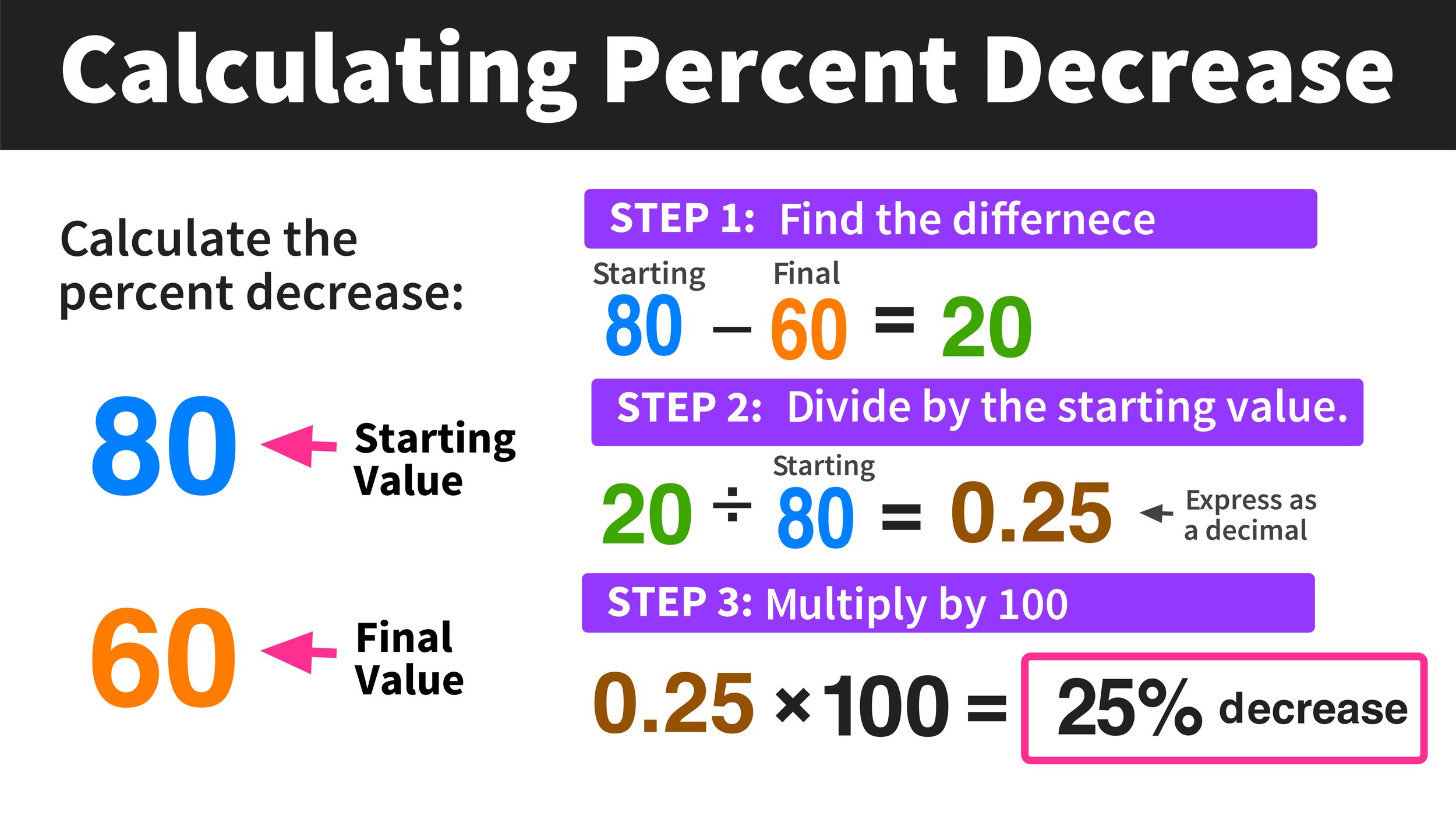
To find the percent decrease between two numbers, you must follow a logical sequence that ensures the result is accurately scaled to the original value. The formula is straightforward, yet its application requires precision.
The Step-by-Step Formula
The mathematical formula for percent decrease is:
((Original Value – New Value) / Original Value) × 100
To execute this calculation:
-
Subtract the new value from the original value. This gives you the absolute decrease. If your stock was worth $50 and is now worth $40, the absolute decrease is $10.
-
Divide the absolute decrease by the original value. This is the most critical step. You are determining what portion of the starting point was lost. In our example: $10 / $50 = 0.2.
-
Multiply the result by 100. This converts the decimal into a percentage. 0.2 × 100 = 20%.
Why the Baseline Matters
In financial analysis, the “Original Value” is often referred to as the “base.” The reason we divide by the original value rather than the new value is to maintain a consistent perspective on growth or decay. In a business context, if your revenue drops from $1,000,000 to $800,000, you have experienced a 20% decrease. If you were to incorrectly divide by the new value ($800,000), you would get 25%, which inaccurately represents the impact on your initial capital.
Understanding this distinction is vital when comparing different financial periods. For instance, a 10% decrease in expenses this year is more significant if last year’s expenses were higher, as it represents a larger absolute saving for the company’s bottom line.
Strategic Budgeting: Using Percent Decrease to Optimize Personal Cash Flow
For the average household, the percent decrease is a primary tool for measuring the success of a savings plan or a debt-reduction strategy. It moves the conversation from “I spent less” to “I am becoming more efficient with my capital.”
Expense Tracking and Optimization
When a person decides to cut their discretionary spending—such as dining out or subscription services—calculating the percent decrease provides a motivational metric. If monthly dining expenses drop from $600 to $450, that represents a 25% decrease. This percentage allows an individual to compare the effectiveness of various cost-cutting measures across different categories. A 5% decrease in a high-cost category like housing or insurance often yields more actual cash than a 50% decrease in a low-cost category like streaming services.
Real vs. Nominal Purchasing Power
In personal finance, the percent decrease is also used to track the “real value” of money in the face of inflation. If inflation is at 5% annually, the purchasing power of $100 decreases. By using the percent decrease formula, a consumer can calculate how much less their savings are worth in terms of goods and services. This realization often serves as the catalyst for moving cash from low-interest savings accounts into higher-yield investment vehicles to offset the decline in value.
Debt Reduction Milestones
When paying off high-interest debt, such as credit cards, tracking the percent decrease in the principal balance is a powerful psychological tool. It helps the debtor see progress in relative terms. Reducing a $10,000 debt by $2,000 is a 20% decrease. Seeing that percentage grow each month reinforces the financial discipline required to reach a zero balance.

Investing and Risk Management: The Impact of Portfolio Drawdowns
In the world of investing, the percent decrease is frequently discussed in terms of “drawdowns.” A drawdown is the peak-to-trough decline during a specific period for an investment or portfolio. Understanding this metric is vital for risk management and for understanding the “mathematics of recovery.”
The Recovery Paradox
One of the most important lessons for any investor is that percent decreases and percent increases are not symmetrical in terms of their impact on capital. This is known as the recovery paradox. If an investment suffers a 50% decrease, it does not need a 50% increase to return to its original value; it needs a 100% increase.
Consider a $10,000 investment that drops by 20%. The new value is $8,000. To get back to $10,000, that $8,000 must grow by $2,000. However, $2,000 is 25% of $8,000. Therefore, a 20% loss requires a 25% gain just to break even. This mathematical reality is why professional money managers focus so heavily on limiting the percent decrease (downside protection) rather than just chasing the highest possible returns.
Analyzing Market Corrections and Bear Markets
Market analysts use percent decrease to categorize market movements. A “correction” is generally defined as a 10% decrease from recent highs, while a “bear market” is defined as a 20% or greater decrease. Investors who understand these benchmarks can keep their emotions in check during volatility. By calculating the percent decrease of their own portfolio during a market dip, an investor can determine if they are outperforming or underperforming the broader market, which helps in deciding whether to rebalance their assets.
Dividend Yields and Price Fluctuations
The percent decrease in a stock’s price often has an inverse relationship with its dividend yield (assuming the dividend payment remains constant). If a stock’s price decreases by 10%, its yield effectively increases for new buyers. Savvy investors use the percent decrease formula to identify “value plays,” where the drop in price has made the income potential of the stock more attractive relative to the cost of entry.
Corporate Performance: Measuring Efficiency and Cost Optimization
In business finance, the percent decrease is a key performance indicator (KPI) used to evaluate everything from operational efficiency to market share retention.
Revenue Leakage and Churn Rates
For subscription-based businesses (SaaS), the churn rate is essentially a measure of the percent decrease in the customer base over a period. If a company starts the month with 1,000 subscribers and ends with 950 (excluding new sign-ups), they have experienced a 5% churn. Management teams analyze this percent decrease to determine the health of their product-market fit and the effectiveness of their customer success teams.
Operating Expense (OpEx) Reduction
Corporate restructuring often aims for a specific percent decrease in operating expenses. If a Chief Financial Officer (CFO) mandates a 15% reduction in overhead to improve profit margins, department heads must use the percent decrease formula to identify where cuts can be made without compromising productivity. This might involve renegotiating vendor contracts or automating manual processes. The percentage provides a standardized goal that can be applied across diverse departments, from marketing to logistics.
Margin Compression
Percent decrease is also used to monitor “margin compression,” which occurs when the cost of goods sold (COGS) increases or the selling price decreases, leading to a smaller profit margin. If a company’s gross margin drops from 40% to 35%, that is a 5-percentage-point drop, but more importantly, it represents a 12.5% decrease in the margin itself. Businesses must track these shifts closely to ensure that a slight decrease in margin doesn’t lead to a catastrophic decrease in net income.
The Psychology of Percentages in Financial Behavior
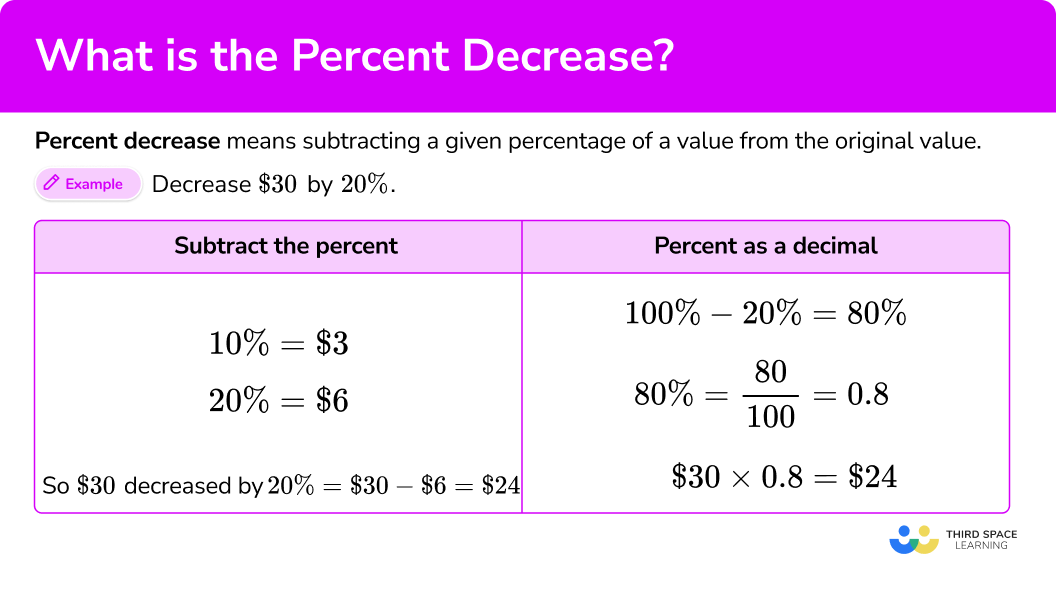
Finally, it is worth noting how the percent decrease influences human behavior and marketing. Retailers frequently use “percent off” (a planned percent decrease in price) to trigger a sense of urgency in consumers. A “40% off” sale is often more enticing than a “Save $20” sign, even if the absolute value is the same, because the percentage implies a greater relative value.
In financial reporting, companies may highlight a “10% decrease in waste” to distract from a “2% decrease in revenue.” As a financially savvy individual, being able to perform these calculations yourself allows you to look past the marketing and see the raw data. You can evaluate whether a “sale” is actually a good deal or if a company’s “cost-saving measure” is significant enough to impact its stock valuation.
In conclusion, finding the percent decrease between two numbers is more than a simple arithmetic exercise; it is a fundamental skill for financial analysis. By mastering the formula ((Original – New) / Original) × 100, you gain the ability to quantify progress, assess risk, and evaluate the true impact of economic changes. Whether you are managing a multi-million dollar portfolio or simply trying to get your monthly spending under control, the percent decrease provides the clarity needed to navigate the complexities of the financial landscape.
aViewFromTheCave is a participant in the Amazon Services LLC Associates Program, an affiliate advertising program designed to provide a means for sites to earn advertising fees by advertising and linking to Amazon.com. Amazon, the Amazon logo, AmazonSupply, and the AmazonSupply logo are trademarks of Amazon.com, Inc. or its affiliates. As an Amazon Associate we earn affiliate commissions from qualifying purchases.