
Understanding how to add a percentage to a number is more than just a basic math skill; it’s a fundamental aspect of financial literacy that empowers individuals and businesses to make informed decisions daily. While seemingly simple, the ability to accurately calculate percentage increases — specifically adding 10 percent — touches upon a vast array of financial scenarios, from personal budgeting and investment tracking to business pricing and growth projections. It’s a foundational concept that, once mastered, unlocks a deeper comprehension of how money works and how values change over time.

This article will demystify the process of adding 10 percent to any number, providing clear, actionable methods. We will then delve into its crucial real-world applications across personal and business finance, illustrating why this seemingly small calculation is an indispensable tool in your financial toolkit. Whether you’re estimating a tip, calculating sales tax, projecting investment returns, or setting a product’s markup, proficiency in this area will equip you for greater financial confidence and control.
The Fundamental Math: Adding 10 Percent Simply
At its core, adding 10 percent to a number involves two primary steps: identifying what 10 percent of the number is, and then incorporating that value back into the original number. There are several efficient ways to achieve this, each with its own advantages depending on the context and the tools available.
Method 1: The Decimal Conversion Approach
This is perhaps the most intuitive method for many, as it breaks the problem into two distinct, easy-to-understand steps. Percentages are essentially fractions of 100. So, 10 percent means 10 out of 100, or 10/100, which as a decimal is 0.10.
To apply this method:
-
Convert the percentage to a decimal: Divide the percentage by 100. For 10%, this is 10 / 100 = 0.10.
-
Calculate the percentage amount: Multiply the original number by this decimal.
-
Add the percentage amount to the original number: This gives you the new, increased total.
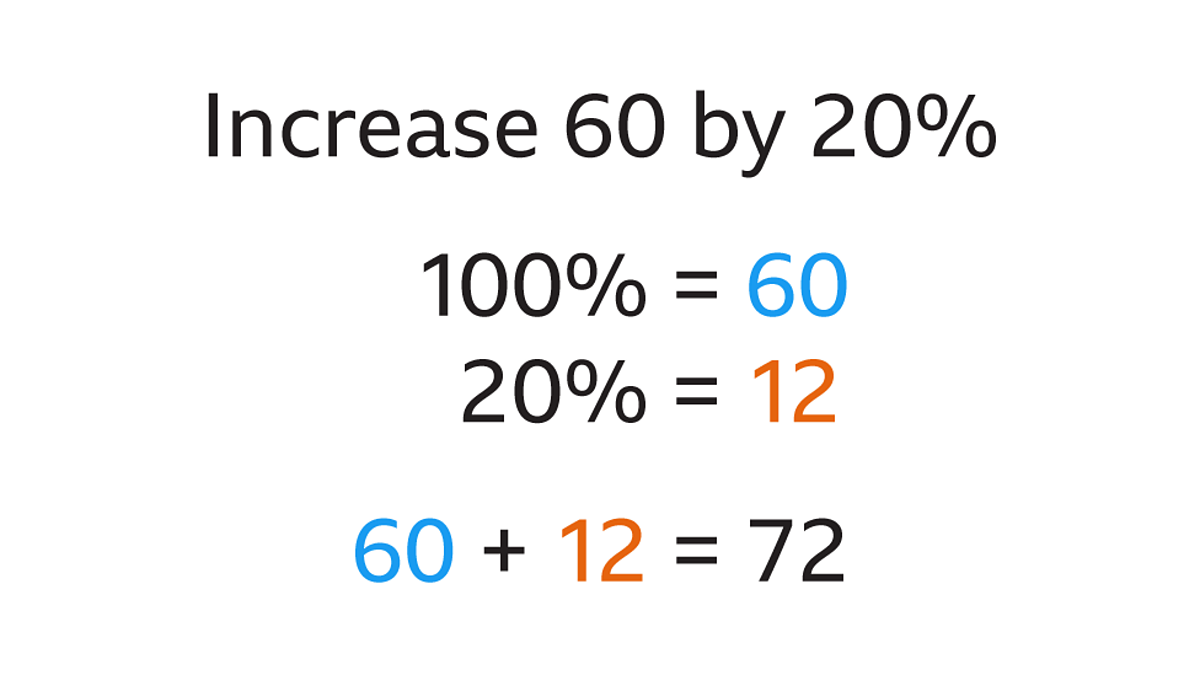
Formula: New Number = Original Number + (Original Number × 0.10)
Example: You have $250, and you want to add 10 percent to it.
-
Calculate 10% of $250: $250 × 0.10 = $25
-
Add this amount to the original number: $250 + $25 = $275
So, adding 10 percent to $250 results in $275. This method is clear, step-by-step, and helps visualize the exact amount of the increase.
Method 2: The Direct Multiplier Approach
This method is more streamlined and often preferred for its efficiency, especially when using calculators or spreadsheets. Instead of calculating the percentage amount separately and then adding it, this approach combines both steps into a single multiplication.
The logic is simple: if you want to add 10% to a number, you’re essentially looking for 100% of the original number plus an additional 10%. In decimal form, this is 1.00 (representing 100%) + 0.10 (representing 10%), totaling 1.10.
To apply this method:
-
Convert the percentage increase to a multiplier: Add 1 to the decimal equivalent of the percentage. For 10%, this is 1 + 0.10 = 1.10.
-
Multiply the original number by this multiplier: This directly gives you the new, increased total.
Formula: New Number = Original Number × 1.10
Example: Again, starting with $250, add 10 percent.
-
The multiplier for a 10% increase is 1.10.
-
Multiply the original number by the multiplier: $250 × 1.10 = $275
The result is identical, but achieved in a single, more direct calculation. This method is particularly useful when performing calculations in a spreadsheet or a financial calculator where a single operation is desired.
Mental Math Shortcuts for 10 Percent
For quick estimations and everyday scenarios, the “move the decimal” trick is invaluable. Calculating 10 percent of a number mentally is often easier than it seems, especially with round numbers.
The Shortcut: To find 10% of any number, simply move the decimal point one place to the left.
Examples:
-
10% of $500 is $50.00 (move decimal from $500.00 to $50.00)
-
10% of $75 is $7.50 (move decimal from $75.00 to $7.50)
-
10% of $123.45 is $12.345 (round to $12.35)
Once you’ve quickly found 10% of the number, simply add that amount back to the original number. This is incredibly useful for on-the-spot calculations, such as estimating a tip at a restaurant or quickly checking a price increase. While not precise to the last cent for complex numbers, it provides an excellent mental benchmark.
Real-World Applications in Personal Finance
The ability to add 10 percent to a number extends far beyond classroom exercises; it’s a practical skill with myriad applications in managing your personal finances effectively. From daily spending to long-term planning, this simple calculation can significantly enhance your financial acumen.
Calculating Tips and Gratuities
One of the most common everyday uses for percentage calculations is tipping. While standard tips often range from 15% to 20%, knowing how to quickly calculate 10% provides an excellent baseline from which to build.
Scenario: Your restaurant bill is $85. You want to leave a 15% tip.
-
First, calculate 10%: Move the decimal point one place left on $85.00, which gives you $8.50.
-
To get 5% (half of 10%), divide $8.50 by 2, resulting in $4.25.
-
Add these together for a 15% tip: $8.50 (10%) + $4.25 (5%) = $12.75.
-
Add the tip to the bill: $85.00 + $12.75 = $97.75.
This mental math strategy allows you to quickly estimate and adjust tips without needing a calculator, ensuring you can show appropriate appreciation for service.
Understanding Sales Tax and Markups
When purchasing goods and services, you often encounter sales tax, which is a percentage added to the base price. Similarly, a service provider might add a small markup to materials.
Scenario: You’re buying a gadget for $300, and the local sales tax is 10%.
-
Using the direct multiplier approach: $300 × 1.10 = $330.
-
This immediately tells you the total cost, including tax.
Understanding this helps you verify prices and budget accurately, avoiding surprises at checkout. It’s also critical when comparing prices between regions with different tax rates.
Savings and Investment Growth (Simple Interest)
While actual investment returns are more complex and often involve compound interest, understanding how a percentage increase works is fundamental to grasping how your savings and investments can grow. For simple interest calculations, knowing how to add a percentage is directly applicable.
Scenario: You invest $1,000 in a product offering a hypothetical 10% simple annual return.
-
After one year, your investment grows by 10%.
-
$1,000 × 1.10 = $1,100.
This helps you project potential growth, even if it’s a simplified view. It’s the building block for understanding more intricate investment concepts.
Budgeting and Expense Tracking
Budgeting involves allocating funds, and sometimes you might need to adjust categories based on changing needs or aspirations. Adding a percentage can help you modify your budget quickly.
Scenario: You want to increase your “entertainment” budget of $200 by 10% next month.
- $200 × 1.10 = $220.
You instantly know your new spending limit for that category. This flexibility allows for dynamic financial planning, adapting to life’s ebb and flow while maintaining control over your spending.
Business Finance: Strategic Uses of 10 Percent Increases
For businesses, understanding percentage increases is not just about tracking expenses but is integral to strategic planning, profitability, and growth. Adding 10 percent can be a routine calculation in various business operations.
Pricing Strategies and Profit Margins
Businesses must price products and services to cover costs and generate profit. Adding a percentage markup is a common way to achieve this.
Scenario: A retailer purchases an item for $50 and wants to add a 10% markup to the cost to cover operational expenses and ensure a minimum profit.
- $50 × 1.10 = $55.
This $55 becomes the minimum selling price. This calculation helps determine the base price before factoring in additional profit margins or competitive adjustments. It’s a foundational step in ensuring the business remains viable.
Salary Increases and Employee Benefits
Annual performance reviews often lead to salary adjustments, which are typically expressed as percentage increases. Businesses need to calculate these accurately to manage payroll and budget for HR expenses.
Scenario: An employee earning $60,000 per year receives a 10% raise.
- $60,000 × 1.10 = $66,000.
The new annual salary is $66,000. This calculation is crucial for human resources departments to process payroll, understand total compensation costs, and project future salary budgets.
Sales Targets and Growth Projections
Setting ambitious yet achievable sales targets is vital for business growth. These targets are frequently articulated as percentage increases over previous periods.
Scenario: A sales team achieved $500,000 in sales last quarter and aims for a 10% increase this quarter.
- $500,000 × 1.10 = $550,000.
The new sales target for the quarter is $550,000. This provides a clear, measurable goal for the sales team and helps management forecast revenue and allocate resources accordingly.
Inventory Management and Stock Adjustments
Businesses often adjust inventory levels based on anticipated demand or supply chain changes. A percentage increase can be used to create buffer stock.
Scenario: Due to an expected increase in demand, a company decides to increase its regular order of 2,000 units by 10%.
- $2,000 times 1.10 = 2,200$ units.
This ensures sufficient stock to meet anticipated customer needs, preventing stockouts and potential loss of sales. It’s a pragmatic application of percentage calculations to maintain operational efficiency.
Avoiding Common Pitfalls and Ensuring Accuracy
While adding 10 percent might seem straightforward, certain nuances can lead to errors. Being aware of these pitfalls and utilizing the right tools can ensure accuracy and confidence in your financial calculations.
The Order of Operations
One common mistake is confusing a “10% increase” with other percentage operations. Ensure you understand what the “base” number is to which the percentage is being added. For instance, increasing a number by 10% and then decreasing the new number by 10% does not get you back to the original number. This is because the base for the second calculation is different. Always ensure you are adding 10% to the correct, initial value or the currently adjusted value as per the problem.
Using the Right Tools
For simple, mental calculations, the decimal shift trick is excellent. However, for critical financial decisions or when dealing with larger numbers and multiple calculations, leveraging appropriate tools is essential.
-
Calculators: Any basic calculator (physical, smartphone app, or computer utility) can easily perform these calculations. Simply input the number and multiply by 1.10, or calculate 10% and add it.
-
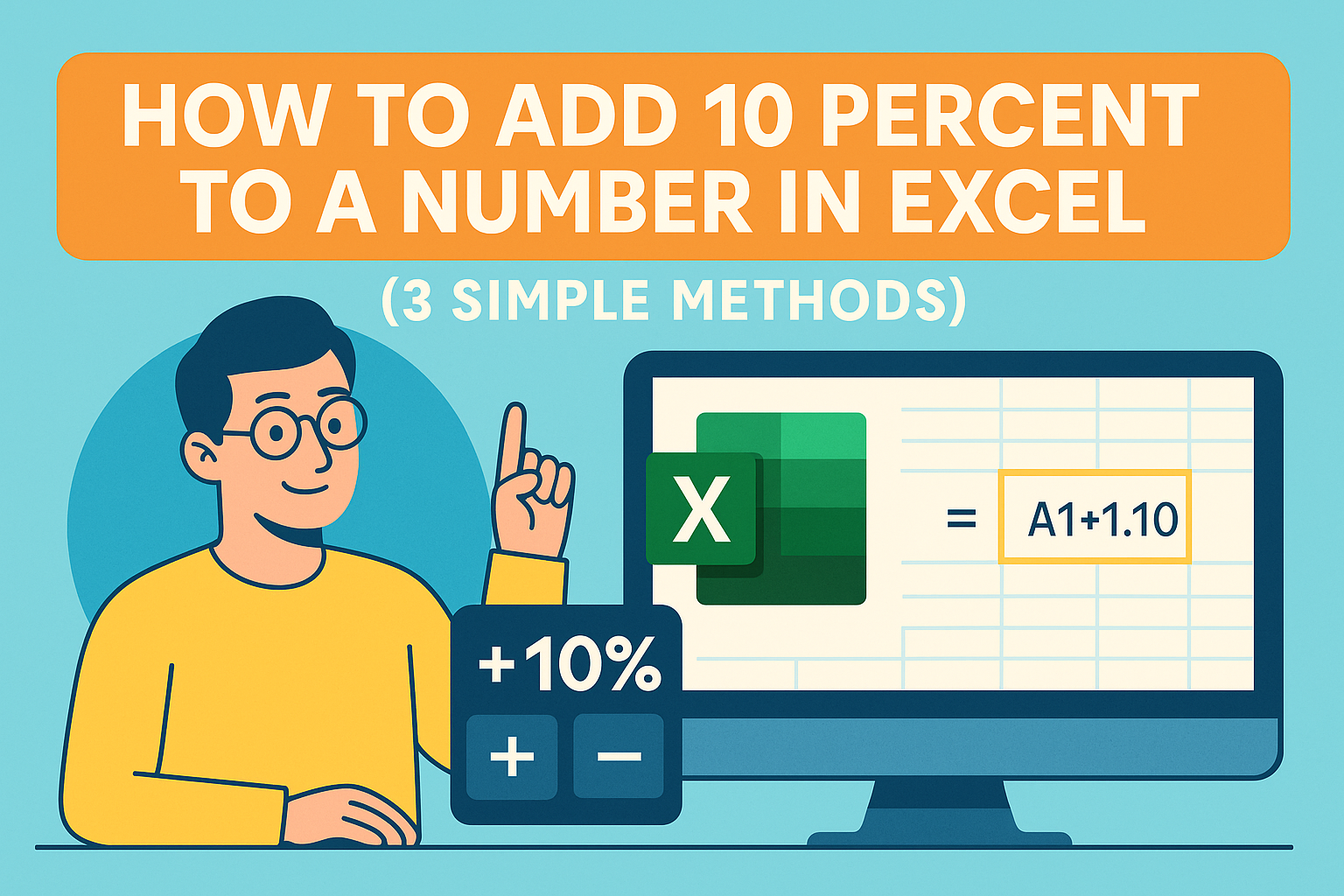
Spreadsheets (Excel, Google Sheets): For extensive lists of numbers or automated calculations, spreadsheets are indispensable. You can set up a column with your original numbers and another column with a formula like
=A2*1.10(if your original number is in cell A2) to instantly apply the 10% increase across hundreds of entries. This not only saves time but also minimizes human error.
Double-Checking Your Work
Especially when significant amounts of money are involved, always double-check your calculations.
-
Mental Estimation: Use the mental math shortcut to get a quick approximation. Does your calculated answer seem reasonable compared to your mental estimate?
-
Reverse Calculation: If you added 10% to get a new number, you can verify by finding 10% of the original number and ensuring that added value matches the difference between your new and old numbers.
-
Recalculate with a different method: If you used the direct multiplier, try the decimal conversion method to see if you arrive at the same result. This cross-verification significantly reduces the chance of errors.
Conclusion
The ability to accurately and swiftly add 10 percent to a number is a foundational skill that permeates nearly every facet of personal and business finance. From quickly estimating a tip at a restaurant to strategically planning business growth or understanding your investment returns, mastering this calculation empowers you with greater financial control and insight.
By understanding the simple decimal conversion and direct multiplier methods, alongside handy mental math shortcuts, you can confidently navigate a myriad of financial scenarios. Furthermore, recognizing the real-world applications in budgeting, pricing, and goal setting underscores its practical importance. Equip yourself with these fundamental calculations, utilize the right tools for accuracy, and always double-check your work. This seemingly small mathematical skill will prove to be a powerful asset in your ongoing journey towards financial literacy and sound decision-making.
aViewFromTheCave is a participant in the Amazon Services LLC Associates Program, an affiliate advertising program designed to provide a means for sites to earn advertising fees by advertising and linking to Amazon.com. Amazon, the Amazon logo, AmazonSupply, and the AmazonSupply logo are trademarks of Amazon.com, Inc. or its affiliates. As an Amazon Associate we earn affiliate commissions from qualifying purchases.