
In the vast and often intricate world of personal finance, investing, and business, percentages are the universal language. They quantify change, express proportions, and simplify complex data into digestible insights. From understanding your investment returns to calculating the sales tax on a purchase, or even interpreting inflation rates, a solid grasp of how to calculate the percent of a number is not just a mathematical skill – it’s a foundational pillar of financial literacy. Without this essential capability, navigating budgets, debt, savings, and investment opportunities becomes significantly more challenging, if not impossible.

This article will demystify the process of calculating percentages, moving from the fundamental “how-to” to its critical applications across various financial scenarios. By the end, you’ll not only know how to find the percent of a number but also deeply appreciate why this skill is indispensable for making informed financial decisions.
The Foundational Skill for Financial Literacy
At its core, a percentage is merely a way of expressing a part of a whole as a fraction of 100. The word “percent” itself is derived from the Latin “per centum,” meaning “by the hundred.” This simple definition underpins its immense utility in finance, providing a standardized way to compare different values and understand relative changes, regardless of the absolute numbers involved.
Understanding What “Percent” Truly Means
Imagine you have a pie cut into 100 slices. If you take 10 slices, you’ve taken 10 percent of the pie. If you’ve taken 50 slices, you’ve taken 50 percent, or half, of the pie. This concept scales to any number: 10% of $100 is $10; 50% of $5,000 is $2,500. It’s always about a portion relative to a whole, with that whole being conceptualized as 100 units.
The beauty of percentages lies in their ability to standardize comparisons. Saying your investment grew by $500 isn’t as informative as saying it grew by 10%. The 10% tells you its relative performance, allowing you to compare it to other investments or market benchmarks, irrespective of your initial capital.
Why Percentages Matter in Your Daily Finances
Percentages are embedded in countless daily financial interactions and decisions. Here are a few prominent examples:
-
Discounts and Sales: When a store advertises “20% off all items,” you need percentages to calculate your savings.
-
Tips: Tipping 15% or 20% at a restaurant requires quick mental or calculator-based percentage calculation.
-
Taxes: Sales tax, income tax rates, and property tax are all expressed as percentages, directly impacting your spending power and liabilities.
-
Interest Rates: Whether it’s the interest you earn on savings or the interest you pay on loans (credit cards, mortgages, car loans), percentages dictate these crucial figures.
-
Budgeting: Allocating a certain percentage of your income to housing, food, savings, or entertainment is a common and effective budgeting strategy.
Mastering percentage calculations empowers you to confidently navigate these scenarios, ensuring you understand the true cost or benefit of financial transactions.
Mastering the Basic Calculations
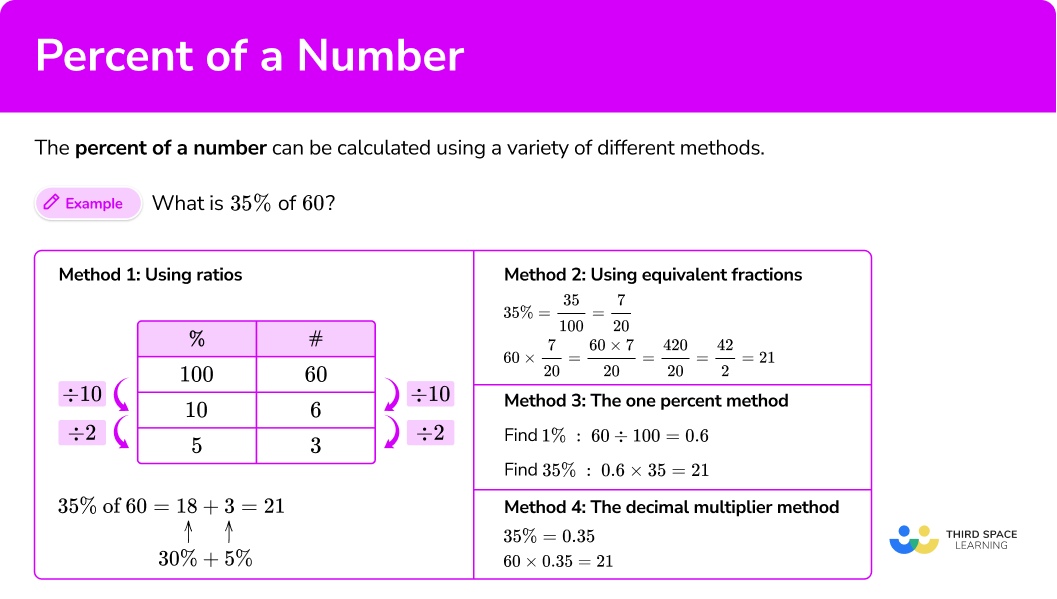
Calculating the percent of a number is a straightforward process once you understand the underlying principle. There are generally two primary methods, both yielding the same result, but often preferred based on personal comfort or the specific context.
Method 1: The Decimal Conversion Approach
This is arguably the most common and versatile method, particularly useful when dealing with calculators or spreadsheets.
Step 1: Convert the percentage to a decimal. To do this, simply divide the percentage by 100. You can also think of this as moving the decimal point two places to the left.
*   Example: 20% becomes 0.20 (20 ÷ 100)


*   Example: 5% becomes 0.05 (5 ÷ 100)


*   Example: 125% becomes 1.25 (125 ÷ 100)
Step 2: Multiply the decimal by the number. The result will be the percentage of that number.
*   **Financial Example:** You want to find 15% of your $3,000 monthly income to allocate to savings.


    *   Convert 15% to a decimal: 15 ÷ 100 = 0.15


    *   Multiply the decimal by the number: 0.15 × $3,000 = $450


    *   Conclusion: You should save $450 from your income.
This method is highly efficient for most financial calculations.
Method 2: The Fractional Approach
While less common for direct calculation on modern tools, understanding the fractional approach offers a deeper conceptual insight and can be useful for mental math with common percentages.
Step 1: Express the percentage as a fraction with a denominator of 100.
*   Example: 20% becomes 20/100


*   Example: 25% becomes 25/100


*   Example: 50% becomes 50/100
Step 2: Simplify the fraction (optional but helpful).
*   20/100 simplifies to 1/5


*   25/100 simplifies to 1/4


*   50/100 simplifies to 1/2
Step 3: Multiply the simplified fraction by the number.
*   **Financial Example:** You see a shirt that costs $40 marked "25% off."


    *   Convert 25% to a fraction: 25/100, which simplifies to 1/4.


    *   Multiply the fraction by the number: (1/4) × $40 = $10


    *   Conclusion: You save $10, so the shirt costs $30.
This method highlights the proportional nature of percentages and can often be quicker for common percentage values like 10%, 25%, 50%, or 75%.
Working with Different Scenarios
Sometimes, the question isn’t directly “What is X percent of Y?” You might need to find the percentage itself or the original whole number.
-
Finding the Percentage: “What percent is $50 of $200?”
-
Divide the part by the whole: $50 ÷ $200 = 0.25
-
Multiply by 100 to convert to a percentage: 0.25 × 100 = 25%
-
Conclusion: $50 is 25% of $200. (e.g., your tax rate was 25%)
-

-
Finding the Whole Number: “$30 is 10% of what number?”
-
Divide the part by the percentage (in decimal form): $30 ÷ 0.10 = $300
-
Conclusion: $30 is 10% of $300. (e.g., if you saved $30 and that was 10% of your income, your income was $300)
-
These variations are crucial for understanding reverse calculations, like determining your original income based on a percentage saved, or finding the pre-tax price of an item.
Real-World Applications in Personal Finance
The ability to calculate percentages translates directly into tangible financial benefits, enabling smarter decisions across your financial life.
Budgeting and Expense Tracking
A common and effective budgeting strategy is the 50/30/20 rule: 50% of income for needs, 30% for wants, and 20% for savings and debt repayment. To implement this, you must calculate percentages of your net income.
-
If your net monthly income is $4,000:
-
Needs (50%): 0.50 × $4,000 = $2,000
-
Wants (30%): 0.30 × $4,000 = $1,200
-
Savings/Debt (20%): 0.20 × $4,000 = $800
-
This provides a clear roadmap for your spending and saving, ensuring you meet your financial goals.
Debt Management
Interest rates on loans (mortgages, credit cards, personal loans) are almost always expressed as percentages. Understanding how to calculate the interest portion of your payments is vital.
-
If you have a credit card balance of $1,000 with an annual interest rate of 18%, your monthly interest rate is 18% ÷ 12 = 1.5%.
-
The interest charged that month (on the unpaid balance): 0.015 × $1,000 = $15.
This simple calculation highlights the cost of carrying a balance and reinforces the importance of paying down high-interest debt.
Saving and Investing
Percentages are the bedrock of investment analysis.
-
Returns on Investment (ROI): If you invested $1,000 and it grew to $1,100, your return is ($1,100 – $1,000) ÷ $1,000 = 0.10, or 10%. Comparing this 10% to other investments or market benchmarks gives you valuable insight into performance.
-
Compound Interest: The magic of compound interest, where your interest earns interest, is fundamentally a percentage calculation applied repeatedly over time. Understanding growth rates is key to projecting future wealth.
-
Retirement Contributions: Many employers offer a matching contribution to 401(k) plans, often expressed as a percentage of your salary (e.g., “we’ll match 3% of your salary”). Knowing how to maximize this is literally leaving free money on the table if ignored.
Understanding Discounts and Sales Tax
These are perhaps the most common daily percentage applications.
-
Discount: An item originally priced at $200 with a 30% discount means you save 0.30 × $200 = $60. The final price is $200 – $60 = $140.
-
Sales Tax: If an item costs $100 and the sales tax is 7%, the tax amount is 0.07 × $100 = $7. The total cost is $100 + $7 = $107. Being able to quickly calculate these helps you manage your spending expectations.
Leveraging Technology for Financial Percentage Calculations
While mental math is valuable, for accuracy and efficiency in complex financial scenarios, technology is your best friend.
Spreadsheet Software (Excel, Google Sheets) for Complex Calculations
Spreadsheets are indispensable for budgeting, investment tracking, and financial modeling. They make percentage calculations trivial with built-in formulas.
-
Basic Percentage: To find 20% of a number in cell A1, you would simply type
=A1*0.20or=A1*20%. -
Percentage Change: To calculate the percentage change from an old value in A1 to a new value in B1, use
=(B1-A1)/A1. -
Budget Allocation: You can set up an entire budget where each category is a percentage of your income, and the spreadsheet automatically calculates the dollar amounts.
Online Calculators and Financial Apps
The internet abounds with specialized calculators for virtually every financial percentage need:
-
Mortgage Calculators: Determine monthly payments, interest paid over the life of the loan.
-
Loan Calculators: Show interest amounts for personal loans, car loans.
-
Investment Return Calculators: Project future growth based on annual percentage returns.
-
Tipping Calculators: Easily split bills and add the appropriate percentage tip.
Many personal finance apps also incorporate these functionalities, making it easy to track spending, project savings, and manage debt with percentage-based insights.
Beyond the Basics: Advanced Financial Percentage Concepts
As you deepen your financial understanding, you’ll encounter more sophisticated percentage-based metrics critical for advanced analysis.
Percentage Change: Tracking Growth and Decline
Beyond simple “percent of,” percentage change is vital for comparing values over time. It measures the relative increase or decrease between an old value and a new value.
-
Formula:
((New Value - Old Value) / Old Value) × 100 -
Financial Example (Inflation): If the price of a gallon of milk increased from $3.00 last year to $3.15 this year:
-
Percentage change = (($3.15 – $3.00) / $3.00) × 100 = ($0.15 / $3.00) × 100 = 0.05 × 100 = 5%.
-
This tells you the inflation rate for milk was 5%. This is crucial for understanding the erosion of purchasing power.
-
-
Investment Performance: Tracking the percentage growth or decline of your portfolio month-over-month or year-over-year is essential for assessing investment strategies.
Basis Points and Their Significance
In professional finance, particularly in bond markets and interest rate discussions, “basis points” (bps) are often used instead of percentages for very small changes. One basis point is equal to 0.01% (one-hundredth of a percentage point).
- Example: A bond yield increasing from 2.50% to 2.75% is an increase of 25 basis points (0.25% change).
This unit of measure prevents ambiguity and simplifies discussions of minute changes in rates.
Understanding Effective Annual Rates (EAR)
When interest is compounded more frequently than once a year (e.g., monthly), the stated annual percentage rate (APR) doesn’t fully reflect the true cost or return. The Effective Annual Rate (EAR) takes compounding into account, providing the actual annual rate of return or cost.
- Example: A credit card with a 19.99% APR compounded monthly has an EAR that is slightly higher, reflecting the effect of earning interest on previously earned interest (or paying interest on previously charged interest).
This is crucial for comparing financial products accurately.
In conclusion, knowing how to get the percent of a number is far more than a basic arithmetic skill. It is an indispensable tool for sound financial management, from the minutiae of daily spending to the complexities of long-term investment planning. By mastering these calculations, you gain clarity, control, and confidence in all your financial endeavors, paving the way for better decision-making and a stronger financial future. Embrace percentages, and you embrace a powerful lever for financial success.
aViewFromTheCave is a participant in the Amazon Services LLC Associates Program, an affiliate advertising program designed to provide a means for sites to earn advertising fees by advertising and linking to Amazon.com. Amazon, the Amazon logo, AmazonSupply, and the AmazonSupply logo are trademarks of Amazon.com, Inc. or its affiliates. As an Amazon Associate we earn affiliate commissions from qualifying purchases.