
In the world of finance, numbers tell a story. But raw numbers alone often fail to capture the true magnitude or significance of change. This is where the concept of percentage increase becomes indispensable. From tracking the growth of your personal savings to analyzing the performance of a multi-million dollar investment portfolio, understanding how to calculate and interpret a percentage increase is a fundamental skill for anyone navigating the financial landscape. It provides a standardized, relative measure that helps you benchmark progress, identify trends, and make informed decisions, transforming absolute figures into actionable insights.
This guide will demystify the process, offering a clear, step-by-step approach to calculating percentage increase and illustrating its diverse applications across personal and business finance. By the end, you’ll not only know how to find a percentage increase but also why it’s one of the most powerful tools in your financial arsenal.
Understanding the Fundamentals: What is Percentage Increase?
Before diving into calculations, it’s crucial to grasp what a percentage increase truly represents and why it holds such prominence in financial analysis.
The Core Concept Defined
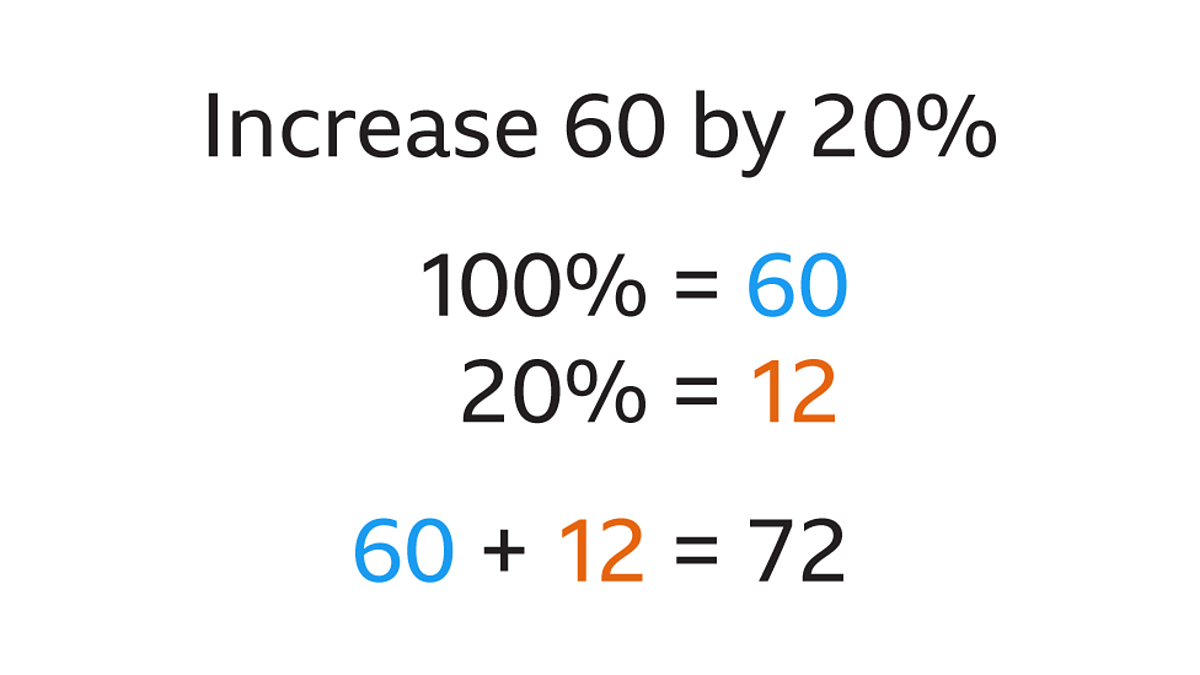
At its simplest, a percentage increase quantifies the relative change between an initial (old) value and a final (new) value, expressed as a proportion of the initial value. It tells you how much a quantity has grown in relation to where it started. For instance, if your investment grew from $100 to $120, a 20% increase tells a more compelling story than just stating a $20 gain, especially if another investment grew from $1,000 to $1,020 (a $20 gain but only a 2% increase).
Why it Matters in Finance
The ability to calculate and interpret percentage increase is foundational in almost every financial domain:
-
Personal Finance: Evaluating the growth of your savings account, understanding the impact of a salary raise, or tracking the appreciation of your home’s value.
-
Investing: Measuring the Return on Investment (ROI) for stocks, bonds, or mutual funds; assessing portfolio performance over time; or comparing the growth rates of different assets.
-
Business Finance: Analyzing sales growth, profit margin improvements, increases in market share, or the escalating cost of goods sold.
-
Economics: Understanding inflation rates, GDP growth, or changes in consumer spending.
It provides a common language for comparison, making it possible to assess performance irrespective of the absolute scale of the numbers involved.
Differentiating from Absolute Change
It’s vital to distinguish percentage increase from absolute change. Absolute change is simply the difference between the new and old values (New Value – Old Value). While useful, absolute change doesn’t provide context. A $100 increase means very different things if the original value was $10 (a 1000% increase) versus if it was $10,000 (a 1% increase). Percentage increase normalizes this change, presenting it as a relative proportion, which is far more insightful for financial analysis and comparison.
The Step-by-Step Formula: Calculating Percentage Increase
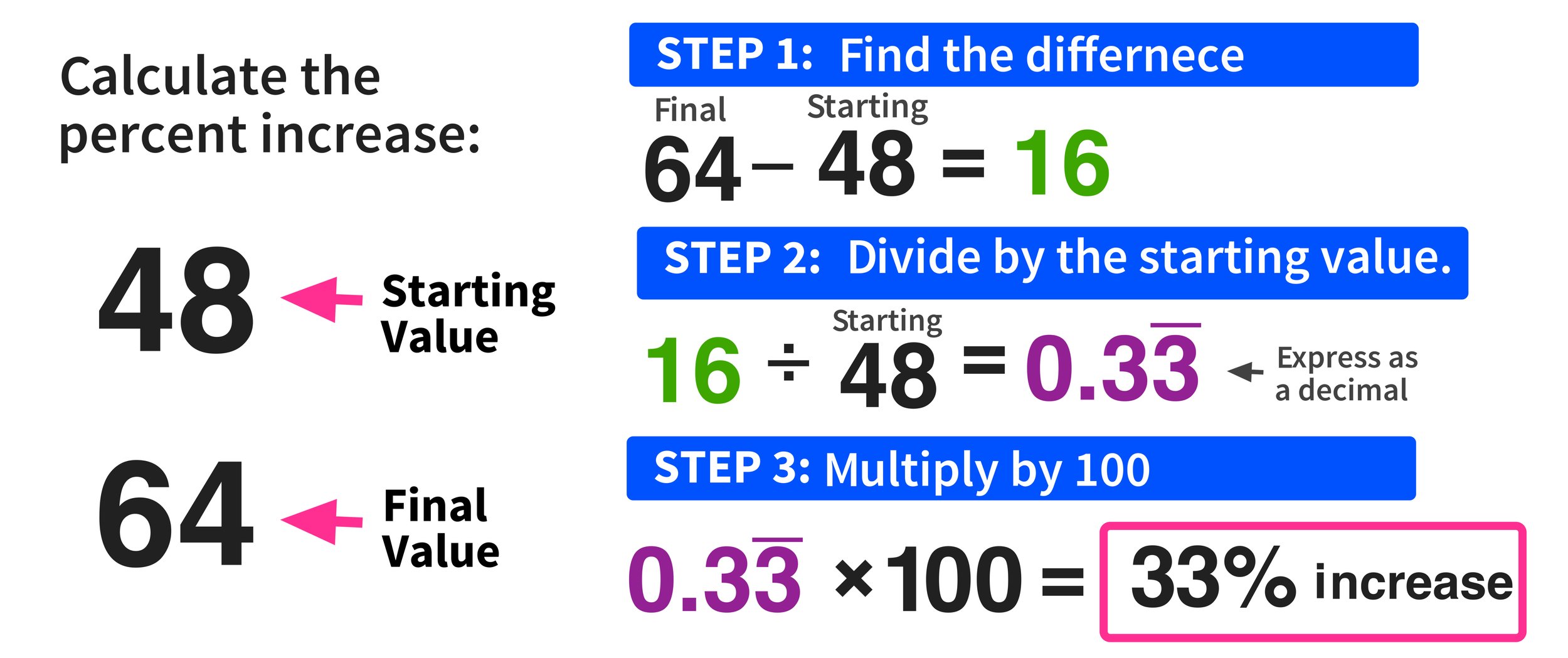
The formula for calculating percentage increase is straightforward and relies on three simple steps. Once you understand these, you can apply them to virtually any financial scenario.
Step 1: Find the Difference (New Value – Old Value)
The first step is to determine the absolute change between the two values. This involves subtracting the initial (old) value from the final (new) value.
- Difference = New Value – Old Value
The result of this step tells you the raw amount by which the quantity has grown. If the new value is smaller than the old value, this difference will be negative, indicating a percentage decrease, which we’ll touch on briefly later.
Step 2: Divide by the Old Value
Next, you need to put that difference into context by comparing it to the starting point. This is achieved by dividing the difference (calculated in Step 1) by the original (old) value.
-
Fractional Increase = (Difference) / Old Value
-
Fractional Increase = (New Value – Old Value) / Old Value
This step yields a decimal number, which represents the increase as a fraction of the initial value. For example, if the result is 0.25, it means the increase was one-quarter of the original amount.
Step 3: Multiply by 100
The final step is to convert the fractional increase into a percentage. You do this by multiplying the decimal result from Step 2 by 100.
- Percentage Increase = ((New Value – Old Value) / Old Value) * 100
This gives you the percentage increase, typically expressed with a percent sign (%).
Worked Example: Personal Savings Growth
Let’s say your savings account balance was $1,500 at the beginning of the year and grew to $1,800 by the end of the year.
-
Difference: $1,800 (New Value) – $1,500 (Old Value) = $300
-
Divide by Old Value: $300 / $1,500 = 0.2
-
Multiply by 100: 0.2 * 100 = 20%
Your savings account experienced a 20% increase.
Worked Example: Investment Portfolio Performance
Imagine your investment portfolio was valued at $50,000 last year and is now worth $57,500.
-
Difference: $57,500 (New Value) – $50,000 (Old Value) = $7,500
-
Divide by Old Value: $7,500 / $50,000 = 0.15
-
Multiply by 100: 0.15 * 100 = 15%
Your investment portfolio saw a 15% increase.
Practical Applications in Personal Finance
Understanding percentage increase isn’t just an academic exercise; it’s a vital skill that empowers you to manage and grow your personal wealth effectively.
Tracking Your Net Worth Growth
Net worth – your assets minus your liabilities – is a crucial indicator of financial health. By calculating the percentage increase in your net worth year over year, you gain a clear picture of your financial progress. A consistent percentage increase indicates effective financial planning, saving, and investing, motivating you to stay on track or adjust strategies as needed.
Analyzing Investment Returns (ROI)
For investors, Return on Investment (ROI) is often expressed as a percentage increase. Whether you’re evaluating a single stock, a mutual fund, or an entire portfolio, calculating the percentage gain allows you to compare the efficiency of different investments regardless of their initial cost. A 10% return on a $1,000 investment yields $100, while a 10% return on a $10,000 investment yields $1,000. The percentage provides the comparative metric for performance.
Understanding Salary Raises and Inflation
When you receive a salary raise, knowing the percentage increase helps you assess its true value. More importantly, comparing this percentage raise to the current inflation rate is critical. If your salary increases by 3% but inflation is 5%, your purchasing power has actually decreased by 2% in real terms. This insight is essential for negotiating future raises and maintaining your standard of living.
Budgeting and Expense Analysis
Monitoring your expenses with percentage increases can reveal significant insights. If your grocery bill has increased by 15% over the last quarter, while your income only increased by 5%, it’s a red flag signaling the need to re-evaluate your spending habits. Identifying categories with disproportionately high percentage increases allows for targeted budgeting adjustments.
Leveraging Percentage Increase in Business & Investing
Beyond personal finance, percentage increase is a cornerstone of business analysis and professional investing, guiding strategic decisions and performance evaluations.
Sales and Revenue Growth
For businesses, tracking the percentage increase in sales and revenue is a fundamental Key Performance Indicator (KPI). A consistent positive percentage increase signals market demand, effective sales strategies, or successful product launches. Conversely, a stagnant or declining percentage indicates potential issues that require investigation, such as market saturation, increased competition, or operational inefficiencies.
Profit Margins and Operational Efficiency
Businesses also analyze the percentage increase in profit margins (gross or net). If revenue is increasing by 10% but profit is only increasing by 5%, it suggests rising costs or inefficiencies. Understanding these percentage shifts allows management to identify areas for cost reduction, process optimization, or pricing adjustments to improve overall profitability.
Stock Market Analysis
In the stock market, investors constantly analyze the percentage increase (or decrease) in stock prices, indices (like the S&P 500), and sector performance. A stock that has increased by 20% over a year tells a very different story than one that has increased by 2%. These percentages help investors gauge a company’s growth trajectory, compare it to competitors, and assess its potential for future returns. It also helps in understanding market volatility and identifying trends.
Real Estate Valuation
Real estate investors and homeowners regularly use percentage increase to track property value appreciation. Understanding that a property has increased in value by 8% year-over-year provides a clear measure of investment performance and can inform decisions about selling, refinancing, or further investment in the property market.
Tools and Tips for Easier Calculation and Interpretation
While the formula is simple, various tools can streamline the calculation process, and a few tips can enhance your interpretation of the results.
Spreadsheet Software (Excel/Google Sheets)
Spreadsheets like Microsoft Excel or Google Sheets are incredibly powerful for calculating percentage increases, especially when dealing with large datasets or needing to track changes over multiple periods.
The formula in a spreadsheet is typically:
=(New_Value - Old_Value) / Old_Value
Then, format the cell as a percentage. For example, if your old value is in cell A1 and your new value is in B1, the formula would be =(B1-A1)/A1.
Online Calculators and Financial Apps
For quick, one-off calculations, numerous online percentage increase calculators are available. Many personal finance apps and investment platforms also automatically calculate and display percentage changes for your accounts and assets, simplifying the process and providing instant insights.
Avoiding Common Mistakes
-
Using the Correct ‘Old Value’: Always ensure you are dividing by the original or starting value. Dividing by the new value or the difference will lead to incorrect results.
-
Understanding Negative Results (Percentage Decrease): If the new value is smaller than the old value, the result of (New Value – Old Value) will be negative. This means you’ve calculated a percentage decrease. The formula remains the same, but the interpretation changes. For example, if a stock went from $100 to $90, the calculation is
((90-100)/100)*100 = -10%. -
Rounding: Be mindful of rounding. For critical financial analysis, maintain sufficient decimal places during intermediate steps and round only the final percentage to an appropriate number of decimal places.

Interpreting the Numbers Beyond the Calculation
Simply knowing the percentage increase is not enough; context is paramount.
-
Timeframe: A 10% increase over one month is phenomenal, while a 10% increase over ten years is mediocre. Always consider the period over which the change occurred.
-
Benchmarking: Compare the percentage increase against relevant benchmarks. Is your investment return of 8% good if the market index (e.g., S&P 500) increased by 15% in the same period?
-
Goals: Relate the percentage increase to your personal or business financial goals. Is the growth sufficient to meet your objectives?
-
External Factors: Consider what external economic, market, or personal factors might have contributed to the increase. Was it organic growth, or a one-time event?
In conclusion, the ability to calculate and interpret a percentage increase is a foundational skill that transcends basic arithmetic, offering profound insights into financial performance and trends. Whether you’re meticulously tracking your personal savings, scrutinizing investment opportunities, or managing business finances, this simple yet powerful calculation empowers you to make smarter, more informed decisions. Embrace this essential financial tool, and you’ll unlock a clearer understanding of your financial world, paving the way for sustained growth and success.
aViewFromTheCave is a participant in the Amazon Services LLC Associates Program, an affiliate advertising program designed to provide a means for sites to earn advertising fees by advertising and linking to Amazon.com. Amazon, the Amazon logo, AmazonSupply, and the AmazonSupply logo are trademarks of Amazon.com, Inc. or its affiliates. As an Amazon Associate we earn affiliate commissions from qualifying purchases.