
In a world increasingly driven by numbers, understanding percentages isn’t just a useful skill—it’s a fundamental pillar of financial literacy. From dissecting personal budgets and evaluating investment returns to understanding interest rates on loans and grasping business profit margins, percentages are the unseen language spoken across all facets of finance. Far from being a mere academic exercise, mastering percentage calculations empowers you to make informed decisions, optimize your financial health, and navigate the complex landscape of money with confidence. This guide will demystify the art of percentage calculation, rooting it firmly in the practical realities of personal and business finance, and transforming a daunting mathematical concept into an indispensable tool for financial success.
The Unseen Language of Money: Why Percentages Are Crucial
Before diving into the mechanics, it’s vital to appreciate why percentages hold such a prominent position in our financial lives. They provide a standardized way to compare parts to wholes, to express change, and to understand proportions, regardless of the absolute numbers involved. This universality makes them an invaluable tool for financial analysis and communication.
Everyday Financial Scenarios
Think about your daily interactions with money. You see sales offering “20% off,” credit card statements detailing an “APR of 18.99%,” or your bank advertising a “1.5% interest rate” on savings. Your employer might deduct a “15% tax” from your paycheck, or you might discuss investing “10% of your income” in a retirement fund. Each of these scenarios relies on percentages to convey crucial financial information concisely and comparably. Without a solid grasp, these numbers can seem abstract, making it difficult to assess their true impact on your wallet.
Building a Strong Financial Foundation
For individuals, understanding percentages is foundational to effective budgeting, saving, and investing. It enables you to allocate funds wisely, project savings growth, and assess the true cost of borrowing. For businesses, it’s essential for pricing strategies, calculating profit margins, managing inventory, and reporting financial performance. In essence, percentages provide the quantitative framework necessary to manage, grow, and protect your financial resources, empowering you to move from simply reacting to financial situations to proactively shaping your financial future.
Mastering the Basics: The Core Percentage Formula
At its heart, calculating a percentage is about relating a part to a whole and expressing that relationship out of one hundred. It’s a simple concept with profound implications.
Understanding the Components: Part, Whole, and Rate
Every percentage calculation involves three key components:
-
The Part: This is the specific amount or quantity you are interested in.
-
The Whole: This is the total amount or quantity against which the part is being compared.
-
The Rate (Percentage): This is the result, expressed as a fraction of 100, showing what portion the part represents of the whole.
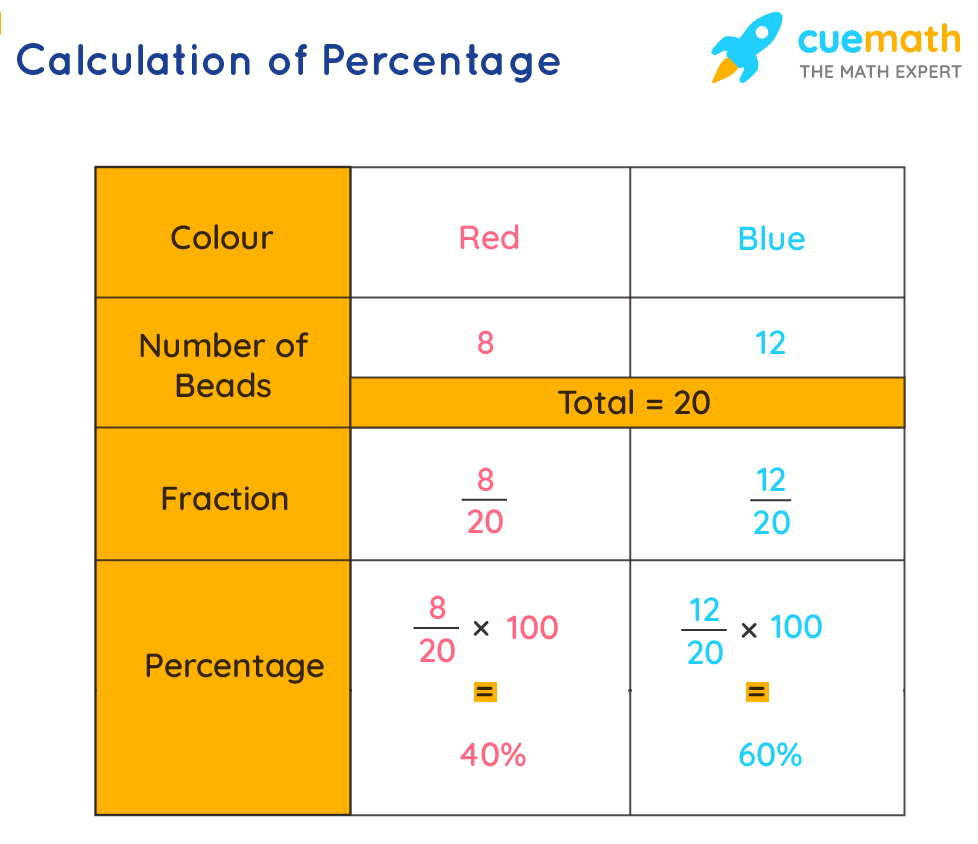
The Fundamental Calculation: (Part / Whole) x 100
The most basic formula for calculating a percentage is:
Percentage (%) = (Part ÷ Whole) × 100
Let’s break this down:
-
Divide the Part by the Whole: This step converts the relationship into a decimal. For instance, if you spent $30 out of a $100 budget, $30 ÷ $100 = 0.30.
-
Multiply by 100: This converts the decimal into a percentage. Continuing the example, 0.30 × 100 = 30%. So, you spent 30% of your budget.
Conversely, if you need to find the “part” when you know the “whole” and the “percentage”:
Part = (Percentage ÷ 100) × Whole
Example: If you want to save 15% of your $4,000 monthly income:
Part = (15 ÷ 100) × $4,000 = 0.15 × $4,000 = $600. You need to save $600.
Real-World Example: Discounts and Sales Tax
Let’s apply this to a common financial scenario:
-
Discounts: You see a jacket originally priced at $120, now with a “25% off” sale.
-
First, calculate the discount amount: (25 ÷ 100) × $120 = 0.25 × $120 = $30.
-
Then, subtract the discount from the original price: $120 – $30 = $90. The new price is $90.
-
Alternatively, if you’re taking 25% off, you’re paying 75% (100% – 25%). So, 0.75 × $120 = $90.
-
-
Sales Tax: You buy an item for $50, and the sales tax is 8%.
-
Calculate the tax amount: (8 ÷ 100) × $50 = 0.08 × $50 = $4.
-
Add the tax to the item’s price: $50 + $4 = $54. The total cost is $54.
-
These simple calculations, when practiced, become second nature and form the bedrock of financial literacy.
Practical Applications in Personal Finance
Percentages are not just abstract numbers; they are powerful tools that directly influence your personal financial well-being. Applying them strategically can lead to better budgeting, smarter borrowing, and more effective investing.
Budgeting and Expense Allocation
Creating a budget often involves allocating a certain percentage of your income to different categories. Common budgeting rules, like the 50/30/20 rule, are built entirely on percentages:
-
50% for Needs: Housing, utilities, groceries, transportation.
-
30% for Wants: Dining out, entertainment, hobbies, new clothes.
-
20% for Savings & Debt Repayment: Retirement contributions, emergency fund, paying down high-interest debt.

If your net monthly income is $5,000:
-
Needs: 0.50 × $5,000 = $2,500
-
Wants: 0.30 × $5,000 = $1,500
-
Savings/Debt: 0.20 × $5,000 = $1,000
Understanding these percentages allows you to quickly assess if your spending aligns with your financial goals and make necessary adjustments.
Understanding Interest Rates (Loans, Savings, Credit Cards)
Interest rates are perhaps the most pervasive application of percentages in personal finance. They determine how much you earn on savings and how much you pay for borrowed money.
-
Savings Accounts/CDs: A 2% annual interest rate means your initial deposit will grow by 2% over a year. If you deposit $1,000, you’ll earn $20 in interest ($1,000 × 0.02) after one year, not accounting for compounding.
-
Loans (Mortgages, Car Loans): The Annual Percentage Rate (APR) dictates the cost of borrowing. A 4% APR on a $200,000 mortgage means a significant portion of your monthly payment goes towards interest, especially in the early years.
-
Credit Cards: These often carry very high APRs (e.g., 18-25%). Understanding that an 18% APR on an unpaid balance means you’re paying $18 for every $100 owed annually (and typically calculated daily or monthly) highlights the urgency of paying off high-interest debt.
Analyzing Investment Returns and Performance
When evaluating investments, percentages are your primary metric for performance.
-
Return on Investment (ROI): Calculated as
((Current Value - Original Cost) / Original Cost) * 100. If you bought shares for $1,000 and they’re now worth $1,200, your ROI is((1200 - 1000) / 1000) * 100 = 20%. This standardizes performance comparison across different investments. -
Diversification: Financial advisors often recommend allocating percentages of your portfolio to different asset classes (e.g., 60% stocks, 30% bonds, 10% cash) to manage risk.
Navigating Debt: APR and Minimum Payments
The Annual Percentage Rate (APR) on debt instruments like credit cards or personal loans is a critical percentage to understand. It represents the annual cost of borrowing. While minimum payments are often expressed as a fixed dollar amount, they are frequently a small percentage of your outstanding balance (e.g., 2-3%). Understanding this percentage reveals how slowly you’ll pay down debt if you only make minimum payments, particularly with high APRs, and underscores the impact of compounding interest against you.
Percentages in Business and Online Income
For entrepreneurs, small business owners, and those pursuing online income, percentage calculations are indispensable tools for profitability, growth, and strategic decision-making.
Profit Margins and Markup Calculations
-
Gross Profit Margin:
((Revenue - Cost of Goods Sold) / Revenue) * 100. This tells a business how much profit it makes from each sale after deducting direct costs. A 30% gross margin means $0.30 of every dollar in sales is profit before operating expenses. -
Net Profit Margin:
((Net Income / Revenue) * 100). This is the ultimate measure of a company’s profitability, showing how much profit is left after all expenses, including taxes, are accounted for. -
Markup: Used to set prices. If a product costs you $50 to acquire, and you want a 40% markup, you calculate the markup amount ($50 × 0.40 = $20) and add it to the cost ($50 + $20 = $70 selling price). Be careful not to confuse markup with gross profit margin, which is calculated based on the selling price.
Commission Structures and Affiliate Marketing
Many sales roles and online income streams rely heavily on percentages.
-
Sales Commissions: If you earn a 10% commission on sales, and you sell $5,000 worth of product, your commission is 0.10 × $5,000 = $500.
-
Affiliate Marketing: You might earn a 7% commission on products sold through your unique link. If your referrals generate $1,000 in sales, you earn $70. Understanding these percentages is key to projecting income and setting performance goals.
Tracking Business Growth and KPIs
Key Performance Indicators (KPIs) often rely on percentages to track progress and identify trends.
-
Website Conversion Rate:
((Number of Sales / Number of Website Visitors) * 100). If 100 people visit your online store and 2 make a purchase, your conversion rate is 2%. This percentage is crucial for optimizing marketing efforts. -
Customer Retention Rate:
((Customers at End of Period - New Customers Acquired) / Customers at Start of Period) * 100). A high retention rate indicates customer satisfaction and loyalty. -
Growth Rates: Measuring month-over-month or year-over-year revenue growth in percentage terms provides a clear, comparable metric for business expansion.
Advanced Considerations and Common Pitfalls
While the core calculations are straightforward, percentages can involve nuances, especially when dealing with changes over time or comparing different bases.
Percentage Change: Increases and Decreases
Calculating percentage change is vital for tracking growth or decline.
-
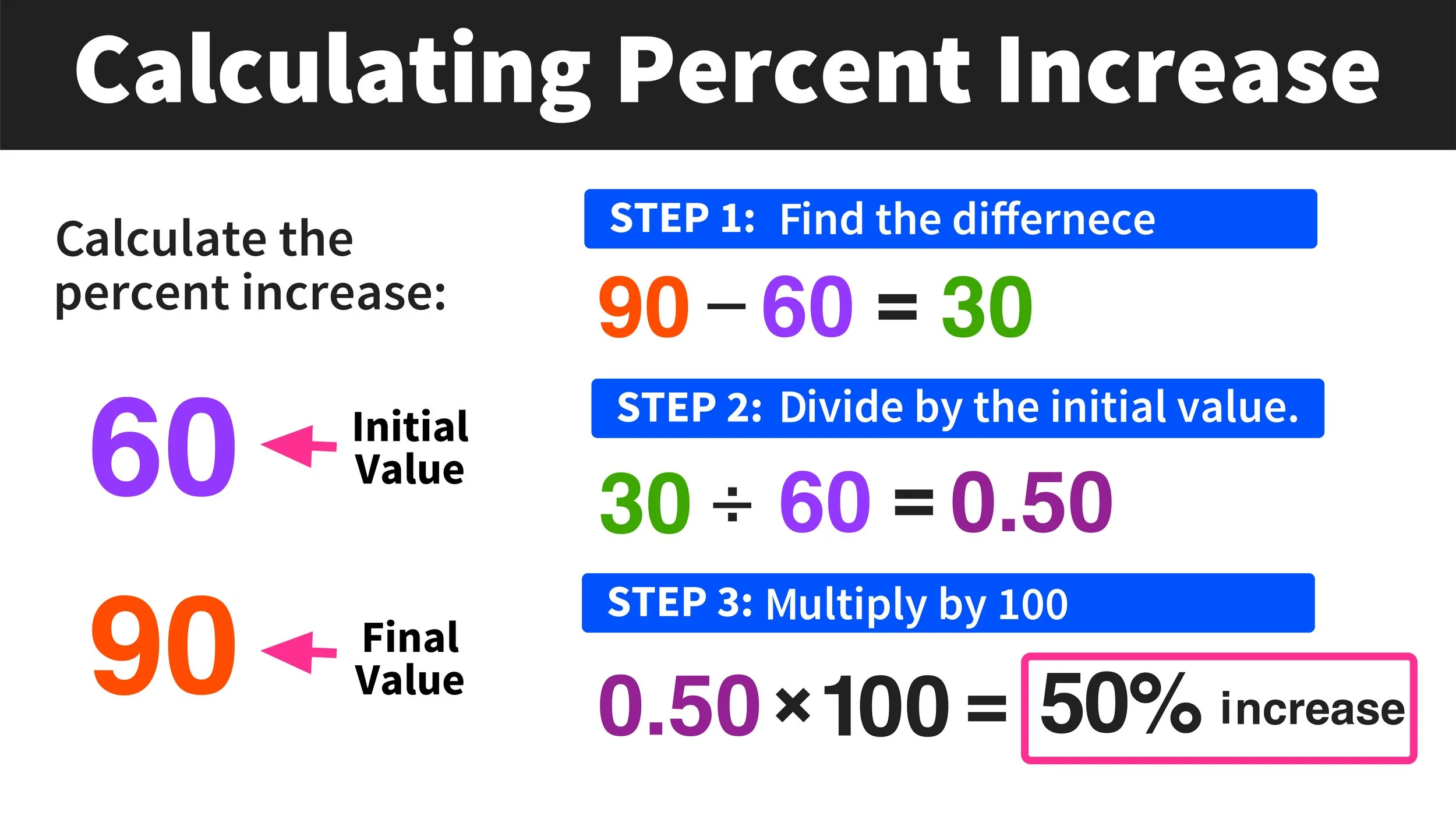
Percentage Increase:
((New Value - Old Value) / Old Value) * 100. If your sales went from $1,000 to $1,200, the percentage increase is((1200 - 1000) / 1000) * 100 = 20%. -
Percentage Decrease:
((Old Value - New Value) / Old Value) * 100. If your inventory value dropped from $5,000 to $4,000, the percentage decrease is((5000 - 4000) / 5000) * 100 = 20%.
Crucially, remember that the “Old Value” or “Original Value” is always the denominator.
Compound Interest: The Power of Time
Compound interest, often hailed as the “eighth wonder of the world,” demonstrates the exponential power of percentages over time. It’s when your interest also earns interest. While the formula A = P(1 + r/n)^(nt) might seem complex, the underlying principle is that a small percentage gain, applied consistently over time, can lead to significant wealth accumulation in savings and investments. Conversely, on debt, it can lead to rapidly growing balances. Understanding this concept is pivotal for long-term financial planning.
Avoiding Misinterpretations and Common Mistakes
-
Changing Baselines: Be wary when percentages are applied to different bases. A “10% raise” followed by a “10% pay cut” does not mean you’re back to where you started. If you earn $100, a 10% raise makes it $110. A 10% cut on $110 is $11, leaving you with $99.
-
Absolute vs. Relative: A “2% increase” might sound small, but if it’s on a national debt of trillions, the absolute amount is enormous. Always consider the whole from which the percentage is derived.
-
Averages of Percentages: You cannot simply average percentages directly if they represent different “wholes.” For example, if one product had a 10% profit margin on $100 in sales and another had a 20% profit margin on $1,000 in sales, the overall average profit margin is not 15%. You need to calculate the total profit and total sales first.
Conclusion
The question “how do I calculate percentages?” opens the door to a deeper understanding of financial mechanics. Far from being a niche mathematical query, it represents a foundational inquiry into the language of money itself. Whether you’re a student building a budget, an individual planning for retirement, or an entrepreneur scaling a business, the ability to confidently calculate, interpret, and apply percentages is an indispensable skill. By mastering these calculations, you don’t just crunch numbers; you gain clarity, reduce risk, identify opportunities, and ultimately take greater control of your financial destiny. Embrace percentages as your most reliable financial compass, guiding you toward informed decisions and lasting financial success.
aViewFromTheCave is a participant in the Amazon Services LLC Associates Program, an affiliate advertising program designed to provide a means for sites to earn advertising fees by advertising and linking to Amazon.com. Amazon, the Amazon logo, AmazonSupply, and the AmazonSupply logo are trademarks of Amazon.com, Inc. or its affiliates. As an Amazon Associate we earn affiliate commissions from qualifying purchases.