
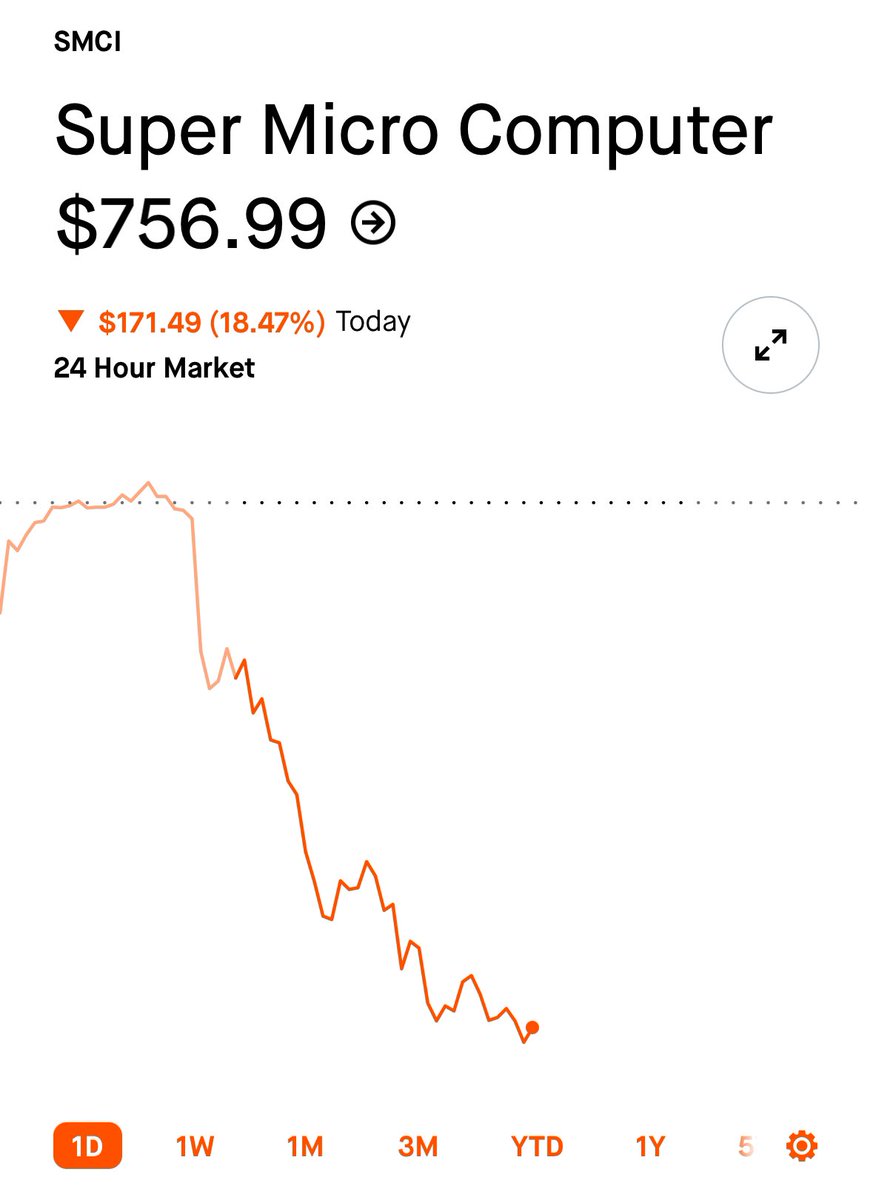
The meteoric rise of Super Micro Computer, Inc. (SMCI) has been one of the most compelling narratives in the modern investing landscape. As a primary beneficiary of the generative AI explosion, the company saw its valuation skyrocket, transitioning from a relatively niche server manufacturer to a cornerstone of the S&P 500. However, the volatility that accompanies such rapid growth has recently turned southward. When investors ask why SMCI is down today, the answer rarely lies in a single data point. Instead, it is a complex tapestry of internal corporate governance concerns, shifting macroeconomic indicators, and a fundamental reassessment of the “AI premium” that has driven the semiconductor and hardware sectors for the past eighteen months.

To understand the downward pressure on SMCI, one must look past the daily ticker fluctuations and examine the structural shifts occurring within the company and the broader market. The stock’s recent performance is a case study in how high expectations can lead to aggressive corrections when reality—or even the perception of reality—shifts.
Internal Governance and Regulatory Headwinds
One of the most significant drivers behind SMCI’s recent downward trajectory is the cloud of uncertainty surrounding its internal financial reporting and corporate governance. For any publicly traded company, especially one experiencing exponential growth, transparency is the bedrock of investor confidence. When that transparency is called into question, institutional capital tends to exit first and ask questions later.
The Impact of Short-Seller Reports and Accounting Scrutiny
The primary catalyst for recent sell-offs can be traced back to targeted reports from short-selling firms, most notably Hindenburg Research. These reports alleged “accounting red flags,” undisclosed related-party transactions, and issues regarding the company’s compliance with export controls. While SMCI has historically faced accounting hurdles—including a temporary delisting from the Nasdaq years ago—the return of these concerns during a period of peak valuation has spooked the market.
Short-seller allegations often create a “sell-off feedback loop.” Even if the allegations are contested by management, the mere existence of an investigation or the threat of regulatory intervention by the SEC creates a risk profile that many conservative fund managers are unwilling to tolerate. In the world of high-stakes investing, the “smoke and fire” analogy often dictates price action.
Delays in Financial Filings
Compounding the anxiety surrounding accounting practices is the company’s decision to delay its annual 10-K filing. In the eyes of the market, a delay in filing official financial statements is a major warning sign. It suggests that the company’s auditors may have found discrepancies that require more time to resolve, or that internal controls are not robust enough to handle the company’s new, larger scale.
For investors, this delay transforms SMCI from a “growth play” into a “transparency risk.” This uncertainty prevents the stock from finding a floor, as fundamental analysts find it difficult to model future earnings without verified historical data. Until the company provides a clean, audited filing, the stock will likely continue to face “overhang,” where any positive news is capped by the lingering fear of a financial restatement.
Erosion of Gross Margins and Competitive Pressures
While the regulatory news captures the headlines, the underlying “Money” story of SMCI is found in its income statement—specifically, its gross margins. During the initial phase of the AI boom, SMCI enjoyed a first-mover advantage. Their ability to quickly bring liquid-cooled server racks to market allowed them to capture significant market share from slower-moving titans like Dell and Hewlett Packard Enterprise (HPE).
The High Cost of Market Share
In recent quarters, however, SMCI’s gross margins have shown signs of compression. To maintain its blistering pace of revenue growth, the company has had to compete more aggressively on price. In the hardware world, scale is often achieved at the expense of profitability. When SMCI reports record-breaking revenue but shrinking margins, the market reacts poorly.
Investors are beginning to realize that the server business, even when powered by NVIDIA’s elite H100 or Blackwell chips, remains a relatively low-margin commodity business compared to the high-margin software or chip-design sectors. As Dell and HPE ramp up their AI server offerings, SMCI no longer has the playground to itself. This increased competition forces a “race to the bottom” on pricing, which lowers the valuation multiple investors are willing to pay for the stock.

The Blackwell Transition and Supply Chain Dependencies
SMCI’s fate is inextricably linked to NVIDIA. Any delay in NVIDIA’s product roadmap, such as the rumored delays in the Blackwell architecture, directly impacts SMCI’s ability to ship its high-end racks. When the market receives news of supply chain bottlenecks or component shortages, SMCI often bears the brunt of the sell-off. The company has invested heavily in inventory to satisfy demand; if that demand is deferred due to external supply chain issues, SMCI is left holding expensive components, tying up cash flow and increasing operational risk.
Macroeconomic Shifts and Sector Rotation
Beyond the company-specific issues, SMCI is a victim of its own success and its categorization as a “momentum stock.” The broader financial environment has shifted significantly in recent months, moving away from the “growth at any cost” mentality that defined 2023 and early 2024.
The Influence of Interest Rates and Inflation Data
As a high-beta stock—meaning it moves more aggressively than the overall market—SMCI is hyper-sensitive to interest rate expectations. When the Federal Reserve signals that rates may stay “higher for longer,” or when inflation data comes in hotter than expected, growth stocks are discounted more heavily. The present value of future earnings is worth less in a high-interest-rate environment.
Recently, we have seen a “rotation” on Wall Street. Investors are taking profits from the “Magnificent Seven” and their hardware satellites (like SMCI) and moving that capital into “Value” sectors like utilities, healthcare, and consumer staples. This rotation isn’t necessarily a critique of SMCI’s business model, but rather a strategic move by institutional investors to de-risk their portfolios in the face of economic uncertainty.
The Psychology of the AI Bubble Debate
There is an ongoing debate among financial analysts regarding whether the AI trade has become “overcrowded.” When a stock like SMCI gains several hundred percent in a year, it becomes a target for profit-taking. Many institutional investors have “rebalancing” rules; if SMCI grows to represent too large a percentage of a portfolio, they are forced to sell shares regardless of the company’s performance.
When the market starts to question the ROI (Return on Investment) of AI for end-users—such as cloud service providers and enterprises—the hardware providers are the first to feel the chill. If Microsoft, Google, and Meta signal even a slight reduction in their capital expenditure (CapEx) plans, SMCI’s projected earnings for the next four quarters are immediately called into question.
Investor Strategy: Navigating the Volatility
For the individual investor, the current decline in SMCI represents a pivotal moment. Is this a “buy the dip” opportunity, or a “falling knife” to be avoided? The answer depends on one’s risk tolerance and time horizon.
Assessing the Fundamental Value
To determine if SMCI is undervalued at its current lower price, investors must look at its Forward P/E (Price-to-Earnings) ratio relative to its growth rate (the PEG ratio). If the company can resolve its accounting concerns and maintain its revenue growth, it may appear cheap compared to other tech giants. However, the “Money” rule of thumb is that cheapness is not a catalyst. A stock can stay “cheap” for a long time if the market lacks trust in the management team.
Risk Management and Position Sizing
The volatility of SMCI today serves as a reminder of the importance of position sizing. High-growth tech stocks should rarely constitute the entirety of a retail portfolio. For those looking to maintain exposure to the AI hardware space, diversifying across the supply chain—from chip makers like NVIDIA and AMD to power management companies and alternative server providers—can mitigate the impact of a single-stock collapse.
In conclusion, SMCI is down today because of a perfect storm of internal governance fears, narrowing profit margins, and a broader market rotation away from high-risk growth assets. While the company remains a vital player in the infrastructure that powers modern artificial intelligence, the transition from a “market darling” to a mature, scrutinized S&P 500 company is often a painful one. Investors must weigh the undeniable growth of the AI sector against the specific risks of SMCI’s corporate structure and the shifting sands of the global economy. Transparency and margin stability will be the two key factors to watch; until both are restored, the road for SMCI will likely remain turbulent.
aViewFromTheCave is a participant in the Amazon Services LLC Associates Program, an affiliate advertising program designed to provide a means for sites to earn advertising fees by advertising and linking to Amazon.com. Amazon, the Amazon logo, AmazonSupply, and the AmazonSupply logo are trademarks of Amazon.com, Inc. or its affiliates. As an Amazon Associate we earn affiliate commissions from qualifying purchases.