
The sight of a crimson dashboard across major global indices often triggers a visceral reaction in even the most seasoned investors. When the market begins a sustained descent, the immediate impulse is to search for a singular culprit—a specific news event, a disappointing earnings report, or a geopolitical flare-up. However, the reality of a market downturn is rarely so linear. Financial markets are complex, adaptive systems where multiple variables intersect, amplify one another, and eventually force a correction or a bear market.
Understanding why the market is going down requires peeling back the layers of macroeconomic policy, corporate health, geopolitical stability, and the underlying psychology of the investing public. By dissecting these components, we can move beyond the “noise” of daily price fluctuations and identify the structural shifts driving the downward trend.
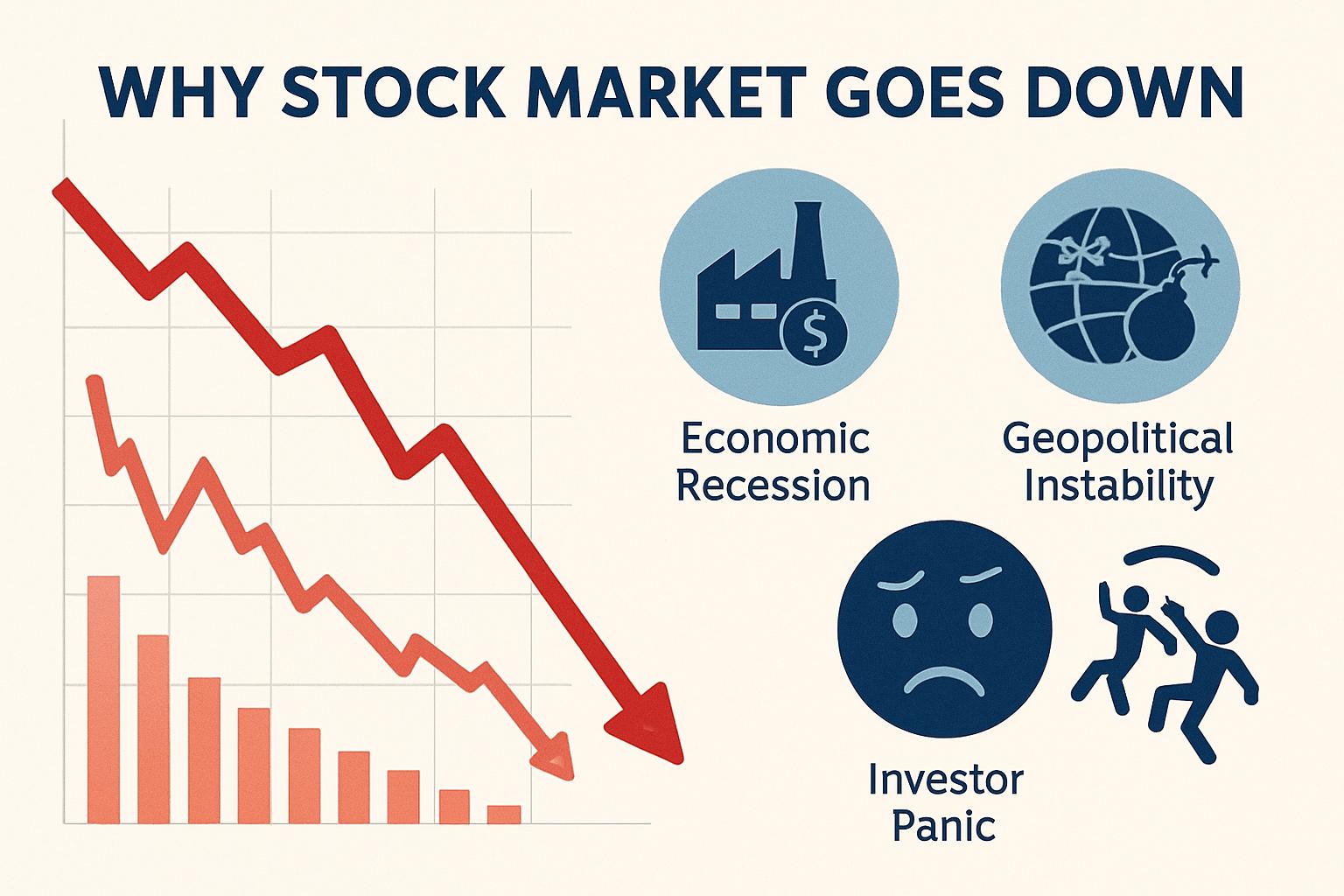
The Dominance of Macroeconomic Forces and Central Bank Policy
In the hierarchy of market drivers, macroeconomic factors—specifically interest rates and inflation—sit at the very top. For over a decade, global markets were buoyed by a “cheap money” era characterized by near-zero interest rates and quantitative easing. As this regime shifts, the friction created by the transition is a primary reason for market declines.
The Impact of “Higher for Longer” Interest Rates
When central banks, led by the Federal Reserve, raise interest rates to combat inflation, they are essentially increasing the cost of capital. For businesses, this means borrowing money for expansion becomes more expensive. For consumers, mortgages, car loans, and credit card debt become more burdensome, leading to reduced discretionary spending.
From an institutional perspective, higher interest rates change the “discount rate” used to value future cash flows. Since a stock’s value is theoretically the present value of its future earnings, a higher discount rate mathematically lowers the current value of those stocks. This is particularly punishing for high-growth tech companies that are expected to generate the bulk of their profits years into the future.
Persistent Inflation and Purchasing Power
Inflation is a double-edged sword. While moderate inflation is often a sign of a healthy, growing economy, “sticky” or runaway inflation erodes the purchasing power of consumers and increases input costs for manufacturers. When companies cannot pass these costs onto consumers, their profit margins shrink. If the market senses that inflation is not cooling as quickly as anticipated, it prepares for further aggressive action from central banks, leading to a preemptive sell-off in equities.
Fundamental Shifts in Corporate Performance and Valuation
While macro trends set the stage, the actual performance of corporations provides the script. Markets are forward-looking mechanisms; they do not trade on what happened yesterday, but on what they expect to happen in the next six to twelve months.
Earnings Compression and Guidance Downgrades
A significant reason for a market downturn is a shift in the “earnings narrative.” During a bull market, investors are willing to pay a premium for growth. However, when large-cap companies begin reporting misses in revenue or, more importantly, issue “soft” guidance for future quarters, the market reacts swiftly.
Earnings compression occurs when the cost of doing business rises—due to wages, energy, or raw materials—at a faster rate than revenue growth. When the “Magnificent Seven” or other market leaders show signs of fatigue, the broader indices, which are often market-cap weighted, naturally follow suit.
Valuation Normalization
Markets occasionally enter periods of “irrational exuberance,” where stock prices decouple from their underlying fundamentals. We see this in inflated Price-to-Earnings (P/E) ratios that far exceed historical averages. When the market goes down, it is often a process of “valuation normalization.” This is a painful but necessary correction where the market sheds its excess and returns to a baseline that more accurately reflects actual economic productivity rather than speculative fervor.
Geopolitical Friction and Global Trade Disruptions
We live in a hyper-connected global economy where a supply chain disruption in one hemisphere can lead to a price spike in another. Geopolitical instability is a major “macro-wildcard” that can derail even the strongest bull markets.
Energy Security and Commodity Volatility
Conflicts in oil-producing regions or essential trade corridors (like the Suez Canal or the Black Sea) create immediate spikes in energy and food prices. Because energy is an input for almost every sector of the economy—from transportation to manufacturing—a rise in crude oil or natural gas prices acts like a universal tax on both corporations and consumers. The uncertainty surrounding energy security often leads institutional investors to move capital out of “risk-on” assets like stocks and into “safe havens” like gold or government bonds.
The End of Frictionless Globalization
For decades, the market benefited from the “peace dividend” of globalization, which allowed companies to optimize supply chains for maximum efficiency and minimum cost. Recent years have seen a shift toward “friend-shoring” and “de-risking,” as trade wars and regional tensions force companies to prioritize resilience over efficiency. This structural shift is inherently inflationary and adds a layer of complexity to corporate operations, which the market often prices in through lower stock valuations.
The Psychological Architecture of a Sell-Off
Market movements are not merely the result of cold, hard data; they are driven by the collective psychology of millions of participants. Human emotion—specifically fear and greed—plays a massive role in why the market goes down and how fast that descent occurs.
The Feedback Loop of Fear
When a decline begins, it can become self-perpetuating. As prices drop, investors who have utilized “margin” (borrowed money) to buy stocks may face margin calls, forcing them to sell their positions to cover their debts. This forced selling puts further downward pressure on prices, triggering more margin calls and more selling.
Furthermore, modern markets are dominated by algorithmic and high-frequency trading. Many of these algorithms are programmed to sell when certain technical levels are breached (such as the 200-day moving average). When these “sell triggers” are hit simultaneously across thousands of funds, it creates a cascade of liquidity that can cause the market to “gap down” rapidly, independent of any new fundamental news.
The Flight to Quality
In times of uncertainty, the “herd mentality” shifts from seeking returns to seeking capital preservation. This is known as a flight to quality. Investors rotate out of speculative sectors like small-cap stocks, biotech, or crypto and into defensive sectors like utilities, healthcare, or cash equivalents. This rotation causes the broader market averages to decline as the heavy-weight growth sectors are liquidated.
Strategic Positioning: Navigating the Downturn
While the reasons for a market decline are often outside an individual’s control, understanding them allows for a more strategic response. A market that is going down is not necessarily a market that is “broken”; it is a market that is re-pricing risk.
The Importance of Rebalancing and Diversification
A downward market exposes the flaws in a portfolio that is too heavily weighted in a single sector. For the disciplined investor, these periods provide an opportunity to rebalance—selling assets that have held their value to buy high-quality assets that have been unfairly punished by the broader sell-off.
Adopting a Long-Term Horizon
Historically, every significant market downturn has been followed by an eventual recovery and a subsequent peak. The challenge for investors is surviving the “valley of despair” without making emotional decisions that lock in permanent losses. By identifying whether the current downturn is driven by temporary factors (like a short-term geopolitical event) or structural factors (like a shift in the interest rate regime), investors can better calibrate their risk tolerance.

Conclusion
The market goes down when the aggregate weight of economic reality, corporate performance, and geopolitical risk outweighs the optimism of buyers. It is a period of price discovery where the “excess” of the previous cycle is burned off, and the foundation for the next period of growth is laid. Whether driven by the Federal Reserve’s hawkish stance, a cooling of corporate earnings, or the simple mathematics of overvaluation, a declining market is a functional—albeit painful—part of the economic cycle. For those who view the market through a lens of fundamentals rather than emotions, these periods are less about the loss of value and more about the recalibration of opportunity.
aViewFromTheCave is a participant in the Amazon Services LLC Associates Program, an affiliate advertising program designed to provide a means for sites to earn advertising fees by advertising and linking to Amazon.com. Amazon, the Amazon logo, AmazonSupply, and the AmazonSupply logo are trademarks of Amazon.com, Inc. or its affiliates. As an Amazon Associate we earn affiliate commissions from qualifying purchases.