
The S&P 500 is not just a collection of companies; it is a meticulously curated index that serves as a cornerstone of global financial markets, a barometer for the U.S. economy, and a critical benchmark for investors worldwide. For anyone looking to understand the pulse of American corporate power, deciphering the S&P 500 is an essential first step. This article delves into the composition of this influential index, explores the criteria for inclusion, highlights its significance to investors, and provides insight into its dynamic nature.
Understanding the S&P 500: More Than Just a Number
At its core, the S&P 500 (Standard & Poor’s 500) is a stock market index that represents 500 of the largest publicly traded companies in the United States. Unlike some indices that simply include a fixed number of companies, the S&P 500 is market-capitalization weighted, meaning companies with larger market values have a greater impact on the index’s performance. This weighting methodology ensures that the index accurately reflects the true scale and influence of its constituent companies within the broader economy.
What is the S&P 500?
Launched in 1957, the S&P 500 has grown to become one of the most widely followed equity indices. It’s often considered the best single gauge of large-cap U.S. equities and a leading indicator of U.S. stock market health. Its broad representation across various sectors makes it a powerful tool for gauging the overall economic landscape, reflecting trends in corporate profitability, consumer spending, and technological innovation. Investors, economists, and analysts alike use the S&P 500 to track market performance, compare investment strategies, and make informed financial decisions.
The Criteria for Inclusion
Being part of the S&P 500 is a mark of prestige and a testament to a company’s financial strength and market influence. The S&P Dow Jones Indices committee, which manages the index, employs a rigorous set of criteria for company inclusion. These criteria go beyond mere size, aiming to ensure the index remains representative, investable, and accurately reflects the U.S. economy.
Key criteria include:
-
Market Cap: While there’s no fixed market capitalization threshold, companies typically need a market cap of at least $14.5 billion (as of recent updates), though this figure is subject to change.
-
Liquidity: The company’s stock must be highly liquid, meaning a significant portion of its shares must be available for public trading (public float) and it must have adequate trading volume to ensure efficient price discovery.
-
Domicile: The company must be a U.S. company, with its primary listing on a U.S. exchange (NYSE or NASDAQ).
-
Profitability: A crucial requirement is that the sum of the most recent four consecutive quarters’ Generally Accepted Accounting Principles (GAAP) earnings must be positive, and earnings for the most recent quarter must also be positive. This ensures that the index reflects financially sound companies.
-
Sector Representation: While not a strict quota, the committee aims to ensure that the index’s sector weights broadly align with those of the broader U.S. market, utilizing the Global Industry Classification Standard (GICS) to categorize companies.
-
Public Float: At least 50% of a company’s outstanding shares must be available to the public.
These criteria are regularly reviewed and updated to maintain the index’s relevance and integrity. Companies that fail to meet these ongoing requirements, perhaps due to declining market cap, poor performance, or mergers, may be removed from the index, making way for new entrants.
Why the S&P 500 Matters to Investors
For investors, the S&P 500 is more than just a list of companies; it’s a foundational element of many investment strategies.
-
Benchmark for Performance: It serves as the primary benchmark against which professional money managers and individual investors measure the performance of their large-cap U.S. equity portfolios.
-
Passive Investing Vehicle: The existence of S&P 500 index funds and Exchange Traded Funds (ETFs) allows investors to gain broad, diversified exposure to the U.S. stock market with a single investment, often at a very low cost. This passive approach aligns with the philosophy that beating the market consistently is difficult, making “owning the market” an attractive long-term strategy.
-
Economic Health Indicator: Its movements are closely watched by economists and policymakers as an indicator of corporate health and broader economic sentiment. A rising S&P 500 often correlates with a strong economy and growing corporate profits, while a decline can signal economic headwinds.
A Snapshot of the S&P 500’s Diverse Landscape
While often seen as a monolithic entity, the S&P 500 is incredibly diverse, encompassing companies from every major sector of the U.S. economy. Its composition is not static; it continually evolves, reflecting shifts in market leadership, economic trends, and technological advancements.
Dominant Sectors and Their Weight
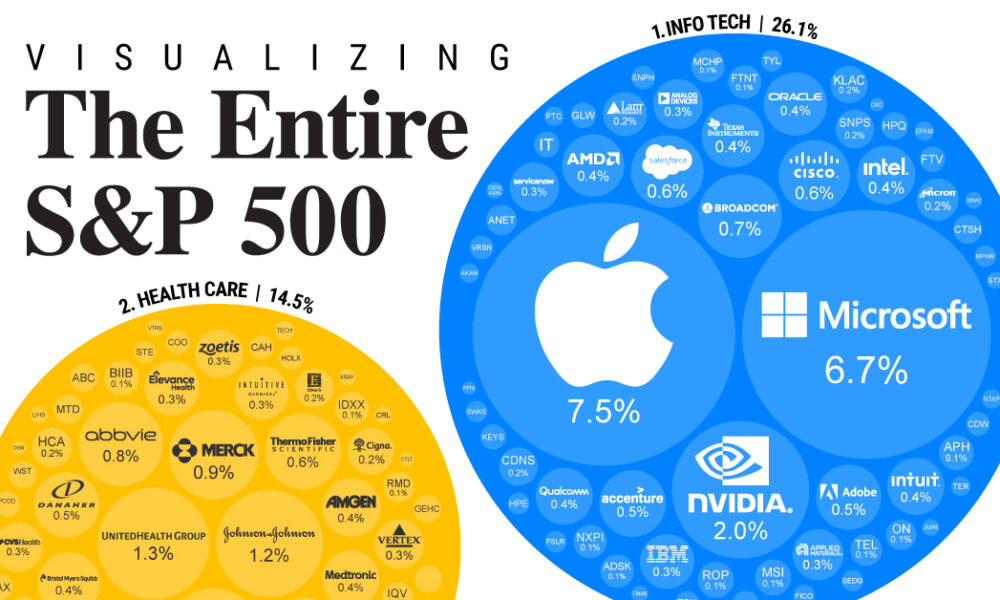
The S&P 500 is segmented into 11 GICS sectors, each representing a distinct part of the economy. The weight of each sector within the index fluctuates based on the collective market capitalization of its constituent companies. Over recent decades, we’ve seen significant shifts in sector dominance.
-
Information Technology: Often the largest sector by market capitalization, it includes giants like Apple, Microsoft, and NVIDIA. Its heavy weighting underscores the tech-driven nature of the modern economy and the disruptive innovation that continues to drive growth.
-
Financials: Companies like Berkshire Hathaway, JPMorgan Chase, and Visa represent the robust financial infrastructure of the U.S., encompassing banking, insurance, investment services, and fintech.
-
Healthcare: With pharmaceutical companies, biotech firms, and medical device manufacturers (e.g., Johnson & Johnson, UnitedHealth Group), this sector plays a crucial role, often seen as defensive due to consistent demand.
-
Consumer Discretionary: This sector includes companies whose products and services are in demand during good economic times, such as Amazon, Tesla, and Home Depot, reflecting consumer spending power.
-
Communication Services: Home to entertainment, media, and telecommunications companies (e.g., Alphabet, Meta Platforms, Verizon), this sector has gained significant weight with the rise of digital platforms and streaming.
Other important sectors include Industrials, Consumer Staples, Energy, Utilities, Materials, and Real Estate, each contributing to the overall diversity and resilience of the index.
The Giants Among Us: Top Holdings
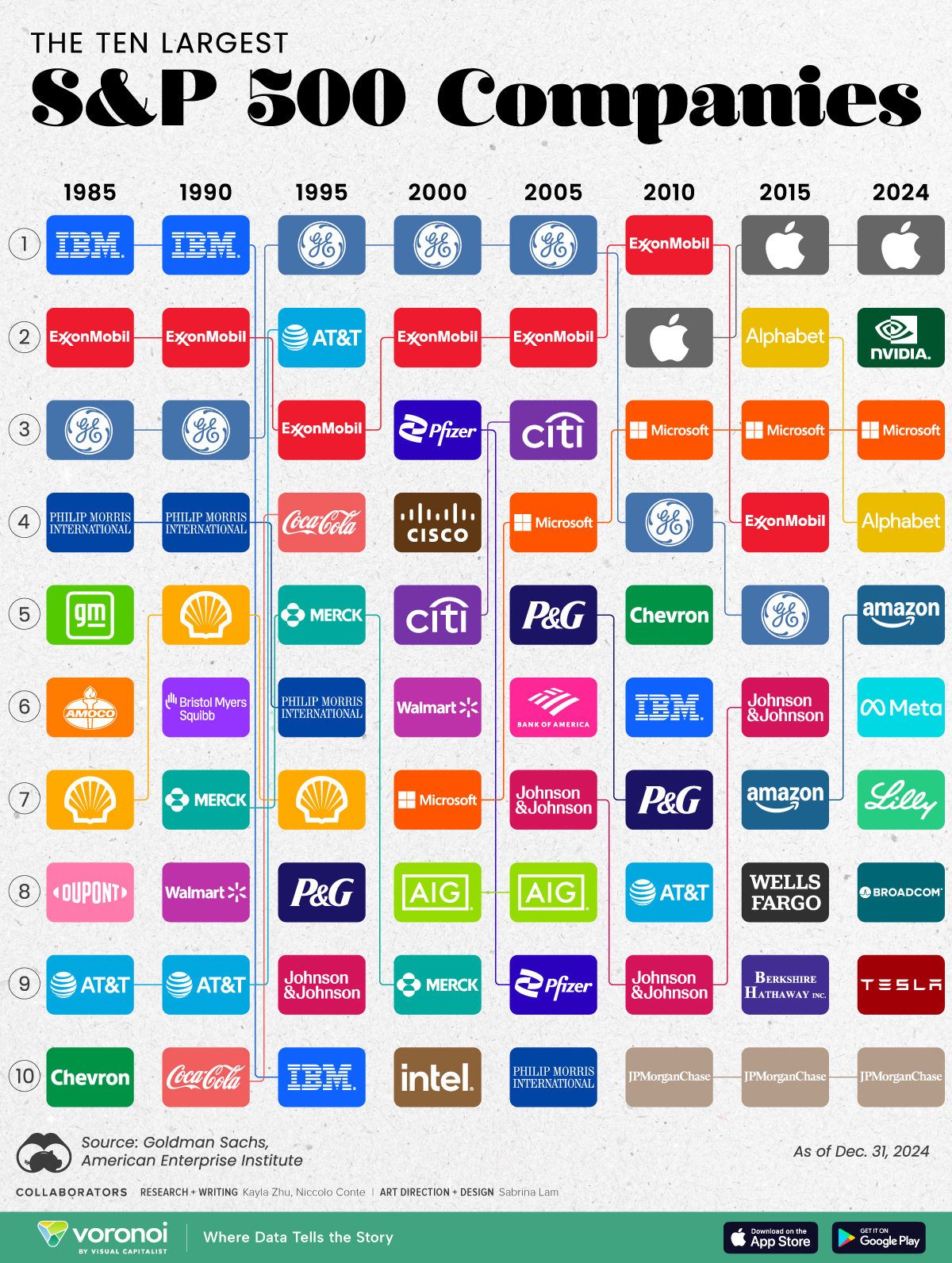
While 500 companies make up the index, a significant portion of its total market capitalization and performance is often driven by a handful of mega-cap companies. These are the giants that frequently dominate headlines and investor portfolios. As of recent periods, companies like Apple, Microsoft, Amazon, Alphabet (Google), NVIDIA, Meta Platforms (Facebook), and Tesla often rank among the top holdings. Their sheer size and market influence mean that their individual performance can significantly sway the entire index. Investors often analyze these companies not just for their individual merit but also for their broader implications for the technology sector and the economy as a whole.
A Dynamic Index: Additions and Deletions
The S&P 500 is a living, breathing index. It is not a permanent club; companies are routinely added and removed. This dynamic nature is critical to its accuracy as a market barometer.
-
Additions: New companies are typically added when they achieve sufficient scale, profitability, and liquidity, often displacing existing constituents that no longer meet the criteria or have been acquired. Recent examples include companies that have achieved rapid growth and market acceptance, reflecting evolving economic landscapes.
-
Deletions: Companies may be removed for various reasons:
-
Acquisition: If a company is acquired by another, it leaves the index.
-
Falling Market Cap/Profitability: Persistent underperformance or a significant decline in market capitalization or profitability can lead to removal.
-
Bankruptcy: Companies facing severe financial distress are removed.
-
Spin-offs: Sometimes a company splits into multiple entities, requiring adjustments.
-
This ongoing rebalancing, typically announced quarterly, ensures that the S&P 500 remains representative of the most influential and financially sound companies in the U.S. stock market, accurately reflecting the ebb and flow of corporate power and innovation.
Investing in the S&P 500: Strategies and Tools
For individual and institutional investors, the S&P 500 offers compelling investment opportunities, primarily through passive strategies that aim to replicate the index’s performance.
Passive Investing through ETFs and Mutual Funds
The most common and efficient way for investors to gain exposure to the S&P 500 is through index-tracking funds.
-
Exchange Traded Funds (ETFs): These funds trade like individual stocks on exchanges and hold the same companies as the S&P 500 in the same proportions. Popular S&P 500 ETFs include SPDR S&P 500 ETF Trust (SPY), iShares Core S&P 500 ETF (IVV), and Vanguard S&P 500 ETF (VOO). They offer low expense ratios, high liquidity, and instant diversification across 500 companies.
-
Index Mutual Funds: Similar to ETFs, these funds pool money from many investors to invest in the S&P 500 components. They are typically bought and sold directly through fund providers and are often a staple in retirement accounts.
Both options provide investors with broad market exposure, long-term growth potential, and significantly lower risk compared to investing in individual stocks, thanks to diversification. This strategy is often recommended for long-term investors seeking to capture market returns without the complexities of stock picking.
Active Stock Picking vs. Index Investing
The S&P 500 also serves as a critical backdrop for the active versus passive investing debate.
-
Active Stock Picking: Some investors and fund managers attempt to “beat the market” by selecting individual stocks they believe will outperform the S&P 500. This requires extensive research, a deep understanding of market dynamics, and a tolerance for higher risk.
-
Index Investing: Proponents of index investing argue that consistently outperforming the S&P 500, especially after fees, is extremely difficult. By simply matching the index, investors are guaranteed to capture the market’s return, benefiting from the long-term upward trend of the U.S. economy. For many, a diversified S&P 500 index fund forms the core of their investment portfolio, supplemented perhaps by more targeted investments.
Considering Sector-Specific Investments within the S&P 500
While a broad S&P 500 index fund offers diversification, some investors might wish to overweight certain sectors based on their economic outlook or investment goals. This can be achieved through:
-
Sector ETFs: There are ETFs that track specific GICS sectors within the S&P 500, such as technology (e.g., XLK), healthcare (e.g., XLV), or financials (e.g., XLF). These allow investors to concentrate their exposure on areas they believe will outperform without having to pick individual stocks within that sector.
-
Individual Stock Selection: Investors who have conviction in specific companies within the S&P 500 can buy their shares directly. However, this strategy comes with higher individual company risk and requires thorough due diligence.
Beyond the Names: The Economic Impact and Future Outlook
The S&P 500 is more than just a list of the largest U.S. companies; it is a profound reflection of the nation’s economic vitality and a window into its future trajectory.
The S&P 500 as an Economic Barometer
As a market-cap weighted index representing a broad swathe of the U.S. economy, the S&P 500’s performance often mirrors the health of American corporate profitability and consumer sentiment. A robust S&P 500 typically signifies strong corporate earnings, economic growth, and investor confidence. Conversely, sustained declines can indicate economic contraction or heightened uncertainty. Analysts closely monitor sector performance within the S&P 500 to identify leading and lagging indicators, providing insights into various facets of the economy, from consumer spending to industrial production and technological innovation.
Navigating Market Volatility with S&P 500 Insights
The stock market is inherently volatile, and the S&P 500 is no exception. However, its long-term historical performance shows a consistent upward trend, demonstrating the resilience and growth capacity of the U.S. economy. For investors, understanding this long-term perspective is crucial. During periods of market downturns, viewing the S&P 500 through a historical lens can reinforce the wisdom of long-term investing strategies like dollar-cost averaging and staying invested rather than trying to time the market. The diversification offered by the S&P 500 helps to cushion the impact of individual company failures or sector-specific downturns.
The Evolving Face of American Business
The composition of the S&P 500 is a dynamic snapshot of the American business landscape. Over the decades, industries have risen and fallen, and new giants have emerged. From the industrial titans of yesteryear to today’s technology and healthcare behemoths, the index continuously adapts to reflect innovation, economic restructuring, and societal shifts. Looking ahead, factors such as artificial intelligence, renewable energy, biotechnology, and global supply chain reconfigurations will undoubtedly shape the future composition of the S&P 500, introducing new leaders and challenging existing ones. The index will continue to represent the cutting edge of American enterprise.
How to Find the Current S&P 500 List and Stay Updated
Given its dynamic nature, the exact list of companies in the S&P 500 changes over time. For investors and researchers, knowing where to find the most current information is essential.
Official Sources and Financial Data Providers
-
S&P Dow Jones Indices Website: The official source for the S&P 500, their website (spglobal.com/spdji/) provides comprehensive information, including current constituents, methodology documents, and news on index changes.
-
Reputable Financial News Outlets: Major financial news providers such as The Wall Street Journal, Bloomberg, Reuters, CNBC, and Investor’s Business Daily frequently publish updates and analyses related to S&P 500 constituents and performance.
-
Brokerage Platforms and Financial Data Services: Most online brokerage accounts and financial data platforms (e.g., Yahoo Finance, Google Finance, Bloomberg Terminal, Refinitiv Eikon) provide up-to-date lists of S&P 500 components, along with their weights, sector classifications, and individual stock data.

The Importance of Regular Research
Staying informed about the S&P 500 is not just about knowing the names on the list, but also understanding the reasons behind changes, the performance of key sectors, and the overall economic context. Regular research and monitoring of financial news are crucial for making informed investment decisions, whether you’re passively investing in an S&P 500 index fund or actively analyzing its constituent companies. The S&P 500 is a powerful tool for understanding market dynamics and a vital component of a well-rounded financial education.
aViewFromTheCave is a participant in the Amazon Services LLC Associates Program, an affiliate advertising program designed to provide a means for sites to earn advertising fees by advertising and linking to Amazon.com. Amazon, the Amazon logo, AmazonSupply, and the AmazonSupply logo are trademarks of Amazon.com, Inc. or its affiliates. As an Amazon Associate we earn affiliate commissions from qualifying purchases.