
In the world of high-stakes investing, few instruments capture the imagination and the anxiety of traders quite like TQQQ. Formally known as the ProShares UltraPro QQQ, TQQQ is not a traditional stock in the sense of owning a piece of a single company like Apple or Microsoft. Instead, it is a leveraged Exchange-Traded Fund (ETF) designed to provide amplified exposure to one of the most powerful indices in the financial world: the Nasdaq-100.
For the uninitiated, TQQQ represents a double-edged sword. It offers the potential for extraordinary gains during periods of market prosperity, but it carries the risk of devastating losses during downturns. To understand whether TQQQ has a place in a financial portfolio, one must look beyond the ticker symbol and grasp the mechanics of leverage, the behavior of the underlying index, and the mathematical realities of daily rebalancing.
Understanding the Fundamentals of TQQQ
To understand TQQQ, one must first understand the QQQ. The Invesco QQQ Trust is a standard ETF that tracks the Nasdaq-100 Index, which includes 100 of the largest non-financial companies listed on the Nasdaq Stock Market. This index is heavily weighted toward technology, consumer services, and health care, featuring global giants such as Nvidia, Amazon, Alphabet, and Meta.
TQQQ takes this foundation and applies a 3x multiplier. This means that for every 1% move in the Nasdaq-100 Index on a given day, TQQQ seeks to move 3% in the same direction. If the Nasdaq-100 rises by 2% in a single trading session, TQQQ is designed to rise by approximately 6%. Conversely, if the index drops by 2%, TQQQ is engineered to fall by 6%.
The Underlying Index: The Nasdaq-100
The Nasdaq-100 is often viewed as a proxy for the growth and innovation sector of the U.S. economy. Because it excludes financial companies and leans heavily into software, hardware, and biotechnology, it tends to be more volatile than the broader S&P 500. TQQQ investors are essentially placing a leveraged bet on the continued dominance of large-cap technology firms. When these companies report strong earnings or benefit from macro trends like the rise of Artificial Intelligence, TQQQ experiences explosive growth.
The Mechanism of Leverage
Unlike a standard ETF that simply buys and holds the stocks within an index, ProShares (the issuer of TQQQ) uses financial derivatives to achieve its 3x daily objective. This includes the use of swap agreements, futures contracts, and other financial instruments. These derivatives allow the fund manager to gain $3 of exposure for every $1 of investor capital. However, maintaining this level of exposure requires constant management, which leads to higher internal costs compared to passive “buy-and-hold” index funds.
How TQQQ Works: The Power of Daily Returns
A critical distinction that every investor must make is that TQQQ tracks the daily performance of its index. It does not promise to track the 3x performance of the Nasdaq-100 over a month, a year, or a decade. This nuance is where many retail investors find themselves in trouble.
The Role of Daily Rebalancing
At the end of every trading day, the fund managers of TQQQ must rebalance their positions to ensure they maintain the 3x leverage ratio for the following day. This process involves buying more exposure when the market goes up and selling exposure when the market goes down. This constant “buying high and selling low” at the end of each session is a mathematical necessity to maintain the leverage target, but it creates a phenomenon known as “volatility decay.”
The Concept of Compounding
In a trending market—one that moves consistently upward with little interruption—compounding works in the investor’s favor. If the Nasdaq-100 goes up 1% every day for five days, a 3x leveraged fund will actually return more than 15% because the 3% daily gains compound on a larger base each day. This is the “goldilocks” scenario for TQQQ, where it outperforms even the theoretical 3x expectations.
However, in a sideways or “choppy” market, the math changes. Imagine the index goes up 5% one day and down 5% the next. In a standard fund, you are roughly back to where you started (slightly lower due to the math of percentages). In a 3x leveraged fund, you go up 15% and then down 15%. Because a 15% loss on a larger number is greater than a 15% gain on a smaller number, you end up significantly lower than your starting point. This is why TQQQ is generally regarded as a tactical tool rather than a long-term foundational asset.
The Risk-Reward Profile of Leveraged ETFs

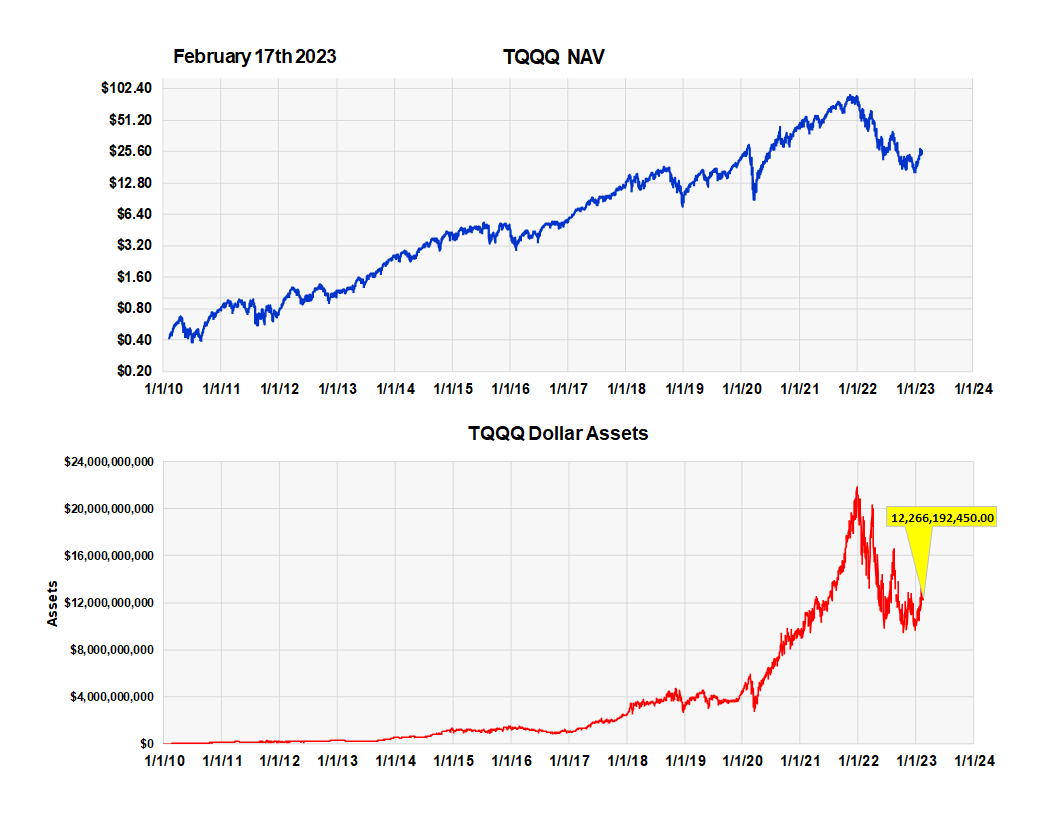
The allure of TQQQ is undeniable. During the decade-long bull market following the 2008 financial crisis, TQQQ was one of the best-performing assets in existence, turning relatively small investments into fortunes. However, the risks are equally monumental.
Performance in Bull vs. Bear Markets
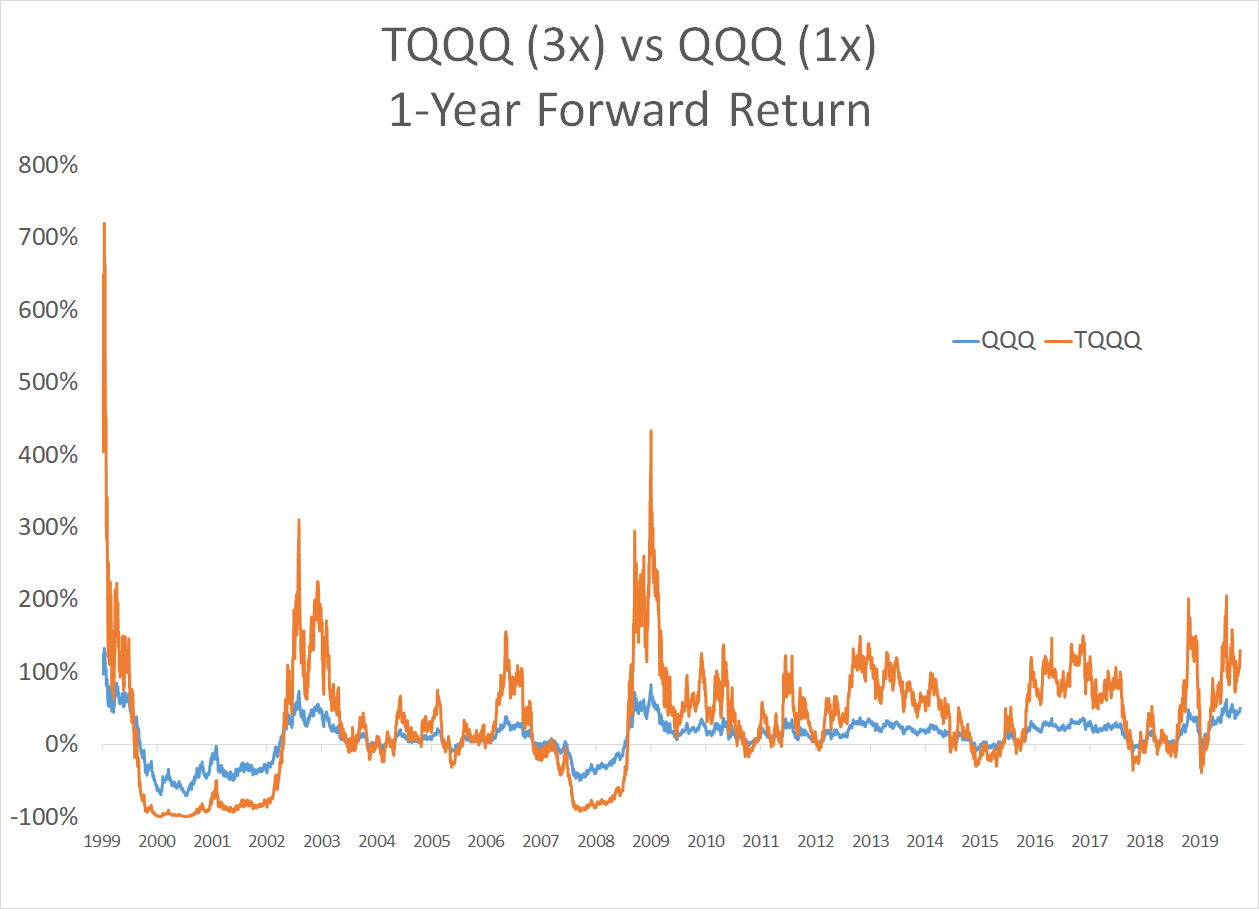
In a sustained bull market, technology companies often lead the charge. Because TQQQ amplifies these moves, it can see triple-digit percentage gains in a single year. For example, during years of low interest rates and rapid tech expansion, TQQQ investors saw returns that dwarfed almost any other asset class.
The flip side is catastrophic. During a bear market or a “tech wreck,” the losses are magnified. A 10% correction in the Nasdaq-100 translates to a 30% loss in TQQQ. If the index enters a true crash, such as a 33.3% decline, a 3x leveraged fund could theoretically lose nearly 100% of its value. While circuit breakers and fund structures aim to prevent a total wipeout to zero, the possibility of a 90% or greater drawdown is very real.
Volatility Decay and Long-Term Holding
Financial professionals often warn against holding TQQQ for long periods because of “volatility drag.” In a volatile market that fluctuates without a clear trend, the value of TQQQ can erode even if the underlying index remains flat over the same period. This decay is the “hidden cost” of leverage. For this reason, the ProShares prospectus explicitly states that the fund is intended for sophisticated investors who monitor their holdings daily and understand the risks of leverage.
Strategic Uses for TQQQ in a Portfolio
Despite the inherent risks, TQQQ is a highly liquid and popular instrument used by various types of market participants. When used correctly, it can serve specific strategic purposes within a diversified financial plan.
Short-Term Trading and Day Trading
TQQQ is a favorite among day traders and swing traders. Because of its high volatility, it provides ample opportunity to profit from small intraday moves in the tech sector. Traders use technical analysis, momentum indicators, and macroeconomic news (such as Fed interest rate decisions) to time their entries and exits. For someone who believes the market will rally for three days following a positive earnings report from a major tech company, TQQQ offers a way to maximize the profit from that short-term conviction.
Hedging and Speculative “Core-Satellite” Strategies
Some advanced investors use TQQQ as a “satellite” holding. They might keep 90% of their portfolio in conservative, low-cost index funds and use 10% for high-risk, high-reward plays like TQQQ. In a strong bull market, that 10% allocation can significantly boost the overall portfolio’s total return.
Others may use it as a temporary hedge or a way to gain large exposure with a small amount of capital. By putting a small amount into TQQQ, an investor can achieve the same market exposure as a much larger investment in QQQ, freeing up the remaining cash for other opportunities or for interest-bearing cash equivalents.
Key Considerations Before Investing in TQQQ
Before adding TQQQ to a brokerage account, it is essential to look at the logistical and financial details that govern the fund.
Expense Ratios and Management Fees
Leveraged ETFs are expensive to operate. ProShares must pay for swap agreements, manage daily rebalancing, and handle the complexities of derivative contracts. Consequently, TQQQ carries an expense ratio of approximately 0.95%. While this may seem small compared to the potential returns, it is nearly ten times more expensive than many standard, non-leveraged ETFs. This fee acts as a constant headwind on the fund’s performance.
Liquidity and Market Hours
TQQQ is one of the most liquid ETFs in the world, often trading tens of millions of shares per day. This high liquidity is a benefit, as it ensures tight bid-ask spreads and allows investors to enter and exit positions quickly without significantly moving the price. However, investors must be cautious about “after-hours” trading. Since TQQQ is based on an index of stocks that trade during standard market hours, the liquidity can dry up in the pre-market or after-market sessions, leading to increased volatility and unfavorable pricing.
The Psychological Toll
Finally, one must consider the psychological aspect of leveraged investing. Seeing a portfolio drop by 15% or 20% in a single week can lead to emotional decision-making and panic selling. TQQQ requires a disciplined exit strategy and a high tolerance for risk. It is an instrument built for the “math-minded” investor who can remain detached from the violent swings in their account balance.
In summary, TQQQ is a sophisticated financial tool that offers a 3x leveraged bet on the giants of the technology world. It is a vehicle for growth and a masterclass in the power of compounding—but it is also a cautionary tale regarding the dangers of volatility and daily rebalancing. For the disciplined trader, it is a powerful engine for wealth creation; for the unaware, it is a fast track to significant capital depletion. As with all leveraged products, the key to success lies in understanding the mechanics before pulling the trigger on a trade.
aViewFromTheCave is a participant in the Amazon Services LLC Associates Program, an affiliate advertising program designed to provide a means for sites to earn advertising fees by advertising and linking to Amazon.com. Amazon, the Amazon logo, AmazonSupply, and the AmazonSupply logo are trademarks of Amazon.com, Inc. or its affiliates. As an Amazon Associate we earn affiliate commissions from qualifying purchases.