
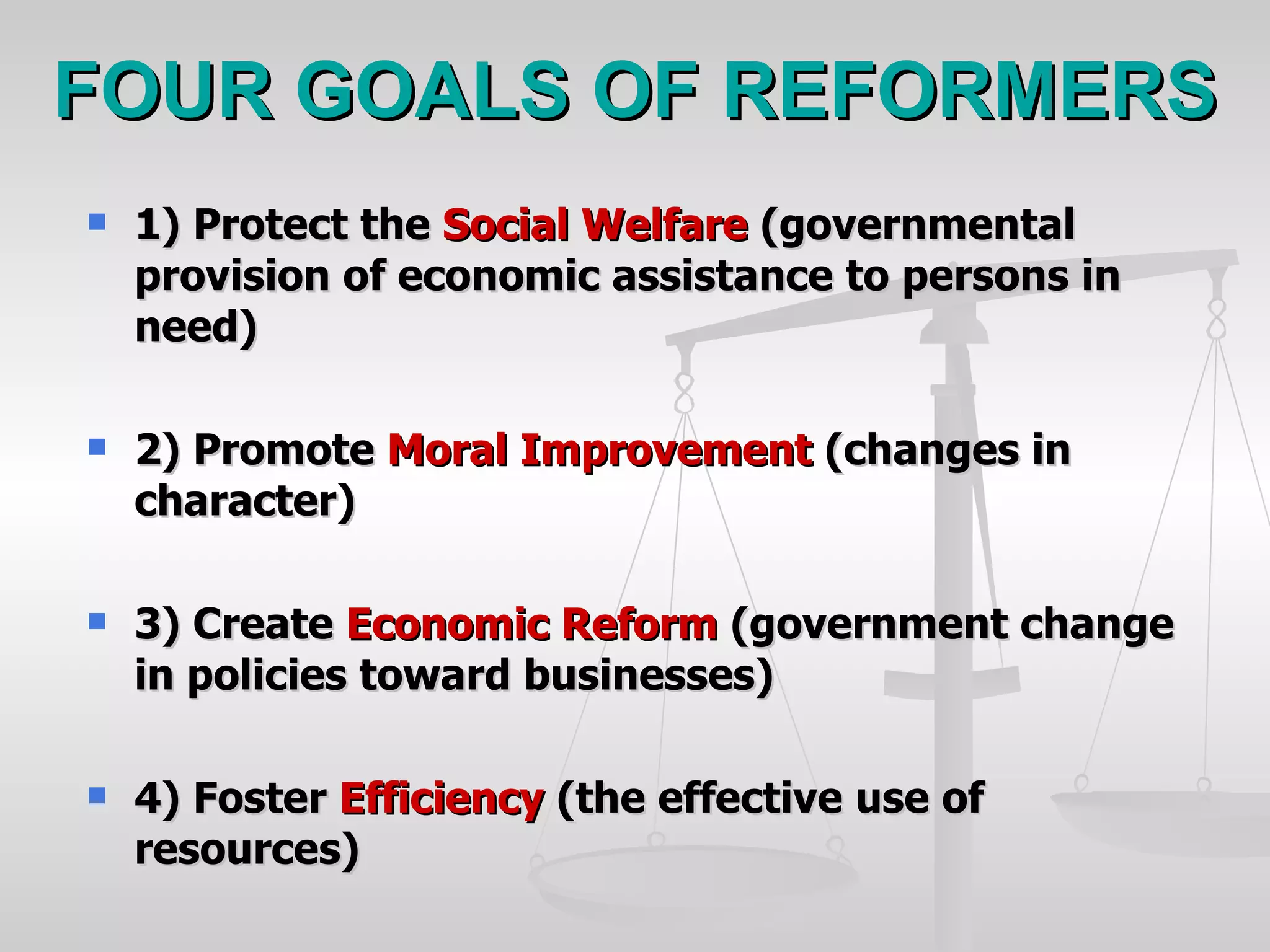
To understand the modern financial ecosystem, one must look back at the foundational shifts that redefined the relationship between capital, labor, and the state. The “Progressive Movement,” while rooted in the early 20th century, established the very framework upon which modern personal finance, corporate governance, and investment strategies are built. At its core, the goal of the progressive movement was to shift the economic paradigm from one of unrestrained, often exploitative industrial growth to a system defined by transparency, competition, and equitable wealth distribution. For the modern investor or business leader, these goals are not merely historical footnotes; they are the precursors to today’s ESG (Environmental, Social, and Governance) standards and the democratized financial tools we use daily.

The Shift from Pure Profit to Purpose-Driven Capital
The primary economic goal of the progressive movement was the correction of market failures that had emerged during the Gilded Age. This era was characterized by “trusts”—massive monopolies that stifled competition and concentrated wealth in the hands of a few. The movement sought to recalibrate the financial scales, arguing that a healthy economy requires a level playing field for all participants, from the titan of industry to the entry-level laborer.
Breaking the Gilded Age Monopolies
In the early 1900s, the concentration of wealth was so extreme that a handful of individuals controlled the majority of the nation’s infrastructure, including railroads and oil. The progressive movement’s goal was to dismantle these monopolies through aggressive antitrust legislation. By breaking up companies like Standard Oil, the movement aimed to foster a competitive marketplace. In modern financial terms, this was the first major push toward market transparency and price discovery. Investors today benefit from these early efforts because they ensure that no single entity can entirely manipulate market prices or barrier-to-entry, allowing for a more diverse and resilient portfolio of investment opportunities.
Modern Market Competition and Antitrust Laws
The legacy of this goal is visible in contemporary business finance. Today’s scrutiny of Big Tech and major financial institutions is a direct continuation of progressive-era ideals. The goal remains the same: ensuring that the market remains open for innovation. For side hustlers and entrepreneurs, this means the ability to enter a market without being immediately crushed by a dominant incumbent. The progressive movement established the precedent that the government has a role in protecting the integrity of the market, a concept that underpins the stability of our current stock exchanges and banking systems.
The ESG Paradigm: Redefining Value in Personal and Corporate Finance
While the early progressive movement focused on legislation, its modern evolution is reflected in the way we invest. The goal of the movement has transitioned into a global effort to align capital with values, often referred to as the “Progressive Investment Revolution.” This is most clearly seen in the rise of ESG criteria, which institutional and individual investors use to vet companies.
Socially Responsible Investing (SRI)
Socially Responsible Investing (SRI) is the direct descendant of the progressive movement’s desire to hold corporations accountable for their impact on society. The goal is no longer just to maximize short-term dividends but to ensure long-term sustainability. Modern investors are increasingly moving their money into funds that prioritize fair labor practices, environmental stewardship, and ethical supply chains. This shift has forced a massive reallocation of capital, proving that “progressive” goals can be highly profitable. Companies with high ESG ratings often show lower volatility and better long-term performance, making this a cornerstone of modern wealth-building strategies.
Measuring Performance through Governance
The “G” in ESG—Governance—speaks directly to the progressive goal of corporate transparency. The movement sought to end the “secretive” nature of corporate boardrooms. Today, this manifests as shareholder activism. Investors now have the power to vote on executive compensation, board diversity, and corporate political spending. This transparency is a financial tool that mitigates risk; a company with strong governance is less likely to engage in the kind of fraudulent activity that can lead to a total loss of investment. By demanding accountability, the progressive movement created a safer environment for the average person to grow their wealth through the public markets.

Financial Inclusion: The Progressive Push for Equitable Access
A major, often overlooked goal of the progressive movement was the democratization of financial systems. In the past, sophisticated financial tools and banking services were reserved for the elite. The progressive ideal was to create a system where every individual, regardless of their socioeconomic status, had the tools necessary to achieve financial independence.
The Role of Fintech in Democratizing Wealth
In the digital age, the goal of financial inclusion is being met by the “Fintech” revolution. Neobanks, micro-investing apps, and zero-commission trading platforms are the modern manifestations of progressive financial reform. By removing the high fees and minimum balance requirements that historically kept the working class out of the markets, these tools have allowed millions to participate in the wealth-generating power of the economy. The movement’s goal was to empower the individual, and today, that empowerment happens through an app that allows a user to buy $5 worth of a diversified ETF.
Microfinance and Community-Based Lending
The progressive movement also laid the groundwork for community-based financial models. The goal was to ensure that capital flowed into underserved communities, not just the financial hubs. This led to the creation of credit unions and, eventually, modern microfinance. These systems provide the “side hustle” economy with the oxygen it needs to survive. By providing small-scale loans to individuals who might not qualify for traditional corporate banking, the progressive movement’s goal of equitable access to capital continues to drive grassroots economic growth.
The Economic Sustainability of Progressive Business Models
Modern business finance is currently grappling with a fundamental question that the progressive movement first raised over a century ago: Who is a corporation ultimately responsible to? The movement’s goal was to challenge the idea of “shareholder primacy”—the notion that a company’s only duty is to its owners—and replace it with a more holistic view of “stakeholder capitalism.”
Stakeholder vs. Shareholder Primacy
Stakeholder capitalism posits that a business must create value for its employees, customers, and the community at large, in addition to its shareholders. From a business finance perspective, this is a strategy for long-term survival. Companies that invest in their employees (a key progressive goal) tend to have higher retention rates, better productivity, and stronger brand loyalty. In today’s economy, where human capital is often the most valuable asset, the progressive goal of protecting labor has become a savvy financial strategy for sustainable growth.
Long-term Wealth Building in a Volatile Market
The ultimate goal of the progressive movement was to create a stable middle class. In the realm of personal finance, this means shifting away from speculative, high-risk gambling and toward long-term, diversified wealth building. The regulations born from the movement—such as the creation of the SEC (Securities and Exchange Commission) in the decades following the initial progressive peak—provide the safety net that makes long-term investing possible. By reducing market manipulation and ensuring that financial disclosures are accurate, the movement gave the individual investor a fighting chance.
Conclusion: The ROI of Progress
The goal of the progressive movement was never to destroy capitalism, but to save it from its own excesses. By introducing competition, transparency, and inclusion into the financial system, the movement created the conditions for the modern global economy to thrive. For today’s investor, business owner, or side-hustler, the goals of the progressive movement are the invisible guardrails that protect their capital and provide the opportunities for growth.
Whether through the lens of ESG investing, the use of inclusive fintech tools, or the adoption of stakeholder-centric business models, the “progressive” approach has proven to be a robust framework for financial success. Understanding these goals allows us to see that the most profitable path forward is often the one that prioritizes transparency, equity, and long-term sustainability. In the end, the movement’s greatest achievement was proving that a more ethical financial system is also a more prosperous one for everyone involved.
aViewFromTheCave is a participant in the Amazon Services LLC Associates Program, an affiliate advertising program designed to provide a means for sites to earn advertising fees by advertising and linking to Amazon.com. Amazon, the Amazon logo, AmazonSupply, and the AmazonSupply logo are trademarks of Amazon.com, Inc. or its affiliates. As an Amazon Associate we earn affiliate commissions from qualifying purchases.