
For many individuals, the tax landscape primarily involves withholding taxes from a regular paycheck. However, a significant portion of the workforce, particularly those embracing entrepreneurship, freelancing, or diversified income streams, operates under a different system: estimated taxes. This critical aspect of personal finance ensures that individuals whose income isn’t subject to regular withholding still contribute their fair share to the tax system throughout the year. Failing to understand and properly manage estimated tax payments can lead to unpleasant surprises, including penalties and interest charges. This comprehensive guide will demystify the process, helping you navigate your obligations with confidence and precision.
Estimated taxes are essentially a pay-as-you-go system for income not subject to standard tax withholding. They apply to various types of income, including earnings from self-employment, independent contracting, rental properties, investments, and even certain pensions or annuities. The IRS, like most tax authorities, prefers to receive tax payments throughout the year rather than a lump sum at tax time. By making quarterly estimated payments, you align with this “pay-as-you-go” principle, ensuring continuous compliance and avoiding potential financial repercussions. Mastering this process is not just about avoiding penalties; it’s about sound financial planning and maintaining control over your tax liability.
Understanding Estimated Taxes: Who Needs to Pay?
The concept of estimated taxes stems directly from the U.S. tax system’s “pay-as-you-go” philosophy. While traditional employees have taxes withheld from each paycheck, those with other forms of income must proactively calculate and pay their tax liability throughout the year. Identifying whether you fall into this category is the crucial first step in fulfilling your tax obligations.
The Rationale Behind Estimated Taxes
The fundamental principle behind estimated taxes is to ensure that the government receives a steady stream of revenue throughout the fiscal year. Without it, individuals with substantial non-wage income could defer their entire tax burden until April 15th, creating significant cash flow challenges for the Treasury. From an individual taxpayer’s perspective, it also helps prevent a massive tax bill at year-end, which can be financially disruptive. It encourages financial discipline and regular assessment of one’s tax situation.
Identifying Your Obligation
The IRS generally requires you to pay estimated tax if you expect to owe at least $1,000 in tax for the current year, and your withholding and refundable credits are expected to be less than the smaller of:
-
90% of the tax to be shown on your current year’s tax return, or
-
100% of the tax shown on your previous year’s tax return (this increases to 110% if your Adjusted Gross Income (AGI) in the prior year was over $150,000, or $75,000 if married filing separately).
This dual test provides “safe harbors” that can help you avoid underpayment penalties, even if your current year’s tax liability ends up being significantly higher than estimated.
Common Scenarios Requiring Estimated Payments
Several common income scenarios typically trigger the need for estimated tax payments:
-
Self-Employment Income: This is perhaps the most prevalent reason. Freelancers, independent contractors, small business owners (sole proprietors, partners, S-corporation shareholders), and gig workers are usually responsible for both income tax and self-employment taxes (Social Security and Medicare) on their net earnings.
-
Rental Income: If you own rental properties and generate a significant profit, you’ll likely need to pay estimated taxes.
-
Investment Income: Substantial income from interest, dividends, capital gains from stock sales, or other investments that aren’t subject to withholding often requires estimated payments.
-
Alimony: Alimony payments received are generally taxable income and may necessitate estimated tax payments. (Note: For divorce or separation agreements executed after December 31, 2018, alimony is not taxable to the recipient or deductible by the payer.)
-
Substantial Income Not Subject to Withholding: This can include winnings from gambling, prize money, or certain types of pension and annuity distributions. Even if you have a W-2 job, if your additional income sources push you above the $1,000 threshold and your employer’s withholding isn’t sufficient to cover the total, you’ll need to make estimated payments.
Calculating Your Estimated Tax Obligation
Accurately calculating your estimated tax liability is perhaps the most challenging, yet critical, step in the process. It requires foresight and a reasonable projection of your financial activity for the year. The goal is to get as close as possible to your actual tax liability to avoid both overpayment (tying up your money) and underpayment (incurring penalties).
Estimating Your Annual Income and Deductions
The foundation of your estimated tax calculation is a realistic forecast of your income and expenses for the entire tax year. Begin by projecting all sources of income: self-employment earnings, rental income, interest, dividends, capital gains, and any other taxable income not subject to withholding. Then, consider all your potential deductions and credits. This might include business expenses, health insurance premiums for the self-employed, IRA contributions, student loan interest, and any other itemized or standard deductions you anticipate taking. It’s often helpful to use your previous year’s tax return as a baseline, adjusting for any anticipated changes in income or expenses.
Utilizing Form 1040-ES
The IRS provides Form 1040-ES, Estimated Tax for Individuals, specifically to help taxpayers calculate and track their estimated tax. This form includes a detailed worksheet designed to guide you through the process. The worksheet asks you to estimate your adjusted gross income, deductions, credits, and ultimately, your total tax liability for the year. It then helps you divide this total into four equal quarterly payments. While you don’t file the worksheet itself, it’s an invaluable tool for ensuring accuracy.
Accounting for Withholding and Credits
If you have a traditional job alongside your self-employment or investment income, you must factor in any taxes already being withheld from your W-2 wages. The 1040-ES worksheet will ask for your total estimated withholding. The goal is to ensure your total payments from both withholding and estimated taxes meet the required thresholds. Similarly, account for any tax credits you expect to claim, as these directly reduce your tax liability. Sometimes, individuals with W-2 income can simply adjust their W-4 form with their employer to increase withholding, covering their additional income without needing to make separate estimated payments.
The Annualized Income Method
For individuals whose income fluctuates significantly throughout the year (e.g., seasonal businesses, large one-time gains), the standard approach of dividing your estimated annual tax into four equal payments might not be appropriate. The annualized income method allows you to adjust your quarterly payments to reflect when you actually earn the income. For example, if you earn most of your income in the latter half of the year, you can pay a smaller estimated tax payment in the earlier quarters and larger payments later on. This method is more complex but can help avoid underpayment penalties if your income is heavily weighted towards certain periods. You’ll use Form 2210, Underpayment of Estimated Tax by Individuals, Estates, and Trusts, to figure the penalty if you use this method.
Methods for Making Estimated Tax Payments
Once you’ve calculated your estimated tax liability, the next step is to actually make the payments. The IRS offers several convenient options, ranging from online electronic transfers to traditional mail, catering to different preferences and needs. Choosing the right method can streamline your payment process and ensure timely compliance.
Online Payment Options
Electronic payments are often the preferred method due to their speed, convenience, and built-in confirmation systems.
-
IRS Direct Pay: This is the easiest and most direct way for individuals to make estimated tax payments. You can pay directly from your checking or savings account for free. No registration is required, and you receive an immediate confirmation email. You can schedule payments up to 365 days in advance, a great feature for planning your quarterly obligations.
-
Electronic Federal Tax Payment System (EFTPS): EFTPS is a more robust system primarily used by businesses, but individuals can also register for it. It allows you to schedule payments up to 365 days in advance and offers a comprehensive payment history. While it requires an initial enrollment period, it provides greater control and detailed record-keeping, especially useful for those with complex tax situations or who need to make various types of federal tax payments.
-
Credit/Debit Card Payments: You can pay your estimated taxes using a credit card, debit card, or digital wallet through one of the IRS-approved third-party payment processors. While convenient, these processors charge a processing fee, which varies depending on the provider and the type of card used. This option is generally best for those who need to meet a payment deadline quickly or want to earn credit card rewards, outweighing the fee.
Payment by Mail
For those who prefer traditional methods or cannot use online options, payment by mail is still available.
-
Using Form 1040-ES Payment Vouchers: If you’re mailing your payment, you must include a payment voucher from Form 1040-ES. Each quarterly payment has a specific voucher corresponding to its due date. Fill out the voucher with your name, address, Social Security number, and the amount of the payment. Make sure the check or money order is made payable to the “U.S. Treasury.”
-
Correct Mailing Addresses: The mailing address for estimated tax payments varies depending on your state of residence. Always refer to the instructions for Form 1040-ES or the IRS website to find the correct address for your geographic location. Sending your payment to the wrong address can cause delays and potential penalties.

Payment Through a Tax Professional
Many taxpayers opt to have their estimated payments handled by their tax professional or through tax preparation software.
- Using Tax Software or an Accountant: Most professional tax software programs and tax preparers offer services to calculate and submit estimated tax payments electronically on your behalf. This can be a significant convenience, ensuring accuracy and timely submission, especially if your tax situation is complex. Your accountant can also advise you on the most advantageous payment methods and strategies.
Key Deadlines and Avoiding Penalties
Missing an estimated tax payment deadline or underpaying your quarterly obligations can lead to penalties from the IRS. Understanding the specific due dates and the “safe harbor” rules is essential for remaining compliant and avoiding unnecessary costs. Proactive planning is your best defense against penalties.
Quarterly Payment Due Dates
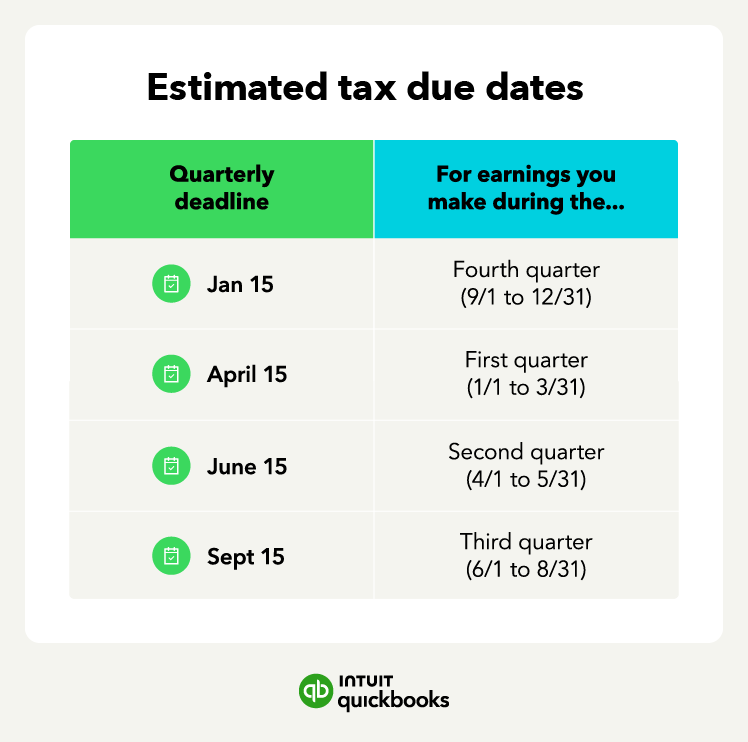
Estimated taxes are typically paid in four equal installments throughout the year, each with a specific due date. It’s crucial to mark these dates on your calendar:
-
1st Quarter (January 1 to March 31): Due April 15
-
2nd Quarter (April 1 to May 31): Due June 15
-
3rd Quarter (June 1 to August 31): Due September 15
-
4th Quarter (September 1 to December 31): Due January 15 of the following year
If any of these dates fall on a weekend or holiday, the deadline shifts to the next business day. For taxpayers in specific disaster areas, the IRS may grant automatic extensions to these deadlines.
Understanding Underpayment Penalties
If you don’t pay enough tax through withholding and estimated payments, you may be charged a penalty for underpayment of estimated tax. The penalty applies if your total tax paid during the year is less than either 90% of your current year’s tax liability or 100% (or 110% for high-income earners) of your previous year’s tax liability, whichever is smaller. The penalty is calculated based on the amount of underpayment for each quarter and the period it remained unpaid. While the penalty rate can fluctuate, it’s based on the federal short-term interest rate plus three percentage points.
Safe Harbors to Avoid Penalties
Fortunately, there are “safe harbor” rules that can help you avoid underpayment penalties, even if your actual tax liability ends up being higher than your estimates:
-
90% Rule: You won’t face a penalty if you pay at least 90% of your current year’s tax liability through withholding and estimated payments.
-
100% / 110% Rule: You also won’t face a penalty if you pay at least 100% of your previous year’s tax liability through withholding and estimated payments. This threshold increases to 110% of your prior year’s tax liability if your Adjusted Gross Income (AGI) for the previous year was over $150,000 ($75,000 if married filing separately). This is often the easiest safe harbor to meet, especially if your income has increased significantly in the current year.
Meeting either of these criteria will generally shield you from underpayment penalties.
Special Circumstances and Waivers
The IRS may waive the penalty for underpayment in certain specific situations, such as:
-
Casualty, Disaster, or Other Unusual Circumstances: If your underpayment was due to a casualty, disaster, or other unusual circumstances, and it would be inequitable to impose the penalty.
-
Retirement or Disability: If you retired (after reaching age 62) or became disabled during the tax year for which estimated payments were due or during the preceding tax year, and the underpayment was due to reasonable cause and not willful neglect.
-
Farmers and Fishermen: Special rules apply to farmers and fishermen, allowing them to make one payment by January 15 of the following year or file their tax return and pay their entire tax by March 1.
If you believe you qualify for a waiver, you generally need to attach Form 2210 to your tax return and provide an explanation.
Best Practices and Pro Tips for Estimated Taxes
Managing estimated taxes effectively goes beyond just making payments on time; it involves strategic planning and consistent monitoring. Adopting these best practices can save you time, reduce stress, and prevent costly errors.
Regular Review and Adjustment
Your income and expenses are rarely static, making your initial estimated tax calculation a living document. It’s crucial to review your income, deductions, and credits regularly, at least quarterly, to ensure your estimated payments remain accurate. If your income significantly increases or decreases, or you incur unexpected expenses, adjust your subsequent estimated payments accordingly. You can even recalculate and send a larger payment for a later quarter if you realize you underpaid earlier in the year. This flexibility is key to staying compliant without overpaying or incurring penalties.
Keeping Meticulous Records
Good record-keeping is paramount for all tax-related matters, and estimated taxes are no exception. Maintain organized records of all your income sources, business expenses, and any other relevant financial transactions throughout the year. Keep copies of all estimated tax payment confirmations, whether electronic or mail-in vouchers. These records will be invaluable when preparing your annual tax return and can serve as proof of payment if any discrepancies arise with the IRS. Cloud-based accounting software or simple spreadsheets can be incredibly helpful for this purpose.
Consulting a Tax Professional
While this guide provides a solid foundation, individual tax situations can be complex. If you have multiple income streams, significant deductions, unusual financial events, or simply feel overwhelmed by the process, consulting a qualified tax professional is highly recommended. A Certified Public Accountant (CPA) or Enrolled Agent (EA) can help you accurately project your income, identify all eligible deductions and credits, calculate your estimated payments, and advise on strategies to minimize your tax liability legally. Their expertise can be a valuable investment, saving you time, money, and potential headaches.
Setting Aside Funds
One of the most common pitfalls with estimated taxes is not having the funds available when payments are due. To avoid this, cultivate the habit of setting aside a portion of your income specifically for taxes as you earn it. Many self-employed individuals open a separate savings account solely for tax purposes, automatically transferring a percentage of each payment they receive into it. This discipline ensures that the money is readily available when the quarterly deadlines arrive, preventing last-minute financial stress. Treat your tax savings as a non-negotiable business expense.
Conclusion
Navigating the world of estimated tax payments might seem daunting at first, but it is a fundamental responsibility for anyone earning income outside of traditional W-2 employment. By understanding who needs to pay, accurately calculating your obligations, leveraging the various payment methods, and adhering to crucial deadlines, you can fulfill your tax duties with confidence. Remember that proactive financial planning, diligent record-keeping, and a willingness to adapt your estimates are your strongest allies. Embrace these strategies, and you’ll not only avoid penalties but also gain greater control over your financial health, ensuring a smooth and compliant tax journey year after year.
aViewFromTheCave is a participant in the Amazon Services LLC Associates Program, an affiliate advertising program designed to provide a means for sites to earn advertising fees by advertising and linking to Amazon.com. Amazon, the Amazon logo, AmazonSupply, and the AmazonSupply logo are trademarks of Amazon.com, Inc. or its affiliates. As an Amazon Associate we earn affiliate commissions from qualifying purchases.