
For millions of self-employed individuals, small business owners, and those with significant income not subject to traditional withholding, quarterly estimated taxes are a fundamental pillar of financial responsibility. Unlike employees who have taxes automatically deducted from each paycheck, these individuals are responsible for proactively paying their income and self-employment taxes throughout the year. The modern solution to this crucial obligation is paying online – a method that offers unparalleled convenience, security, and efficiency. This comprehensive guide will demystify the process, helping you navigate the world of online quarterly tax payments with confidence.

Understanding Quarterly Taxes: Who, What, and Why
Before diving into the mechanics of online payments, it’s essential to grasp the underlying principles of quarterly estimated taxes. This foundational knowledge ensures you understand your obligations and the importance of timely payments.
Who Needs to Pay Quarterly Taxes?
The requirement to pay quarterly estimated taxes is primarily triggered when you expect to owe at least $1,000 in tax for the year. This threshold applies to a broad range of taxpayers, including:
-
Self-Employed Individuals: Freelancers, independent contractors, gig workers, and sole proprietors typically fall into this category. Since no employer is withholding taxes on their behalf, they must estimate and pay their own income and self-employment taxes.
-
Small Business Owners: Partners in a partnership, S-corporation shareholders, and even C-corporations often need to make estimated payments. The specifics depend on the business structure and how income is passed through to the owners.
-
Individuals with Significant Un-Withheld Income: This includes income from investments (e.g., dividends, interest, capital gains), rental properties, alimony (for agreements before 2019), or even prizes and awards. If your W-2 job doesn’t withhold enough to cover these additional income streams, you may need to supplement with estimated payments.
Generally, if you expect your withholding and credits to be less than the smaller of (1) 90% of the tax to be shown on your current year’s return, or (2) 100% of the tax shown on your previous year’s return (110% if your adjusted gross income was over $150,000), you’ll likely need to pay estimated taxes.
What Are Estimated Taxes?
Estimated taxes are essentially the “pay-as-you-go” method for people whose income isn’t subject to adequate withholding. The U.S. tax system operates on this principle: you must pay tax as you earn or receive income during the year. For employees, this is handled through payroll withholding. For others, it’s managed through estimated tax payments.
These payments cover several components:
-
Income Tax: Your federal income tax liability.
-
Self-Employment Tax: This is a combination of Social Security and Medicare taxes for self-employed individuals, calculated on your net earnings from self-employment. It essentially covers both the employer and employee portions of these taxes, totaling 15.3% on the first $168,600 of earnings (for 2024), and 2.9% for Medicare tax on all net earnings beyond that.
-
Alternative Minimum Tax (AMT): If applicable, this can also be included in estimated payments.
The goal is to pay enough tax throughout the year to avoid a significant tax bill and potential underpayment penalties when you file your annual tax return.
Why Online Payments Are the Smart Choice
In today’s digital age, paying your quarterly taxes online isn’t just a convenience; it’s a best practice. The advantages are numerous:
-
Speed and Convenience: Payments can be made 24/7 from anywhere with internet access, eliminating trips to the post office or the need for stamps and envelopes.
-
Security: Online payment portals provided by the IRS and authorized third parties use robust encryption and security protocols to protect your financial information.
-
Instant Confirmation: You receive immediate confirmation of your payment, providing irrefutable proof of submission – a crucial benefit compared to the uncertainty of mailed checks.
-
Reduced Errors: Manual processes are prone to errors. Online systems often guide you through the process, minimizing mistakes in payment amounts or due dates.
-
Scheduled Payments: Many online platforms allow you to schedule payments in advance, ensuring you never miss a deadline.
Essential Steps to Calculate Your Quarterly Tax Payments
Before you can pay your quarterly taxes online, you first need to accurately calculate how much you owe. This is often the most challenging part of the process, but careful planning can simplify it.
Estimating Your Annual Income and Deductions
The accuracy of your estimated tax payments hinges on your ability to project your income and expenses for the entire tax year.
-
Review Last Year’s Return: Your previous year’s tax return is an excellent starting point. It provides a baseline for your income, deductions, and tax liability.
-
Project Current Year Income: Consider all potential income sources: self-employment earnings, rental income, investment income, and any other income not subject to withholding. Be realistic about potential growth or decline.
-
Estimate Deductions and Credits: Factor in standard or itemized deductions, business expenses (e.g., office supplies, mileage, software subscriptions), retirement contributions, and any tax credits you anticipate qualifying for.
-
Account for Changes: Have you started a new business? Had a significant life event (marriage, new child)? Are you anticipating a large capital gain or loss? These changes will impact your projections.
Utilizing Form 1040-ES (Estimated Tax for Individuals)
The IRS provides Form 1040-ES, Estimated Tax for Individuals, specifically to help you calculate your quarterly payments. This form includes a detailed worksheet that walks you through the estimation process:
-
Calculate Your Expected Adjusted Gross Income (AGI): This involves subtracting certain deductions from your gross income.
-
Determine Your Expected Deductions and Exemptions: Use your estimated standard deduction or itemized deductions.
-
Figure Your Expected Taxable Income: Subtract deductions from your AGI.
-
Calculate Your Estimated Income Tax: Apply the appropriate tax rates to your taxable income.
-
Add Self-Employment Tax: If applicable, calculate this separately and add it to your income tax.
-
Subtract Credits: Deduct any anticipated tax credits.
-
Divide by Four: The resulting total is your estimated annual tax liability. Divide this by four to determine your quarterly payment amount.
While the form is a valuable tool, many taxpayers use tax software or consult with a tax professional to complete this worksheet more accurately.
The “Safe Harbor” Rules
To avoid underpayment penalties, you generally need to pay at least 90% of your current year’s tax liability or 100% of your prior year’s tax liability through withholding and estimated payments. For individuals with an Adjusted Gross Income (AGI) exceeding $150,000 ($75,000 for married filing separately) in the prior year, the safe harbor increases to 110% of the prior year’s tax liability.
Understanding these “safe harbor” rules is crucial. If your income fluctuates significantly, it might be safer to base your payments on last year’s tax to ensure you meet the 100% (or 110%) threshold, even if your current year’s income ends up being lower than anticipated. You can always adjust later.
Your Guide to Paying Quarterly Taxes Online
Once you’ve calculated your estimated tax, the next step is to make the payment. The IRS offers several secure and convenient online options.
Official IRS Payment Options
The IRS provides direct and approved third-party channels for making federal estimated tax payments:
-
IRS Direct Pay (IRS.gov/payments):
-
Description: This free service allows you to pay directly from your checking or savings account. No registration is required.
-
Process: Simply visit IRS.gov/payments, select “Make a Payment,” choose “Estimated Tax” as the payment type, and follow the prompts. You’ll need your Social Security Number (SSN) or Employer Identification Number (EIN), date of birth, and prior year’s tax filing status to verify your identity.
-
Benefits: Free, easy to use, immediate confirmation, allows you to pay on behalf of someone else (e.g., a spouse).
-
Limitations: You can make only two payments within a 24-hour period.
-
-
Electronic Federal Tax Payment System (EFTPS):
-
Description: EFTPS is a free service provided by the U.S. Treasury for making all types of federal tax payments. It requires a one-time enrollment process that can take 5-7 business days to complete as a PIN is mailed to you.
-
Process: Enroll at EFTPS.gov. Once enrolled and you receive your PIN, you can log in, select “Estimated Tax” or the appropriate form (e.g., 1040-ES), and schedule your payment.
-
Benefits: Highly secure, allows you to schedule payments up to 365 days in advance, provides an exhaustive payment history, suitable for both individuals and businesses, can cancel or change pending payments up to two days before the due date.
-
Limitations: Requires advance enrollment, which can be a hurdle if you’re close to a deadline.
-
-
Debit/Credit Card via Approved Payment Processors:
-
Description: The IRS partners with several third-party payment processors that allow you to pay your estimated taxes using a debit card, credit card, or digital wallet (e.g., PayPal).
-
Process: Visit IRS.gov/payments and select the “Pay with Debit Card, Credit Card or Digital Wallet” option. You’ll be redirected to a list of approved processors (e.g., ACI Payments, Inc., PayUSAtax, Official Payments). Choose a processor and follow their instructions.
-
Benefits: Extremely convenient, allows you to potentially earn credit card rewards, provides immediate confirmation.
-
Limitations: These processors charge a convenience fee, typically a percentage of the payment amount for credit cards (often 1.87% to 2.29%) and a flat fee for debit cards (around $2.50-$4.00). Weigh the fee against any rewards earned.
-
State Tax Considerations
It’s crucial to remember that quarterly estimated taxes aren’t just a federal obligation. Most states with an income tax also require estimated payments if you expect to owe a certain amount (often $500 or $1,000, depending on the state).
-
Check State Tax Websites: Each state’s Department of Revenue or equivalent agency will have its own online payment portal and specific requirements.
-
Similar Online Options: Many states offer direct pay options, electronic funds transfer (EFT) systems similar to EFTPS, or allow payments via approved third-party processors.
-
Separate Calculations: You will need to make separate calculations for your state estimated taxes, as state tax rates and deductions differ from federal ones.
Benefits of Online Payment Methods
Beyond the general advantages, specific benefits of online payment methods for estimated taxes include:
-
Avoidance of Mail Delays: No risk of your payment getting lost or delayed in the mail, which could result in penalties.
-
Enhanced Record Keeping: Digital confirmations and payment histories are easily accessible and can be stored electronically, simplifying your tax preparation process.
-
Flexibility: The ability to choose the payment method that best suits your needs, whether it’s a free direct debit or a fee-based credit card payment for rewards.
Common Pitfalls and Best Practices
Navigating quarterly taxes requires diligence. Being aware of common mistakes and adopting best practices can save you headaches and money.
The Danger of Underpayment Penalties
The most significant pitfall for those paying estimated taxes is underpayment. If you don’t pay enough tax throughout the year, the IRS can charge you an underpayment penalty, even if you eventually pay your full tax liability by the April filing deadline.
-
How Penalties Are Calculated: The penalty is generally calculated based on the amount of underpayment for each quarter, the period of underpayment, and the applicable interest rate.
-
Exceptions: There are some exceptions to the penalty, such as for those who suffered a casualty or disaster, or who are newly retired or disabled and meet certain income criteria.
-
Strategies to Avoid: The best strategies are to aim for one of the “safe harbor” thresholds (90% of current year’s tax or 100%/110% of prior year’s tax) and to adjust your payments if your income or deductions change significantly during the year.
Keeping Meticulous Records
Good record-keeping is invaluable.
-
Document Everything: Keep detailed records of all income and expenses. This includes invoices, receipts, bank statements, and any other financial documents.
-
Payment Confirmations: Always save your online payment confirmation numbers, emails, or screenshots. These are your proof of payment.
-
Digital vs. Physical: Consider a robust digital filing system for all your tax-related documents, securely backed up, alongside any essential physical records.
Reviewing and Adjusting Throughout the Year
Your initial estimate might not be perfect, and that’s okay. The key is to be flexible.
-
Quarterly Check-ups: At the end of each quarter, review your actual income and expenses against your projections.
-
Modify Future Payments: If your income has been unexpectedly high or low, or if you’ve incurred significant new expenses, adjust your future estimated tax payments accordingly. You don’t need to amend past payments; simply modify the remaining ones. This iterative approach helps keep you on track.
Consider Professional Assistance
While paying quarterly taxes online is straightforward, calculating the amounts can be complex, especially for businesses with fluctuating income or significant deductions.
-
When to Consult a Tax Professional: If your financial situation is complex, if you’re unsure about deductions, or if you want to ensure optimal tax planning, engaging a Certified Public Accountant (CPA) or Enrolled Agent (EA) can be a wise investment.
-
Benefits of Expert Guidance: A professional can help you accurately project income, identify all eligible deductions and credits, ensure compliance with federal and state laws, and structure your payments to avoid penalties.
Key Dates and Deadlines
Adhering to the quarterly payment schedule is critical. Missing a deadline can result in penalties, even if you pay the correct amount later.
The Standard Quarterly Schedule
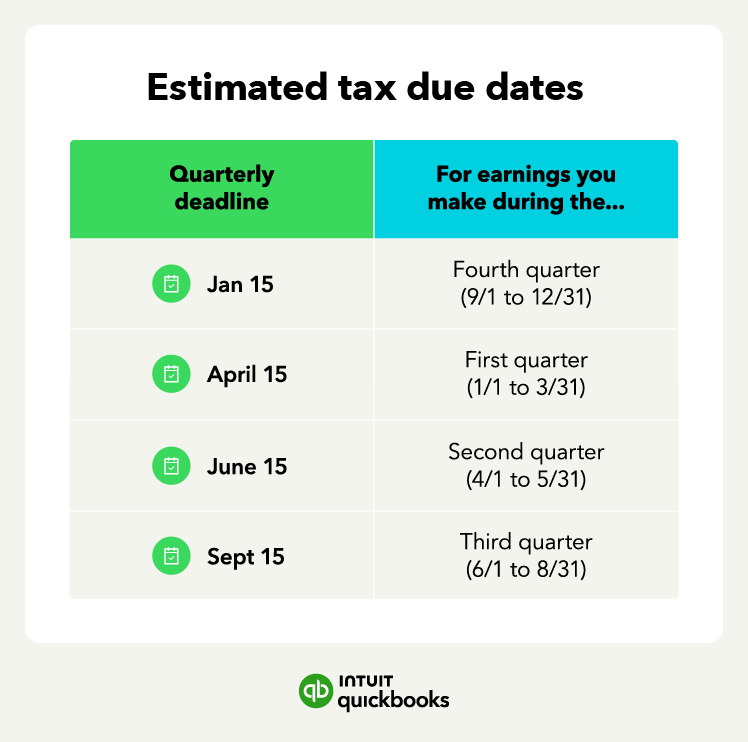
For most calendar-year taxpayers, the estimated tax payment due dates are:
-
Quarter 1 (January 1 to March 31): Due April 15
-
Quarter 2 (April 1 to May 31): Due June 15
-
Quarter 3 (June 1 to August 31): Due September 15
-
Quarter 4 (September 1 to December 31): Due January 15 of the following year

Special Circumstances
-
Weekends and Holidays: If a due date falls on a weekend or holiday, the deadline shifts to the next business day.
-
Fiscal Year Filers: If your tax year is not the calendar year, your due dates will be different, corresponding to your specific fiscal quarters.
-
Farmers and Fishermen: Special rules apply to farmers and fishermen, who may have only one estimated tax payment due per year.
Paying your quarterly taxes online is an essential financial discipline for millions of Americans. By understanding who needs to pay, how to accurately calculate your obligations, and leveraging the convenience and security of online payment portals, you can efficiently meet your tax responsibilities. Proactive planning, meticulous record-keeping, and timely adjustments will not only ensure compliance but also empower you with greater control over your financial health, allowing you to focus on growing your business or managing your wealth without the looming threat of tax penalties. Embrace the digital convenience and master your quarterly tax payments with confidence.
aViewFromTheCave is a participant in the Amazon Services LLC Associates Program, an affiliate advertising program designed to provide a means for sites to earn advertising fees by advertising and linking to Amazon.com. Amazon, the Amazon logo, AmazonSupply, and the AmazonSupply logo are trademarks of Amazon.com, Inc. or its affiliates. As an Amazon Associate we earn affiliate commissions from qualifying purchases.