
Navigating the landscape of federal taxes can often feel like a complex journey, but understanding how to properly fulfill your payment obligations is a fundamental aspect of financial responsibility. For individuals, small businesses, and large corporations alike, timely and accurate tax payments are crucial to avoid penalties, interest, and legal complications. Whether you’re a W-2 employee facing a balance due, a self-employed freelancer making quarterly payments, or an investor with significant capital gains, knowing your options and choosing the most suitable method is paramount.
This guide aims to demystify the process of paying your federal taxes, offering a comprehensive overview of the various methods available through the Internal Revenue Service (IRS). We’ll explore the primary payment avenues, delve into the nuances of each, and provide insights into managing your tax payments effectively, even when financial challenges arise. Our goal is to empower you with the knowledge to make informed decisions, ensuring a smooth and compliant tax-paying experience.
Understanding Your Federal Tax Payment Obligations
Before diving into the “how,” it’s essential to grasp the “when” and “why” of federal tax payments. Your obligation to pay federal taxes isn’t a one-size-fits-all scenario; it varies based on your income sources, employment status, and overall financial situation.
When Do You Typically Pay?
The most common deadline for federal income tax payments is Tax Day, which falls on April 15th each year (or the next business day if April 15th is a weekend or holiday). This is the day when most individuals file their annual income tax returns and pay any outstanding balance due for the previous tax year.
However, many taxpayers pay taxes throughout the year:
-
Withholding from Paychecks: For W-2 employees, federal income tax is typically withheld from each paycheck by their employer. This is an ongoing payment mechanism designed to cover most, if not all, of your tax liability by year-end.
-
Estimated Taxes: If you are self-employed, a gig worker, an investor, or have significant income not subject to withholding (e.g., rental income, alimony), you are usually required to pay estimated taxes quarterly. These payments are due on April 15th, June 15th, September 15th, and January 15th of the following year. Failing to pay sufficient estimated taxes can result in underpayment penalties.
What If You Owe More Than Withheld/Paid?
It’s common for individuals to find they owe an additional amount after filing their annual tax return. This typically happens if your withholding or estimated payments throughout the year didn’t fully cover your tax liability. In such cases, the balance due must be paid by Tax Day to avoid interest and potential penalties for late payment.
Who Needs to Pay Estimated Taxes?
The IRS generally requires you to pay estimated taxes if you expect to owe at least $1,000 in tax for the year. This primarily impacts:
-
Self-Employed Individuals: Freelancers, independent contractors, small business owners.
-
Individuals with Significant Investment Income: Capital gains, dividends, interest, or rental income.
-
Those with Other Non-Wage Income: Alimony, prizes, awards, etc.
It’s crucial to estimate your income and deductions accurately throughout the year to avoid underpaying and incurring penalties. The IRS provides tools like the Tax Withholding Estimator to help you determine if you’re withholding enough or need to make estimated payments.
Primary Methods for Paying Your Federal Taxes
The IRS offers several convenient and secure methods to pay your federal taxes. Each option comes with its own set of advantages and considerations, allowing taxpayers to choose the method that best fits their financial habits and circumstances.
Direct Pay (IRS Website)
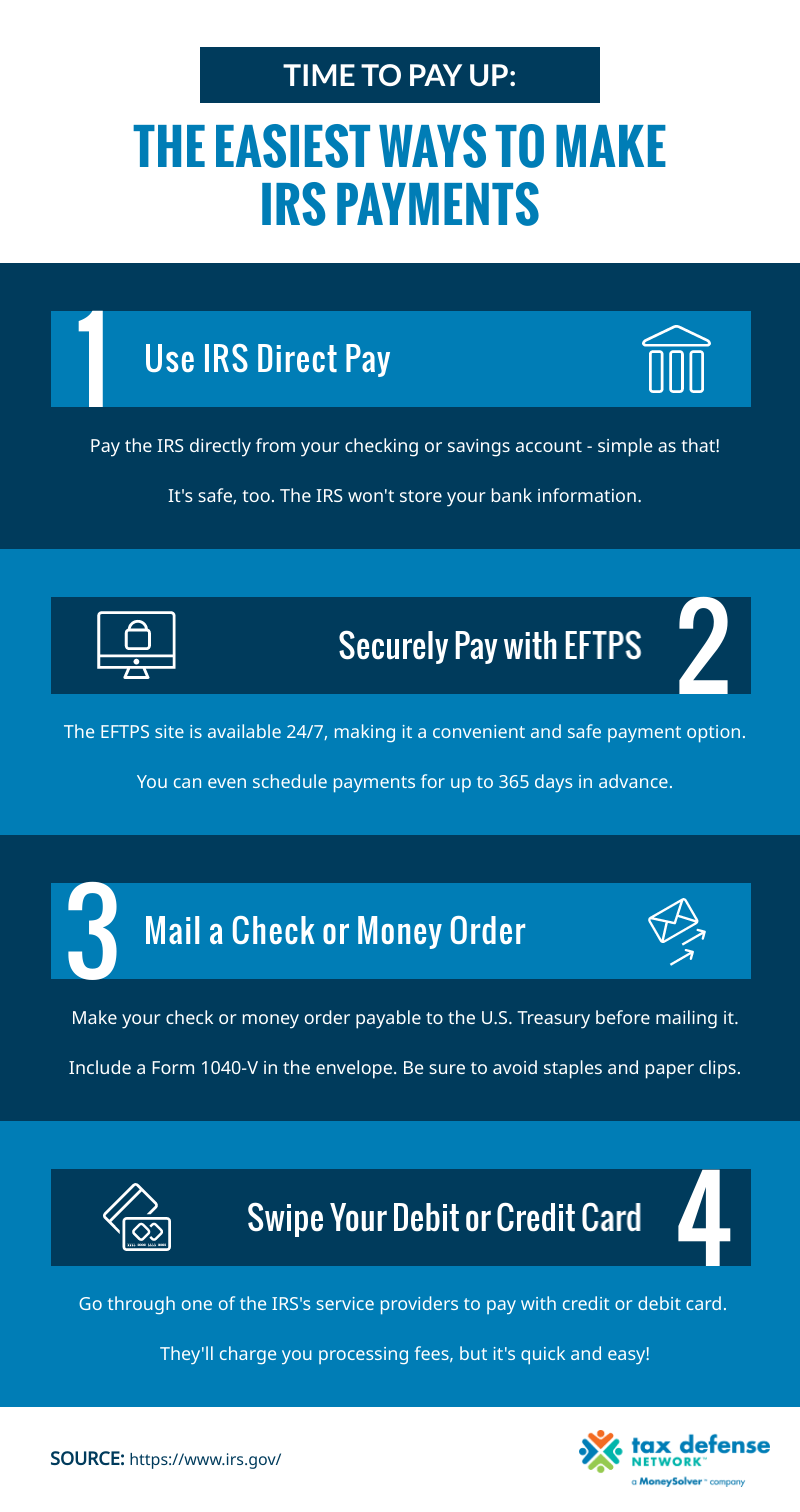
IRS Direct Pay is arguably one of the most straightforward and cost-effective ways to pay your taxes directly from your bank account. It’s a free service provided by the IRS, allowing you to make payments for various tax forms and types, including Forms 1040, estimated taxes, and even certain business taxes.
-
Pros: Free, secure, direct from your checking or savings account. You receive immediate confirmation.
-
Cons: Requires bank account information (routing and account number), and only allows up to two payments within a 24-hour period.
-
Process: Visit the IRS.gov/payments page, select IRS Direct Pay, choose your reason for payment, verify your identity using previous tax information, and enter your bank account details.
Electronic Federal Tax Payment System (EFTPS)
EFTPS is a free service specifically designed for taxpayers who need to make federal tax payments electronically. It’s particularly popular among businesses and individuals who make recurring estimated tax payments, as it allows for scheduling payments up to 365 days in advance.
-
Pros: Free, secure, highly flexible for scheduling payments, excellent for recurring payments.
-
Cons: Requires prior enrollment (which can take 5-7 business days to complete as a PIN is mailed to you). Not ideal for last-minute, one-off payments if you’re not already enrolled.
-
Process: Enroll online at EFTPS.gov, wait for your PIN to arrive by mail, then activate your enrollment. Once activated, you can schedule payments securely through the website or by phone.
Credit or Debit Card, or Digital Wallet
For those who prioritize convenience or wish to earn rewards points (for credit cards), paying federal taxes through a credit card, debit card, or digital wallet is an option. However, it’s important to be aware that the IRS uses third-party payment processors for these transactions, and these processors charge a fee.
-
Pros: Convenience, immediate payment confirmation, potential credit card rewards, and a good option if you need to pay but don’t have immediate cash flow (though interest accrues on credit card balances).
-
Cons: Third-party processing fees (typically a percentage for credit cards, a flat fee for debit cards, usually ranging from 1.87% to over 2% for credit cards). These fees can add up significantly for large tax bills.
-
Process: The IRS website lists authorized payment processors (e.g., PayUSAtax, ACI Payments Inc.). You select a processor, navigate to their website, and complete the payment using your card or digital wallet details.
Check, Money Order, or Cashier’s Check
The traditional method of paying by mail remains an option for those who prefer it or don’t have access to electronic payment methods.
-
Pros: No processing fees for the payment itself, provides a physical record.
-
Cons: Slower, relies on mail delivery (which can be delayed or lost), and requires accurate addressing. Payment is only credited when received, not when postmarked.
-
Process: Make your check or money order payable to “U.S. Treasury.” Write your name, address, daytime phone number, Social Security Number (SSN) or Employer Identification Number (EIN), the tax year, and the related tax form number (e.g., “2023 Form 1040”) on the payment. For individual income tax, include a Form 1040-V, Payment Voucher. Mail your payment to the appropriate IRS address, which varies depending on your location and the type of payment.
Cash (through Retail Partners)
While less common, you can pay your federal taxes with cash through IRS-authorized retail partners. This method caters to individuals who prefer cash transactions.
-
Pros: Convenient for cash-based taxpayers, provides a physical receipt.
-
Cons: Limited participating locations, involves a third-party service, and transaction limits may apply.
-
Process: You must first obtain a payment barcode from the IRS website (IRS.gov/paywithcash) or by calling them. Take this barcode to a participating retail store (e.g., 7-Eleven, CVS, Family Dollar), where the cashier will scan it and accept your cash payment. A fee may apply from the retail partner.
Navigating Payment Challenges and Solutions
Life can throw unexpected curveballs, and sometimes, paying your federal taxes on time and in full isn’t feasible. The IRS understands this and offers various relief options to help taxpayers manage their obligations without undue hardship.
What If You Can’t Afford to Pay on Time?
It’s critical to understand that even if you can’t pay, you should always file your tax return on time or file for an extension. An extension to file (Form 4868) gives you more time to submit your paperwork, but it does not extend the time to pay your taxes. Interest and penalties for late payment will still accrue from the original due date.
If you genuinely cannot pay your tax bill, consider these options:
-
Short-Term Payment Plan (up to 180 days): You can request a temporary delay in payment if you expect to be able to pay your full tax liability within 180 days. Interest and penalties still apply.
-
Offer in Compromise (OIC): An OIC allows certain taxpayers to resolve their tax liability with the IRS for a lower amount than they originally owed. This is generally an option when taxpayers are facing significant financial hardship and cannot pay their full tax liability. The IRS considers your ability to pay, income, expenses, and asset equity when evaluating an OIC.
-
Installment Agreement: If you can’t pay your full tax liability immediately but can make monthly payments, an installment agreement allows you to do so for up to 72 months. You’ll still accrue interest and penalties, but they may be reduced, and you avoid more severe collection actions.
Understanding Penalties and Interest
The IRS levies penalties for various reasons related to non-compliance:
-
Failure to File Penalty: If you don’t file your return by the due date (including extensions), the penalty is typically 5% of the unpaid taxes for each month or part of a month that a return is late, capped at 25% of your unpaid tax.
-
Failure to Pay Penalty: If you don’t pay your taxes by the due date, the penalty is 0.5% of the unpaid taxes for each month or part of a month that taxes remain unpaid, also capped at 25% of your unpaid tax.
-
Underpayment of Estimated Tax Penalty: Applies if you don’t pay enough tax throughout the year through withholding or estimated tax payments.
-
Interest: In addition to penalties, the IRS charges interest on underpayments and unpaid tax. The interest rate is adjusted quarterly and generally applies to any unpaid tax from the original due date of the return, even if you have an extension to file.
Seeking Professional Help
When facing complex tax situations or financial difficulties, don’t hesitate to seek professional guidance. Tax professionals like Certified Public Accountants (CPAs) or Enrolled Agents (EAs) can offer invaluable advice on payment strategies, help you navigate IRS programs, and even represent you before the IRS. Utilizing their expertise can save you significant stress, time, and potential penalties.
Best Practices for Tax Payment
Paying your federal taxes doesn’t have to be a source of anxiety. By adopting a few best practices, you can streamline the process and maintain good financial standing with the IRS.
Keep Meticulous Records
Regardless of the payment method you choose, always keep thorough records. This includes confirmation numbers for electronic payments, copies of checks and payment vouchers, and dates of payment. These records serve as proof of payment in case of any discrepancies or inquiries from the IRS.
Plan Ahead
Don’t wait until the last minute. If you anticipate owing taxes, start setting aside funds throughout the year. For self-employed individuals, regularly estimating and making quarterly payments is crucial. For W-2 employees, reviewing your W-4 form annually and adjusting your withholding can prevent a large tax bill or refund surprise.
Review Your Withholding
Use the IRS Tax Withholding Estimator tool (available on IRS.gov) to review and adjust your W-4 form. This helps ensure that the correct amount of tax is withheld from your paycheck, minimizing the chance of owing a large sum at year-end or receiving an excessively large refund (which essentially means you’ve given the government an interest-free loan).
Understand Payment Deadlines
Mark all relevant tax deadlines on your calendar, especially if you make estimated tax payments. Missing these deadlines can lead to penalties and interest, even if you eventually pay the full amount.
Be Aware of Scams
The IRS will never initiate contact with taxpayers via email, text messages, or social media channels to request personal or financial information. Only use official IRS channels or IRS-authorized payment processors when making payments. Be vigilant against phishing attempts and fraudulent schemes designed to steal your money or identity.
Conclusion
Paying your federal taxes is an indispensable part of financial stewardship. While the process may seem daunting at first, the IRS provides a variety of accessible and secure methods to fulfill your obligations. From direct electronic transfers to traditional mail-in checks and even cash payments, there’s a solution to fit nearly every taxpayer’s needs.
By understanding your payment obligations, exploring the available methods, and being proactive in managing your tax liability, you can ensure a smooth and penalty-free tax season. Remember, if you face financial challenges, the IRS offers programs to help, and seeking professional guidance can be a wise investment. With careful planning and informed choices, you can confidently navigate the world of federal tax payments, contributing to the nation’s infrastructure and services while maintaining your own financial well-being.
aViewFromTheCave is a participant in the Amazon Services LLC Associates Program, an affiliate advertising program designed to provide a means for sites to earn advertising fees by advertising and linking to Amazon.com. Amazon, the Amazon logo, AmazonSupply, and the AmazonSupply logo are trademarks of Amazon.com, Inc. or its affiliates. As an Amazon Associate we earn affiliate commissions from qualifying purchases.