
Navigating the landscape of higher education finance can often feel like a complex journey, filled with forms, deadlines, and crucial decisions. At the heart of this process for millions of students lies the Free Application for Federal Student Aid (FAFSA). This indispensable application is the gateway to federal grants, scholarships, work-study programs, and federal student loans, playing a pivotal role in making college affordable. However, merely submitting the FAFSA isn’t the final step; understanding and regularly checking its status is an equally critical component of securing the funding you need.

Ignoring your FAFSA status can lead to missed opportunities, delayed aid disbursements, or even the outright forfeiture of financial assistance. This guide aims to demystify the process of checking your FAFSA status, providing a comprehensive, step-by-step walkthrough to ensure you remain proactive and informed. By understanding each stage of your application, from submission to the final aid offer, you empower yourself to address any issues promptly, ultimately paving the way for a smoother financial aid experience and a more accessible path to your educational goals.
Understanding the FAFSA Application Lifecycle
The FAFSA isn’t a static document; it embarks on a journey from your initial submission through a series of processing stages before it translates into potential financial aid. Grasping this lifecycle is fundamental to effectively monitoring your application and anticipating subsequent steps.
The Initial Submission: What Happens Next?
Once you hit ‘submit’ on your FAFSA, whether online or via mail, it enters the processing queue. For applications submitted electronically, which is highly recommended for speed and accuracy, you should receive an immediate confirmation page. This page typically includes a confirmation number and a preliminary estimate of your Expected Family Contribution (EFC), though this estimate is subject to change based on full processing. Within a few business days—typically 3 to 5 for online submissions—the Department of Education begins processing your application. Paper applications, on the other hand, can take several weeks due to manual data entry and mail delivery times.
It is paramount to save your confirmation page details, including the confirmation number. This number is your primary identifier if you need to inquire about your application before it fully processes or if you encounter any technical difficulties. During this initial phase, the system cross-references your information with federal databases, such as the Social Security Administration and the Internal Revenue Service, to verify your identity and financial data. Any discrepancies or unverified information will be flagged, potentially slowing down processing and necessitating further action on your part.
The Role of the Student Aid Report (SAR)
The first major output of the FAFSA processing journey is the Student Aid Report (SAR). This crucial document serves as a summary of the information you provided on your FAFSA and, most importantly, reveals your official Expected Family Contribution (EFC). The EFC is a number that colleges use to determine your eligibility for federal student aid; it is not the amount of money your family will have to pay for college, nor is it the amount of federal student aid you will receive. Instead, it’s an index number used to calculate your financial need.
Once your FAFSA is fully processed, typically within 3-5 days for online submissions, your SAR will be available electronically. If you provided an email address on your FAFSA, you’ll receive an email with instructions on how to access it on the Federal Student Aid website (StudentAid.gov). If you didn’t provide an email address, or submitted a paper FAFSA, a paper copy will be mailed to you, which can take 7-10 days, or even longer.
Reviewing your SAR meticulously is non-negotiable. Look for any errors in your personal information, financial data, or the EFC calculation. Even minor inaccuracies can significantly impact your aid eligibility. The SAR also provides a list of schools you designated to receive your FAFSA information. If you find errors or realize you need to add or remove schools, the SAR is your cue to make those corrections. Understanding your SAR is the cornerstone of managing your financial aid journey, empowering you to ensure accuracy and readiness for the next steps.
Step-by-Step Guide to Checking Your FAFSA Status Online
The digital age has streamlined many financial processes, and checking your FAFSA status is no exception. The Federal Student Aid website offers a user-friendly portal to track your application’s progress, review your SAR, and make any necessary corrections.
Accessing the Federal Student Aid Website
Your primary hub for all FAFSA-related activities is StudentAid.gov. This official government website is a comprehensive resource for federal student aid information and the platform where you manage your FAFSA application. Before you can check your status, you’ll need to log in. This requires your FSA ID, a unique username and password combination that serves as your electronic signature for federal student aid documents.
If you haven’t already created an FSA ID, you’ll need to do so. This process involves providing your Social Security number, date of birth, and other personal information, which is then verified against federal databases. It’s crucial that both the student and at least one parent (if the student is dependent) create separate FSA IDs to electronically sign the FAFSA. Always keep your FSA ID secure and remember your credentials, as you’ll use them not only to check your status but also to make corrections, sign promissory notes for federal loans, and access your loan history in the future. Once logged in, you’ll be directed to your personalized dashboard, which provides an overview of your federal student aid information.
Navigating to Your Application Status
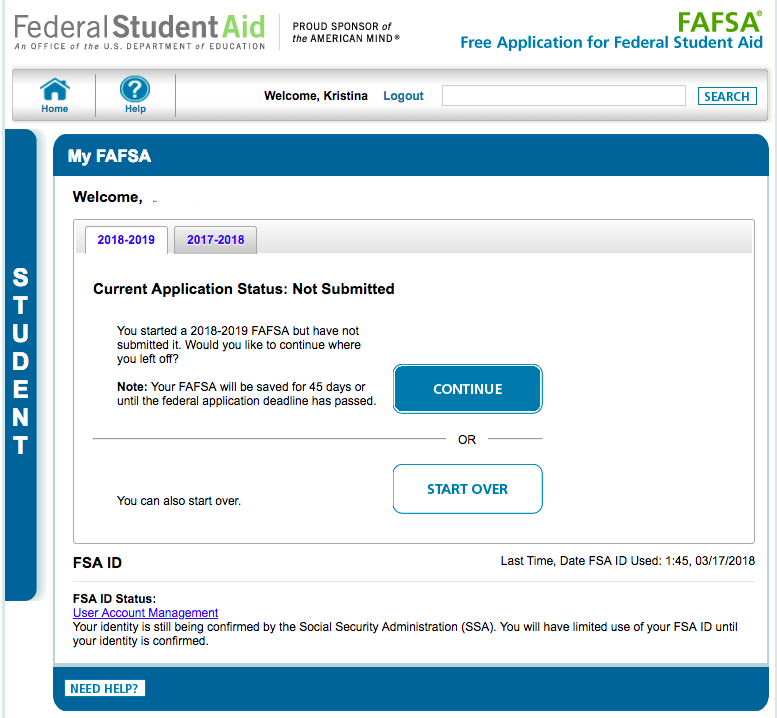
From your StudentAid.gov dashboard, locating your FAFSA status is straightforward. Look for a section or link typically labeled “My FAFSA” or “Check My Application Status.” Clicking this will take you to a page displaying your most recent FAFSA application and its current processing status.
Common status indicators you might encounter include:
-
“Processing”: Your application has been submitted and is currently being reviewed by the Department of Education. It hasn’t been fully processed yet.
-
“Processed Successfully”: Your application has been fully processed, and your Student Aid Report (SAR) is available for review. This is the ideal status, indicating no immediate issues.
-
“Processed – Requires Correction”: Your application was processed, but there’s an error or missing information that needs to be addressed. Your SAR will highlight the specific issues.
-
“Rejected”: This is a more serious status, meaning your application could not be processed due to significant errors or missing critical information (e.g., no signature, incorrect Social Security number). Immediate action is required.
-
“In Review”: Sometimes, an application may go into a deeper review process if certain data points trigger flags that require manual verification.
Understanding what each status means allows you to anticipate the next steps. For instance, a “Processed Successfully” status means your SAR is ready, and your information has been sent to the colleges you listed. A “Rejected” status demands immediate attention to rectify the issues to avoid delays in receiving aid.
Understanding Your Expected Family Contribution (EFC)
As mentioned earlier, your Expected Family Contribution (EFC) is a critical numerical index calculated from the information on your FAFSA. It is found on your Student Aid Report (SAR) and is perhaps the most significant piece of information derived from your FAFSA. The EFC is not what you will pay, but rather a calculation of your family’s financial strength and ability to contribute to college costs. Financial aid offices at colleges use your EFC to determine the amount of federal student aid you are eligible to receive.
Specifically, a college will calculate your “financial need” by subtracting your EFC from their Cost of Attendance (COA). The COA includes tuition and fees, room and board, books and supplies, transportation, and personal expenses. The difference between the COA and your EFC is your financial need, and colleges will then attempt to meet that need through a combination of grants, scholarships, work-study, and loans. A lower EFC generally translates to a higher eligibility for need-based aid, such as Pell Grants or subsidized loans. Conversely, a higher EFC means less eligibility for need-based aid, though you might still qualify for unsubsidized loans regardless of need. Reviewing your EFC on your SAR is vital for setting realistic expectations about the financial aid you may receive and for comparing aid packages from different institutions.
Addressing Common FAFSA Status Issues and Corrections
While many FAFSA applications sail through the processing phase without a hitch, it’s not uncommon to encounter statuses that require further action. Proactive engagement with these issues is key to avoiding delays in your financial aid.
When Your FAFSA Status Requires Action
Certain FAFSA statuses act as red flags, signaling that you need to take immediate steps to keep your application on track.
-
“Rejected” or “Incomplete” Status: These statuses indicate fundamental problems with your FAFSA that prevented it from being processed. Common culprits include missing signatures (especially the FSA ID signature), an incorrect Social Security number, or incomplete sections of the application. Your SAR, or the rejection notice, will typically detail the specific reasons for rejection. It’s crucial to identify these errors quickly and proceed with corrections.
-
“Verification Required”: This status means your college (or sometimes the Department of Education) needs to verify the information you provided on your FAFSA. Verification is a standard process, selected randomly or if your FAFSA data appears inconsistent. Colleges may ask for additional documentation such as tax transcripts, W-2 forms, untaxed income statements, or household size verification. It’s imperative to respond promptly and accurately to all verification requests from your financial aid office. Failure to do so will halt your financial aid disbursement, even if you’ve been offered aid.
-
Dealing with Data Discrepancies: Sometimes, your FAFSA might be processed, but with flags for discrepancies between the information you provided and data matched with federal agencies (like the IRS). These discrepancies could range from minor spelling errors to significant differences in reported income. Your SAR will usually highlight these potential issues, and your college’s financial aid office may reach out for clarification or require specific documentation to resolve them.
How to Make FAFSA Corrections
If your FAFSA status indicates that corrections are needed, or if you discover errors upon reviewing your SAR, making those changes is typically a straightforward process via StudentAid.gov.
-
Log In: Access your FAFSA account using your FSA ID.
-
Select “Make FAFSA Corrections”: On your dashboard, locate your processed FAFSA and select the option to make corrections.
-
Navigate to the Correction Section: The online form will guide you through the sections where you can update information. You’ll only be able to modify fields that are allowed for correction. For instance, most demographic information, financial data, and college selections can be updated.
-
Submit Electronically: After making changes, you (and your parent, if dependent) will need to sign the updated FAFSA electronically with your FSA IDs. The corrected FAFSA will then be reprocessed, and a revised SAR will be generated.
-
Review the New SAR: Always review your new SAR to ensure the corrections were applied accurately and that your EFC has been updated correctly, if applicable.
Common corrections include updating tax information if you initially used estimated figures, adjusting asset information, changing household size, or adding/removing schools from your list. It’s important to understand that significant corrections to financial data may alter your EFC and, consequently, your aid eligibility. Be meticulous in your corrections to avoid further delays.
What Happens After Your FAFSA is Processed: The Aid Offer
Once your FAFSA is successfully processed and any necessary corrections or verifications are complete, the information is sent to the colleges you listed on your application. This marks a significant transition from the federal processing stage to the institutional financial aid assessment.
The Financial Aid Offer Letter
The culmination of the FAFSA process, from a student’s perspective, is the financial aid offer letter (sometimes called an award letter). This crucial document is sent directly from each college you applied to and were accepted by, usually starting in late winter or early spring for the following academic year. It’s important to remember that the FAFSA itself doesn’t offer aid; it only determines your eligibility. The colleges then package specific aid based on your EFC, their Cost of Attendance (COA), and the availability of their own institutional funds.
An aid offer letter typically itemizes the different types of financial aid you’re eligible for at that particular institution. This can include:
-
Grants: Money you don’t have to pay back (e.g., Pell Grant, Federal Supplemental Educational Opportunity Grant – FSEOG, institutional grants).
-
Scholarships: Merit-based or need-based funds that also don’t need to be repaid.
-
Work-Study: A program that allows you to earn money to help pay for educational expenses through part-time jobs, usually on campus.
-
Loans: Money you must pay back, with interest (e.g., Federal Direct Subsidized and Unsubsidized Loans, PLUS Loans).
When comparing aid offers from different institutions, look beyond the total amount. Pay close attention to the “net price” – the cost of attendance minus grants and scholarships. This is the true out-of-pocket cost you or your family will be responsible for. Understand the breakdown of grants versus loans, as loans accrue interest and must be repaid, impacting your future financial standing.
Next Steps After Receiving Aid Offers
Receiving aid offers is an exciting but critical juncture. You’ll need to carefully review each offer, understand the terms, and make informed decisions.
-
Accepting, Declining, or Modifying Aid: Most colleges will provide instructions on how to accept, decline, or partially accept components of your aid package, often through an online portal. You might choose to decline certain loans if you don’t need them, thereby reducing future debt.
-
Understanding Loan Terms and Repayment Responsibilities: If you accept federal student loans, it’s essential to understand the interest rates, repayment start dates, and available repayment plans. Federal student aid often requires entrance counseling, which educates borrowers on their rights and responsibilities. While loans can bridge funding gaps, borrowing responsibly is paramount to avoid overwhelming debt post-graduation.
-
Connecting with Your College’s Financial Aid Office: If you have questions about your aid offer, believe there’s been an error, or if your family’s financial situation has changed significantly since you filed your FAFSA (e.g., job loss, medical expenses), immediately contact the financial aid office at your chosen institution. They can often provide clarification, make adjustments, or guide you through an “appeal” process for additional aid. Being proactive and communicative can often unlock additional resources or better terms.
The journey from FAFSA submission to receiving an aid offer is multifaceted. Each step, from monitoring your status to understanding your aid package, requires attention and informed decision-making to optimize your financial path to higher education.

Conclusion
Securing the financial resources necessary for higher education is a pivotal step towards achieving academic and career aspirations. The FAFSA stands as the cornerstone of this process, unlocking access to a wide array of federal, state, and institutional financial aid. However, the true power of the FAFSA isn’t just in its submission, but in the diligent monitoring of its status.
By understanding the FAFSA application lifecycle, proficiently navigating the Federal Student Aid website, and promptly addressing any issues that arise, students and their families can proactively manage their financial aid journey. Regularly checking your FAFSA status is not merely a bureaucratic task; it is a critical act of financial self-advocacy. It ensures that your application progresses smoothly, that any errors are swiftly corrected, and that you are fully prepared to evaluate and accept the financial aid offers that will help make your educational dreams a reality. Embrace this process with diligence and communication, and you will undoubtedly optimize your chances of funding a successful college experience.
aViewFromTheCave is a participant in the Amazon Services LLC Associates Program, an affiliate advertising program designed to provide a means for sites to earn advertising fees by advertising and linking to Amazon.com. Amazon, the Amazon logo, AmazonSupply, and the AmazonSupply logo are trademarks of Amazon.com, Inc. or its affiliates. As an Amazon Associate we earn affiliate commissions from qualifying purchases.