
In the intricate world of finance, few metrics hold as much sway over both the individual consumer and the sprawling corporate landscape as the prime interest rate. It’s a foundational benchmark, a numerical pulse that indicates the health and direction of an economy, influencing everything from the cost of your credit card debt to the viability of a multi-million-dollar business loan. But what exactly is this elusive “prime rate,” who determines it, and why should its current standing be a critical component of your financial awareness?
The prime rate represents the interest rate that commercial banks charge their most creditworthy corporate customers. It’s not a static figure; rather, it’s a dynamic economic indicator that responds to broader monetary policy set by central banks, primarily the Federal Reserve in the United States. When the prime rate shifts, it sends ripples across the entire financial system, affecting borrowing costs for consumers, profitability for businesses, and even the returns on certain savings and investment products. Understanding its current trajectory and implications is not merely academic; it’s an essential tool for navigating your personal and business finances strategically.
While I cannot provide a real-time, live figure as this article is being read, I can explain precisely what the prime rate is, how to find its current value, and, more importantly, how its level, whether high or low, impacts your financial decisions. Staying informed about the prime rate empowers you to make smarter choices about borrowing, saving, and investing, positioning you to thrive regardless of economic winds.
Understanding the Prime Interest Rate: A Fundamental Concept
To truly grasp the significance of the prime interest rate, one must first demystify its definition, its origins, and its fundamental role within the financial ecosystem. It’s more than just a number; it’s a critical indicator that underpins vast swathes of economic activity.
What Exactly Is It?
At its core, the prime interest rate is the lowest interest rate at which money can be borrowed commercially. Specifically, it’s the interest rate that banks in the United States charge their most creditworthy corporate clients on short-term loans. Think of it as the baseline cost of borrowing for the safest borrowers. Any other borrower, be it a small business, an individual, or a corporation with a slightly less stellar credit profile, will typically pay an interest rate that is a certain percentage above the prime rate. This additional percentage, known as a “spread,” compensates the lender for the increased risk associated with that borrower.
Crucially, the prime rate is not set in isolation. In the U.S., it is directly influenced by the Federal Funds Target Rate, which is determined by the Federal Reserve’s Federal Open Market Committee (FOMC). The Federal Funds Rate is the target rate for overnight lending between banks, a powerful lever that the Fed uses to manage the money supply, control inflation, and influence economic growth. The prime rate typically moves in lockstep with changes to the Federal Funds Rate, usually staying at a fixed spread (historically around 3 percentage points) above it. So, when the Fed raises the Federal Funds Rate, banks generally raise their prime rate almost immediately, and vice versa.
Who Sets the Prime Rate?
While individual commercial banks officially set their own prime rates, these decisions are largely dictated by the actions of the central bank. In the United States, the Federal Reserve does not directly set the prime rate. Instead, it sets the Federal Funds Target Rate. This target then influences the rate at which banks lend to each other overnight. To maintain competitive profitability and manage their own cost of capital, commercial banks then adjust their prime lending rates accordingly.
The widely accepted benchmark for the prime rate in the U.S. is the “Wall Street Journal Prime Rate.” The Wall Street Journal surveys the 10 largest banks in the country and publishes the most common rate quoted. This provides a standardized, easily accessible figure that individuals and businesses can reference. Other countries have similar mechanisms, often tied to their respective central bank’s policy rates, highlighting the global importance of this benchmark. The synchronous movement of major banks’ prime rates ensures a relatively uniform lending environment for top-tier borrowers across the banking sector.
Why Does It Matter So Much?
The prime rate matters because it acts as a fundamental benchmark for a vast array of financial products and services, creating a ripple effect across the entire economy. For consumers, it directly impacts the interest rates on variable-rate loans such as credit cards, home equity lines of credit (HELOCs), and adjustable-rate mortgages (ARMs). When the prime rate rises, the cost of borrowing for these products increases, leading to higher monthly payments for those with variable rates. Conversely, a falling prime rate can alleviate financial burdens.
For businesses, especially small and medium-sized enterprises, the prime rate is a critical factor in determining the cost of capital for expansion, inventory, or operational needs. Higher prime rates can make borrowing more expensive, potentially stifling investment and growth, while lower rates can stimulate economic activity. Beyond direct lending, the prime rate also indirectly influences other financial markets, affecting bond yields, stock valuations (as corporate borrowing costs impact profitability), and even the rates offered on savings accounts and certificates of deposit (CDs) as banks compete for deposits. Its broad influence makes it a crucial economic indicator for anyone trying to understand the current financial climate.
The Current Landscape: Navigating Today’s Prime Rate Environment
The prime interest rate is not a fixed monument; it’s a dynamic weather vane constantly responding to economic forces. Understanding its current standing and the underlying factors driving its fluctuations is key to making informed financial decisions.
Where Does It Stand Today? (Hypothetical/Illustrative)
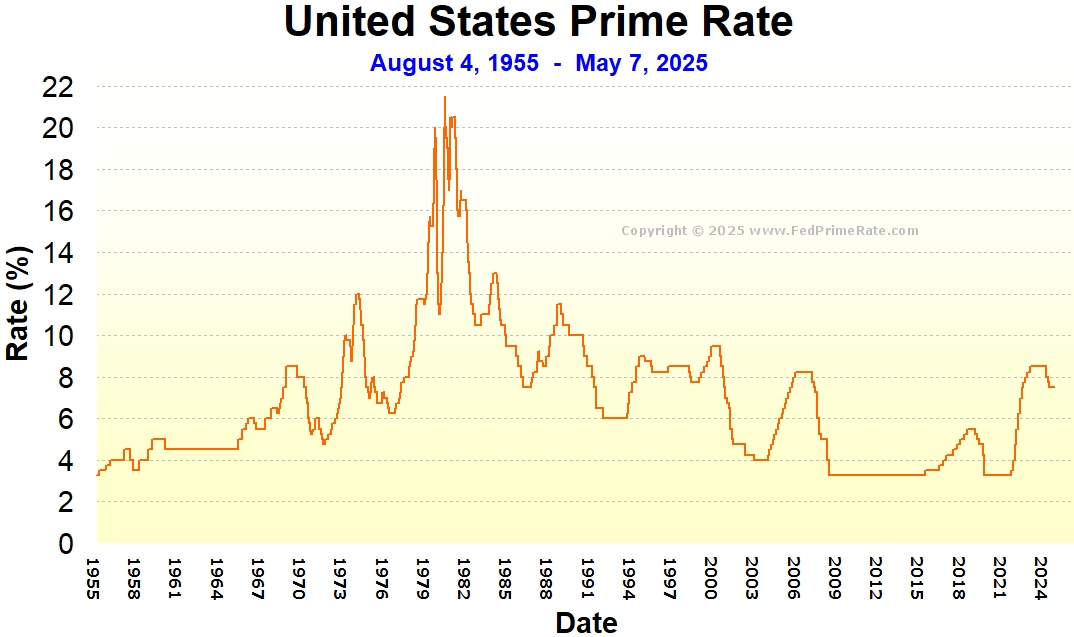
As an AI, I don’t have real-time access to live market data. However, to illustrate, let’s consider a recent historical context. Over the past couple of years, many major economies, including the U.S., have experienced periods of significant interest rate volatility. Following a prolonged era of historically low rates, central banks embarked on a series of aggressive rate hikes to combat surging inflation. This led to a substantial increase in the Federal Funds Rate, which in turn pushed the prime rate considerably higher.
For instance, if the Federal Funds Target Rate range was, say, 5.25% to 5.50%, the Wall Street Journal Prime Rate would typically be 8.50%. This would represent a significant increase from rates seen just a few years prior when the prime rate might have been closer to 3.25% or 3.50%. To find the exact current prime rate, one should always refer to reliable financial news sources like The Wall Street Journal, Bloomberg, or the websites of major banks. They regularly update this figure, often within minutes of a Federal Reserve announcement. The current environment is characterized by central banks carefully watching inflation and economic data, potentially pausing rate hikes but remaining prepared to act if inflation proves sticky, or considering cuts if economic conditions deteriorate significantly.
Factors Driving Prime Rate Fluctuations
The prime rate’s movements are a direct consequence of several interconnected economic factors, primarily influenced by the central bank’s monetary policy decisions.
-
Monetary Policy and the Federal Funds Rate: This is the most direct driver. When the Federal Reserve’s Federal Open Market Committee (FOMC) votes to raise or lower the Federal Funds Target Rate, banks typically adjust their prime rate by the same amount, almost immediately. The Fed uses this tool to manage the money supply, either to cool down an overheating economy (by raising rates) or stimulate a sluggish one (by lowering rates).
-
Inflation Expectations: Central banks are primarily mandated to maintain price stability. If inflation is high or expected to rise, the Fed is likely to raise interest rates, which translates to a higher prime rate, to curb demand and control rising prices. Conversely, if inflation is subdued, the Fed has more leeway to keep rates lower.
-
Economic Growth and Employment Data: A robust economy with strong GDP growth and low unemployment might lead the Fed to consider raising rates to prevent overheating. A weak economy, characterized by slow growth and rising unemployment, might prompt the Fed to lower rates to encourage borrowing and investment. Key economic reports, such as job numbers, GDP figures, and consumer spending data, are closely watched for signals.
-
Global Economic Conditions: While domestic factors are paramount, global economic trends can also influence the Fed’s decisions. International trade tensions, currency fluctuations, and economic conditions in major trading partners can indirectly affect domestic inflation and growth, thus playing a role in the Fed’s assessment of appropriate interest rate policy.
These factors are constantly in flux, making the prime rate a barometer of broader economic health and central bank strategy.

The Prime Rate’s Impact on Your Personal Finances
The prime interest rate might seem like an abstract concept, but its movements have very tangible effects on your everyday personal finances, impacting both your borrowing costs and your potential returns on savings and investments.
Borrowing Costs for Consumers
For most individuals, the most direct and immediate impact of a shifting prime rate is felt through their borrowing costs, particularly on variable-rate financial products.
-
Credit Cards: A significant portion of credit card interest rates are variable, meaning they are tied to an index, which is typically the prime rate. If the prime rate increases, the Annual Percentage Rate (APR) on your credit card will likely increase as well, leading to higher minimum payments and a greater total cost if you carry a balance. This can quickly erode your budget.
-
Home Equity Lines of Credit (HELOCs): HELOCs are almost universally variable-rate products, directly indexed to the prime rate plus a margin. As the prime rate rises, your monthly payment for a HELOC will increase. For homeowners relying on HELOCs for renovations or other large expenses, this can significantly impact their cash flow.
-
Adjustable-Rate Mortgages (ARMs): While fixed-rate mortgages are unaffected by prime rate changes, ARMs have interest rates that adjust periodically (e.g., every one, three, five, or seven years) after an initial fixed period. The rate adjustment is usually tied to an index like the prime rate (or other short-term rates that correlate with prime), plus a margin. When the prime rate goes up, the interest rate on your ARM will likely increase at its next adjustment period, resulting in higher monthly mortgage payments.
-
Personal Loans and Small Business Loans: Many unsecured personal loans and lines of credit, as well as loans for small businesses, are often priced based on the prime rate plus a certain spread, reflecting the borrower’s creditworthiness. A higher prime rate means higher interest payments, impacting the feasibility of personal projects or the growth plans of a small business.
Savings and Investments
While the impact on borrowing costs is often more immediate and noticeable, the prime rate also indirectly influences your savings and investment opportunities.
-
Savings Accounts & Certificates of Deposit (CDs): When the prime rate and broader interest rates rise, banks tend to offer higher interest rates on savings accounts, money market accounts, and CDs to attract deposits. This can be beneficial for savers, as their money earns a better return. Conversely, falling rates mean lower returns on these products.
-
Money Market Accounts: These accounts are designed to offer competitive interest rates, which are often tied to short-term market rates that closely track the prime rate. During periods of rising rates, money market accounts can become attractive for parking cash while still earning a decent return.
-
Investment Decisions: A higher prime rate can impact the broader investment landscape. For bonds, newly issued bonds may offer higher yields, making them more attractive. For stocks, higher borrowing costs for corporations can reduce profitability, potentially leading to lower stock valuations. Additionally, higher interest rates can make safer, fixed-income investments more appealing, drawing money away from riskier assets like stocks. Conversely, lower rates can make stocks more attractive relative to bonds. Understanding the prime rate’s direction can help investors adjust their portfolio allocation strategies.
Strategies for Managing Your Money in a Dynamic Rate Environment
Given the pervasive influence of the prime rate, having proactive strategies to manage your money is essential, whether rates are rising, falling, or remaining stable. Adaptability is key to protecting and growing your financial well-being.
For Borrowers
When the prime rate fluctuates, especially upwards, borrowers need to be particularly vigilant and proactive to minimize increased costs.
-
Refinancing Variable-Rate Debt: If you have loans with variable interest rates (like HELOCs or ARMs) and the prime rate is on an upward trend, consider refinancing them into fixed-rate alternatives. While fixed rates might initially be higher than your current variable rate, they offer predictability and protection against future rate hikes, potentially saving you a significant amount over the long term. This strategy is particularly powerful when rates are relatively low but expected to rise.
-
Debt Consolidation: For high-interest, variable-rate debts like credit card balances, consider consolidating them into a single loan with a lower, fixed interest rate, if available. This not only simplifies payments but can also shield you from rising prime rate impacts on multiple debts. Look for personal loans or balance transfer credit cards with introductory 0% APR periods, but be sure to pay off the balance before the promotional period ends.
-
Accelerating Payments: Whenever possible, especially during periods of rising rates, prioritize paying down the principal on your variable-rate loans faster. Even small extra payments can reduce the total interest you pay over the life of the loan and lessen the impact of subsequent rate increases.
-
Understanding Loan Terms: Always read the fine print of your loan agreements. Understand how your interest rate is calculated, which index it’s tied to, and how often it can adjust. Being aware of these terms allows you to anticipate changes and plan accordingly.
For Savers and Investors
A dynamic rate environment also presents opportunities and considerations for those looking to save and invest.
-
Seek High-Yield Savings Accounts: In a rising interest rate environment, banks become more competitive for deposits. Shop around for high-yield savings accounts and money market accounts offered by online banks or credit unions, which often provide significantly better returns than traditional brick-and-mortar banks.
-
Certificates of Deposit (CDs): CDs can be attractive when rates are rising. You can lock in a higher interest rate for a fixed period (e.g., 6 months, 1 year, 5 years). Consider a “CD laddering” strategy, where you invest in several CDs with staggered maturity dates. This allows you to benefit from potentially higher rates as older CDs mature, without locking all your money up for too long.
-
Bond Investments: As interest rates rise, newly issued bonds typically offer higher yields, making them more attractive. For existing bondholders, rising rates generally cause bond prices to fall. Investors looking for income during rising rate environments might consider short-duration bond funds or individual short-term bonds to minimize interest rate risk, or explore Treasury Inflation-Protected Securities (TIPS) if inflation is a concern.
-
Review Your Investment Portfolio: Periodically review your investment portfolio in light of current interest rate trends. Higher rates can make it more expensive for companies to borrow, potentially impacting their earnings and stock prices. Growth stocks, which rely heavily on future earnings, can be particularly sensitive. Consider diversifying your portfolio and consulting with a financial advisor to ensure your investment strategy aligns with your risk tolerance and the current economic outlook.
Staying Informed: Your Key to Financial Agility
In an economic climate where the prime interest rate can shift with significant implications, staying well-informed is not just good practice—it’s a critical component of financial agility and success. Ignorance can lead to missed opportunities or, worse, unforeseen financial strains.
Reliable Sources for Prime Rate Information
Accessing accurate and timely information about the prime rate is easier than ever, thanks to a plethora of reputable sources. Make it a habit to check these regularly:
-
Federal Reserve Announcements: The official statements from the Federal Open Market Committee (FOMC) meetings are the primary source for changes to the Federal Funds Target Rate, which directly influences the prime rate. These announcements typically occur eight times a year, with additional unscheduled meetings if economic conditions warrant.
-
Reputable Financial News Outlets: Major financial news publications like The Wall Street Journal, Bloomberg, Reuters, and CNBC consistently report on the current prime rate and provide expert analysis on its implications. The Wall Street Journal’s published prime rate is widely considered the authoritative benchmark.
-
Your Bank’s Websites and Statements: Most commercial banks prominently display their current prime lending rate on their websites. Additionally, if you have variable-rate loans, your monthly statements should reflect any changes to your interest rate, which will be tied to the prime rate.
-
Financial Aggregator Websites: Many personal finance websites and investment platforms offer real-time or near real-time updates on key economic indicators, including the prime rate. Just ensure the source is credible and frequently updated.
Proactive Financial Planning
Beyond merely knowing the current rate, integrating this knowledge into your proactive financial planning is where its true value lies.
-
Regularly Review Your Loans and Savings Products: Don’t wait for a crisis. Set a reminder to periodically review the interest rates on your credit cards, HELOCs, ARMs, personal loans, and savings accounts. Compare them against the current prime rate and what competitors are offering. This vigilance allows you to identify opportunities for refinancing or switching accounts to optimize your costs or returns.
-
Consult with Financial Advisors: A qualified financial advisor can provide personalized guidance, helping you understand how prime rate changes specifically impact your financial situation and how to adjust your strategies accordingly. They can offer insights into investment opportunities or debt management tactics that you might not consider on your own.
-
Budgeting and Forecasting: Incorporate potential interest rate changes into your personal and business budgets. If you have variable-rate debt, run scenarios to see how a 0.25% or 0.50% increase in the prime rate would affect your monthly payments. This foresight allows you to build a financial buffer and avoid being caught off guard.
-
Educate Yourself Continuously: The financial landscape is ever-evolving. Make a commitment to continuous learning about economic indicators, monetary policy, and personal finance best practices. The more knowledgeable you are, the more confident and effective you will be in managing your money.

Conclusion
The prime interest rate is far more than an obscure economic statistic; it is a critical benchmark that permeates every corner of our financial lives. From the interest you pay on your credit card balance to the return you earn on your savings, and the viability of a business expansion, the prime rate acts as a foundational determinant.
While its exact value fluctuates based on a complex interplay of central bank policy, inflation, and broader economic conditions, understanding its function and its “right now” position is an indispensable tool for financial empowerment. By staying informed through reliable sources, adopting proactive strategies for both borrowing and saving, and integrating this knowledge into your financial planning, you can navigate the dynamic currents of the economy with greater confidence and control. The key lies not just in knowing “what’s the prime interest rate right now,” but in understanding its implications and strategically positioning your finances to thrive in any economic climate.
aViewFromTheCave is a participant in the Amazon Services LLC Associates Program, an affiliate advertising program designed to provide a means for sites to earn advertising fees by advertising and linking to Amazon.com. Amazon, the Amazon logo, AmazonSupply, and the AmazonSupply logo are trademarks of Amazon.com, Inc. or its affiliates. As an Amazon Associate we earn affiliate commissions from qualifying purchases.