
Shipping a puppy across state lines is a complex operation that sits at the intersection of high-stakes logistics and significant financial investment. For professional breeders, new pet owners, and entrepreneurs in the pet industry, understanding the economics of interstate puppy transport is essential. This is not merely a matter of moving a living being from point A to point B; it is a specialized service industry with its own market rates, regulatory costs, and risk management profiles. To successfully navigate this process, one must view it through the lens of a cost-benefit analysis, ensuring that the financial outlay aligns with the safety and speed required for the transaction.
The Economic Landscape of Pet Transportation Services
The pet industry has seen a massive surge in valuation over the last decade, with expenditures in the United States alone exceeding $130 billion annually. Within this broader economy, pet transportation has emerged as a high-margin niche. When a buyer in New York purchases a puppy from a breeder in Texas, the logistics of that delivery become a primary cost driver in the overall transaction.
Direct Costs vs. Operational Expenses
When evaluating how to ship a puppy, the first step is to categorize the expenses. Direct costs are the fees paid directly to a service provider—be it an airline or a ground transport company. However, the true financial picture includes operational expenses that the shipper must absorb before the puppy even leaves the premises.
The direct costs for professional ground transport typically range from $300 to $1,000, depending on the distance and the level of service (e.g., shared vs. private transport). Air travel costs can vary wildly. A “flight nanny” service, where a human courier carries the puppy in the cabin, can cost anywhere from $500 to $2,000 plus the price of the airfare. From a business perspective, these costs must be factored into the sale price of the animal or clearly itemized as a pass-through cost to the consumer to maintain profit margins.
Market Trends in the Pet Logistics Industry
The “premiumization” of the pet industry has significantly impacted shipping. Consumers are increasingly willing to pay for white-glove services that guarantee climate-controlled environments and real-time GPS tracking. For a business providing these services, the capital expenditure involved in maintaining a fleet of specialized vehicles or employing a network of certified flight nannies is substantial. Investors in this space look for high-utilization rates of specialized equipment to justify the overhead. For the individual shipper, these market trends mean that while there are more options than ever, the floor for “safe” shipping costs has risen.
Budgeting for Interstate Puppy Relocation
Financial planning for puppy shipping requires a line-item budget that accounts for both the obvious and the hidden fees. Failure to account for these can lead to “scope creep” in your relocation budget, turning a profitable sale into a break-even or loss-making endeavor.
Ground Transport vs. Air Travel: A Cost-Benefit Analysis
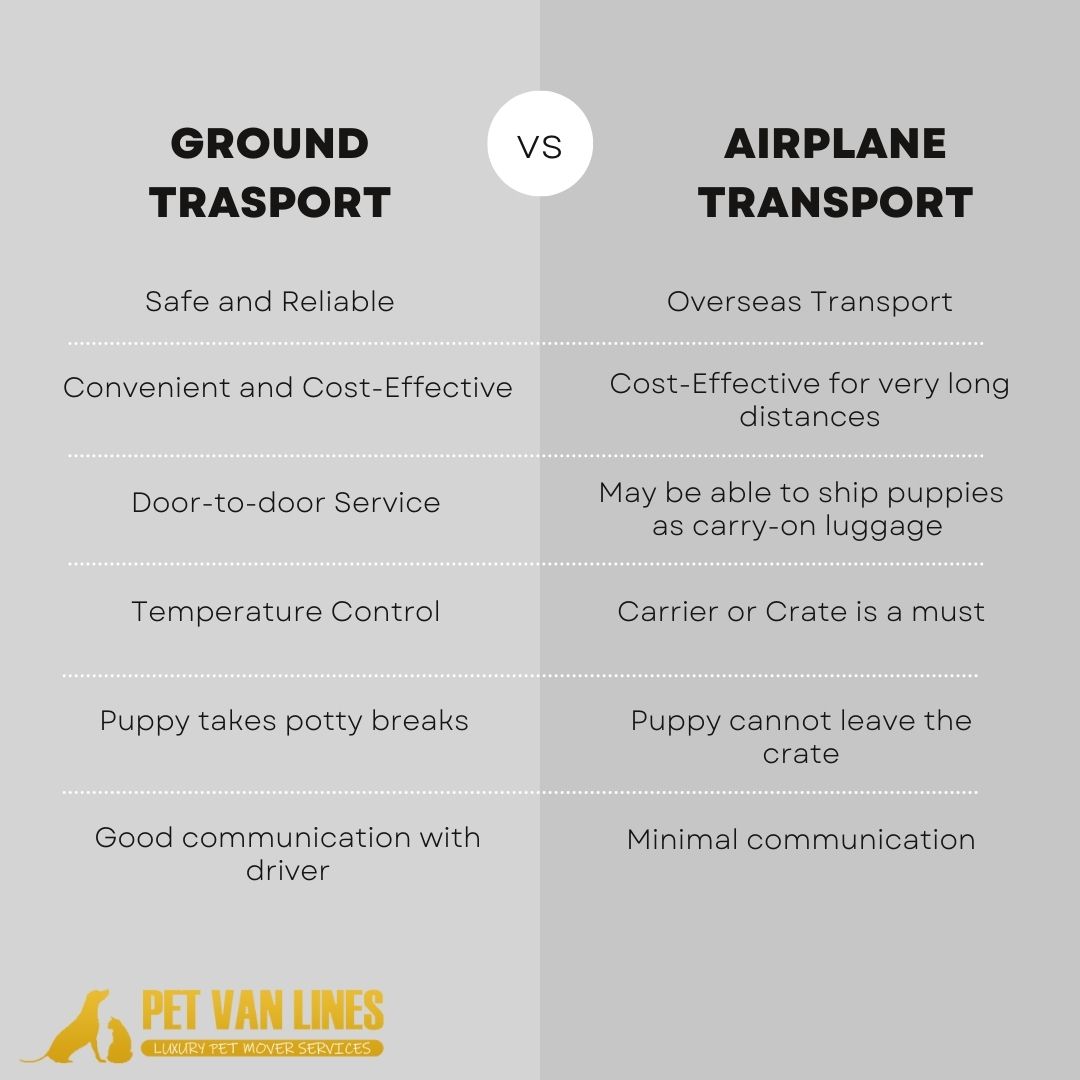
Choosing between ground and air is the most significant financial decision in the process. Ground transport is often more cost-effective for medium distances (under 500 miles) and offers lower volatility in pricing. The overhead for ground transport includes fuel, driver labor, and vehicle depreciation. Because ground transport can carry multiple pets at once, the “per unit” cost is often lower, allowing for more competitive pricing in the mid-tier market.
In contrast, air travel is a high-speed, high-cost option. Shipping a puppy in the cargo hold of a plane (via services like American Airlines’ PetEmbark or United’s specialized programs) involves strict crate requirements and “tendered” cargo fees. However, many premium buyers now shun cargo shipping in favor of flight nannies. From a financial standpoint, the flight nanny model is a labor-intensive service that commands a premium. The ROI on this method is found in the reduction of risk; the likelihood of a puppy falling ill or being injured is significantly lower in-cabin, which protects the seller from the massive financial hit of a “dead-on-arrival” or “sick-on-arrival” insurance claim.
Hidden Costs: Health Certificates, Kennels, and Insurance
Beyond the transport fee itself, several mandatory financial outlays exist:
-
Veterinary Documentation: Every puppy crossing state lines must have a CVI (Certificate of Veterinary Inspection). These usually cost between $50 and $150. This is a non-negotiable regulatory cost mandated by the USDA and state departments of agriculture.
-
Specialized Equipment: If shipping via air, the crate must be IATA-compliant. These are not standard pet store crates; they are reinforced, bolted, and designed for aviation safety. A high-quality shipping kennel can cost $100 to $300.
-
Insurance Premiums: Transit insurance is a critical risk-management tool. It typically costs 1% to 3% of the puppy’s total value. For a high-value breed worth $5,000, an additional $150 in insurance is a prudent expense to protect against total loss during transit.

Maximizing ROI for Breeders and Professional Sellers
For those in the business of breeding and selling dogs, shipping is not just a logistical hurdle; it is a tool for market expansion. By mastering the financial aspects of shipping, a breeder can expand their customer base from a local 50-mile radius to the entire continental United States.
Building Shipping Costs into Your Business Model
Successful breeders utilize two primary financial strategies for shipping: the “Flat Rate” model and the “Actual Cost” model.
-
The Flat Rate Model: The seller charges a fixed fee (e.g., $500) for shipping regardless of the destination. This simplifies the sales process and can be a marketing advantage. However, it requires a volume-based approach where shorter shipments subsidize the longer, more expensive ones.
-
The Actual Cost Model: This is more transparent and protects the seller’s margins. By using third-party logistics (3PL) calculators, the seller provides an invoice for the exact quote provided by the transporter. This is often the preferred method for high-ticket, rare breeds where the buyer expects a bespoke shipping experience.
Liability Management and Financial Protection
One of the most overlooked aspects of shipping a puppy is the financial impact of “contingent liability.” If a puppy is injured during transport, who bears the financial burden? Is the breeder obligated to provide a full refund, or does the transport company’s insurance cover the loss?
To protect the bottom line, it is essential to have a clear, legally binding contract that stipulates when the “transfer of risk” occurs. In many commercial transactions, this happens “FOB Origin” (Free on Board), meaning the buyer assumes risk once the puppy is handed to the transporter. From a financial perspective, defining this point of transfer is as important as the shipping price itself, as it dictates who is responsible for the capital loss in the event of an accident.
Evaluating the Financial Viability of DIY vs. Professional Services
Many individuals consider driving the puppy themselves to save money. While this may seem like a budget-friendly option, a true financial analysis often proves otherwise.
Opportunity Cost and Time Value
The “DIY” approach involves hidden costs that are often ignored: fuel, tolls, hotel stays, and—most importantly—opportunity cost. If a professional breeder spends 24 hours driving a puppy to another state, they are losing 24 hours of labor that could be spent on kennel management, marketing, or client relations.
If your time is valued at $50 per hour, a 24-hour round trip costs $1,200 in labor alone. When you add $200 in fuel and $150 for a hotel, the “free” DIY trip has actually cost $1,550. In this scenario, hiring a professional transporter for $600 is not just more convenient; it is a mathematically superior financial decision.

Vendor Selection and Price Optimization
When selecting a professional service, the lowest price is rarely the most economical choice. In the logistics world, extreme low-cost providers often lack the necessary USDA certifications and insurance coverage. A “cheap” transporter who operates “under the table” puts the shipper at risk of legal fines and the total loss of the animal without recourse.
For optimal price performance, shippers should look for companies that use digital logistics platforms. These platforms aggregate “backhaul” opportunities—where a transporter has an empty crate on a return trip—allowing them to offer discounted rates to fill the space. Leveraging these market efficiencies can reduce shipping costs by 20% to 30% without sacrificing the quality of care or increasing financial risk.
By treating the shipment of a puppy as a professional logistics project, stakeholders can ensure that the process is not only safe for the animal but also financially sound for the parties involved. Whether you are a business owner scaling your operations or a buyer making a significant personal investment, a rigorous focus on the financial metrics of transport will lead to more predictable outcomes and a healthier bottom line.
aViewFromTheCave is a participant in the Amazon Services LLC Associates Program, an affiliate advertising program designed to provide a means for sites to earn advertising fees by advertising and linking to Amazon.com. Amazon, the Amazon logo, AmazonSupply, and the AmazonSupply logo are trademarks of Amazon.com, Inc. or its affiliates. As an Amazon Associate we earn affiliate commissions from qualifying purchases.