
In the fast-paced world of global finance, few tickers command as much attention as AMZN. For investors, retail traders, and institutional fund managers alike, the question of what Amazon stock is selling for today is more than a query about a simple numerical value; it is a gateway into understanding the broader health of the consumer economy, the scaling potential of cloud computing, and the shifting dynamics of digital advertising. Amazon.com, Inc. has evolved from a niche online bookseller into a diversified behemoth, making its share price a critical barometer for the tech-heavy Nasdaq and the S&P 500.

To understand what Amazon is selling for today, one must look beyond the real-time ticker and delve into the fundamental valuation metrics, market sentiment, and macroeconomic factors that dictate its movement. Stock prices are rarely static, fluctuating based on interest rate projections, quarterly earnings reports, and the constant tug-of-war between bullish growth expectations and bearish recessionary fears.
Understanding Amazon’s Current Market Position and Stock Valuation
When an investor asks about the current price of Amazon stock, they are looking at a figure that has been shaped by decades of aggressive reinvestment and strategic pivots. Following its historic 20-for-1 stock split in 2022, the price per share became significantly more accessible to the average retail investor. However, the lower nominal price does not mean the company is “cheaper” in terms of valuation; rather, it simply redistributed the company’s massive market capitalization into a larger number of shares.
The Dynamics of Real-Time Stock Pricing
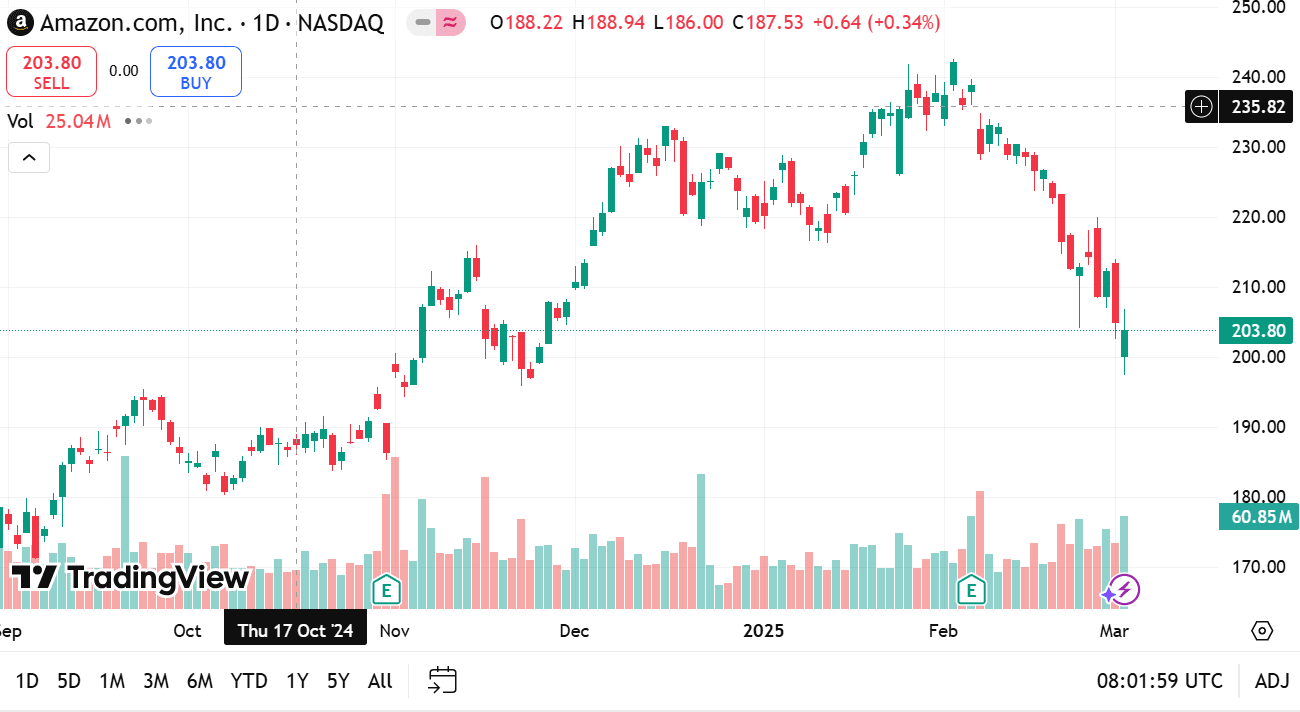
The price you see on your brokerage app at any given moment is the “last traded price,” the point at which a buyer and a seller recently agreed to transact. For a high-liquidity stock like Amazon, this price moves in milliseconds. During periods of high volatility—such as the release of Consumer Price Index (CPI) data or Federal Reserve interest rate announcements—Amazon’s stock can swing several percentage points in a single session. This volatility is often a reflection of Amazon’s sensitivity to discretionary spending. When the “price of money” (interest rates) rises, growth stocks like Amazon often face downward pressure as their future cash flows are discounted at a higher rate.
Key Performance Indicators (KPIs) Influencing AMZN
Investors evaluate Amazon’s price through the lens of several key metrics. While the nominal stock price is the headline, the Price-to-Earnings (P/E) ratio and the Price-to-Sales (P/S) ratio offer a clearer picture of whether the stock is “expensive” or “on sale.” Historically, Amazon has traded at a premium P/E ratio compared to the broader market because investors prioritize its massive revenue growth and dominant market share over immediate net income. Today, the focus has shifted slightly toward operating margin expansion, particularly within its North American and International retail segments, which were previously lower-margin compared to its cloud business.
Factors Driving Amazon’s Stock Price in the Current Economy
The current selling price of Amazon stock is a composite reflection of its three primary engines: E-commerce, Amazon Web Services (AWS), and its burgeoning Advertising wing. Each of these sectors responds differently to economic stimuli, providing a unique hedge for the company’s overall valuation.
The Cloud Computing Dominance: AWS
Amazon Web Services remains the crown jewel of the company’s portfolio and the primary driver of its stock valuation. AWS provides the infrastructure for a significant portion of the internet, offering everything from storage to advanced machine learning tools. When Amazon reports its quarterly earnings, the market often ignores the retail numbers to focus exclusively on AWS growth rates. If AWS shows signs of acceleration, the stock price typically surges, regardless of the retail environment. This is because AWS operates at much higher margins than the logistics-heavy retail side, accounting for a disproportionate share of the company’s operating income.
E-commerce Evolution and Logistics Optimization
The retail division, while lower in margin, provides the massive scale that fuels the Amazon ecosystem. In recent years, Amazon has focused on a “regionalization” of its fulfillment network. By moving inventory closer to the end consumer, the company has drastically reduced its “cost to serve.” For investors tracking the stock price, improvements in shipping speeds and reductions in fulfillment costs are positive signals. A more efficient logistics network translates to higher free cash flow—a metric that professional analysts value more than almost any other when determining what the stock should be selling for.
The Rising Influence of Advertising Revenue
A relatively new but powerful driver of Amazon’s stock price is its advertising business. By leveraging its vast repository of first-party shopper data, Amazon has become the third-largest digital advertising platform in the world, trailing only Google and Meta. Unlike the retail business, advertising has incredibly high margins. Every dollar of ad revenue contributes significantly more to the bottom line than a dollar of merchandise sales. The market has begun to price in this high-margin growth, providing a floor for the stock price even during periods of sluggish retail sales.
Analyzing Financial Metrics: Is AMZN a Buy, Hold, or Sell?
Determining if Amazon is selling at a fair price requires a deep dive into the company’s balance sheet and cash flow statements. For the value-oriented investor, the sheer size of Amazon can be daunting, but the financial health of the organization remains robust.
Price-to-Earnings (P/E) and Forward Multiples
Because Amazon reinvests so much of its capital back into the business, its trailing P/E ratio can often look inflated. Savvy investors instead look at the “Forward P/E,” which estimates earnings over the next twelve months. If the forward P/E is lower than the historical average, it may suggest that the stock is undervalued relative to its growth potential. Currently, as Amazon optimizes its operations and begins to reap the rewards of its massive infrastructure investments during the pandemic era, many analysts believe the company is entering a “harvesting” phase where earnings will grow faster than revenue.
Free Cash Flow and Capital Expenditure
Free Cash Flow (FCF) is the lifeblood of any business, and for Amazon, it has been a point of contention and triumph. After a period of heavy capital expenditure (CapEx) to build out its delivery network and data centers, Amazon has seen a significant inflection point in FCF. When FCF turns positive and begins to grow, it allows the company to pay down debt, buy back shares, or invest in “moonshot” projects like Project Kuiper (satellite internet). A strengthening FCF profile is almost always a precursor to a rising stock price, as it proves the business model is sustainable and self-funding.
Strategic Outlook: The Future of Amazon as a Core Investment
As we look at what Amazon stock is selling for today, we must also consider the “long-term” horizon that founder Jeff Bezos famously championed. The company is no longer just a store; it is a utility for the modern world.
Artificial Intelligence and Future Growth Levers
The integration of Generative AI is the latest frontier for Amazon. Through AWS Bedrock and its proprietary Titan models, Amazon is positioning itself as the foundational layer for companies looking to build AI-driven applications. Furthermore, AI is being used internally to optimize supply chains and personalize the shopping experience. If Amazon can successfully monetize AI through AWS, it creates a new “growth leg” that could justify a significantly higher stock price in the coming years. Investors are currently watching for signs that AI is contributing to “compute” demand in the cloud, which would provide a massive tailwind for AMZN.
Potential Risks and Market Volatility
No investment is without risk. Amazon faces constant regulatory scrutiny both in the United States and the European Union regarding antitrust concerns and market dominance. Additionally, as a global entity, it is highly sensitive to currency fluctuations. If the U.S. Dollar remains exceptionally strong, it can eat into the profits generated by its international segments. Furthermore, competition from emerging e-commerce players like Temu or Shein, and the perennial rivalry with Walmart and Microsoft (in the cloud space), ensures that Amazon cannot afford to be complacent.
Conclusion for the Modern Investor
What Amazon stock is selling for today is a reflection of the market’s collective wisdom regarding the future of commerce, technology, and data. While the daily fluctuations are driven by headlines and algorithmic trading, the long-term value is driven by the company’s ability to innovate and maintain its “Day 1” mentality. For the individual investor, the current price represents an entry point into one of the most sophisticated cash-generating machines in history. Whether the price is up or down on any given day, the underlying mechanics of AWS, advertising, and a world-class logistics network remain the true anchors of its financial identity. Understanding these components is essential for anyone looking to build a portfolio that stands the test of time in an ever-evolving financial landscape.
aViewFromTheCave is a participant in the Amazon Services LLC Associates Program, an affiliate advertising program designed to provide a means for sites to earn advertising fees by advertising and linking to Amazon.com. Amazon, the Amazon logo, AmazonSupply, and the AmazonSupply logo are trademarks of Amazon.com, Inc. or its affiliates. As an Amazon Associate we earn affiliate commissions from qualifying purchases.