
Navigating the world of personal and business finance often involves taking out loans. Whether it’s a mortgage, a car loan, a student loan, or a business line of credit, understanding how loans are structured and, crucially, how they are computed is an indispensable skill. Many people focus solely on the monthly payment, overlooking the total cost, the impact of interest rates, and the long-term financial implications. This guide aims to demystify the process, empowering you with the knowledge to accurately compute loans, compare offers, and make informed financial decisions.
A loan is essentially an agreement where a lender provides a sum of money to a borrower, which the borrower agrees to repay over a specified period, typically with added interest. The complexity often arises from the various components and calculation methods involved. By breaking down these elements, you’ll gain clarity and control over your financial obligations, ensuring you secure loans that align with your financial health and goals.
Understanding the Core Components of a Loan
Before delving into the mathematics, it’s essential to grasp the fundamental elements that constitute any loan. Each component plays a critical role in determining the total cost and the repayment schedule.
Principal Amount
The principal is the initial sum of money you borrow from the lender. It’s the face value of the loan and forms the basis upon which interest is calculated. If you take out a $20,000 car loan, $20,000 is your principal. Repaying the principal is the ultimate goal of any loan, alongside covering the accrued interest.
Interest Rate (APR vs. Nominal Rate)
The interest rate is the percentage charged by the lender for the use of their money. It’s typically expressed as an annual percentage. However, it’s crucial to distinguish between the nominal interest rate and the Annual Percentage Rate (APR).
-
Nominal Interest Rate: This is the stated rate on the loan, without taking into account any fees or compounding frequency.
-
Annual Percentage Rate (APR): The APR provides a more comprehensive measure of the cost of borrowing. It includes the nominal interest rate plus any additional fees associated with the loan, such as origination fees, processing fees, and sometimes closing costs, spread over the life of the loan. The APR allows for a more accurate comparison between different loan products, as it reflects the true annual cost of borrowing. Always compare loans using their APRs to get a real sense of the overall expense.
Loan Term
The loan term refers to the duration over which you are expected to repay the loan. This is usually expressed in years or months. Common loan terms include 15-year or 30-year mortgages, 3-year or 5-year car loans, and various terms for personal loans. A longer loan term typically results in lower monthly payments but often leads to paying more interest over the life of the loan. Conversely, a shorter term means higher monthly payments but less interest paid overall.
Payment Frequency
This specifies how often you are required to make payments. The most common frequency is monthly, but some loans may require bi-weekly, weekly, or even quarterly payments. The payment frequency impacts how often interest is compounded and, consequently, the total interest paid. More frequent payments can sometimes reduce the total interest due, especially if interest is compounded with each payment.
Key Loan Calculation Formulas and Concepts
Computing a loan involves applying specific mathematical formulas. While many online calculators simplify this process, understanding the underlying mechanics empowers you to verify results and comprehend the true cost.
Simple Interest Calculation
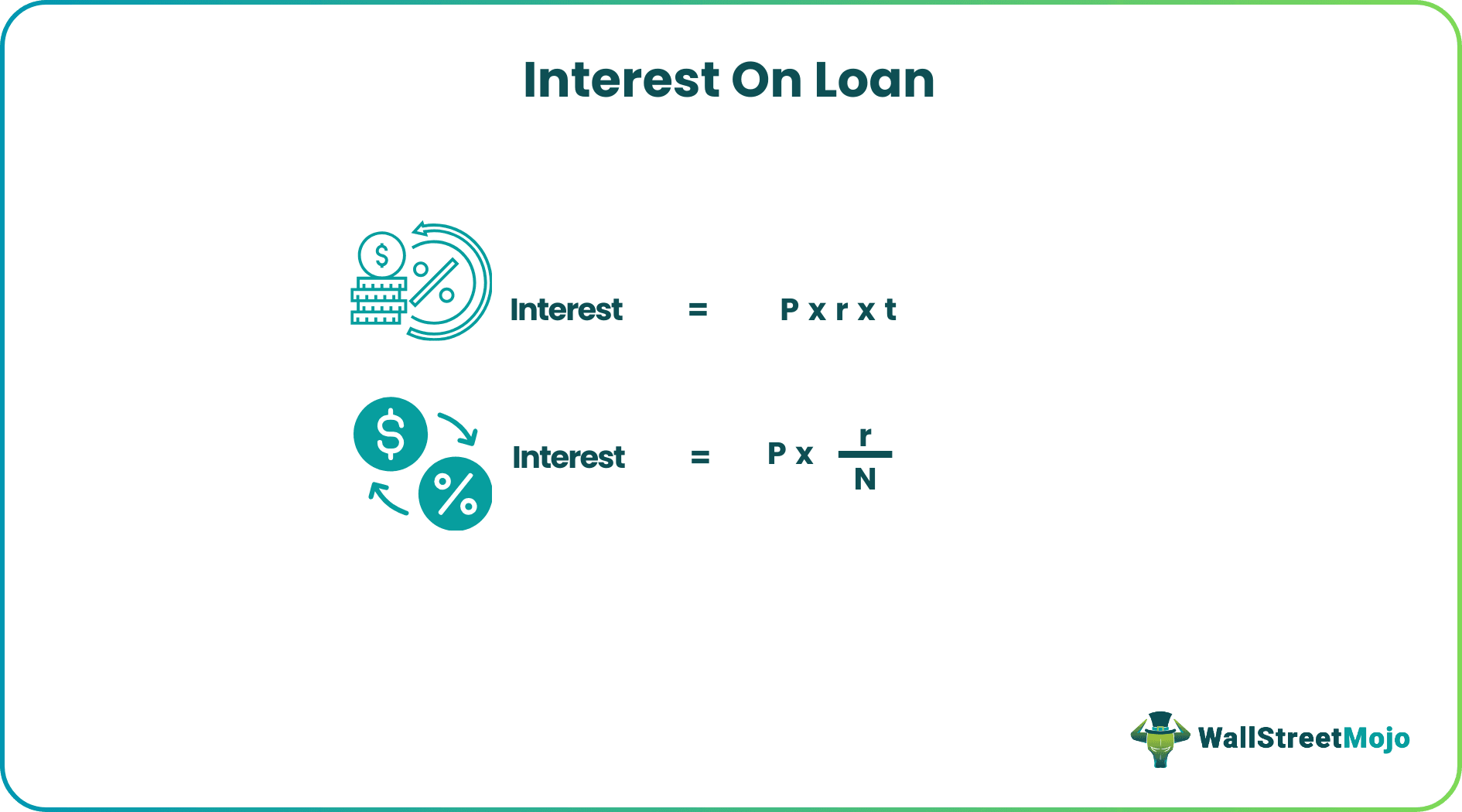
Simple interest is the easiest to calculate and applies primarily to short-term loans or when only the interest on the principal is considered without compounding. The formula is:
Simple Interest = Principal × Rate × Time
Where:
-
Principal (P): The original amount borrowed.
-
Rate (R): The annual interest rate (expressed as a decimal, e.g., 5% = 0.05).
-
Time (T): The loan term in years.
For example, a $10,000 loan at 6% simple interest for 3 years would accrue: $10,000 × 0.06 × 3 = $1,800 in interest. The total repayment would be $11,800.
Compound Interest (and Amortization)
Most consumer loans use compound interest, meaning interest is calculated not only on the initial principal but also on the accumulated interest from previous periods. This is where amortization comes into play. Amortization is the process of gradually paying off a debt over time through a series of regular payments. Each payment consists of both principal and interest.
In the early stages of an amortizing loan, a larger portion of your payment goes towards interest. As the principal balance decreases, a larger portion of subsequent payments goes towards reducing the principal.
Amortization Schedule Explained
An amortization schedule is a table detailing each loan payment, showing how much of each payment is applied to interest and how much to the principal, and the remaining loan balance after each payment. It’s a powerful tool for visualizing the repayment process and understanding how your debt reduces over time.
Key columns in an amortization schedule typically include:
-
Payment Number
-
Beginning Balance
-
Interest Paid
-
Principal Paid
-
Ending Balance
Monthly Payment Formula
The most common calculation needed for a loan is determining the fixed monthly payment. The formula for a fully amortizing loan (where the loan is paid off completely by the end of the term) is:
M = P [ i(1 + i)^n ] / [ (1 + i)^n – 1]
Where:
-
M: Monthly payment
-
P: Principal loan amount
-
i: Monthly interest rate (annual rate divided by 12, expressed as a decimal)
-
n: Total number of payments (loan term in years multiplied by 12)
Let’s say you borrow $100,000 for a mortgage at an annual interest rate of 4.5% over 30 years.
-
P = $100,000
-
i = 0.045 / 12 = 0.00375
-
n = 30 years × 12 months/year = 360 payments

Plugging these values into the formula would yield your monthly payment. (For this example, it would be approximately $506.68).
Step-by-Step Guide to Computing a Loan
While the formulas can seem daunting, the process of computing a loan becomes straightforward once you have the necessary information and choose your method.
Gathering Necessary Information
Before you begin any calculation, ensure you have all the required data points:
-
Principal Amount (P): The exact amount you wish to borrow.
-
Annual Interest Rate: The nominal annual interest rate (or APR if you want to include fees from the start). Convert this to a monthly rate by dividing by 12 and then to a decimal.
-
Loan Term: The total number of years or months over which you plan to repay the loan. If in years, convert to total months for the formula (years × 12).
-
Additional Fees: Be aware of any origination fees, closing costs, or other charges that might increase the true cost of the loan (reflected in the APR).
Manual Calculation Examples
While possible, manual calculations for complex amortizing loans can be tedious and prone to error. They are excellent for understanding the mechanics but rarely used for practical everyday computations. However, practicing simple interest or the first few rows of an amortization schedule manually can solidify your understanding. For instance, calculating the interest portion of the first payment:
- Interest for 1st month = (Principal × Monthly Interest Rate)
Subtract this interest from the total monthly payment to find the principal portion paid. Then, subtract the principal paid from the original principal to get the new outstanding balance. Repeat for the next month.
Utilizing Online Calculators and Spreadsheets
For accuracy and efficiency, online loan calculators or spreadsheet software (like Microsoft Excel or Google Sheets) are highly recommended.
-
Online Loan Calculators: Numerous free online tools are available (from banks, financial websites, etc.) that simply require you to input the principal, interest rate, and term. They instantly provide the monthly payment, total interest paid, and often an amortization schedule.
-
Spreadsheet Software: For those comfortable with spreadsheets, functions like
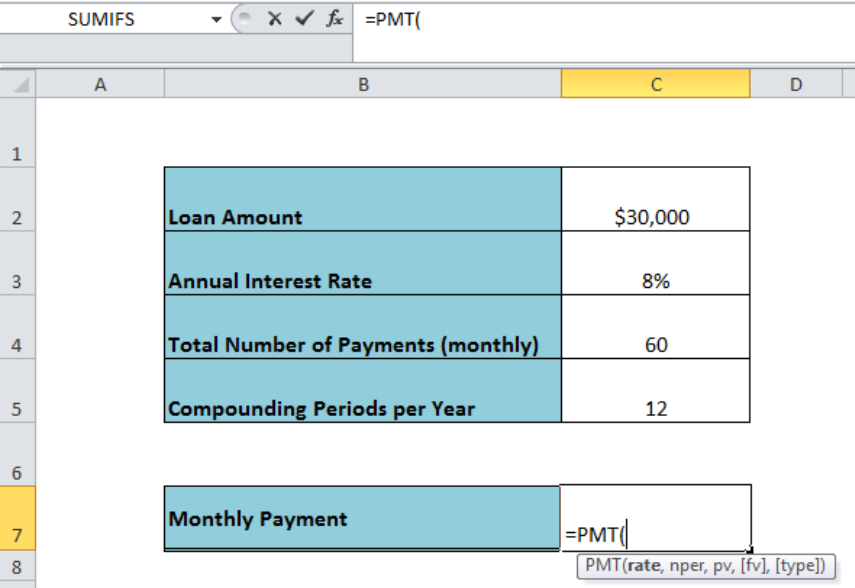
PMT(for monthly payment),IPMT(for interest payment), andPPMT(for principal payment) in Excel/Google Sheets are invaluable. You can create a fully customizable amortization schedule by setting up columns and formulas. This offers the most flexibility for “what-if” scenarios, such as how changing the interest rate or adding extra payments affects the loan.
Beyond the Basics: Important Factors to Consider
Computing the basic monthly payment is just the beginning. A truly comprehensive understanding of a loan requires looking at its broader financial impact.
Total Cost of the Loan
This is perhaps the most critical figure after the monthly payment. The total cost of the loan is the sum of all your monthly payments over the entire loan term. It equals:
Total Cost = (Monthly Payment × Total Number of Payments) + Any Upfront Fees Not Included in Principal
This figure allows you to see the actual dollar amount you will pay beyond the principal. A seemingly small difference in interest rate or term can result in thousands of dollars in total cost variation.
Hidden Fees and Charges
Be vigilant about fees that might not be immediately obvious. These can significantly inflate the true cost of borrowing. Common fees include:
-
Origination Fees: Charged by the lender for processing the loan.
-
Application Fees: For processing your loan application.
-
Late Payment Fees: Penalties for missing payment deadlines.
-
Prepayment Penalties: Some loans charge a fee if you pay off the loan early. Always check for this, especially if you anticipate having extra funds to accelerate repayment.
These fees often increase the APR, which is why comparing APRs is generally more reliable than just nominal interest rates.
Impact of Early Repayment
Paying more than your minimum monthly payment, or making additional lump-sum payments, can dramatically reduce the total interest paid and shorten the loan term. When you pay extra, that additional amount typically goes directly towards reducing the principal balance (assuming no prepayment penalties). A smaller principal balance means less interest accrues in subsequent periods, accelerating the amortization process. Before making extra payments, confirm with your lender that the additional funds will be applied directly to the principal.
Different Loan Types (Fixed vs. Variable)
The type of interest rate can significantly affect your loan computations and financial planning:
-
Fixed-Rate Loans: The interest rate remains constant for the entire loan term. This provides predictable monthly payments and makes future financial planning easier. Most mortgages, car loans, and personal loans are fixed-rate.
-
Variable-Rate Loans (ARM – Adjustable-Rate Mortgage): The interest rate can change over the loan term, usually in response to a benchmark interest rate (like the prime rate). This means your monthly payments can fluctuate. While they might offer lower initial rates, they carry the risk of increased payments if interest rates rise. Computing a variable-rate loan requires anticipating potential rate changes and understanding the cap structures.
Practical Applications and Informed Decision-Making
Mastering loan computation moves beyond academic exercise; it’s a vital tool for making sound financial choices that impact your financial well-being.
Comparing Loan Offers
With the ability to compute loans, you can objectively compare different offers from various lenders. Don’t just look at the monthly payment; analyze the APR, the total cost, and the flexibility of the loan terms. A loan with a slightly higher monthly payment but a significantly lower total interest paid over the term could be the better choice. Creating a simple comparison chart in a spreadsheet can visually highlight the differences between multiple offers.
Budgeting for Loan Payments
Knowing the exact monthly payment allows you to integrate it accurately into your personal or business budget. Overestimating or underestimating this critical expense can lead to financial strain or missed opportunities. Understanding the breakdown of principal and interest within each payment also helps you see how much of your money is going towards growing equity versus simply covering borrowing costs.
Understanding Your Financial Commitment
Ultimately, computing a loan is about understanding the full extent of your financial commitment. It’s not just about borrowing money; it’s about making a promise to repay it, along with the cost of borrowing, over a defined period. This knowledge empowers you to negotiate better terms, plan for future financial goals, and ensure that the loan you take out is truly affordable and serves your best interests, rather than becoming an unexpected burden.
By diligently applying these principles and utilizing the tools available, you transform the complex act of loan computation into a clear, manageable process. This fundamental financial literacy is your strongest defense against unfavorable terms and your greatest asset in building a secure financial future.
aViewFromTheCave is a participant in the Amazon Services LLC Associates Program, an affiliate advertising program designed to provide a means for sites to earn advertising fees by advertising and linking to Amazon.com. Amazon, the Amazon logo, AmazonSupply, and the AmazonSupply logo are trademarks of Amazon.com, Inc. or its affiliates. As an Amazon Associate we earn affiliate commissions from qualifying purchases.