
The Dow Jones Industrial Average (DJIA), often referred to simply as “the Dow,” is arguably the most recognized stock market index in the world. For over a century, it has served as a primary pulse-check for the American economy. While there are thousands of publicly traded companies in the United States, the Dow focuses on a surprisingly small and elite group. To answer the fundamental question: there are exactly 30 companies in the Dow Jones Industrial Average.
These 30 companies are intended to represent the broader health of the U.S. industrial and financial landscape. Despite the relatively small sample size compared to the S&P 500 or the Nasdaq Composite, the Dow remains a critical benchmark for investors, financial analysts, and the general public. Understanding why there are 30 companies, how they are chosen, and how their performance is calculated is essential for any investor looking to navigate the complexities of the modern market.

The Foundation of the Dow Jones Industrial Average
The Dow Jones Industrial Average was created by Charles Dow and his business partner Edward Jones in 1896. At its inception, the index contained only 12 companies, most of which were involved in heavy industry—railroads, cotton, gas, sugar, tobacco, and oil. These were the “smokestack” industries that powered the American Gilded Age.
From 12 to 30: A Century of Expansion
As the American economy grew and diversified, the index needed to evolve to maintain its relevance. The number of components expanded to 20 in 1916 and finally to 30 in 1928. It has remained at 30 companies ever since. This specific number was chosen to provide a broad enough cross-section of the economy to be representative, while remaining small enough to be calculated manually in an era before digital computers.
The Prestige of “Blue-Chip” Status
The 30 companies within the Dow are frequently called “Blue-Chip” stocks. This term, borrowed from poker where blue chips have the highest value, refers to companies that are household names, financially stable, and leaders in their respective industries. Being added to the Dow is considered a mark of supreme corporate achievement, signaling that a company has reached the pinnacle of stability and influence in the global marketplace.
The Selection Process: How the 30 Are Chosen
Unlike many other indices that use a purely quantitative approach based on market capitalization, the Dow Jones Industrial Average is maintained by a selection committee. This committee, overseen by S&P Dow Jones Indices, is responsible for deciding which companies are in and which are out.
Subjective vs. Objective Criteria
There are no rigid rules for a company to be included in the Dow, but there are strong guidelines. To be considered, a company must be incorporated and headquartered in the United States, and a plurality of its revenue should be derived from the U.S. economy. Beyond geography, the committee looks for companies with an excellent reputation, a history of sustained growth, and significant interest among investors.
The goal of the committee is to ensure the index reflects the current state of the U.S. economy. This means that as the economy shifts from manufacturing toward technology and services, the composition of the 30 companies must shift as well. This is why original members like General Electric—once the longest-running component of the Dow—were eventually removed to make room for tech giants and healthcare leaders.
The Recent Evolution of the Components
The Dow is not a static list. In recent years, the committee has been active in swapping companies to better reflect the 21st-century economy. For instance, the removal of Walgreens Boots Alliance in early 2024 to make room for Amazon marked a significant shift, acknowledging the dominance of e-commerce and consumer services over traditional retail pharmacy. Similarly, the inclusion of companies like Nvidia highlights the index’s increasing weight toward artificial intelligence and high-performance computing, replacing older legacy tech firms that no longer lead the vanguard of innovation.
The Price-Weighting Mechanism: A Unique Calculation
One of the most distinctive, and sometimes controversial, aspects of the Dow is how it is calculated. While most modern indices, like the S&P 500, are market-cap weighted (meaning larger companies have a bigger impact), the Dow is price-weighted.
The Impact of Share Price
In a price-weighted index, the price of a single share of stock determines how much influence that company has on the index’s total value. For example, a company with a stock price of $200 will have double the impact on the Dow’s movement as a company with a stock price of $100, regardless of the actual size of the company.
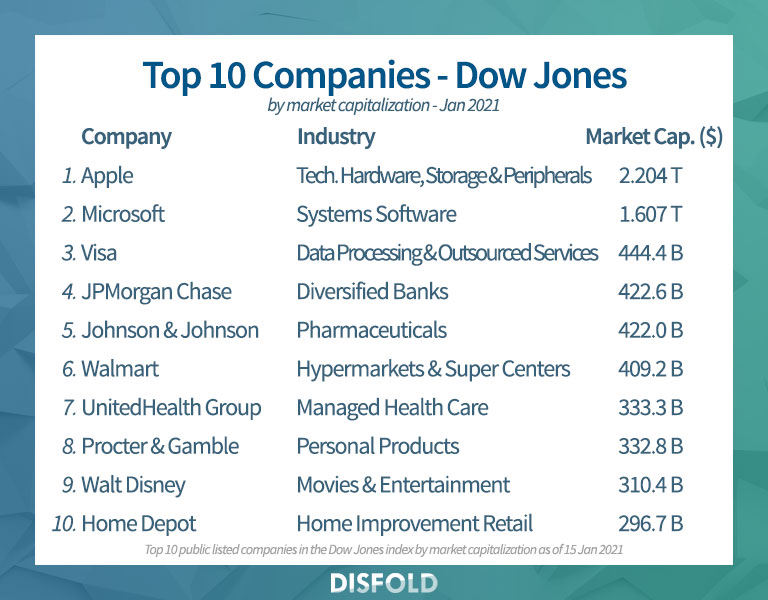
This leads to interesting dynamics. UnitedHealth Group, which often carries one of the highest share prices in the index, has a significantly larger influence on the Dow’s daily fluctuations than a massive company like Apple or Microsoft if their share prices happen to be lower due to stock splits.
The Dow Divisor
Because companies frequently undergo stock splits or issue dividends, the simple average of the 30 stock prices would be misleading over time. To account for this, the index uses the “Dow Divisor.” This is a continuously adjusted numerical value used to divide the sum of all 30 stock prices.
When a company in the Dow splits its stock—for example, a 2-for-1 split—its share price drops by half. Without an adjustment, the Dow would appear to crash. Instead, the Dow Divisor is adjusted downward to ensure that the index value remains the same before and after the split. As of recent years, the divisor is a fraction much smaller than one, which means that a $1 move in any of the 30 stocks actually results in a multi-point move in the overall index.
Analyzing the Current 30 Components and Sector Representation
To understand the “Money” aspect of the Dow, one must look at where these 30 companies sit within the broader economy. Today’s Dow is far less “industrial” than its name suggests.
The Dominance of Technology and Financials
Information technology and financial services represent the largest slices of the Dow’s pie. Companies like Microsoft, Apple, Salesforce, and IBM represent the tech sector, while Goldman Sachs, JPMorgan Chase, and Visa represent the financial backbone. Because the financial sector tends to have higher share prices, it often exerts a disproportionate amount of influence on the index compared to its actual percentage of the U.S. GDP.
Healthcare and Consumer Discretionary
Healthcare is another massive pillar of the Dow, represented by giants like UnitedHealth, Johnson & Johnson, and Amgen. On the consumer side, the index includes “defensive” stocks like Procter & Gamble and Coca-Cola, as well as “discretionary” stocks like Nike, Home Depot, and the recently added Amazon. This mix allows the Dow to track both essential spending and luxury or optional spending, providing a holistic view of the American consumer’s health.
The Decline of Energy and Traditional Industry
In the early 20th century, the Dow was dominated by energy and steel. Today, Chevron is the lone pure-play energy representative, and Honeywell and Caterpillar represent the modern industrial and aerospace sectors. This transition reflects the “de-industrialization” of the American economy in favor of a service- and data-driven marketplace.
The Role of the Dow Jones in Modern Portfolio Strategy
For the individual investor, the fact that there are only 30 companies in the Dow presents both opportunities and limitations. How should one use this information in a personal finance strategy?
The Dow as a Benchmark
Most investors use the Dow as a quick reference to see if the market is “up” or “down” for the day. Because the 30 companies are so large and stable, the Dow tends to be less volatile than the Nasdaq or small-cap indices. If the Dow is rising, it generally indicates that the largest, most profitable American corporations are performing well, which often correlates with high consumer confidence and economic stability.
Investing in the 30 Giants
Investors who want exposure to these 30 companies without buying each stock individually often turn to Exchange-Traded Funds (ETFs). The most famous of these is the SPDR Dow Jones Industrial Average ETF Trust, known by its ticker symbol “DIA” or “Diamonds.” By holding the DIA, an investor gains a diversified stake in the 30 most influential companies in America, benefiting from their dividends and long-term stability.

The Limitations of the “Thirty”
Critics often argue that 30 companies are not enough to represent the modern, multi-trillion-dollar U.S. equity market. They point out that the price-weighting system is an antiquated relic of the 19th century and that the S&P 500 provides a more accurate mathematical representation of market value.
However, for many, the Dow’s simplicity is its strength. By focusing on 30 massive, profitable leaders, the index cuts through the “noise” of thousands of smaller, speculative companies. For a long-term investor focused on “Money” and wealth preservation, the Dow represents the bedrock of corporate America—the companies that have survived depressions, wars, and technological revolutions to remain at the top of the food chain.
In summary, while the number 30 is small, the weight of the companies within the Dow Jones Industrial Average is immense. These 30 entities represent the pinnacle of business strategy, market dominance, and financial resilience. Whether used as a daily economic barometer or a core component of a retirement portfolio, the 30 companies of the Dow remain the definitive list of the giants that move the world’s markets.
aViewFromTheCave is a participant in the Amazon Services LLC Associates Program, an affiliate advertising program designed to provide a means for sites to earn advertising fees by advertising and linking to Amazon.com. Amazon, the Amazon logo, AmazonSupply, and the AmazonSupply logo are trademarks of Amazon.com, Inc. or its affiliates. As an Amazon Associate we earn affiliate commissions from qualifying purchases.