
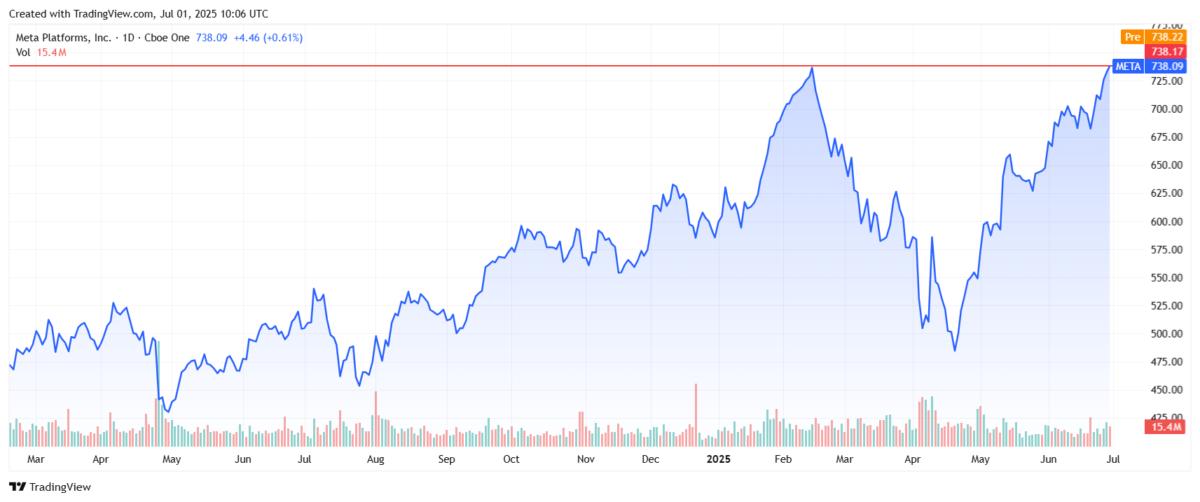
In the volatile landscape of the Nasdaq, few narratives have been as dramatic or as financially rewarding for investors as the resurgence of Meta Platforms, Inc. After a disastrous 2022 that saw the company’s market capitalization plummet by more than 60%, Meta has orchestrated a turnaround that has redefined its standing in the “Magnificent Seven.” The climb from the depths of a $90 share price to record-breaking highs is not merely a product of a broader market rally; it is the result of a calculated, disciplined, and technologically driven transformation. To understand why Meta stock is up, one must analyze the intersection of fiscal discipline, a pivot toward artificial intelligence, and a fundamental shift in how the company returns value to its shareholders.

The “Year of Efficiency” and the Leaner Corporate Structure
The primary catalyst for Meta’s stock recovery was Mark Zuckerberg’s public pivot toward fiscal conservatism. In early 2023, Zuckerberg dubbed the period the “Year of Efficiency,” a signal to Wall Street that the era of unchecked spending on speculative projects was over. This declaration was met with immediate approval from institutional investors who had grown weary of the company’s bloated payroll and the seemingly bottomless pit of Reality Labs spending.
Operational Streamlining and Margin Expansion
Between late 2022 and 2023, Meta executed several rounds of significant layoffs, reducing its workforce by approximately 25%. While these cuts were painful from a human resources perspective, they were viewed by the market as a necessary correction to the over-hiring that occurred during the pandemic. By flattening the organizational structure and removing layers of middle management, Meta significantly lowered its operating expenses.
The financial impact of these moves was reflected almost immediately in the company’s operating margins. As revenue began to stabilize and expenses dropped, Meta’s bottom line expanded. For investors, this signaled that the company could generate higher earnings per share (EPS) even in a moderate-growth environment. The ability to do “more with less” has become a central pillar of the Meta investment thesis, proving that the company can scale its reach without exponentially increasing its costs.
Shifting Away from Speculative Spending
While Meta remains committed to the long-term vision of the metaverse, the company has successfully reframed its narrative around Reality Labs. Previously, investors viewed the billions of dollars flowing into virtual reality as a drain on the core business. However, by prioritizing short-term profitability and demonstrating a path toward balancing metaverse investments with core advertising growth, Meta regained the trust of the financial community. The market is now more willing to tolerate the losses in the Metaverse division because the core Family of Apps—Facebook, Instagram, and WhatsApp—is generating record levels of free cash flow.
The AI Revolution: Driving Ad Performance and User Engagement
If efficiency provided the foundation for the stock’s rise, Artificial Intelligence (AI) provided the fuel. Meta has emerged as a primary beneficiary of the AI boom, but not in the way many originally expected. While other companies focused on standalone chatbots, Meta integrated AI into the very fabric of its advertising engine and content discovery algorithms.
Overcoming the ATT Headwinds with Generative AI
One of the biggest drags on Meta’s stock in 2021 and 2022 was Apple’s App Tracking Transparency (ATT) policy, which severely limited Meta’s ability to track user behavior across apps. This decimated the company’s ad targeting capabilities and cost it billions in lost revenue.
Meta’s response was a massive investment in AI-driven modeling. By using sophisticated machine learning techniques to predict user preferences with less data, Meta effectively “coded its way out” of the Apple problem. Tools like Advantage+ use AI to automate ad creation and placement, delivering significantly higher returns on ad spend (ROAS) for marketers. As advertisers saw better performance, they shifted their budgets back to Meta, driving revenue growth back into the double digits.
Meta’s Open-Source Strategy and the Llama Ecosystem
Beyond advertising, Meta’s release of its Llama (Large Language Model Meta AI) series has positioned it as a central player in the global AI ecosystem. Unlike its competitors who keep their models behind proprietary walls, Meta’s open-source approach has garnered favor with developers and tech enthusiasts alike. From an investor’s perspective, this strategy is brilliant: it allows Meta to set the industry standard for AI development, benefiting from the collective innovation of the global developer community while ensuring its own platforms remain at the cutting edge. This technological leadership has resulted in a “valuation rerating,” where the market now prizes Meta as an AI powerhouse rather than just a social media conglomerate.
Monetizing the Future: Reels, Messaging, and Emerging Revenue Streams
A core reason for Meta’s stock appreciation is the successful monetization of its newer features. For years, investors were concerned that Instagram Reels—the company’s answer to TikTok—was cannibalizing the more profitable Feed and Stories formats. Recent earnings reports have put those fears to rest.
The Growth of Instagram Reels and Vertical Video
Meta has successfully bridged the monetization gap for Reels. Engagement on the platform is at an all-time high, driven by an AI-powered recommendation engine that keeps users scrolling longer. As the ad load on Reels has increased and the pricing has improved, what was once a “revenue drag” has become a “revenue tailwind.” This transition is a textbook example of Meta’s ability to copy a competitor’s successful format and monetize it at a global scale through its superior ad infrastructure.
Click-to-Message and the Business Messaging Opportunity
Often overlooked in the broader Meta narrative is the silent growth of WhatsApp and Messenger as business tools. Meta has seen explosive growth in “Click-to-Message” ads, where a user clicks an ad on Facebook or Instagram and starts a direct conversation with a business on WhatsApp. This creates a high-intent, high-conversion channel that is extremely valuable to small and medium-sized businesses. As Meta continues to roll out payment features within WhatsApp, particularly in markets like India and Brazil, investors are beginning to price in the massive, untapped potential of business messaging as a significant third pillar of revenue.
Shareholder Value and Capital Allocation: Dividends and Buybacks
Perhaps the most surprising catalyst for Meta’s stock price in recent months has been its shift in capital allocation strategy. In early 2024, Meta did something that few expected from a high-growth tech giant: it initiated its first-ever quarterly dividend.
The Inaugural Dividend: A Signal of Maturity
The introduction of a $0.50 per share dividend was a watershed moment for the stock. In the world of finance, a dividend is a signal of corporate maturity and financial health. It tells the market that the company is generating more cash than it can reasonably reinvest in the business and is committed to sharing that wealth with its owners. This move opened the door for a new class of investors—income-oriented funds and institutional “value” buyers—who previously could not or would not hold a non-dividend-paying tech stock.
Aggressive Share Repurchase Programs
In addition to the dividend, Meta has continued to buy back its own shares at an aggressive pace. By authorizing tens of billions of dollars in share repurchases, the company is effectively reducing the total supply of shares available. For investors, this means that their individual “slice of the pie” becomes more valuable over time. This consistent demand for its own stock provides a floor for the share price and demonstrates management’s confidence that the stock is still undervalued relative to its future earnings potential.
Valuation and the Outlook for Investors
Despite the massive run-up in the stock price, many analysts argue that Meta is not overvalued compared to its peers. When looking at the Forward Price-to-Earnings (P/E) ratio, Meta often trades at a discount to other tech giants like Microsoft, Apple, or Nvidia, despite having similar or even superior growth profiles.
Comparative Analysis and Sector Positioning
Meta’s current valuation is supported by its massive free cash flow and a dominant market position. Unlike many other tech companies that rely on high-interest debt or venture capital, Meta is self-funding its AI and metaverse ambitions through its highly profitable advertising business. In an environment where interest rates remain a concern, companies with clean balance sheets and strong cash generation are highly prized by the market.
The Long-Term Bull Case
The “bull case” for Meta remains simple: the company owns the most valuable attention-capture machines in the world. With over 3.9 billion monthly active people across its Family of Apps, Meta has a reach that no other platform can match. As it continues to refine its AI capabilities and explore new ways to monetize that attention—whether through premium AI features, hardware like the Ray-Ban Meta glasses, or enterprise software—the growth runway remains long.
In conclusion, Meta stock is up because the company has successfully transitioned from a period of existential crisis to a period of operational excellence. By cutting the fat, mastering AI, and adopting a shareholder-friendly financial policy, Meta has transformed itself into a leaner, smarter, and more profitable version of its former self. For the modern investor, Meta represents a unique combination of a “legacy” cash-flow machine and a high-growth AI disruptor, a duality that the market is currently rewarding with all-time high valuations.
aViewFromTheCave is a participant in the Amazon Services LLC Associates Program, an affiliate advertising program designed to provide a means for sites to earn advertising fees by advertising and linking to Amazon.com. Amazon, the Amazon logo, AmazonSupply, and the AmazonSupply logo are trademarks of Amazon.com, Inc. or its affiliates. As an Amazon Associate we earn affiliate commissions from qualifying purchases.