
The history of computing has been defined by the relentless miniaturization of the transistor. For decades, Moore’s Law held steady, doubling the density of components on integrated circuits every two years. However, as we approach the atomic scale, the classical physics that govern our laptops and smartphones begin to break down, replaced by the counterintuitive rules of quantum mechanics. In this transitional era of high-performance computing, IonQ has emerged as a pivotal force.
IonQ is a leading quantum hardware and software company that specializes in trapped-ion quantum computing. Unlike classical computers that process information in bits (0s and 1s), IonQ’s systems utilize qubits, which can exist in multiple states simultaneously through superposition. While several architectural approaches to quantum computing exist—ranging from superconducting loops to topological qubits—IonQ’s reliance on nature’s most stable building blocks, individual atoms, positions it as a unique and formidable player in the race for “quantum advantage.”

The Core Technology: Why Trapped Ions Matter
To understand what IonQ is, one must first understand the “trapped ion” approach. Most quantum computers require environments colder than deep space to function, utilizing artificial structures like superconducting circuits to mimic the behavior of atoms. IonQ takes a different route by using actual atoms—specifically Ytterbium or Barium—as their qubits.
The Science of Atomic Qubits
In IonQ’s architecture, individual atoms are stripped of an electron to become positively charged ions. These ions are then suspended in a vacuum chamber using electromagnetic fields, a process known as “trapping.” Because every Ytterbium atom is identical to every other Ytterbium atom in the universe, the qubits are perfectly uniform by nature. This eliminates the “manufacturing variability” that plagues superconducting systems, where no two fabricated circuits are ever truly identical.
These trapped ions are manipulated using high-precision lasers. By hitting an ion with a specific frequency of light, engineers can change its internal electronic state, effectively performing logic gates. Because the ions are suspended in a vacuum and isolated from the environment, they maintain their quantum state (coherence) for significantly longer periods than many competing technologies.
Precision Control via Laser Engineering
The “hardware” of an IonQ system is essentially a sophisticated optical laboratory condensed into a deployable rack. Instead of traditional wires and traces, the “interconnects” are laser beams. This allows for a level of flexibility that is impossible in fixed-circuit architectures. In a trapped ion system, any qubit can be made to interact with any other qubit in the chain. This “all-to-all connectivity” is a critical technical advantage; it reduces the overhead required to run complex algorithms, as information does not need to be “swapped” across a physical grid to reach its destination.
Navigating the Quantum Hardware Landscape
The tech industry is currently a battlefield of competing quantum modalities. To appreciate IonQ’s position, it is necessary to compare its trapped-ion method against the more widely publicized superconducting approach favored by giants like IBM and Google.
Trapped Ions vs. Superconducting Circuits
Superconducting quantum computers rely on macroscopic circuits cooled to millikelvin temperatures. While these systems can perform operations very quickly, they suffer from high error rates and short coherence times. Furthermore, scaling them requires massive dilution refrigerators and complex wiring for every additional qubit.
IonQ’s trapped ions, by contrast, offer much higher fidelity. The error rates are lower because the qubits are natural atoms rather than man-made structures. While the “gate speed” (how fast an operation is performed) is slower than superconducting systems, the superior coherence and connectivity often mean that IonQ systems can complete a complex calculation more accurately and with fewer total qubits. Moreover, IonQ has made significant strides in miniaturizing their traps, moving from large laboratory setups to “IonQ Forte,” a system that fits into standard data center environments.
The Advantage of All-to-All Connectivity
In a classical computer, data moves through a fixed architecture of gates. In many quantum systems, a qubit can only “talk” to its immediate neighbors. If Qubit A needs to interact with Qubit Z, the system must perform a series of “SWAP” gates to move the data across the chip. Each swap introduces a potential for error.
IonQ’s architecture avoids this. Because the ions are trapped in a single chain and manipulated by a programmable laser array, the system can pair any two ions regardless of their position in the trap. From a software developer’s perspective, this makes the hardware much more efficient, allowing for deeper circuits and more complex logic without the exponential accumulation of noise.

IonQ’s Software Ecosystem and Cloud Integration
Hardware is only half of the equation. For quantum computing to be useful, it must be accessible to developers who may not have a PhD in atomic physics. IonQ has focused heavily on the “Quantum-as-a-Service” (QaaS) model, ensuring their hardware is integrated into the tools that tech professionals already use.
Quantum-as-a-Service (QaaS)
IonQ was the first company to have its quantum hardware available on all three major public clouds: Amazon Braket, Microsoft Azure Quantum, and Google Cloud Marketplace. This accessibility is a cornerstone of their business strategy. It allows tech teams to experiment with quantum algorithms using familiar API calls and cloud environments.
By abstracting the complexity of the laser-ion interaction, IonQ allows developers to write code in high-level languages like Qiskit, Cirq, or PennyLane. The IonQ compiler then takes that high-level code and translates it into the specific laser pulses required to execute the gates on the hardware.
Algorithmic Qubits (AQ): A New Standard for Performance
The tech world has long been obsessed with “qubit counts.” However, IonQ has pushed for a more nuanced metric called Algorithmic Qubits (AQ). The company argues that simply having 100 qubits is meaningless if the error rate is so high that you can only perform two operations before the system crashes.
AQ is a benchmark that measures how many “useful” qubits a system has—meaning qubits that are high-fidelity enough to execute a circuit of a certain depth. As of the current roadmap, IonQ is scaling its AQ count aggressively, aiming for “AQ 64” and beyond, which the company believes will be the threshold where quantum computers begin to outperform classical supercomputers in specific, high-value tasks.
The Real-World Impact: From Material Science to Artificial Intelligence
While we are still in the NISQ (Noisy Intermediate-Scale Quantum) era, IonQ is already being used to solve problems that are computationally expensive for classical hardware. The “Tech” niche of quantum computing isn’t just about faster speeds; it’s about solving different types of math entirely.
Accelerating Machine Learning with Quantum Circuits
One of the most promising intersections is Quantum Machine Learning (QML). IonQ’s systems are being used to explore “Quantum Neural Networks.” These models can potentially recognize patterns in data that are too complex for classical neural networks to discern. Because quantum systems can represent high-dimensional probability distributions more naturally than classical bits, IonQ’s hardware is being tested for tasks like image recognition, fraud detection, and generative modeling.
Optimization and Supply Chain Revolution
Optimization is perhaps the most immediate application for IonQ’s technology. Problems like the “Traveling Salesperson Problem” or complex logistics routing grow exponentially difficult as more variables are added. Classical computers struggle with these “NP-hard” problems. IonQ’s ability to explore many paths simultaneously through superposition makes it an ideal tool for logistics companies looking to optimize delivery routes or for financial institutions aiming to balance risk in a multi-billion dollar portfolio in real-time.
Molecular Simulation and Material Science
The simulation of molecules is inherently a quantum problem. Classical computers use approximations to simulate chemical reactions because the interactions between electrons are too complex to map bit-for-bit. IonQ’s trapped ions are themselves quantum objects, making them perfect simulators for other quantum systems. This has massive implications for the tech industry, particularly in developing better battery chemistries for EVs, new superconductors, or more efficient catalysts for carbon capture.
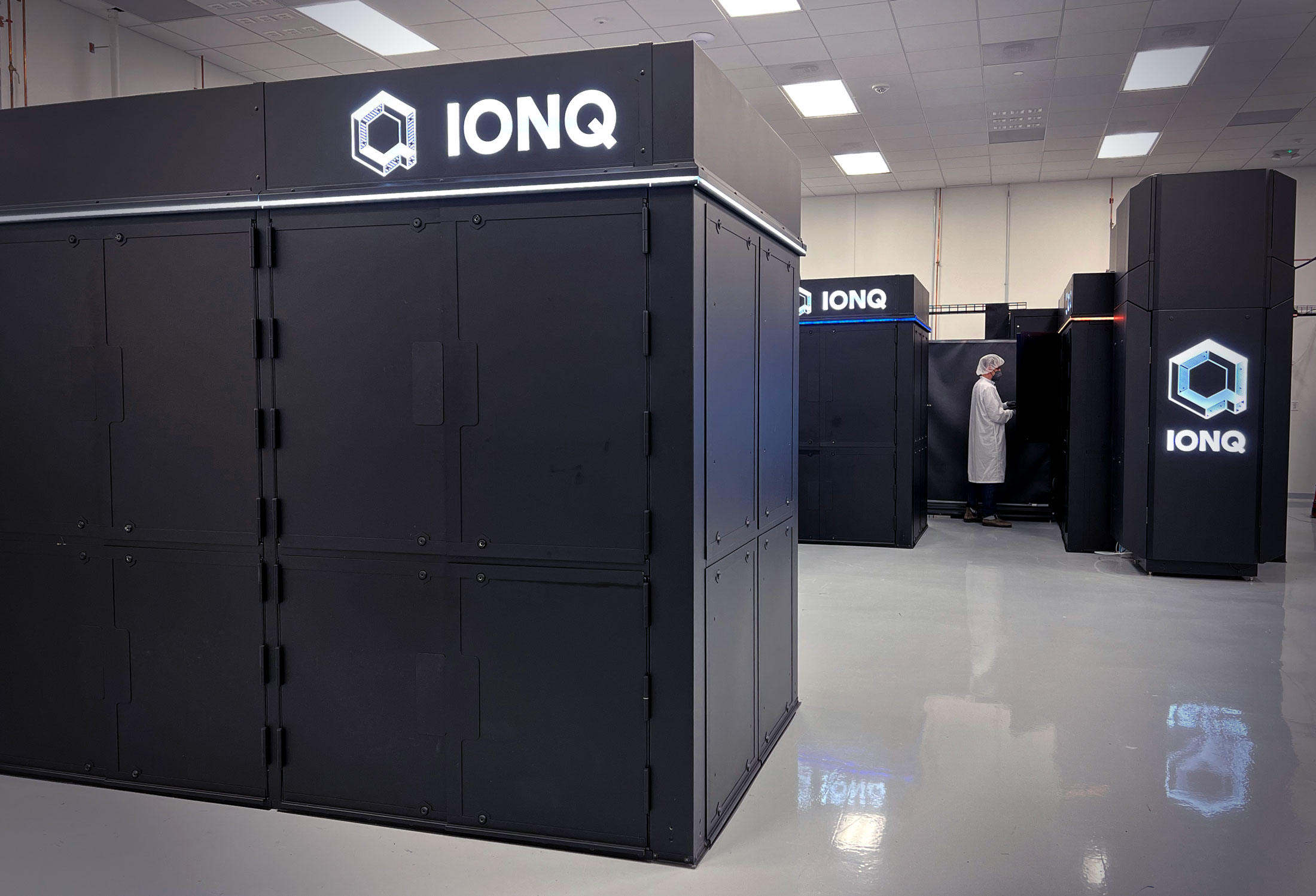
The Future Roadmap: Scaling Toward Quantum Advantage
IonQ’s roadmap is focused on two primary pillars: miniaturization and error correction. The company is transitioning from the “IonQ Aria” generation to “IonQ Forte,” which utilizes acousto-optic deflectors to steer laser beams with even greater precision.
Beyond 2025, IonQ aims to move toward “Barium” qubits, which offer even better properties for scaling than Ytterbium. They are also developing photonic interconnects—essentially using light to link multiple quantum chips together. This “modular” approach is the key to reaching hundreds, and eventually thousands, of Algorithmic Qubits.
For the technology sector, IonQ represents the shift from “Can we build it?” to “What can we do with it?” As the hardware continues to stabilize and the AQ counts rise, IonQ is positioning itself not just as a hardware manufacturer, but as the foundational layer for the next century of digital innovation. The era of quantum utility is approaching, and IonQ’s trapped ions are at the very center of that transition, turning the most fundamental units of matter into the world’s most powerful computational tools.
aViewFromTheCave is a participant in the Amazon Services LLC Associates Program, an affiliate advertising program designed to provide a means for sites to earn advertising fees by advertising and linking to Amazon.com. Amazon, the Amazon logo, AmazonSupply, and the AmazonSupply logo are trademarks of Amazon.com, Inc. or its affiliates. As an Amazon Associate we earn affiliate commissions from qualifying purchases.