
Since its initial public offering in 2004, Google—now organized under the parent company Alphabet Inc.—has become a cornerstone of the modern investment portfolio. As the company grew from a dominant search engine into a global conglomerate spanning cloud computing, autonomous driving, and artificial intelligence, its share price followed a similar meteoric trajectory. For many retail investors, a soaring share price can become a barrier to entry, often prompting corporate boards to execute stock splits.
To date, Alphabet (Google) has undergone three significant stock split events. While the total number of splits is relatively low compared to other tech giants that have been public for decades, the nature and scale of these splits have had profound implications for the company’s capital structure and accessibility. Understanding the history of these splits is essential for any investor looking to analyze historical price data, adjust cost bases, or understand the management’s philosophy regarding shareholder equity.

The History of Alphabet (Google) Stock Splits
The timeline of Google’s stock splits is unique because it involves not just the division of shares, but the creation of entirely new share classes designed to preserve the voting power of the company’s founders, Larry Page and Sergey Brin.
The 2014 Split and the Birth of Class C Shares
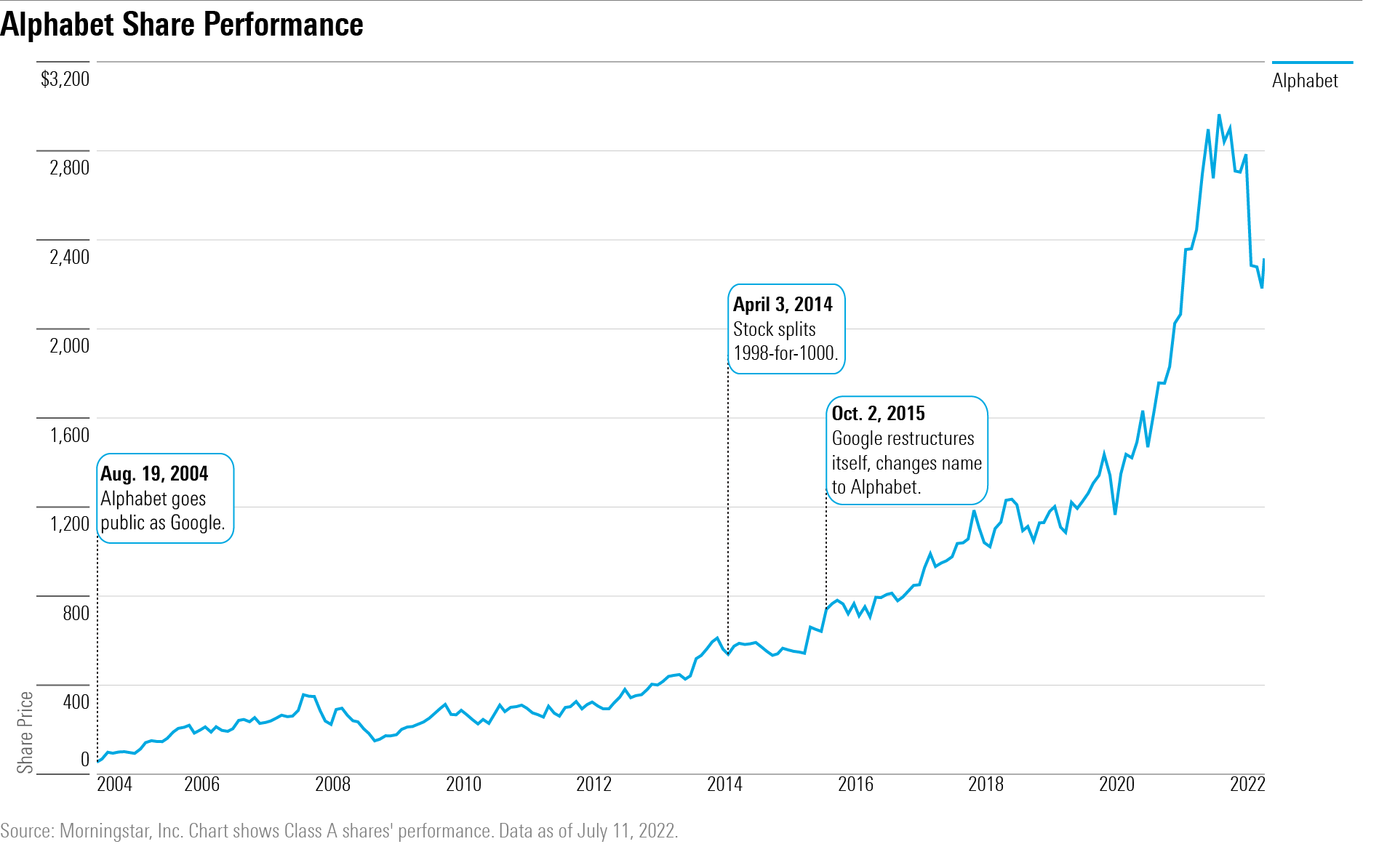
The first major event occurred on April 3, 2014. This was not a traditional 2-for-1 split in the simplest sense. Instead, Google distributed a stock dividend of one share of Class C capital stock (trading under the ticker GOOG) for each share of Class A common stock (trading under the ticker GOOGL) held by investors.
This effectively functioned as a 2-for-1 split, doubling the number of shares held by investors and halving the price per share. However, the critical financial distinction was that Class A shares carried one vote per share, while the new Class C shares carried no voting rights. This move was a strategic financial maneuver to allow the company to issue stock for employee compensation and acquisitions without diluting the voting control of the founders, who hold Class B shares (which carry ten votes per share and are not publicly traded).
The 2015 “Adjustment” Split
Shortly after the major 2014 split, a secondary, minor adjustment occurred on April 27, 2015. This was a result of a class-action settlement related to the 2014 creation of the non-voting Class C shares. To compensate Class C shareholders for the potential price discrepancy between voting and non-voting shares, the company issued a small fractional stock dividend. While often omitted from simplified lists of stock splits, it is a crucial detail for forensic accounting and precise cost-basis calculations for long-term holders.
The 2022 Mega Split: 20-for-1
The most significant event in the company’s financial history regarding share count occurred on July 15, 2022. Alphabet announced a 20-for-1 stock split for all three classes of its shares. At the time of the announcement, Alphabet shares were trading near $2,800. Following the split, the share price was adjusted to approximately $140.
This massive split was designed to make the stock significantly more accessible to retail investors who might have been intimidated by a four-digit share price. Furthermore, it positioned Alphabet for potential inclusion in price-weighted indices, such as the Dow Jones Industrial Average, which generally excludes stocks with excessively high nominal prices.
Understanding the Mechanics: Why Companies Like Alphabet Split Their Stock
From a purely fundamental perspective, a stock split is a “cosmetic” change. It is often compared to cutting a single pizza into sixteen slices instead of eight; you have more pieces, but the total amount of pizza remains identical. In financial terms, the company’s market capitalization remains unchanged, but the price per share decreases while the number of shares outstanding increases proportionally.
Accessibility for Retail Investors
In the era of high-frequency trading and digital brokerages, a $3,000 share price can be a psychological and practical barrier. Even though many modern brokerages offer fractional shares, many retail investors still prefer to own “whole” shares. By bringing the price down to a more manageable double or triple-digit figure, Alphabet increased the “unit” liquidity of its stock, making it easier for a broader base of investors to participate in the company’s growth.
Liquidity and Market Perception
Stock splits are often viewed as a signal of corporate confidence. A board of directors typically authorizes a split when they believe the share price has reached a high level due to sustained growth and that the upward trajectory is likely to continue. While the split itself doesn’t create value, the market often reacts positively to the announcement, interpreting it as a “bullish” sign. This increased demand can lead to short-term price appreciation leading up to the split date.
Inclusion in Price-Weighted Indices
The Dow Jones Industrial Average (DJIA) is a price-weighted index, meaning companies with higher share prices have a greater influence on the index’s movement. Because of this, the DJIA committee is hesitant to include stocks with exceptionally high nominal prices, as a single stock could disproportionately sway the entire index. By executing a 20-for-1 split, Alphabet effectively lowered its “price” to a range that made it a viable candidate for the Dow, further increasing its prestige and the amount of institutional capital required to track the index.
The Impact of Stock Splits on Shareholder Value and Portfolio Strategy
For the individual investor, a stock split requires a shift in how they view their position and their future strategy. While the total value of the investment doesn’t change on the day of the split, the subsequent market dynamics can offer both opportunities and challenges.
The Psychological Rally vs. Fundamental Reality
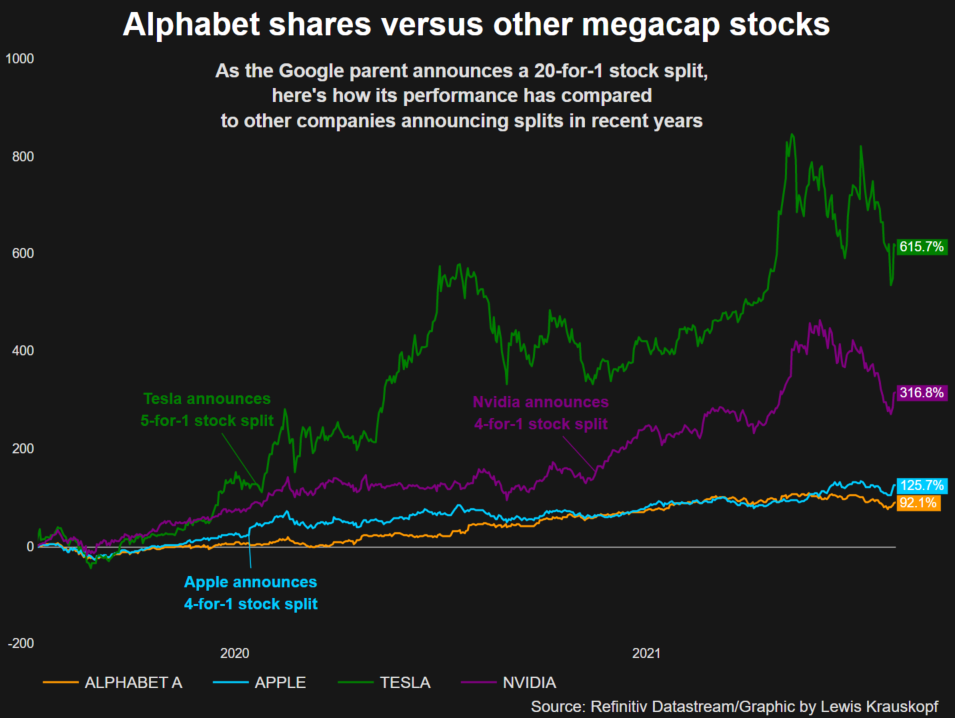
Data suggests that companies often outperform the broader market in the twelve months following a stock split announcement. This is rarely because of the split itself, but rather because companies that split their stock are usually those experiencing strong earnings growth and market leadership. Investors should be careful not to view a split as a “buy signal” in isolation; instead, it should be seen as a confirmation of the company’s historical success and management’s optimism.
Tax Implications and Cost Basis Adjustments
One of the most practical aspects of managing a stock split is the adjustment of the cost basis. For tax purposes, the total amount of capital invested remains the same, but it is now spread across a larger number of shares.
For example, if an investor bought one share of Alphabet at $2,000 before the 2022 split, their cost basis was $2,000 per share. After the 20-for-1 split, they owned 20 shares with a cost basis of $100 per share. It is vital for investors to keep accurate records of these adjustments to ensure they do not overpay on capital gains taxes when they eventually sell their positions. Most modern brokerages automate this process, but manual verification is always recommended for high-net-worth portfolios.
Options Trading and Fractional Shares
Stock splits have a massive impact on the options market. Standardized options contracts represent 100 shares of the underlying stock. Before the 2022 split, a single call option on Alphabet would have required the trader to control $280,000 worth of stock, making the premiums prohibitively expensive for many. Post-split, a 100-share contract represented roughly $14,000 worth of stock. This increased the liquidity of the options market for Alphabet, allowing more investors to use hedging strategies, such as covered calls or protective puts, to manage their risk.
Analyzing Alphabet’s Performance Post-Split: A Financial Perspective
Looking at Alphabet’s trajectory since its most recent split reveals the intersection of market sentiment and macroeconomic reality. The 2022 split occurred during a period of high inflation and rising interest rates, which initially suppressed the valuation of growth-oriented tech stocks.
Historical Price Action Following Splits
Historically, Alphabet has shown resilience. Following the 2014 split, the company continued to dominate the advertising market, and its share price eventually recovered to and surpassed its pre-split highs. The 2022 split was followed by a period of volatility, but as the company pivoted toward “AI-first” initiatives, the lowered share price provided a base for a new wave of institutional and retail accumulation.
Long-term Growth Prospects vs. Short-term Volatility
For a long-term investor, the number of splits is less important than the underlying business metrics: Price-to-Earnings (P/E) ratios, Free Cash Flow (FCF), and Revenue growth. Alphabet’s decision to split its stock does not change its competitive advantage in search, its growing share in the cloud market, or its massive investments in DeepMind. Investors should use the post-split environment to reassess their position sizes and determine if the lower nominal price allows for a more effective dollar-cost averaging (DCA) strategy.
Conclusion: Navigating Alphabet as a Long-Term Investment
The history of Google’s stock splits—from the complex creation of Class C shares in 2014 to the massive 20-for-1 split in 2022—reflects a company that has matured from a high-growth startup into a dominant global institution. For the investor, these splits are significant milestones that represent the company’s evolution and its desire to remain accessible to the broader investing public.
While the “split” itself is a neutral event for a portfolio’s value, the context surrounding it is invaluable. It signals management’s confidence and increases the stock’s utility in the options market and within major indices. As Alphabet continues to lead the charge in the artificial intelligence revolution, its stock split history serves as a reminder of how far the company has come—and how it continues to manage its relationship with its diverse base of shareholders. Whether you are holding GOOGL for the voting rights or GOOG for the pure equity exposure, understanding these three pivotal moments in the company’s financial history is essential for navigating the future of one of the world’s most valuable enterprises.
aViewFromTheCave is a participant in the Amazon Services LLC Associates Program, an affiliate advertising program designed to provide a means for sites to earn advertising fees by advertising and linking to Amazon.com. Amazon, the Amazon logo, AmazonSupply, and the AmazonSupply logo are trademarks of Amazon.com, Inc. or its affiliates. As an Amazon Associate we earn affiliate commissions from qualifying purchases.