
In the realm of personal finance, travel is often categorized as one of the most significant discretionary expenses a household can incur. However, viewing airfare not merely as a cost, but as a market-driven commodity allows for strategic acquisition. Understanding when flights are the cheapest requires a deep dive into the economics of dynamic pricing, market volatility, and financial optimization. For the savvy individual who manages their travel budget with the same rigor as an investment portfolio, timing the market is the difference between a high-cost liability and a high-value experience.

The Anatomy of Dynamic Pricing: Why Flight Costs Fluctuate
To master the art of finding the cheapest flights, one must first understand the underlying financial mechanisms used by the aviation industry. Airlines employ sophisticated yield management systems—algorithmic engines that adjust prices in real-time based on supply, demand, and consumer behavior. This is not a static environment; it is a live market that functions similarly to a high-frequency trading floor.
Supply and Demand in the Aviation Sector
The fundamental driver of flight pricing is the balance between seat inventory (supply) and passenger interest (demand). Airlines aim to reach “break-even” on a flight as early as possible and then maximize profit on the remaining seats. This is why prices fluctuate wildly as the departure date approaches. When demand is low, prices are slashed to ensure the aircraft does not fly with empty seats—a “wasted asset.” Conversely, when demand spikes, such as during major holidays or global events, the price increases exponentially to capture the maximum willingness to pay from late-booking corporate travelers or desperate holiday-goers.
The Role of Booking Windows in Capital Preservation
Financial experts often refer to the “Goldilocks window” for booking. Research into historical pricing data suggests that for domestic flights, the prime window for capital preservation is typically between one and three months before departure. For international routes, the timeline extends to between two and eight months. Booking too early can lead to paying a premium based on projected demand that may never materialize, while booking too late subjects the buyer to the “panic pricing” targeted at business travelers with inflexible schedules and deep corporate pockets.
Strategic Timing: Maximizing ROI on Your Travel Spend
When we ask “when is flights the cheapest,” we are looking for the intersection of historical data and behavioral patterns. Maximizing the return on investment (ROI) for your travel spend requires identifying the specific days and months where market participants are least active.
The Tuesday Myth vs. Mid-Week Reality
There is a long-standing myth in the personal finance world that booking a flight at 3:00 AM on a Tuesday is the secret to low prices. While there was once a shred of truth to this—due to how airlines manually updated their databases—modern AI-driven pricing has rendered this specific “hack” obsolete.
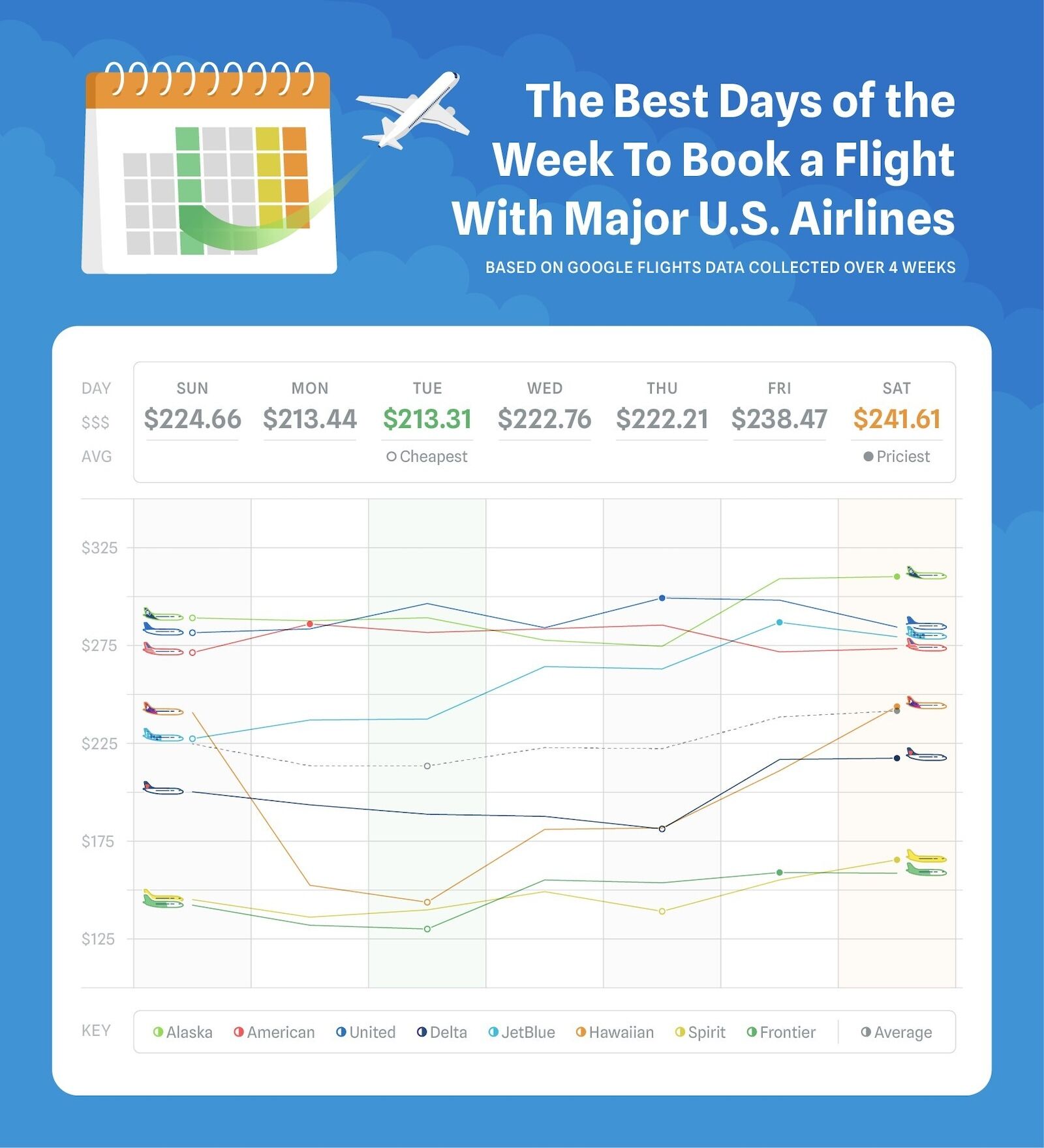
However, the day you fly remains a critical financial variable. Mid-week travel (Tuesdays and Wednesdays) is consistently cheaper than weekend travel. From a financial perspective, weekends are high-demand periods for leisure travelers, while Mondays and Fridays are dominated by high-revenue corporate accounts. By shifting your travel schedule to the middle of the week, you are effectively “buying” during a market dip, often saving 20% to 40% on the total fare.
Seasonal Volatility and the Shoulder Season Advantage
Seasonality acts as a macro-economic force on airfare. The peak summer months and the December holiday season represent periods of extreme market volatility and inflated prices. For the financially disciplined traveler, the “shoulder seasons”—typically April to May and September to October—offer the best value. During these windows, the demand for travel drops significantly, but the “utility” of the travel (weather, availability of services) remains high. Investing in travel during the shoulder season allows you to enjoy premium destinations at a fraction of the cost, preserving your capital for other financial goals.
Leveraging Financial Technology for Predictive Booking
In the digital age, individual investors have access to tools that were once reserved for institutional travel agencies. Using financial technology (FinTech) to track, forecast, and automate your flight purchases is essential for anyone looking to optimize their personal balance sheet.
Algorithmic Price Tracking and Forecasting Tools

Platforms such as Google Flights, Hopper, and Kayak utilize massive datasets to provide “price predictors.” These tools analyze years of historical pricing on specific routes to advise whether you should “Buy Now” or “Wait.” Using these tools is akin to setting a limit order in the stock market. By setting price alerts, you remove the emotional component of the purchase and wait for the market to hit your target entry price. This systematic approach ensures that you are never buying at the peak of a price surge.
Credit Card Ecosystems and Point Valuation
The modern financial landscape offers another layer of savings through credit card rewards and loyalty programs. When calculating the “cost” of a flight, one must consider the effective net cost after accounting for points earned or redeemed.
Travel-specific credit cards (such as those from Chase, American Express, or Capital One) often provide a 1.5x to 2x valuation on points when redeemed through their proprietary portals. Furthermore, “transfer partners” allow you to move points to airline loyalty programs, where the value of a single point can sometimes exceed 2.0 cents. For a high-net-worth individual or a disciplined saver, using points to cover the “cash” cost of a flight is a strategic move that keeps liquidity in your high-yield savings accounts while still allowing for luxury travel.
Advanced Cost-Reduction Tactics for the Financial-Minded Traveler
Beyond simple timing, there are several advanced strategies that require a deeper understanding of airline hub-and-spoke models and international currency markets.
The Hidden City Ticketing Strategy
Known in the industry as “skiplagging,” this involves booking a flight with a layover in your actual destination and simply not taking the second leg of the trip. Often, a flight from New York to Los Angeles with a layover in San Francisco is cheaper than a direct flight from New York to San Francisco. While this requires careful management (traveling with carry-on only and understanding the potential risks to loyalty accounts), it is a clear example of using market inefficiencies to one’s financial advantage.
Currency Arbitrage and Regional Pricing
Airlines often price their tickets differently depending on the “point of sale” or the currency used for the transaction. By using a VPN to appear as though you are booking from a country with a weaker currency, or by paying in the local currency of the airline’s home country, you can sometimes find significant discrepancies in price. This is a form of currency arbitrage. For example, booking a domestic flight within a foreign country using that country’s local version of a travel site often yields a lower price than booking through a US-based aggregator.
Integrating Travel Costs into Your Personal Wealth Strategy
Finding the cheapest flight is not just about the transaction itself; it is about how that transaction fits into your overall financial health. Managing travel expenses should be an integral part of your long-term budgeting and wealth-building strategy.
Sinking Funds and Automated Travel Savings
To avoid the “financial shock” of a high-priced flight, many financial planners recommend the use of a “sinking fund.” This is a dedicated savings account—ideally a High-Yield Savings Account (HYSA)—where you deposit a fixed amount every month specifically for travel. By automating this process, you treat your travel goals as a monthly bill rather than a sporadic, stressful expense. When the “Goldilocks window” for a cheap flight opens, you already have the capital ready to deploy, allowing you to act quickly before the market corrects upward.
Balancing Comfort and Capital Retention
Finally, it is important to consider the concept of “value” over just “price.” A $400 flight with two 10-hour layovers may be the “cheapest” option, but the opportunity cost of your time and the additional expenses incurred during those layovers (food, hotels, lost productivity) may make it more expensive in the long run than a $600 direct flight.
A professional financial approach to travel involves calculating the “Total Cost of Ownership” (TCO) for a flight. This includes baggage fees, seat selection, transportation to and from the airport, and the value of your own time. Sometimes, paying a slightly higher price for a more efficient route provides a better overall return on your lifestyle and your sanity.
By applying these financial principles—understanding market dynamics, leveraging technology, and maintaining a disciplined budget—the question of “when is flights the cheapest” becomes less of a guessing game and more of a calculated financial decision. In the end, the goal is to see the world without compromising your path toward financial independence.
aViewFromTheCave is a participant in the Amazon Services LLC Associates Program, an affiliate advertising program designed to provide a means for sites to earn advertising fees by advertising and linking to Amazon.com. Amazon, the Amazon logo, AmazonSupply, and the AmazonSupply logo are trademarks of Amazon.com, Inc. or its affiliates. As an Amazon Associate we earn affiliate commissions from qualifying purchases.