
In the complex machinery of the global economy, banks serve as the primary engines of liquidity, credit, and stability. When we ask, “What are the world’s largest banks?” the answer reveals more than just a list of names; it provides a snapshot of geopolitical power, economic shifts, and the sheer scale of modern capital. For investors, business leaders, and personal finance enthusiasts, understanding who holds the most assets is essential for gauging the health of the international financial system.
To rank these institutions, economists and financial analysts typically look at “Total Assets.” This metric includes everything the bank owns: loans, reserves, investment securities, and physical assets. While market capitalization tells us what investors think a bank is worth, total assets tell us how much capital the bank actually controls and deploys into the global market.
The Metric of Might: Why Total Assets Matter
Before diving into the specific institutions, it is vital to understand why asset size is the gold standard for ranking banks. In the realm of business finance, a bank’s balance sheet is a reflection of its reach. A bank with five trillion dollars in assets has a vastly different influence on global interest rates, infrastructure lending, and sovereign debt than a mid-sized regional player.
These “mega-banks” are often classified as G-SIBs—Global Systemically Important Banks. Regulatory bodies, such as the Financial Stability Board, monitor these entities closely because their failure could trigger a localized or global economic collapse. Consequently, the world’s largest banks operate under stringent capital requirement rules, ensuring they have enough of a “buffer” to withstand economic downturns. This makes them not just the largest, but often the most scrutinized organizations on the planet.
The Great Wall of Finance: China’s Dominance
For the past decade, the top of the leaderboard has been dominated by a single nation: China. The “Big Four” state-owned Chinese banks have consistently occupied the top four spots globally, a testament to China’s rapid economic expansion and its centralized approach to financial management.
Industrial and Commercial Bank of China (ICBC)
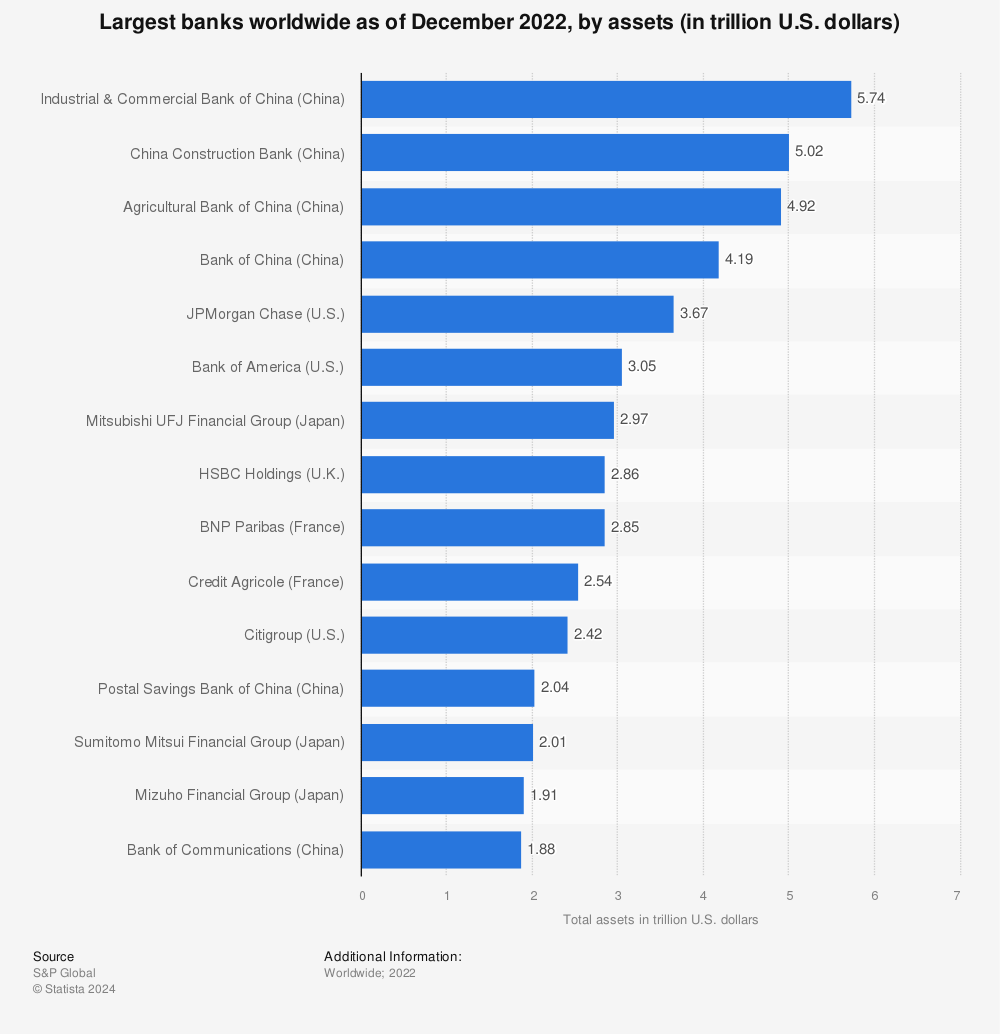
The Industrial and Commercial Bank of China (ICBC) is currently the largest bank in the world by total assets, a title it has held for several consecutive years. With assets exceeding $6 trillion, ICBC’s balance sheet is larger than the entire GDP of many developed nations.
ICBC serves hundreds of millions of personal customers and several million corporate clients. Its primary function has historically been to fund China’s massive infrastructure projects and industrial growth. However, in recent years, it has expanded its footprint into international markets, offering sophisticated wealth management and corporate banking services across Asia, Europe, and the Americas.
China Construction Bank (CCB)
Ranking second is the China Construction Bank. As the name suggests, this institution was originally established to manage government funds for infrastructure and large-scale construction projects. Today, it is a commercial powerhouse. CCB’s growth mirrors the urbanization of China; as cities expanded, so did the bank’s mortgage portfolios and corporate lending divisions. With assets hovering around $5 trillion, CCB remains a pillar of global finance.
Agricultural Bank of China (ABC)
Known colloquially as AgBank, this institution was founded to provide financing to the rural sectors of China. Over the decades, it has evolved into a diversified financial giant. While it still maintains a strong presence in agricultural lending, its retail banking network is one of the most extensive in the world. Its inclusion in the top three highlights the immense scale of the Chinese domestic market.
Bank of China (BOC)
The Bank of China is the most internationalized of the Chinese “Big Four.” While the others focus heavily on domestic growth, BOC has long been the primary vehicle for China’s foreign exchange and international trade finance. It operates in dozens of countries and plays a critical role in the internationalization of the Yuan (RMB).
The American Powerhouses: Wall Street’s Global Reach
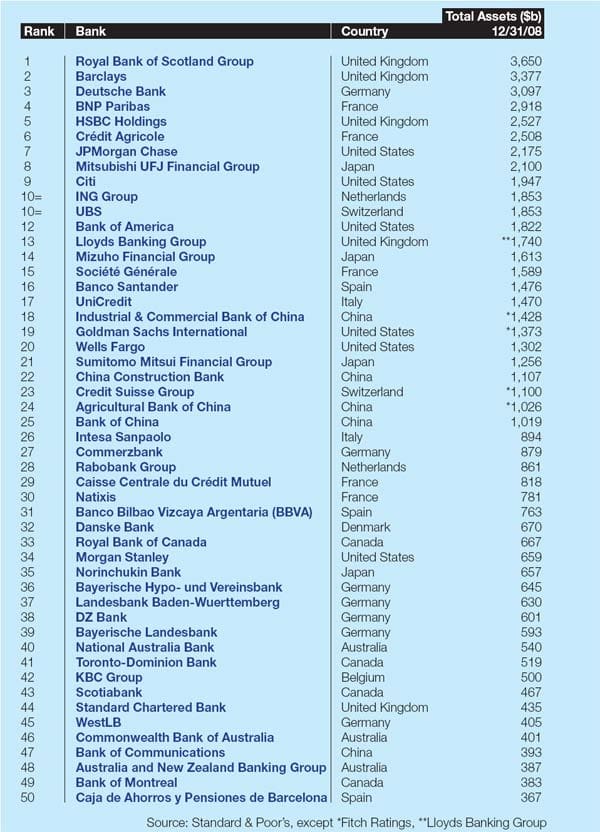
While China leads in terms of sheer asset volume, U.S. banks remain the leaders in terms of market influence, investment banking, and technological innovation. The American banking sector is characterized by a “fortress balance sheet” mentality, prioritized after the 2008 financial crisis.
JPMorgan Chase & Co.
JPMorgan Chase is the largest bank in the United States and usually ranks within the top five globally. Under the long-term leadership of Jamie Dimon, the bank has become a model of diversified financial services. It is a leader in retail banking (Chase), investment banking, and asset management.
What sets JPMorgan apart is its ability to generate high returns on equity despite its massive size. For investors, JPMorgan is often viewed as the “gold standard” of the industry, balancing a massive asset base of nearly $4 trillion with cutting-edge fintech integration and a dominant share of the global investment banking fee pool.
Bank of America (BofA)
Bank of America holds the second spot in the U.S. hierarchy. It is a retail banking behemoth, serving a significant percentage of American households. Following its acquisition of Merrill Lynch during the financial crisis, BofA also became a global leader in wealth management and investment banking. Its focus on “responsible growth” and digital banking adoption has allowed it to maintain a massive asset base while streamlining its physical branch network.
Citigroup and Wells Fargo
Citigroup and Wells Fargo round out the major American players. Citigroup is notable for its vast international network, often described as the “world’s local bank,” though it has recently undergone restructuring to focus on high-margin corporate and wealth segments. Wells Fargo, conversely, remains a powerhouse in the U.S. mortgage and mid-market commercial lending sectors, despite navigating various regulatory challenges over the past decade.
The Global Contingent: Europe and Japan
Outside of the U.S. and China, the landscape of the world’s largest banks is populated by historic European institutions and Japanese conglomerates.
HSBC Holdings (UK/Hong Kong)
Headquartered in London but with deep roots in Hong Kong, HSBC is the largest bank in Europe by assets. It serves as a vital bridge between Western capital markets and Asian growth opportunities. HSBC’s strength lies in trade finance and global liquidity management. Its “pivot to Asia” strategy in recent years reflects the shifting gravity of global wealth toward the East.
BNP Paribas (France)
Following the consolidation of the European banking sector, BNP Paribas has emerged as the Eurozone’s largest lender. It has successfully diversified across retail banking, corporate and institutional banking (CIB), and investment services. In the wake of Brexit, BNP Paribas has positioned itself as the primary alternative to London-based firms for European corporate finance.
Mitsubishi UFJ Financial Group (MUFG) (Japan)
Japan’s largest bank, MUFG, is a product of various mergers and represents the pinnacle of Japanese financial stability. With a massive presence in both domestic retail and international corporate lending, MUFG is a key player in the global bond markets and maintains a strategic partnership with Morgan Stanley, giving it significant reach into the U.S. investment banking sector.
Why Size Matters for the Modern Investor
Understanding the hierarchy of the world’s largest banks is not just an exercise in trivia; it is a fundamental part of strategic financial planning. For the individual investor, these banks represent the “blue chips” of the financial sector. They offer stability and dividends, often acting as a proxy for the health of their respective national economies.
For business owners, the size of a bank dictates the level of service and the scale of credit available. Large multinational corporations require the infrastructure of an ICBC or a JPMorgan to manage cross-border transactions, hedge currency risks, and underwrite massive debt offerings.
However, the dominance of these giants also presents challenges. The “too big to fail” phenomenon remains a topic of intense debate. As these banks grow, they become more complex, making them harder to regulate and potentially more susceptible to systemic shocks. This has led to the rise of “challenger banks” and fintech startups that aim to disrupt the traditional banking model. Yet, despite the rise of digital-only banks, the sheer asset power and regulatory moats of the world’s largest banks ensure they remain the gatekeepers of global capital.

Conclusion: The Future of Financial Giants
The list of the world’s largest banks is a living document. While China currently holds the crown in terms of assets, the landscape is shifting. Factors such as rising interest rates, the adoption of Artificial Intelligence in banking operations, and the transition to a green economy will influence which institutions grow and which contract.
As we look forward, the competition between the American model of market-driven investment banking and the Chinese model of state-supported expansion will continue to define the rankings. For those navigating the world of money and finance, keeping a close eye on these titans is essential. They are more than just repositories for cash; they are the architects of the global financial future.
aViewFromTheCave is a participant in the Amazon Services LLC Associates Program, an affiliate advertising program designed to provide a means for sites to earn advertising fees by advertising and linking to Amazon.com. Amazon, the Amazon logo, AmazonSupply, and the AmazonSupply logo are trademarks of Amazon.com, Inc. or its affiliates. As an Amazon Associate we earn affiliate commissions from qualifying purchases.