
In the complex landscape of personal finance, the security of your capital is the foundation upon which all other investment and savings strategies are built. When you deposit money into a financial institution, you are essentially providing that institution with a loan, which they use to fund mortgages, business loans, and other interest-bearing activities. In exchange, the bank provides you with liquidity and, often, interest. However, this relationship carries an inherent risk: what happens if the bank fails? This is where the Federal Deposit Insurance Corporation (FDIC) becomes the most critical component of the American banking system.

Understanding which banks are FDIC insured and how that insurance functions is not merely a matter of academic interest; it is a vital step in risk management for every individual and business owner. Since its inception in 1933, the FDIC has ensured that no depositor has lost a single penny of insured funds due to a bank failure. To navigate your financial journey safely, you must understand the mechanisms of this protection, the limits of its coverage, and the methods for verifying the status of your chosen institution.
The Scope and Mechanics of FDIC Insurance
The FDIC is an independent agency of the United States government that protects depositors against the loss of their insured deposits if an FDIC-insured bank or savings association fails. FDIC insurance is backed by the full faith and credit of the United States government. This means that even in the event of a systemic financial crisis, the government stands behind the insured limits to maintain public confidence in the financial system.
The $250,000 Standard Coverage Limit
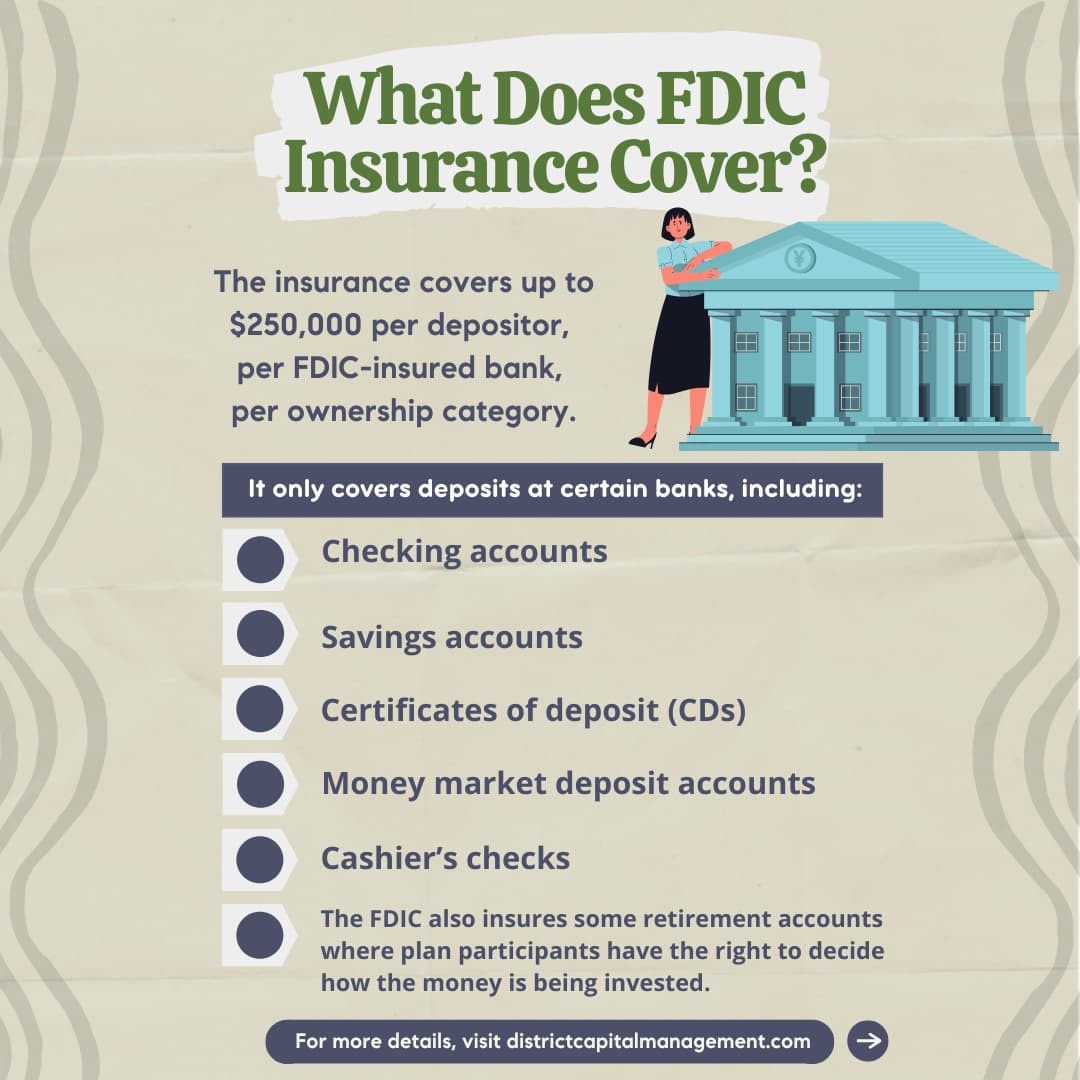
The standard insurance amount is $250,000 per depositor, per insured bank, for each account ownership category. This limit is the cornerstone of deposit security. It is important to note that this limit includes both the principal balance and any accrued interest. If you have a savings account with $248,000 and it earns $3,000 in interest, only $250,000 of the $251,000 total would be insured if the bank failed.
Understanding Ownership Categories
One of the most common misconceptions is that a single person is limited to $250,000 total at one bank across all accounts. In reality, the FDIC provides coverage based on “ownership categories.” Common categories include:
-
Single Accounts: Owned by one person (e.g., a standard checking or savings account).
-
Joint Accounts: Owned by two or more people with equal rights to withdraw. Each co-owner is insured up to $250,000. Therefore, a joint account for a married couple is insured up to $500,000.
-
Certain Retirement Accounts: Such as IRAs and Keogh plan accounts.
-
Revocable Trust Accounts: Where the owner designates beneficiaries who will receive the funds upon the owner’s death.
By strategically utilizing these categories, a single household can often insure significantly more than $250,000 at a single institution.
Qualifying Financial Products
Not every product offered by a bank is covered by FDIC insurance. The FDIC covers traditional banking products, including:
-
Checking accounts
-
Negotiable Order of Withdrawal (NOW) accounts
-
Savings accounts
-
Money Market Deposit Accounts (MMDAs)
-
Certificates of Deposit (CDs)
-
Cashier’s checks, money orders, and other official items issued by the bank
Identifying FDIC-Insured Institutions
The vast majority of traditional banks operating in the United States are FDIC insured. This includes national banks, state-chartered banks, and federal savings associations. However, with the rise of digital banking and “fintech” platforms, the lines have become increasingly blurred, making it essential for consumers to perform due diligence.
Traditional and Online Banks
Most household names—such as JPMorgan Chase, Bank of America, Wells Fargo, and Citibank—are FDIC-insured members. Similarly, many prominent online banks like Ally Bank, Marcus by Goldman Sachs, and Discover Bank are also fully insured institutions. These banks hold their own charters and deal directly with the FDIC.
The “BankFind” Verification Process
The most reliable way to determine if a bank is insured is to use the FDIC’s “BankFind” tool available on their official website. This database allows users to search by the bank’s name, web address, or location. A successful search will provide the bank’s “FDIC Certificate Number” and confirm its active status. If a financial institution does not appear in this database, it is not a bank insured by the FDIC.
Neobanks and Partner Bank Relationships
The modern era of finance has introduced “neobanks” or “fintech apps” like Chime, Revolut, or Current. It is critical to understand that many of these companies are not banks themselves. Instead, they are technology platforms that partner with FDIC-insured banks to hold customer funds.
In these arrangements, the fintech company provides the user interface and the app, while the “partner bank” holds the actual deposits. This is often referred to as “pass-through insurance.” For your funds to be protected, the fintech platform must correctly deposit your money into an account at the partner bank, and the records must identify you as the owner. While this setup is generally safe, it adds a layer of complexity. Investors should always identify which specific partner bank is holding their funds and verify that bank’s FDIC status.
Credit Unions: The NCUA Alternative
When researching FDIC insurance, you may find that your local credit union is not listed. This is because credit unions are not banks; they are member-owned cooperatives. Credit unions are insured by the National Credit Union Administration (NCUA) through the National Credit Union Share Insurance Fund (NCUSIF).
The NCUA provides the exact same level of protection as the FDIC: $250,000 per depositor, per institution, per ownership category. While the agency name is different, the security provided to your “shares” (the credit union equivalent of deposits) is identical in scope and backing to FDIC insurance.
Strategies for Managing Large Deposits
For high-net-worth individuals or businesses maintaining large cash reserves, the $250,000 limit can pose a challenge. When your liquid assets exceed this threshold, simply leaving the money in a single checking account introduces “counterparty risk”—the risk that the bank might fail and leave you as an unsecured creditor for the amount above the insurance limit.
Diversification Across Multiple Institutions
The most straightforward method to protect large sums is to spread deposits across multiple FDIC-insured banks. Since the $250,000 limit applies per institution, you can have $250,000 at Bank A, $250,000 at Bank B, and $250,000 at Bank C, with all $750,000 fully insured. While effective, this can become an administrative burden, requiring the management of multiple logins, statements, and tax forms.
Deposit Networks: CDARS and ICS
To simplify the process of diversifying large deposits, many banks participate in networks such as the IntraFi Network (formerly known as CDARS and ICS). When you deposit a large sum at a participating bank, they use a sophisticated automated system to distribute those funds in increments under $250,000 across dozens or even hundreds of other banks in the network.
Through this system, a depositor can access millions of dollars in FDIC insurance while only dealing with a single “relationship bank.” You receive one statement, deal with one set of paperwork, but enjoy the protection of the entire network’s aggregate FDIC coverage.
Maximizing Ownership Categories
As mentioned previously, understanding the legal structure of your accounts can drastically increase your coverage. For a family of four, it is possible to insure millions of dollars at a single bank through a combination of individual accounts, joint accounts, and trust accounts with various beneficiaries. However, this requires careful legal titling and a thorough understanding of FDIC rules to ensure no errors are made that could void the coverage.
What Is Not Covered: The Limits of Protection
Perhaps more important than knowing what is covered is knowing what is not. A common financial mistake is assuming that because you bought a product at a bank, it is protected by the FDIC. This is often not the case.
Investment Products
The FDIC does not insure investments, even if they were purchased through a bank representative. This includes:
-
Stock investments
-
Bond investments
-
Mutual funds
-
Exchange-Traded Funds (ETFs)
-
Annuities
-
Municipal securities
These products carry market risk. If the value of the stock market drops, the FDIC does not reimburse your losses. Furthermore, if the brokerage firm holding these assets fails, the FDIC does not step in (though the Securities Investor Protection Corporation, or SIPC, may provide different protections for missing assets).
Cryptocurrency and Digital Assets
Despite the growing integration of digital assets into the broader financial world, cryptocurrency is not FDIC insured. If a crypto exchange or a “crypto bank” fails, the FDIC does not provide a safety net. Some platforms claim to have private insurance, but this is not the same as federal protection and does not carry the same guarantee of solvency.
Safe Deposit Boxes
Contrary to popular belief, the contents of a safe deposit box are not insured by the FDIC. The FDIC only insures “deposits.” If a bank suffers a fire, flood, or robbery that affects your safe deposit box, you must rely on your own homeowners’ insurance or private insurance policies to recover those losses.
Conclusion: Building a Secure Financial Foundation
In the modern economy, cash is not just a medium of exchange; it is a strategic asset. Whether it represents an emergency fund, a down payment for a home, or corporate payroll, the safety of that cash is paramount. Verification is the first step: look for the “FDIC” logo at the branch or on the website and confirm the institution’s status via official government databases.
By understanding the $250,000 limits, leveraging ownership categories, and recognizing the difference between insured deposits and uninsured investments, you can construct a financial fortress that is resilient against institutional failure. In a world of economic uncertainty, FDIC insurance remains one of the most powerful and reliable tools for the preservation of wealth. Safe banking is not just about choosing the bank with the best interest rate; it is about ensuring that your capital remains yours, no matter what happens to the institution holding it.
aViewFromTheCave is a participant in the Amazon Services LLC Associates Program, an affiliate advertising program designed to provide a means for sites to earn advertising fees by advertising and linking to Amazon.com. Amazon, the Amazon logo, AmazonSupply, and the AmazonSupply logo are trademarks of Amazon.com, Inc. or its affiliates. As an Amazon Associate we earn affiliate commissions from qualifying purchases.