
Understanding the conversion of fractions to decimals, such as “what is 9/16 in decimal,” might seem like a basic mathematical exercise. However, in the realm of personal finance, investing, and business operations, this fundamental skill is indispensable. From dissecting investment returns and allocating budget percentages to comprehending interest rates and ownership stakes, a solid grasp of fractional and decimal representations empowers individuals and businesses to make informed financial decisions. The ability to seamlessly translate between these numerical formats is a cornerstone of financial literacy, impacting everything from daily budgeting to complex financial modeling.
The Indispensable Role of Fractions and Decimals in Financial Literacy
At its core, finance is the art and science of managing money, and money management is inherently quantitative. Fractions and decimals provide the language through which financial relationships are expressed, understood, and manipulated. Whether you are dividing an inheritance, calculating a discount, or assessing the proportion of a company you own through stock, the underlying mathematical principles are often rooted in these basic numerical forms. Ignoring or misinterpreting them can lead to significant financial errors, missed opportunities, or an incomplete understanding of one’s own financial landscape.
Understanding Proportions: Budgets, Savings, and Debt
Every household and business budget operates on proportions. How much of your income goes towards housing? What percentage is allocated to savings? What fraction of your revenue is spent on operational costs? These questions, though often phrased in percentages, frequently derive from fractional allocations that are then converted to decimals for ease of calculation and comparison. For instance, if you aim to save 1/10 of your income, you implicitly understand this as 0.10 or 10%. Similarly, if you’re tracking debt repayments, understanding what fraction of your principal has been repaid, or what decimal portion of your income is consumed by interest, is crucial for assessing financial health and progress. A simple fraction like 9/16 could represent the proportion of a project budget allocated to a specific phase, or the share of a company’s profit distributed to minority shareholders, making its decimal equivalent (0.5625) critical for precise financial planning and reporting.
Investment Calculations: Stock Shares and Market Prices
Historically, and even in some niche markets today, stock prices and financial instruments were quoted in fractions. While decimalization has made modern stock markets largely decimal-based, understanding the underlying fractional concepts remains valuable. For instance, if a stock split results in investors receiving a fractional share, or if certain complex options or derivatives contracts reference fractional increments, the ability to convert these back to decimals is paramount for accurate valuation and portfolio management. Furthermore, understanding what fraction of a total portfolio a particular asset represents, or the fractional change in a stock’s price, helps investors contextualize their gains or losses. If you own 9/16 of a particular mutual fund, translating this to 0.5625 allows for clear communication and calculation of your exact stake.
Interest Rates and Loan Repayments
Interest rates, whether on savings accounts, credit cards, or mortgages, are universally expressed as percentages, which are essentially decimals (e.g., 5% is 0.05). However, when calculating actual interest accrued or paid, these decimal rates are applied to principal amounts. Understanding how various components contribute to your total interest or how your payments are distributed between principal and interest often involves fractional thinking that is then converted to decimals for computation. For example, if you pay down 9/16 of your outstanding credit card balance, knowing its decimal equivalent (0.5625) allows you to quickly calculate the remaining balance and subsequent interest accrual. This precision is vital for managing debt effectively and planning for financial obligations.
Converting Fractions to Decimals: A Practical Skill for Financial Management
The process of converting a fraction like 9/16 to its decimal equivalent is straightforward but carries significant weight in financial contexts. This simple mathematical operation bridges the gap between conceptual proportions and concrete numerical values, enabling accurate calculations and informed decision-making.
The Simple Division Method
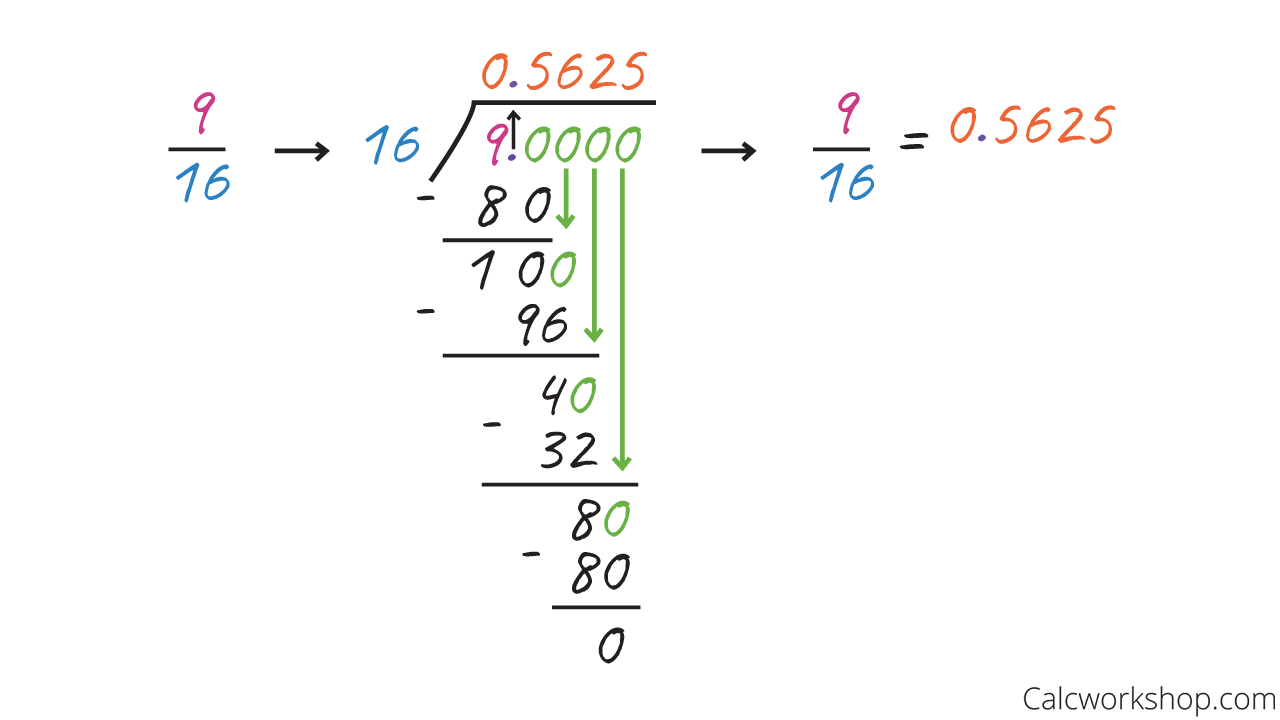
To convert any fraction to a decimal, you simply divide the numerator (the top number) by the denominator (the bottom number). For 9/16:
Numerator = 9
Denominator = 16
Divide 9 by 16:
9 ÷ 16 = 0.5625

Thus, 9/16 in decimal form is 0.5625. This decimal represents slightly more than half (0.50) but less than three-fifths (0.60), providing a precise figure that can be easily used in calculations, spreadsheets, and financial models. For example, if you need to calculate 9/16 of $1,000,000 for an investment, using 0.5625 allows for a direct multiplication: $1,000,000 * 0.5625 = $562,500.
Why Precision Matters in Financial Dealings
In finance, precision is not just a preference; it is often a requirement. Small discrepancies, especially when compounded over time or applied to large sums, can result in substantial errors. Rounding too early or incorrectly converting fractions can lead to miscalculations in profit margins, incorrect interest payments, or an inaccurate assessment of investment performance. For example, if a business calculates a profit share of “approximately 9/16” and rounds it to 0.56, they would be short-changing stakeholders compared to the precise 0.5625. Over millions of dollars, this seemingly small difference can amount to thousands, if not tens of thousands, of dollars. Financial regulations and auditing standards often demand exact figures, underscoring the importance of precise fraction-to-decimal conversions.
Real-World Applications of 9/16 in Financial Contexts
While 9/16 might seem like an arbitrary fraction, its decimal equivalent 0.5625 has various practical implications across different financial scenarios. Recognizing these applications reinforces the value of fundamental mathematical skills in managing money effectively.
Budgeting for Fractional Shares
In the modern investment landscape, many brokerage platforms offer fractional share investing, allowing individuals to invest specific dollar amounts into stocks, even if that amount only buys a fraction of a single share. If an investor decides to allocate exactly 9/16 of their monthly investment budget to a particular stock, knowing that 9/16 is 0.5625 allows them to instantly calculate the precise monetary value. Similarly, in a partnership, if one partner holds a 9/16 stake in the profits, all calculations for profit distribution must be based on this precise decimal figure to ensure fairness and accuracy. This translates directly into tangible dollars for individuals and businesses alike.
Understanding Property Ownership and Equity Stakes
In real estate or business partnerships, ownership can sometimes be divided into specific fractions. Imagine a property jointly owned by several individuals, where one party holds a 9/16 share. This is a significant majority stake, representing 56.25% of the total value. When it comes time to sell the property, refinance, or distribute rental income, each owner’s share of the proceeds or obligations must be calculated precisely based on their fractional (or decimal) ownership. An error in converting 9/16 could lead to serious disputes and legal complications, highlighting how basic math underpins complex financial agreements.
Discount and Sale Calculations
While not as common to see discounts expressed directly as 9/16, understanding the conversion provides a useful mental framework. More commonly, you might see “56.25% off” a product or service. Recognizing that this is precisely 9/16 off could offer quick comparisons or mental shortcuts for those adept at working with common fractions. For example, if you know that a 1/2 discount (50%) is significant, seeing 56.25% (9/16) immediately tells you it’s an even better deal, exceeding the halfway mark. This quick conversion ability enhances one’s consumer financial intelligence, allowing for faster and more confident purchasing decisions.
Beyond 9/16: Cultivating Broader Financial Numeracy
The ability to convert 9/16 to 0.5625 is a small piece of a much larger puzzle: financial numeracy. This encompasses a broader understanding of numbers, percentages, ratios, and basic mathematical operations, all of which are critical for navigating the complexities of personal and business finance.
Practical Tools for Financial Calculations
While manual conversion is a fundamental skill, modern financial management heavily relies on digital tools. Spreadsheets (like Excel or Google Sheets), financial calculators, and specialized accounting software all perform these conversions instantaneously. However, understanding the underlying math ensures that users can verify the outputs, interpret results correctly, and troubleshoot any potential errors. For instance, knowing that 9/16 is 0.5625 helps confirm that a spreadsheet formula returning 56.25% for a budget allocation is correct. Relying solely on tools without understanding the basics is akin to driving without knowing how an engine works – you can get by until something goes wrong.

The Importance of Double-Checking Financial Figures
In personal budgeting, investing, or business accounting, double-checking every calculation is a best practice. Even with advanced software, human error in data entry or formula creation can lead to significant mistakes. A quick mental check or a manual calculation of a fraction-to-decimal conversion can catch these errors before they escalate. For a financial professional, the ability to quickly verify that 9/16 of a total amount equals the calculated decimal value is a testament to their attention to detail and commitment to accuracy, qualities that are highly valued in any money-related field. Mastering these basic numerical transformations ensures confidence and accuracy in all financial endeavors.
aViewFromTheCave is a participant in the Amazon Services LLC Associates Program, an affiliate advertising program designed to provide a means for sites to earn advertising fees by advertising and linking to Amazon.com. Amazon, the Amazon logo, AmazonSupply, and the AmazonSupply logo are trademarks of Amazon.com, Inc. or its affiliates. As an Amazon Associate we earn affiliate commissions from qualifying purchases.