
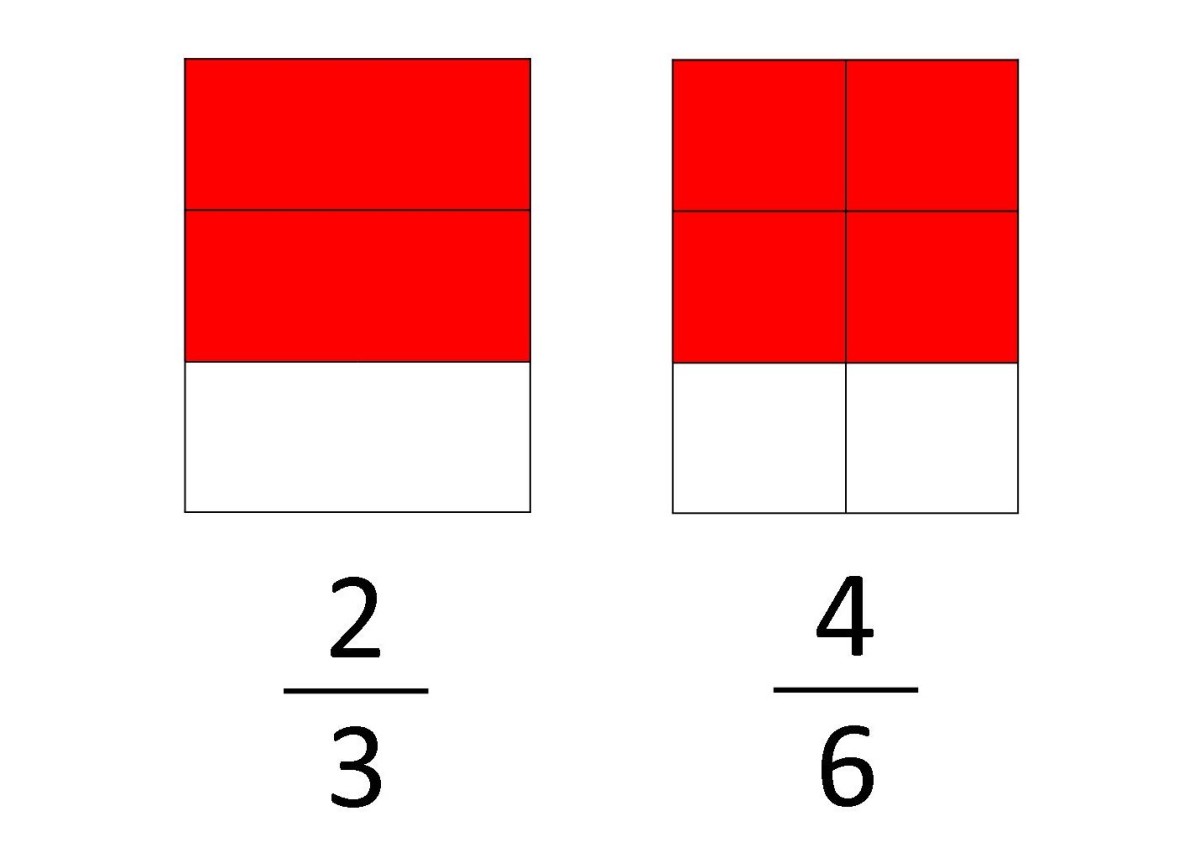
In the realm of mathematics, the question of what fraction is equivalent to 4/6 has a simple, definitive answer: 2/3. By dividing both the numerator and the denominator by their greatest common divisor, which is 2, we arrive at a simplified expression of the same value. However, in the sophisticated world of personal finance, investing, and corporate strategy, this mathematical transition from 4/6 to 2/3 represents much more than a classroom exercise. It serves as a foundational metaphor for the principle of proportionality—a concept that dictates everything from debt-to-income ratios to asset allocation and profit margins.
Understanding the “equivalent fraction” of your financial health is the difference between a cluttered, inefficient portfolio and a streamlined, high-performance wealth engine. Whether you are managing a household budget or overseeing a multi-million dollar investment fund, the ability to simplify complex figures into actionable ratios is a hallmark of financial literacy.
The Power of Simplification in Personal Finance
The process of reducing 4/6 to 2/3 is known as simplification. In finance, simplification is the antidote to “analysis paralysis.” Many investors look at their accounts and see a chaotic spread of numbers: varying interest rates, fluctuating stock prices, and mismatched debt obligations. To gain clarity, one must find the equivalent fractions that define their true financial standing.
The Debt-to-Income (DTI) Ratio
One of the most critical applications of fractional equivalence is the Debt-to-Income ratio. If an individual earns $6,000 a month and spends $4,000 on debt servicing (mortgage, car loans, credit cards), their DTI is 4/6. While this might look manageable on the surface to some, simplifying it to 2/3 reveals a starker reality: 66.6% of every dollar earned is spoken for before it even hits the bank account.
Lenders typically look for a DTI ratio that is equivalent to or lower than 36% (roughly 1/3). When your financial fraction is 4/6, you are essentially operating at double the risk threshold preferred by major financial institutions. Recognizing that 4/6 is equivalent to 2/3 allows a borrower to see that they are keeping only one-third of their labor’s value, prompting a necessary pivot toward debt consolidation or income diversification.
Net Profit Margins and Business Efficiency
For entrepreneurs and side-hustlers, the 4/6 fraction often appears in the context of gross versus net. If a product costs $4 to produce and sells for $6, the cost-to-revenue ratio is 4/6. This simplifies to a 2/3 expenditure rate, leaving a 1/3 (or 33.3%) gross profit margin. In the competitive landscape of e-commerce or SaaS (Software as a Service), understanding these equivalent fractions is vital for scaling. A business that cannot simplify its operational costs—moving the fraction from 4/6 toward a leaner 1/3—will eventually struggle with cash flow as it grows.
Strategic Asset Allocation: The 2/3 Rule
In the world of investing, the relationship between 4/6 and 2/3 often manifests in portfolio construction. Determining how much of your capital should be at risk versus how much should be preserved is an exercise in fractional balancing.
The Aggressive Growth Blueprint
A portfolio that allocates 4/6 of its total value to equities and 2/6 to fixed income or cash is essentially a 66/33 split. This is often referred to as an “aggressive growth” posture. For young investors with a high risk tolerance and a long time horizon, maintaining this 2/3 equity equivalent is a proven strategy for outpacing inflation and capturing market premiums.
However, the importance of “equivalent fractions” becomes clear during a market rebalance. If the stock market performs exceptionally well, your 4/6 allocation might drift to 5/6. At this point, the investor must sell off the excess to return to the original 2/3 equivalent. This disciplined approach ensures that you “sell high” and maintain the proportional integrity of your investment strategy.
Real Estate Equity and Loan-to-Value
Real estate investors use the equivalent of 4/6 when calculating Loan-to-Value (LTV) ratios. If you own a property worth $600,000 and have a mortgage of $400,000, your LTV is 4/6. Simplified, you have 2/3 debt and 1/3 equity. This fraction is a pivot point for many investors; reaching the 2/3 mark often triggers the ability to eliminate Private Mortgage Insurance (PMI) or provides enough “skin in the game” to refinance at a more favorable interest rate. Understanding the mathematical equivalence helps investors set milestones for equity growth.
Behavioral Finance: The Psychology of 4/6 vs. 2/3
The way we perceive fractions can significantly impact our spending and saving habits. Behavioral finance suggests that humans do not always react rationally to equivalent values; our reactions are often dictated by how those values are framed.
The Denominator Effect
In many cases, the fraction 4/6 feels “heavier” than 2/3. In a marketing context, a discount framed as “Buy 4, Get 2 Free” (which involves 6 items total) can feel more substantial than a simple “33% off” or “1/3 discount,” even though the mathematical impact on the consumer’s wallet is identical.
Smart savers use this psychological quirk to their advantage. By framing their savings goals as “saving 4 out of every 6 dollars of a bonus,” the goal feels more tangible and structured than simply saying “I will save 66%.” This granular approach to budgeting helps individuals visualize the physical units of currency being moved into high-yield savings accounts or brokerage portfolios.
Risk Perception and Loss Aversion
Investors often struggle with the concept of equivalence when facing losses. A 4/6 drop in the value of a speculative asset feels catastrophic, whereas a 2/3 drop—while mathematically the same—is often discussed in more clinical, detached terms in financial media. Understanding that these are equivalent allows an investor to strip away the emotion. If an asset has lost 4/6 of its value, the fundamental question is not “How much have I lost?” but “Is the remaining 1/3 of the value positioned for a recovery?”
Tools and Techniques for Financial Fraction Analysis
To move beyond basic arithmetic and into the realm of professional-grade financial management, one must utilize tools that automate the identification of these ratios.
Using FinTech to Monitor Equivalents
Modern fintech apps and dashboarding tools are designed to do the work of simplifying 4/6 for you. Wealth management platforms like Personal Capital or Mint (and its successors) aggregate all your accounts to present a “Big Picture” fraction. They take thousands of data points—from your 401(k) balance to your credit card debt—and boil them down to a simple debt-to-asset ratio. If your dashboard shows that your liabilities are 4/6 of your assets, the software provides the visual clarity needed to begin the “simplification” process: paying down debt to shift the fraction toward 1/6 or zero.
The Spreadsheet Methodology
For those who prefer a hands-on approach, the spreadsheet remains the gold standard for financial modeling. By using simple formulas, you can track the equivalence of your spending habits over time.
-
Formula for Savings Rate:
=SUM(Savings)/SUM(Gross_Income) -
Formula for Expense Ratio:
=SUM(Expenses)/SUM(Gross_Income)
By setting up these ratios, you can track if your “Spending Fraction” is consistently 4/6. If it is, you are living on 66% of your income. In the world of FIRE (Financial Independence, Retire Early), the goal is often to invert this: living on 2/6 (1/3) and saving 4/6 (2/3). The math is identical, but the direction of the flow determines your future net worth.

Conclusion: The Strategic Value of the Equivalent Fraction
What fraction is equivalent to 4/6? It is 2/3. But more importantly, it is a reminder that in finance, things are rarely as complex as they seem. Every large, intimidating number can be reduced to a simple ratio. Every massive debt can be understood as a fraction of annual income. Every diversified portfolio can be broken down into proportional slices of a pie.
By mastering the concept of equivalent fractions, you gain the ability to look past the “noise” of the 4/6 and see the “signal” of the 2/3. This clarity is the cornerstone of effective money management. It allows you to communicate more effectively with financial advisors, make more informed decisions about loans and investments, and ultimately, steer your financial life with the precision of a mathematician and the insight of a seasoned investor. Whether you are aiming for a 2/3 savings rate or trying to lower your debt to a 1/3 fraction of your income, the journey begins with understanding that simplification is the ultimate form of financial sophistication.
aViewFromTheCave is a participant in the Amazon Services LLC Associates Program, an affiliate advertising program designed to provide a means for sites to earn advertising fees by advertising and linking to Amazon.com. Amazon, the Amazon logo, AmazonSupply, and the AmazonSupply logo are trademarks of Amazon.com, Inc. or its affiliates. As an Amazon Associate we earn affiliate commissions from qualifying purchases.