
Navigating the complex landscape of disability benefits can be daunting, yet understanding and estimating potential entitlements is a critical component of sound financial planning. Whether you’re anticipating a future need, currently facing a disabling condition, or simply wish to be prepared, knowing how to approximate these benefits can offer immense peace of mind and help you make informed decisions about your financial future. This article delves into the various types of disability benefits, the factors that influence their amounts, and practical steps you can take to estimate what you might receive, all within the context of personal finance and strategic money management.

Understanding the Types of Disability Benefits
Before you can estimate benefits, it’s essential to understand that “disability benefits” isn’t a single, monolithic entity. Instead, it encompasses several distinct programs, each with its own eligibility criteria, calculation methods, and financial implications.
Social Security Disability Insurance (SSDI)
SSDI is a federal insurance program designed for workers who have paid Social Security taxes (FICA) through their employment. It’s akin to an insurance policy you’ve been paying into, and eligibility is based on your work history and the number of “work credits” you’ve accumulated. To qualify, you must have worked long enough and recently enough. The Social Security Administration (SSA) defines disability as the inability to engage in any substantial gainful activity (SGA) due to a medically determinable physical or mental impairment that is expected to result in death or has lasted or is expected to last for a continuous period of not less than 12 months.
The benefit amount for SSDI is directly tied to your lifetime average earnings covered by Social Security. It is calculated based on your Average Indexed Monthly Earnings (AIME) and translated into your Primary Insurance Amount (PIA), which is the base amount your monthly benefit will be. This means that individuals with higher historical earnings typically receive higher SSDI benefits, up to a maximum cap. It’s important to note that SSDI benefits are not means-tested; your other income or assets do not affect your eligibility or benefit amount, though working while receiving benefits is subject to SGA limits.
Supplemental Security Income (SSI)
SSI is another federal program administered by the SSA, but it’s fundamentally different from SSDI. SSI is a needs-based program designed to provide financial assistance to aged, blind, or disabled individuals who have limited income and resources. Unlike SSDI, you don’t need a work history to qualify for SSI. Its primary purpose is to ensure a minimum basic income for those who meet the disability criteria and also fall below specific financial thresholds.
The maximum federal SSI benefit amount is set annually and is the same for everyone who qualifies, although some states supplement the federal payment. To estimate SSI benefits, you must consider all sources of countable income (earned and unearned) and your total countable resources (assets). The SSA employs complex rules for what counts as income and resources, and specific exclusions exist (e.g., your primary residence, one vehicle). The benefit amount is essentially the federal benefit rate minus your countable income. This means the more countable income you have, the lower your SSI benefit will be, potentially even reducing it to zero if your income exceeds the federal maximum.
Private Disability Insurance
Beyond government programs, many individuals secure private disability insurance policies, either through their employer (group policies) or by purchasing individual plans. These policies are critical for replacing a portion of your income if you become disabled and are unable to work.
-
Short-Term Disability (STD): These policies typically cover a short period, often 3-6 months, and replace a percentage of your income (e.g., 50-70%) during temporary disabilities. They often have short waiting periods (e.g., 7-14 days).
-
Long-Term Disability (LTD): LTD policies kick in after STD benefits expire or after a longer “elimination period” (e.g., 90-180 days). They provide benefits for an extended period, potentially until retirement age, depending on the policy terms. LTD benefits typically replace 50-70% of your pre-disability income, up to a defined maximum monthly benefit.
Estimating private disability benefits involves a careful review of your specific policy. Key factors include the benefit percentage, the maximum monthly payout, the definition of disability (e.g., “own occupation” vs. “any occupation”), the elimination period, and the benefit period. These policies are a cornerstone of robust financial protection, ensuring that your income stream doesn’t completely dry up if you face a disabling event.
Key Factors Influencing Benefit Amounts
Accurately estimating disability benefits requires a detailed understanding of the specific variables that govern each program. Missing just one piece of information can lead to significant discrepancies in your projections.
For SSDI: Your Earning History (AWP/AIME)
The cornerstone of your SSDI benefit calculation is your earnings record. The SSA uses your “Average Indexed Monthly Earnings” (AIME) to determine your Primary Insurance Amount (PIA). The AIME is derived from your highest 35 years of earnings, adjusted for changes in general wage levels over time (indexing). This indexing ensures that your past earnings are brought to a comparable level with current wages.
Once your AIME is calculated, it’s run through a formula with “bend points” to determine your PIA. The PIA is the base amount you would receive if you were to become entitled to disability benefits (or retirement benefits at your full retirement age). The higher your indexed earnings over your career, the higher your AIME and consequently, your monthly SSDI benefit will be. Understanding this direct correlation is crucial for anyone planning their financial future, as consistent, higher earnings contribute to greater protection.
For SSI: Income and Resources
SSI, being a needs-based program, is heavily influenced by your financial situation.
-
Income Limits: Your countable income directly reduces your SSI benefit. The SSA differentiates between earned income (wages, self-employment) and unearned income (pensions, Social Security benefits, gifts). Generally, a portion of earned income is disregarded, but most unearned income reduces your SSI dollar-for-dollar after a small general exclusion.
-
Asset Limits: To qualify for SSI, your “countable resources” must not exceed specific limits ($2,000 for an individual, $3,000 for a couple). Resources include cash, bank accounts, stocks, bonds, and other liquid assets. Certain assets are excluded, such as your primary residence, one vehicle, and essential household goods.
-
“Deeming” Rules: If you live with a spouse or a parent (and you are a child under 18), a portion of their income and resources may be “deemed” available to you, potentially affecting your SSI eligibility or benefit amount. These rules are complex and often require careful consideration.
Estimating SSI benefits, therefore, involves a meticulous inventory of all income sources and assets, applying the SSA’s exclusion rules, and then performing the subtraction from the federal benefit rate.
For Private Insurance: Policy Terms and Riders
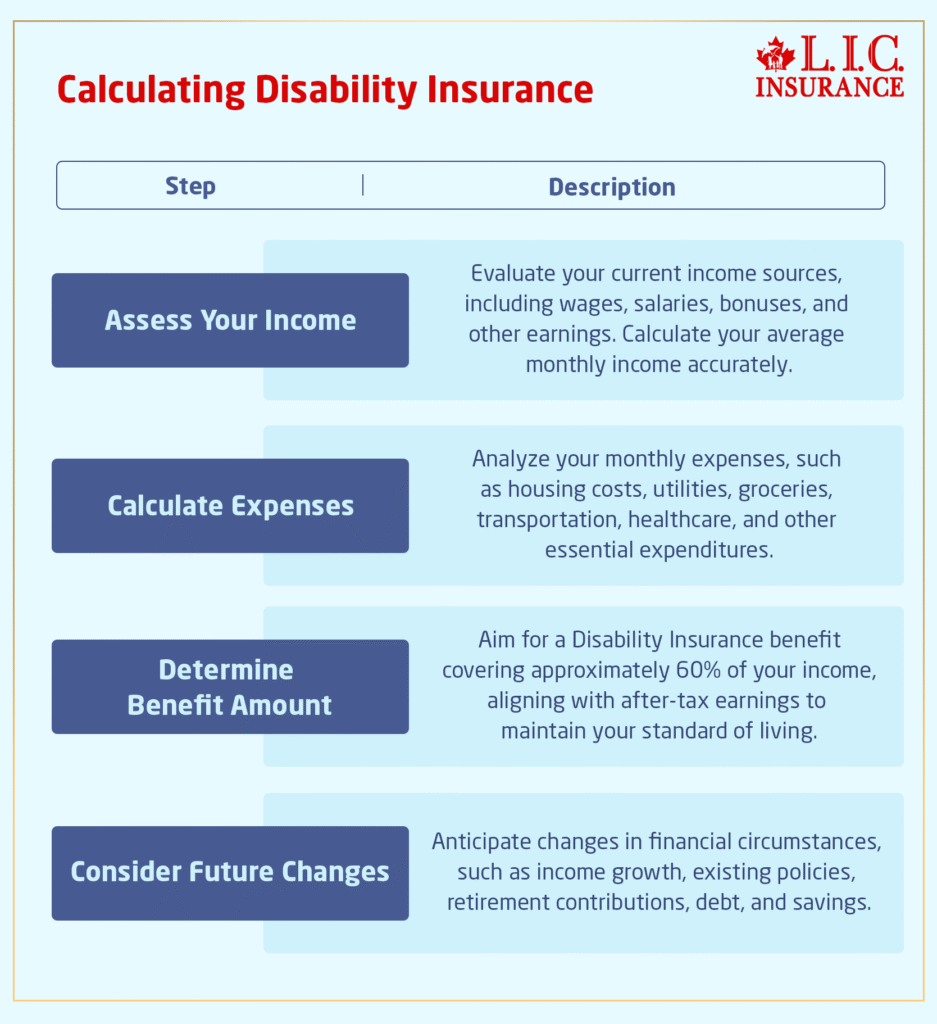
The amount you receive from a private disability insurance policy is entirely dependent on the specific contract you hold.
-
Benefit Percentage and Maximum: Policies typically replace 50-70% of your pre-disability income, up to a specified maximum monthly benefit. For example, a policy might replace 60% of your income, but cap benefits at $5,000 per month. If you earned $10,000 per month, 60% would be $6,000, but you would only receive $5,000 due to the cap.
-
Elimination Period (Waiting Period): This is the period after your disability begins but before benefits start paying out. Common periods are 30, 60, 90, or 180 days for LTD. The longer the elimination period, the lower your premiums, but the longer you must support yourself without benefit income.
-
Benefit Period: This dictates how long benefits will be paid – typically 2 years, 5 years, to age 65, or for life.
-
Definition of Disability: This is crucial. “Own occupation” disability means you’re considered disabled if you can’t perform the duties of your specific occupation. “Any occupation” means you’re disabled if you can’t perform the duties of any occupation for which you are reasonably suited by education, training, or experience. “Own occupation” policies are more expensive but offer broader protection.
-
Riders: Additional features like a Cost of Living Adjustment (COLA) rider, which increases benefits over time, or a residual disability rider, which pays partial benefits if you can work part-time, can significantly impact the total financial support you receive.
A thorough review of your policy document, ideally with a financial advisor or insurance professional, is essential for accurate estimation.
Practical Steps to Estimate Your Benefits
With an understanding of the different benefit types and influencing factors, you can now take concrete steps to estimate your potential disability benefits.
Utilizing Social Security Administration Resources
The SSA provides excellent tools for estimating your SSDI benefits.
-
Create a “My Social Security” Account: This free online account is invaluable. It allows you to access your personalized Social Security Statement at any time.
-
Review Your Social Security Statement: This statement provides a detailed record of your earnings history and, crucially, an estimate of your future disability benefits based on your current earnings record. It will show your estimated monthly SSDI benefit if you were to become disabled now, as well as your estimated retirement and survivor benefits. This is often the most accurate starting point for SSDI estimation.
-
Use SSA’s Benefit Calculators: While the statement provides a quick estimate, the SSA website also offers more detailed calculators if you wish to model different scenarios or confirm figures.
Remember, these estimates are based on your earnings to date. If your earnings change significantly in the future, your actual benefit could differ.
Reviewing Your Private Disability Policy
For private insurance, the process is more direct but requires diligent record-keeping.
-
Gather Policy Documents: Locate your insurance policy certificate or full policy document. This is where all the details—benefit percentage, maximums, waiting periods, benefit duration, and definition of disability—are laid out.
-
Contact Your Insurer or Financial Advisor: If you have trouble interpreting your policy or can’t locate the document, contact your insurance provider directly or speak with the financial advisor who helped you purchase the policy. They can walk you through the specifics and help you calculate your potential payout.
-
Understand ‘Own Occupation’ vs. ‘Any Occupation’: Reiterate the definition of disability. This dictates the conditions under which you can claim benefits. An “own occupation” policy offers broader protection and a higher likelihood of benefit approval for specific career-ending injuries or illnesses.
Considering State and Other Programs
While federal and private benefits are primary, don’t overlook other potential sources of support.
-
State Disability Benefits: A handful of states (e.g., California, New York, New Jersey, Rhode Island, Hawaii, and Puerto Rico) have their own state-mandated short-term disability insurance programs, often paid for through payroll deductions. These can provide a bridge before long-term benefits or SSDI kicks in.
-
Workers’ Compensation: If your disability is work-related, you might be eligible for workers’ compensation benefits, which cover medical expenses and lost wages. These benefits can sometimes offset or be offset by Social Security disability payments.
-
Veterans’ Benefits: Veterans with service-connected disabilities may be eligible for disability compensation from the Department of Veterans Affairs (VA). These benefits are separate from Social Security and can be received concurrently.
Investigate any potential state or specialized programs that might apply to your situation, as they can significantly impact your overall financial support.
Financial Planning Around Disability
Estimating benefits is just the first step; integrating those estimates into a comprehensive financial plan is where true preparedness lies.
Bridging the Gap: What Benefits Might Not Cover
It’s rare for disability benefits to fully replace your pre-disability income. SSDI typically replaces a lower percentage of higher earners’ incomes. Private policies often cap benefits at 50-70%. SSI offers a bare minimum.
-
Understand Potential Income Shortfalls: Calculate the difference between your current income and your estimated total disability benefits. This “gap” represents the income you would need to cover from other sources.
-
Emergency Funds and Savings: A robust emergency fund becomes even more critical when facing a disabling condition. It can cover the elimination period for private insurance, the long waiting period for SSDI (typically five full calendar months), and any income shortfalls. Adequate personal savings, investments, or even a spouse’s income might be necessary to maintain your standard of living.
Tax Implications of Disability Benefits
Disability benefits are not always tax-free, and understanding the tax implications is crucial for accurate financial planning.
-
SSDI Taxation: A portion of your SSDI benefits may be taxable if your “provisional income” (adjusted gross income plus non-taxable interest plus one-half of your Social Security benefits) exceeds certain thresholds ($25,000 for an individual, $32,000 for a married couple filing jointly).
-
SSI Taxation: SSI benefits are generally not taxable income.
-
Private Benefits Taxation: The taxation of private disability benefits depends on who paid the premiums. If your employer paid the premiums and didn’t include them as taxable income to you, your benefits will likely be taxable. If you paid the premiums with after-tax dollars, your benefits are generally tax-free.
Factor these potential tax liabilities into your estimations to get a realistic picture of your net benefit.
Seeking Professional Guidance
The intricacies of disability benefits, especially when navigating multiple programs and considering individual financial circumstances, often warrant professional assistance.
-
Financial Advisors Specializing in Disability: A financial advisor with expertise in disability planning can help you analyze your current financial situation, assess coverage gaps, and integrate potential benefits into your long-term financial strategy.
-
Disability Attorneys/Advocates: If you are actively applying for benefits, particularly SSDI or SSI, and face denials, a disability attorney or advocate can be invaluable. They understand the nuances of the application and appeals process and can significantly improve your chances of approval.
In conclusion, estimating disability benefits is a multi-faceted process that integrates personal financial history, insurance policy details, and government program rules. By proactively understanding the various programs, identifying key influencing factors, and utilizing available resources, you can gain a clear picture of your potential entitlements. This knowledge empowers you to make informed financial decisions, build a resilient financial plan, and navigate life’s uncertainties with greater confidence.
aViewFromTheCave is a participant in the Amazon Services LLC Associates Program, an affiliate advertising program designed to provide a means for sites to earn advertising fees by advertising and linking to Amazon.com. Amazon, the Amazon logo, AmazonSupply, and the AmazonSupply logo are trademarks of Amazon.com, Inc. or its affiliates. As an Amazon Associate we earn affiliate commissions from qualifying purchases.