
Supplemental Security Income (SSI) provides a financial lifeline to millions of Americans with limited income and resources who are elderly, blind, or disabled. While the program offers vital support, understanding the exact amount an individual can receive is complex, involving federal benefit rates, state supplements, and a myriad of factors related to personal income and assets. Delving into the intricacies of SSI is crucial for anyone considering applying or currently receiving benefits, ensuring they navigate the system effectively and maximize their financial stability.
Understanding Supplemental Security Income (SSI)
SSI is a needs-based federal program administered by the Social Security Administration (SSA) that provides monthly payments to eligible individuals. It is fundamentally distinct from Social Security Disability Insurance (SSDI) or retirement benefits, which are based on an individual’s work history and contributions to Social Security taxes. SSI, by contrast, is funded by general U.S. Treasury funds and is designed for those who meet strict income, resource, and medical criteria.
To qualify for SSI, an individual must be:
-
Aged 65 or older, OR
-
Blind, OR
-
Disabled.
In addition to these demographic requirements, applicants must also meet strict financial criteria, demonstrating limited income and resources. This means the program targets the most financially vulnerable populations, aiming to provide a basic level of financial support for essential needs like food and shelter. Unlike SSDI, a lack of work history does not prevent someone from receiving SSI, making it a critical safety net for individuals who may have never been able to work or have exhausted their work-related benefits.
The Maximum Federal Benefit Rate (FBR)
The foundation of the SSI payment structure is the Federal Benefit Rate (FBR). This is the maximum federal payment an eligible individual or couple can receive each month. The FBR is set by Congress and is subject to annual cost-of-living adjustments (COLAs) to help benefits keep pace with inflation.
For 2024, the maximum federal SSI payment is:
-
$943 per month for an eligible individual.
-
$1,415 per month for an eligible couple.
It is important to emphasize that these figures represent the maximum federal amount. Very few recipients actually receive the full FBR. The actual payment can be significantly lower due to a variety of factors, primarily how the SSA calculates “countable income.” The FBR is adjusted each year based on the Consumer Price Index for Urban Wage Earners and Clerical Workers (CPI-W), ensuring that recipients’ purchasing power is somewhat maintained despite economic fluctuations. These COLAs are typically announced in October for the following year and are applied to both SSI and Social Security benefits.
Factors Affecting Your Actual SSI Payment
While the FBR sets the ceiling for federal SSI payments, an individual’s actual monthly benefit is determined by a complex formula that takes into account various forms of income, resources, and living arrangements. The SSA applies a series of exclusions and deductions to different types of income to arrive at what it calls “countable income,” which then reduces the FBR.
“Countable Income” Reductions
The primary mechanism for reducing the FBR is through countable income. The SSA distinguishes between earned income (wages from work) and unearned income (pensions, Social Security benefits, gifts, interest, etc.), applying different rules to each.
-
Unearned Income: For most types of unearned income, the SSA applies a $20 general income exclusion. After this exclusion, the remaining unearned income is deducted dollar-for-dollar from the FBR.
- Example: If the FBR is $943 and an individual receives $100 in unearned income (e.g., a small pension), the first $20 is excluded. The remaining $80 is subtracted from the FBR. Their SSI payment would be $943 – $80 = $863.
-
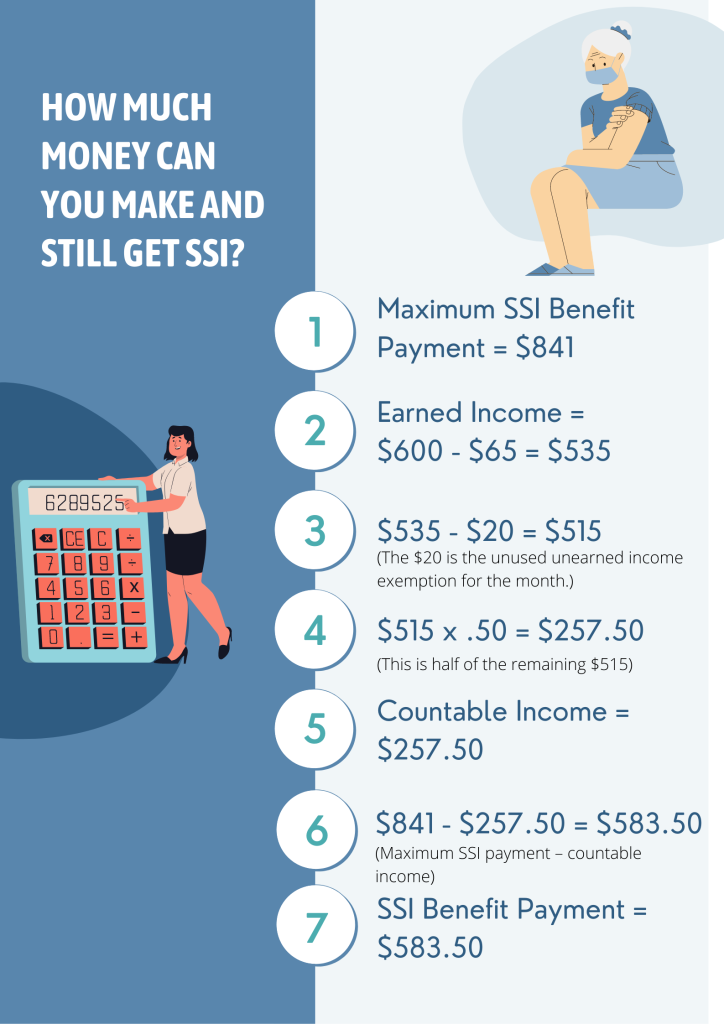
Earned Income: The SSA is generally more lenient with earned income to encourage work, even for those receiving SSI. For earned income, the SSA applies the $20 general income exclusion (if not already used for unearned income), then an additional $65 earned income exclusion. After these exclusions, only half of the remaining earned income is counted against the FBR.
-
Example: If the FBR is $943 and an individual earns $300 from part-time work, and has no unearned income:
-
$20 general exclusion is applied: $300 – $20 = $280.
-
$65 earned income exclusion is applied: $280 – $65 = $215.
-
Half of the remaining amount is counted: $215 / 2 = $107.50.
-
This $107.50 is then subtracted from the FBR. Their SSI payment would be $943 – $107.50 = $835.50.
-
-
-
In-Kind Support and Maintenance (ISM): If an individual receives food or shelter for free or for less than fair market value, the SSA considers this as ISM, which is treated as a form of unearned income. This most commonly occurs when an individual lives with others who pay for some or all of their living expenses. This can result in a reduction of up to one-third of the FBR, known as the “one-third reduction rule” (VTR), or a “Presumed Maximum Value” (PMV) calculation, which is capped at one-third of the FBR plus the $20 general exclusion.
-
Deeming of Income: In certain situations, the SSA may “deem” a portion of another person’s income as available to the SSI applicant or recipient. This applies to:
-
Spouses: If an SSI applicant has a spouse who is not eligible for SSI, a portion of the spouse’s income may be deemed.
-
Parents: If an SSI applicant is a child (under 18 or under 22 if a student) and lives with parents, a portion of the parents’ income may be deemed.
-
Sponsors: For non-citizens, a sponsor’s income may be deemed for a period of time.
-
These rules are complex and can significantly reduce the potential SSI payment, making accurate reporting of all income sources critical.
Resource Limits

Beyond income, SSI recipients must also adhere to strict resource limits. Resources are defined as cash or any assets that can be converted to cash to pay for food or shelter.
-
Individual Resource Limit: $2,000
-
Couple Resource Limit: $3,000
If an individual’s or couple’s countable resources exceed these limits, they are ineligible for SSI. However, many assets are excluded from this calculation, including:
-
The home an individual lives in (primary residence).
-
One vehicle, regardless of value, if used for transportation.
-
Household goods and personal effects.
-
Life insurance policies with a face value of $1,500 or less.
-
Burial funds up to $1,500 for an individual, plus certain burial plots.
-
Property essential to self-support (e.g., tools for a trade).
-
ABLE accounts (Achieving a Better Life Experience), up to a certain limit.
Understanding what counts and what doesn’t count as a resource is vital for maintaining SSI eligibility.
State Supplemental Payments (SSP)
Some states provide an additional payment on top of the federal SSI benefit, known as a State Supplemental Payment (SSP). These payments vary significantly by state, and some states do not provide an SSP at all.
-
States with SSPs: Many states offer an SSP, with amounts and eligibility criteria determined at the state level. These can range from small additional amounts to substantial increases, particularly for individuals in specific living arrangements (e.g., assisted living facilities).
-
States without SSPs: A number of states have opted not to provide state supplements, meaning recipients in those states receive only the federal benefit, minus any countable income.
The presence and amount of an SSP can significantly impact the total monthly income an SSI recipient receives, making it an important factor for financial planning and for individuals considering relocation.
Managing Your SSI Benefits and Financial Planning
Receiving SSI involves ongoing responsibilities and offers opportunities for strategic financial planning. Maintaining eligibility and maximizing benefits requires careful attention to reporting requirements and an understanding of related programs.
Reporting Changes to SSA
SSI is a dynamic, needs-based program. Recipients are legally obligated to report changes in their income, resources, living arrangements, marital status, and any other relevant factors to the SSA promptly. Failure to do so can lead to:
-
Overpayments: The SSA might determine you received more than you were entitled to, requiring you to pay it back.
-
Benefit Suspension or Termination: If changes are not reported, your benefits could be suspended or stopped entirely.
-
Penalties: In some cases, intentional misrepresentation can lead to fraud charges.
It is generally recommended to report changes within 10 days of the change occurring to avoid complications.
Impact on Other Benefits
One significant advantage of receiving SSI is that it often serves as a gateway to other crucial assistance programs.
-
Medicaid: In most states, SSI eligibility automatically qualifies an individual for Medicaid, providing comprehensive health insurance coverage.
-
SNAP (Food Stamps): SSI recipients are typically eligible for the Supplemental Nutrition Assistance Program, which helps with food costs.
-
Housing Assistance: SSI may also help individuals qualify for various housing assistance programs.
Understanding these linkages can help recipients access a broader network of support services, significantly improving their overall financial well-being.
Financial Strategies for SSI Recipients
While SSI offers a basic income, careful financial management is still essential.
-
Budgeting: Creating and sticking to a budget is paramount to manage limited funds effectively.
-
ABLE Accounts: For individuals who became blind or disabled before age 26, an ABLE account allows them to save money (up to certain limits, currently $18,000 per year) without impacting their SSI or Medicaid eligibility. Funds can be used for qualified disability expenses.
-
Work Incentives: The SSA offers various work incentives to encourage SSI recipients to work without immediately losing their benefits. These include:
-
Student Earned Income Exclusion (SEIE): For students under age 22, a portion of their earned income is excluded.
-
Impairment Related Work Expenses (IRWE): Costs for certain disability-related items and services needed to work can be deducted from earned income.
-
Blind Work Expenses (BWE): Blind individuals can deduct a broader range of work expenses.
-
Plan to Achieve Self-Support (PASS): Allows disabled individuals to set aside income and resources for a specific work goal without affecting SSI eligibility.
-
Ticket to Work Program: Provides free employment services, career counseling, and job placement assistance.
-
-
Financial Literacy: Seeking guidance from financial advisors or non-profit organizations specializing in disability benefits can provide valuable insights into managing money, understanding benefits, and planning for the future.
Applying for SSI
The application process for SSI can be lengthy and requires detailed documentation. Individuals can apply online for certain benefits, over the phone, or in person at a local Social Security office.
Required documentation typically includes:
-
Proof of age (birth certificate).
-
Proof of U.S. citizenship or eligible non-citizen status.
-
Social Security card.
-
Information about income, resources, and living arrangements.
-
Medical records and information about doctors, hospitals, and medical conditions if applying due to disability or blindness.
It is crucial to be thorough and provide all requested information accurately. The SSA will review your application, assess your financial eligibility, and for disability or blindness claims, forward your medical information to a state agency that determines medical eligibility. Patience and persistence are often required throughout this process.
In conclusion, the amount you get on SSI is not a fixed sum but rather a variable figure influenced by federal regulations, state policies, and most importantly, your individual financial circumstances. Understanding the maximum federal benefit, how different types of income reduce that benefit, resource limits, and the potential for state supplements is key to navigating the program effectively. With careful planning and diligent reporting, SSI can provide the essential financial foundation needed by vulnerable individuals to live with dignity and security.
aViewFromTheCave is a participant in the Amazon Services LLC Associates Program, an affiliate advertising program designed to provide a means for sites to earn advertising fees by advertising and linking to Amazon.com. Amazon, the Amazon logo, AmazonSupply, and the AmazonSupply logo are trademarks of Amazon.com, Inc. or its affiliates. As an Amazon Associate we earn affiliate commissions from qualifying purchases.