
In the intricate world of finance, where numbers dictate everything from personal budgets to global market trends, understanding percentages is not merely a mathematical exercise – it’s an indispensable skill. From calculating discounts during a sale to deciphering interest rates on a loan, or evaluating the performance of an investment portfolio, percentages are the universal language that helps us quantify proportions, changes, and relationships within our financial lives. To truly grasp the levers of personal wealth, business profitability, and economic indicators, one must first demystify “what is percent of a number.” This article will delve into the fundamentals, practical applications, and strategic insights surrounding percentages, equipping you with the knowledge to make more informed and powerful financial decisions.

The Fundamentals: Deconstructing “Percent of a Number”
At its core, a percentage is a way to express a number as a fraction of 100. It provides a standardized method for comparing different quantities and understanding parts of a whole, making complex data digestible and comparable across various contexts, especially in finance.
Defining Percentage: A Universal Language of Proportion
The term “percent” originates from the Latin phrase “per centum,” meaning “by the hundred” or “out of one hundred.” When we say “X percent,” we are essentially stating “X parts out of every 100 parts.” For instance, 25% means 25 out of 100, which can also be represented as the fraction 25/100 or the decimal 0.25. This universality allows us to easily compare different scenarios. Whether it’s a 5% increase in your salary, a 15% tax rate, or a 20% down payment on a house, the concept remains consistent: a specified portion relative to a total. Understanding this fundamental definition is the first step toward unlocking financial clarity.
The Core Calculation: How to Find a Percentage of a Number
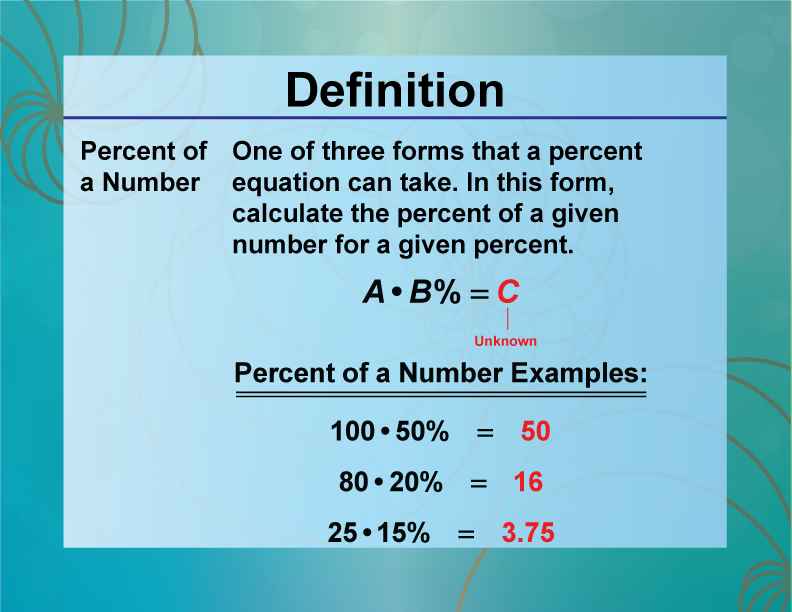
Calculating a percentage of a number is a straightforward process, but its applications are vast. The general formula involves converting the percentage into its decimal equivalent and then multiplying it by the total number.
Step-by-step example: Let’s say you want to find 15% of $200.
-
Convert the percentage to a decimal: Divide the percentage by 100. So, 15% ÷ 100 = 0.15.
-
Multiply the decimal by the total number: 0.15 × $200 = $30.
Therefore, 15% of $200 is $30.
This simple calculation forms the basis for everything from determining sales tax on a purchase to calculating the interest earned on a savings account. Understanding this mechanic empowers you to quickly evaluate financial scenarios on the fly. Conversely, you might need to find the whole number when given a part and its percentage. If $30 is 15% of an unknown number, you’d divide the part by the decimal equivalent of the percentage: $30 ÷ 0.15 = $200. This is particularly useful when reverse-engineering discounts or understanding proportions.
Common Misconceptions and Pitfalls
While conceptually simple, percentages can be a source of confusion if not handled carefully. A common pitfall is confusing “percentage points” with “percentage change.” For example, if an interest rate goes from 5% to 7%, that’s a 2 percentage point increase, but a (7-5)/5 * 100% = 40% percentage change. Misinterpreting this can lead to significant errors in financial analysis. Another mistake is ignoring the base value; 10% of a small number is very different from 10% of a large number. Always consider the absolute numbers alongside their percentage representation to gain a complete picture. Precision also matters; rounding too early in complex calculations can accumulate errors, leading to incorrect final figures, especially in large-scale financial modeling.
Percentages in Personal Finance: Everyday Applications
For individuals, percentages are the silent workhorses that drive daily financial decisions, from managing spending to building long-term savings. Mastery here translates directly into better financial health.
Budgeting and Savings: Allocating Your Income
One of the most powerful applications of percentages in personal finance is in budgeting. The popular 50/30/20 rule, for instance, suggests allocating 50% of your income to needs, 30% to wants, and 20% to savings and debt repayment. These percentages provide a flexible framework for managing your money, allowing you to quickly assess if your spending aligns with your financial goals. Calculating savings goals also heavily relies on percentages; if you aim to save 10% of every paycheck, you can easily determine the exact amount to set aside. Tracking expenses as a percentage of your total income helps identify areas of overspending and opportunities for optimization, transforming vague financial goals into concrete, actionable plans.
Debt Management: Interest Rates and Payments
Debt is almost universally expressed in terms of percentages. The Annual Percentage Rate (APR) on credit cards, mortgages, and personal loans dictates the cost of borrowing money. Understanding how to calculate interest based on these percentages is crucial. For example, if you have a credit card balance of $1,000 with an 18% APR, you can calculate the monthly interest charges to understand the true cost of carrying that debt. Minimum payments are often a small percentage of your outstanding balance, but knowing how compound interest works (interest calculated on the initial principal and accumulated interest) reveals how these seemingly small percentages can lead to significant financial burdens over time. Informed debt management starts with a clear understanding of these percentage-based calculations.
Shopping and Discounts: Maximizing Your Spending Power
Retail therapy often involves percentages, whether you realize it or not. Sales, discounts, and coupons are almost always advertised as percentages off the original price (e.g., “25% off all electronics”). Knowing how to quickly calculate these discounts helps you determine the actual sale price and evaluate if it’s a good deal. Similarly, sales tax is applied as a percentage of your purchase price, and gratuities (tips) in many service industries are typically calculated as a percentage of the bill. Mastering these calculations ensures you’re not overpaying and that you can accurately budget for your expenditures, maximizing your purchasing power and avoiding surprises at the register.
Percentages in Investing and Wealth Building
Beyond day-to-day spending, percentages are the cornerstone of investment analysis, helping individuals assess risk, measure returns, and plan for future financial growth.
Investment Returns: Measuring Growth and Performance
When you invest, your primary goal is to grow your money, and percentages are the standard metric for measuring that growth. Return on Investment (ROI) is typically expressed as a percentage, indicating the profitability of an investment relative to its cost. Annualized returns provide a consistent way to compare investments over different timeframes, while the Compound Annual Growth Rate (CAGR) offers a smoothed annual growth rate over a specified period longer than one year, reflecting the effects of compounding. Dividend yields, often expressed as a percentage of a stock’s price, indicate the income an investment generates. Understanding these metrics is vital for evaluating the performance of your portfolio and making informed decisions about where to allocate your capital.
Portfolio Allocation and Diversification
Diversification is a core principle of sound investing, and it’s fundamentally about percentages. Investors allocate different percentages of their portfolio to various asset classes (e.g., 60% stocks, 30% bonds, 10% cash) to manage risk and optimize returns. These target percentages guide investment decisions and trigger rebalancing strategies when market fluctuations cause the actual allocations to drift significantly from the desired percentages. For instance, if your stock allocation grows to 70% due to market gains, you might sell some stocks and buy bonds to return to your 60/40 target, maintaining your preferred risk profile. This percentage-based approach ensures a disciplined and strategic investment methodology.
Inflation and Purchasing Power
Inflation, defined as the rate at which the general level of prices for goods and services is rising, and subsequently, the purchasing power of currency is falling, is also expressed as a percentage. Understanding the inflation rate is critical because it directly impacts the real return on your investments. A nominal return of 5% on an investment might feel good, but if inflation is 3%, your real return is only 2%. Over long periods, even small inflation percentages can significantly erode purchasing power. By accounting for inflation, investors can set more realistic financial goals and select investments that are more likely to outpace the rise in living costs, preserving and growing their wealth effectively.
Percentages in Business and Entrepreneurship
For businesses, percentages are the lifeblood of financial analysis, guiding strategic decisions from pricing and profitability to resource allocation and performance evaluation.
Profitability Metrics: Gauging Business Health
Every business aims for profitability, and percentages are the key indicators of financial health. Gross profit margin (Gross Profit / Revenue * 100%) tells a company how much profit it makes from each sale after deducting the cost of goods sold. Net profit margin (Net Profit / Revenue * 100%) provides the ultimate measure of profitability, showing the percentage of revenue left after all expenses, including taxes, are accounted for. Other vital percentage-based metrics include Return on Assets (ROA) and Return on Equity (ROE), which assess how efficiently a company uses its assets and shareholder equity to generate profits. These percentages are essential for internal decision-making, investor relations, and competitive analysis.
Pricing Strategies and Discounts
Businesses frequently use percentages to determine pricing and implement promotional strategies. Markup percentages are used to set sale prices above the cost of goods, ensuring a healthy profit margin. For example, a 50% markup on a product costing $10 means it will sell for $15. Conversely, businesses use discount percentages to attract customers during sales events, needing to carefully balance increased sales volume with maintaining adequate profit margins. Sales commissions, often a percentage of sales revenue, motivate sales teams. A deep understanding of how these percentages impact both revenue and cost is fundamental for sustainable business operations and strategic market positioning.
Financial Ratios and Performance Analysis
Beyond basic profitability, businesses rely on a suite of financial ratios, almost all of which are percentage-based, to analyze various aspects of their operations. Liquidity ratios (e.g., current ratio, quick ratio) assess a company’s ability to meet short-term obligations. Solvency ratios (e.g., debt-to-equity ratio) indicate its long-term financial stability. Efficiency ratios (e.g., inventory turnover) measure how effectively a company uses its assets. By comparing these percentages over time, against industry benchmarks, or with competitors, businesses can identify strengths, weaknesses, and areas for improvement. This rigorous, percentage-driven analysis forms the backbone of sound financial management and strategic planning.
Advanced Applications and Strategic Thinking with Percentages
Moving beyond basic calculations, a nuanced understanding of percentages enables more sophisticated financial analysis and strategic planning.
Understanding Percentage Change vs. Percentage Points
As briefly touched upon earlier, the distinction between percentage change and percentage points is paramount in advanced financial discourse. When financial news reports that an interest rate moved from 4% to 5%, that’s a 1 percentage point increase. However, the percentage change in the interest rate is (5-4)/4 * 100% = 25%. This difference is critical for accurately interpreting economic reports, market movements, and policy changes. Misinterpreting this can lead to vastly different conclusions about the magnitude and impact of financial events, influencing investment strategies and risk assessments. For instance, a small percentage point change in a bond yield can translate to a significant percentage change in its price.
The Power of Compounding: Exponential Growth
Perhaps one of the most profound concepts in finance that relies on percentages is compounding. Compounding is the process of generating earnings from previous earnings, leading to exponential growth. When interest or returns are reinvested, they too begin to earn interest, creating a snowball effect. The “Rule of 72,” a common approximation, states that by dividing 72 by an annual percentage rate of return, you can estimate how many years it will take for an investment to double. This powerful concept underscores the importance of starting to invest early and consistently, allowing even modest percentage returns to accumulate into substantial wealth over the long term. Conversely, compound interest can also work against you with debt, illustrating how seemingly small percentage interest rates on loans can accumulate into large burdens.
Mitigating Risk with Probability and Percentages
In finance, risk assessment often involves understanding probabilities, which are expressed as percentages. Insurance premiums, for example, are calculated based on the percentage likelihood of an event occurring. In investment, analysts use percentages to estimate the probability of various market outcomes, helping to construct diversified portfolios that mitigate specific risks. Diversification itself is a percentage-based strategy; by allocating your investments across different asset classes, industries, and geographies, you reduce the percentage of your total portfolio exposed to any single risk. This strategic use of percentages allows for a more informed approach to managing uncertainty and protecting financial assets.

Conclusion
The question “what is percent of a number?” may seem simple on the surface, but its answer unlocks a fundamental understanding that permeates every aspect of the financial world. From managing your daily budget and decoding investment returns to analyzing business profitability and making strategic financial decisions, percentages are the indispensable tool that empowers clarity and precision. They allow us to quantify, compare, and project, transforming raw numbers into meaningful insights.
Mastering percentages is not just about performing calculations; it’s about developing a financial intuition that enables you to critically evaluate information, identify opportunities, and mitigate risks. In an increasingly complex economic landscape, those who understand the language of percentages are better equipped to navigate challenges, seize opportunities, and ultimately, achieve their financial goals. Embrace this core concept, and you will find yourself in a far more empowered position to manage and grow your money effectively.
aViewFromTheCave is a participant in the Amazon Services LLC Associates Program, an affiliate advertising program designed to provide a means for sites to earn advertising fees by advertising and linking to Amazon.com. Amazon, the Amazon logo, AmazonSupply, and the AmazonSupply logo are trademarks of Amazon.com, Inc. or its affiliates. As an Amazon Associate we earn affiliate commissions from qualifying purchases.